Here’s an audio essay centering around two selections from The Strange Doctor Weird, a radio program from the 1940’s featuring the voice of Maurice Tarplin as the titular character, written by Robert A. Arthur and directed by Jock McGregor. The program is, in many ways, a sequel to The Mysterious Traveler, a program from which many of the Doctor Weird stories were culled from. These versions, told in 15 minute segments, appeared on a number of stations as material that could easily fill out an hour or programming, and was most well known as being sponsored by Adam Hats, who could afford their own radio program in those days.
Accompanying these stories is a live performance by me, as I mix and apply effects to sounds made in the studio, as well as the sounds of recorded music by The Black Noise Orchestra and Yellow Crystal Star.
The recent thunder and lightning – very atypical this time of year – has filled our town with lights and sounds that are not usually part of the typical makeup of our fair city. In many ways it reminded me of nothing less that The New Gods themselves traversing the threshold of a Boom Tube, a sound so dramatic that is insists that you listen, above all other things. It was with that in mind that I decided to let The King by my guide, and put together some spacey wonder, ambient landscapes, and droning rock music that would make the man himself proud.
I didn’t get to mention it during the show, but I always like to draw attention to Sailboats whenever I can. Little known, and even less seen, they manage to capture some of the eeriest and most beautiful strangeness every time I listen. They are on the Pecho Grande label, and while their site says that much of their catalog is out of print, I bet if you asked nicely you could locate a copy or two. I highly recommend checking out Sailboats, as well as the other incredible things they have to offer.
During this show, Miss Rikki & Tunacan Jones was lurking around in the studio, and they helped influence the direction of this audio essay, obviously. But between Mr. Tarplin & Kirby guiding the way, it’ll be hard to resist this broadcast.
Enjoy!
The Strange Dr. Weird
This episode features samples of “Journey Into The Unknown” and “The Man Who Knew Everything” by The Strange Doctor Weird!, originally aired on 21 November 1944 and 20 March 1945.
HOUR 1
Part I: Improvisation
01.) Austin FM Theme * Paco Jones * Austin FM Theme * Self-Released (2016)
02.) Excerpt * The Black Noise Orchestra * 20 September 2006
03.) Yeti (Improvisation) * Amon Düül II * Yeti
Part II: Journey Into The Unknown 1
04.) Excerpt 1 * Obe’ Skupla * 8 April 2006
05.) Journey Into The Unknown [pt 1] * Austin Rich * 19 May 2013
06.) Nine Thousand And Second Amaranth Shower [Excerpt] * Yellow Crystal Star * Rainbow Bridge To Nonlocality: Myriad Forms of You
Part III: Journey Into The Unknown 1
07.) Journey Into The Unknown [pt 2] * Austin Rich * 19 May 2013
08.) Excerpt 2 * Obe’ Skupla * 8 April 2006
HOUR 2
Part IV: Trigger In
09.) Excerpt 3 * Obe’ Skupla * 8 April 2006
10.) Trigger In, Trigger Out * Acid Mothers Temple & The Cosmic Inferno * Just Another Band From The Cosmic Inferno
14.) Excerpt 5 * Obe’ Skupla * 8 April 2006
15.) The Man Who Knew Everything * Austin Rich * 19 May 2013
16.) Up Under: Triumph, The Mask Melted Away To Reveal The Way * Yellow Crystal Star * Rainbow Bridge To Nonlocality: Myriad Forms of You
This is probably my favorite Sci-Fi story from the Golden Age, and this story always manages to bring a tear to my eye. It is heartfelt, funny, honest, and speaks to something that we all suffer from, and that we all must face. There is something in the struggle of Rhysling that is not only romantic and speaks of something long since gone, but it pulls forward within me something that is hard to pin down, but means all of the world to me.
Presented in this format is a mash-up of three different versions of Rhysling’s story, with music and accompaniment that only makes sense of a space hobo like him. Stay tuned for hour three on the podcast-only, as I feature a number of other songs that should have, but didn’t, make the cut.
Enjoy!
The Green Hills of Earth
This episode features samples of Dimension X from June 10th 1950, X-Minus 1 from July 7th 1955, and the CBS Radio Workshop from 21 July 1957.
HOUR 1
Part I: Super Rocket Rumble
01.) Austin FM Theme * Paco Jones * Austin FM Theme * Self-Released (2016)
02.) 0002 * Amao Quartet * Improcreations
03.) Men Into Space * Buddy Morrow * Brain In A Box
04.) Astrononmie Domine * Pink Floyd
05.) Super Rocket Rumble * Man… Or Astro-Man? * Deluxe men in space
Part II: The Spaceman
06.) Out to launch * Sonny Sharrock * Space Ghost
07.) The Spaceman * Charles Manson * 60 Birthday
08.) Cosmic Ballad * Perrey And Kingsley
Part III: Hard Travelin’
09.) Yes! I Am A Long Way From Home * Mogwai
10.) Follow Blind * Wipers
11.) Dirty Joke From Outer Space pt I * Sunroof!
12.) Hard Travelin’ * Woody Guthrie
HOUR 2
Part IV: Space Loneliness
13.) Spaceball Ricochet * T. Rex
14.) Space Loneliness * Sun Ra
15.) Clink, Clink, Another Drink * Spike Jones
Part V: Headed Home
16.) Talking Hard Work * Woody Guthrie
17.) Dirty Joke From Outer Space pt II * Sunroof!
18.) Headed Home * George & Caplan
Part VI: Homecoming
19.) Keep On The Sunny Side * The Carter Family
20.) Homecoming * Replikants
21.) Spaceship Landing * Kyuss
22.) The Intergalactic Laxative * Donavan
HOUR 3
Part VII: Starship
23.) Space Station # 5 * Fastbacks * new mansions in sound
24.) Get Outta That Spaceship And Fight Like A Man * The Grifters
25.) Starship * Spaceman 3
26.) Revenge * Black Flag
Part VIII: Death Is Not The End
27.) 2000 Light Years From Home * The Rolling Stones
28.) Space Age Ballad * Acid Mothers Temple & The Melting Paraiso U.F.O.
29.) A Long Way From Home * The Kinks
30.) Dirty Joke From Outer Space pt IiI * Sunroof!
31.) Up The Wooden Hills To Bedfordshire * Small Faces
32.) Spaceship Landing * Kyuss
33.) Death Is Not The End * Nick Cave & The Bad Seeds
Sometimes broadcasting is very confusing (and complicated). Case in point: there are some shows that exist in four time periods at once. Join me, for a romp through 1950, 2011, 2018 and 2155, as we try to hide from The Searchers and fumble our way through time, as we move, horribly and inextricably toward The Future
Enjoy!
To The Future
Throughout this program there are samples of the Dimension X radio program, “To The Future,” originally aired 27 May 1950 on NBC.
HOUR 1
Part I: Time Was
01.) Austin FM Theme * Paco Jones * Austin FM Theme * Self-Released (2016)
02.) Time Stands Still * Lee Ranaldo * East Jesus: Some Recordings 1981-1991
03.) Time Was * John Coltrane * Coltrane * Impulse Records
04.) The Time Machine Main Title / Credits * Russel Garcia * Brain In A Box: The Science Fiction Collection * Rhino Records
Part II: Once Upon A Time
05.) Sentimental Journey * Esquivel * Space Age Bachelor Pad Music
06.) Dan vs. Time * godheadSilo * Skyward in Triumph * Sub Pop Records
07.) We Can See Through Time * Le Ton Mite * Tickets to Real Imaginary Places * Zicmuse Records
08.) Once Upon A Time * Sonny Sharrock * Ask the Ages * Axiom Records
09.) Tomorrow Afternoon * Tony Williams * Life Time
Part III: There Will Never Be A Better Time
10.) There’s Nothing Sexy About Time * Kinski * Don’t Climb On And Take The Holy Water
11.) Abandoned Mine Shaft In The Corridors Of Time * Sinking Body * Grappling With The Homonids * Vermiform Records
12.) Take Time * The Books * The Lemon of Pink * Tomlab Records
13.) There Will Never Be A Better Time * Desert Sessions * Volume 9 & 10
HOUR 2
Part IV: Time Flies
14.) Universal Time II * Zip Code Rapists * Zip Code Rapists
15.) Time Flies * The Ex * Dizzy Spells * Touch And Go Records
16.) A Stitch In Spacetimes * Nil Admirari * Togetherness With Battlesnakes
17.) Time Stands Still [Excerpt] * Lee Ranaldo * East Jesus: Some Recordings 1981-1991
18.) Just In Time * Sun Ra And His Myth Science Arkestra * We Travel The Spaceways Bad And Beautiful
Part V: Now Is The Time
19.) If Not This Time * Fifty Foot Hose * Cauldron * Phoenix Records 39.) Running Out Of Time * Dead Moon * Hard Wired in Ljubljana * Empty Records
20.) Time Funnel * Jan Davis * Lux And Ivy’s Favorites Volume 04
21.) I Just Wasn’t Made For These Times * The Beach Boys * Pet Sounds
22.) Stranded In Time * The United States Of America * The United States Of America
23.) Now Is The Time * The Wipers * Over The Edge
Part VI: As Time Goes By
24.) As Time Goes By * Rudy Vallee
25.) Time Is Tight * Booker T. & the M.G.’s * The Complete Stax-Volt Singles 1968-1971
26.) Check Out Time * Ornette Coleman * Love Call * Blue Note Records
HOUR 3
Part VII: Time And Space
27.) Time And Space * Jandek * You Walk Alone
28.) All The Time In The World * Roger Miller * The Benevolent Disruptive Ray
29.) Rewind The Time * Oliver Squash * 30 Piece
30.) Time * The Residents * God In Three Persons
31.) Time Stands Still * Lee Ranaldo * East Jesus: Some Recordings 1981-1991
32.) She Makes Me Want To Build A Time Machine * Aristeia * You Give Me Strength, You Give Me Patience!
Part VIII: Retrovertigo
33.) A Spoon Taught Me The Secret Of Time Travel * The Jezebel Spirit * Turtles All The Way Down * (Self-Released)
34.) Retrovertigo * Mr. Bungle * California * Warner Bros. Records
35.) What Time Is It? * Thinking Fellers Union Local 282 * Tangle
37.) A Second Of Time * Half Eye * Broken Rope
43.) She Lives (In A Time Of Her Own) * 13th Floor Elevators * Easter Everywhere * Decal Records
36.) Times Encounter * Nigel Simpkins * Messthetics Vol. 1
37.) One Day At A Time * Thee Headliners * Rain & Blood
Join us for a presentation that is only available to listeners of The Executive Version of or program. Other listeners do not get to hear a show of this caliber normally, so this week, we are offering something special to listeners who have made it clear they want to invest in a higher quality product. And with that in mind, we bring you The Executive Version. For those special clientele.
There’s a bit of a party going on during this show. This is the kind of special atmosphere we create when we are assembling this program, a feature that is only available to those listeners who subscribe to The Executive Version of program. And where else would you get these kinds of corrections to the patent lies that were said on broadcast radio? For example:
The song was by Tärr, not Cornelius F. Van Stafrin III.
And:
While O-Type was was essentially MX-80 performing under a different name, this record was actually MX-80 performing a song called O-Type.
Not Forgetting:
Some jokes from 2013 – about a certain social media platform – may have aged a little poorly in the last few years, considering a tendency toward claiming things are “fake news.” With that in mind, consider this selection a snapshot of a simpler time in the past, when such a joke wasn’t horrifying and the beginning of the end times, as it were.
And lastly:
Not all of the material in this show came from a record, as stated in several times throughout. I have added * asterisks to the tracks that were not from Vinyl Records. Two (2) asterisks such as ** have been added to indicate bonus content not available during the live broadcast.
These kinds of inaccuracies are usually included in most broadcasts you hear on the radio, but for listeners of The Executive Version, you get these corrections, free of charge. It’s just one of the many ways that this program is better than the one being heard by everyone else.
So much so that there are bonus moments to The Executive Version that are only available on the podcast. Because the only thing more exclusive than something only a special audience can hear is having added bonuses for those who pay a little more.
Enjoy!
The Executive Version
HOUR 1
Part I: Headlines
* 01.) Austin FM Theme * Paco Jones * Austin FM Theme * Self-Released (2016)
02.) The Executive Version * Monty Python * The Album Of The Trailer of the Film of Monty Python and the Holy Grail * Charisma / Arista Records
03.) My Prayer * Lionel Hampton * Golden Vibes
04.) I Yam What I Yam * Robin Williams & Harry Nillson * The Original Motion Picture Soundtrack for Popeye
05.) Erie Canal * Oscar Brand * Bawdy Songs & Backroom Ballads Vol. 2 * Audio Fidelity Records
06.) Headlines * George Carlin * On The Road * Atlantic Records
* 07.) The Facebook Fiction Initiative * Austin Rich * The Facebook Fiction Initiative * 21 June 2013
Part II: Leisurely Waiting
08.) The Blob * The Five Blobs * “The Blob” b/w “Saturday Night in Tiajuana” * Columbia Records
09.) Martian Melody * The Martian Band * “Flying Saucer The 2nd” b/w “Martian Melody” * L’Universe Records
* 10.) Leisurely Waiting * Debris * Static Disposal * Anopheles Records
11.) Linda Wants To Be Alone * Gary Wilson * Mary Had Brown Hair * Stone’s Throw Records
* 12.) I Been Refused * Devo * Hardcore Devo Vol. 2 * Warner Bros. Records
13.) Springtime For Hitler * Henry Mancini * The Big Latin Band of Henry Mancini * RCA Victor Records
* 14.) “Baseball” Excerpt: Barbershop Quartet Warning * Jesse Thorn * The Sound Of Young America * maximumfun.org
* 15.) Phonograph Records * Mars Production * Mars Production Library CK-713 * Mars Records
16.) Space/Time Continuum: “Heaven And Hell, Part I” * Vangelis * The Music of Cosmos * RCA Records
* 17.) Smile Awhile * Michael Yonkers Band * Microminiature Love * Sub Pop Records
Part III: In 3-D!
* 18.) Pacific Radio Fire * Austin Rich * Senior Citizens * 27 March 2006
19.) The Announcement * Monty Python * The Album Of The Trailer of the Film of Monty Python and the Holy Grail * Charisma / Arista Records
20.) Them From “Helen Of Troy” * Les Baxter * 7″
21.) I Hate The 90’s * Rodney And The Tube Tops * 7″
22.) U-Stink-But-I-(Heart)-U * Billy And The Boingers * “I’m A Boinger” b/w “U-Stink-But-I-(Heart)-U” 7″
23.) Nature Trail To Hell (In 3-D) * “Weird A” Yankovic * In 3-D
** 24.) Elmira * Austin Rich * Senior Citizens * 27 March 2006
HOUR 2
Part IV: Signal Processor Failure
25.) Let’s Do The Pretzel * Mad “Twists” Rock ‘n’ Roll * Big Top Records
26.) Snoopy Vs. The Red Baron * The Royal Guardsmen * 7″
27.) Tiptoe Through The Tuplips * Tiny Tim * 7″
28.) Signal Processor Failure / Why We Are Lazy * Men’s Recovery Project * Make A Baby EP * Vermiform Records
* 29.) Mole Machine * Simply Saucer * Cyborgs Revisited * Get Back Records
* 30.) Embraceable You * Ornette Coleman * The Best of Ornette Coleman * Atlantic Records
Part V: Hurricane
* 31.) Barber Shop * Mars Production * Mars Production Library CK-713 * Mars Records
32.) metalized excitements of our shared dreams of technology [Excerpt] * Tärr * Tärr / Cornelius F. Van Stafrin III Split 12″ * oms-b Records
33.) Wild Thing * Senator Bobby & The Hardly-Worthit Players Featuring Bill Minkin * Wild Thing 7″ * Parkway Records
* 34.) Fish Dance * John Lurie * Fishing With John
35.) Hurricane * Thinking Fellers Union Local 282 * Admonishing The Bishops * Matador Records
* 36.) Talk Show * Austin Rich * Senior Citizens * 27 March 2006
* 37.) L’Agonie * Jacky Chalard * Je Sus Vivant, Mais J’ai Peur De Gilbert Deflez * Finders Keepers Records
38.) O-Type Part Two * MX-80 Sound * O-Type: The Original Motion Picture Soundtrack 7″ * Ralph Records
Part VI: The End of The World
39.) This Is Side Two! * Monty Python * The Album Of The Trailer of the Film of Monty Python and the Holy Grail * Charisma / Arista Records
40.) Voodoo Suite [Excerpt Part I] * Pérez Prado * Voodoo Suite
41.) Bright College Days * Tom Lehrer * An Evening Wasted with Tom Lehrer
42.) How Much Is That Doggy In The Window? * Patti Page
43.) Beep Beep * The Playmates
44.) Voodoo Suite [Excerpt Part II] * Pérez Prado * Voodoo Suite
45.) The End Of The World * Beyond The Fringe
** 46.) Coffee * Austin Rich * Senior Citizens * 27 March 2006
Ever since I first got a copy of Fat Wreck Chords Short Music For Short People, I’ve always wanted to do an all Short Songs show, not only because they managed to achieve something pretty amazing by cramming songs by 101 artists onto one CD, but because, to be honest, they left out a lot of stuff. (Ahem, Dead Kennedys, cough cough.) I knew that, with my affinity for shortness of the musical variety, they hadn’t yet had the final word on short songs, and with that in mind, I compiled 290 tracks that I shoved into two hours.
While I can’t say that every band imaginable is represented, I can say that just about every genre IS, along with quite a few genres you didn’t know existed, and some others that you might have been trying to forget. We can’t please everyone. But you know what they say in the midwestern realm of college radio: “If you don’t like the music, just wait 30 seconds.” I managed to keep most of the stuff in this show under that scant length, and only a few exceptions trickled over. I also keep myself limited to one song per artist per hour. On a show where the average length is around 10 seconds long, some of those 30 second songs from Short Music feel like dirges.
This show includes music taken from records (7″, 10″ and 12″), cassette tapes, CDs & .mp3s, and might be the single most diverse show I’ve ever assembled, media-wise. Obviously, a show like this couldn’t possible happen without digital technology; it’s just too hard to switch media twice a minute for an entire hour. (I did consider it, but backed out once I realized how long my playlist was.)
There is something already ambitious about writing a pop song. It’s a claim that, in about four minutes, you’ll be able to write something that carries the same kind of weight and power that more cultured artists can in an average composition. The irony, of course, being that Pop Music took over the music world in a way that compositional artists could not. Now, anyone with access to the internet can send their Pop Songs around the world, conveying in a few minutes something that used to take a whole record.
The idea that you can compress these ideas even further – into the realm of a few seconds, in some cases – is just as ambitious as a concept record. Can you compress the strength of a complete song into something that only takes a few seconds to convey? Like some sort of Sci-Fi gimmick that seems futuristic, artists have been trying for years to create compact versions of their usual fare, and often with impressive results. To say that The Ramones set the blueprint when they recorded “Judy Is A Punk” (clocking in at no more than 1:30), the bar was already set so tremendously low that the world has been working on faster, more compact, and even shorter songs.
In making this show, I made a conscious effort to present something unique. Songs in this show appear from records, cassettes, CDs, digital files, and all manner of mix-matched media. To have assembled it all in one room in a pre-digital age would have taken a lot of work; to fit it into a show would have taken ages. While the computer made this show much easier for me to do, even that work made me appreciate the kinds of work radio personas went through in the old days to deliver shows like this. Think about it when you digest this one.
I want to give a huge thanks to Ratskin Records for their fantastic release, Triskaidekaphobia, which contains 13 Second songs by over 200 artists. I used this disc to assemble the Five Minute “Bathroom Break” I took in before the second commercial break. I received a copy of this disc after one of their artists heard that I had done a short songs show, and was hoping that I could use this one for future installments. Thanks again for this great disc; I barely even scratched the surface of what it offers, and still played 23 cuts from it. The future is now.
With hindsight, I realized that this show could only be a Grumpy Punk show, which is why these shows are labeled as such, now. He would find perverse interest in this much short music.
001.) Paco Theme
002.) Short Attention Span * Fizzy Bangers * Short Music For Short People * Fat Wreck Chords
003.) Exotica [Excerpt] * Martin Denny * Forbidden Island * Scamp Records
Part I:
004.) Quit Your Job * Chixdiggit * Short Music For Short People * Fat Wreck Chords
005.) Porch * Pinhead Gunpowder * Compulsive Disclosure * Lookout! Records
006.) The Nail That Sticks Up Gets Hammered Down * Born Against * The Rebel Sound Of Shit And Failure
007.) We Skate * Screeching Weasel * Boogadaboogadaboogada * Lookout! Records
008.) You Stupid Jerk * Angry Samoans * The Unboxed Set * Triple X Records
009.) I Like Food * Descendents * Short Music For Short People * Fat Wreck Chords
010.) Doin’ Fine * The Groovie Ghoulies * Short Music For Short People * Fat Wreck Chords
011.) Long Enough To Forget You * Samiam * Short Music For Short People * Fat Wreck Chords
012.) Rock ‘n’ Roll * Ice And The Iced * Killed By Death Vol. 77 * Redrum Records
013.) Ketchup Soup * Teen Idols * Short Music For Short People * Fat Wreck Chords
014.) Tiny Pink Noise [Live] * The Avengers * Died For Your Sins * Lookout! Records
015.) I Hate Menudo * Chicano-Christ * Come’ CaCa EP * Nemesis Records
016.) Rage Against The Machine Are Capitalist Phonies * White Flag * Short Music For Short People * Fat Wreck Chords
017.) Don’t Lick My Leg * Stikky * The Thing That Ate Floyd * Lookout! Records
018.) Alienation * Citizen Fish * Short Music For Short People * Fat Wreck Chords
019.) Big Fat Skinhead * Snuff * Short Music For Short People * Fat Wreck Chords
020.) I Spent The Rent * The Queers * A Day Late And A Dollar Short * Lookout! Records
021.) Stake Fin * Black Dice * Troubleman Mix-Tape * Troubleman Records
022.) Hei-Hei * GLO * Killed By Death Vol. 77 * Redrum Records
023.) Overcoming Learned Behavior * Good Riddance * Short Music For Short People * Fat Wreck Chords
024.) Deny Everything * Circle Jerks * Group Sex * Frontier Records
025.) Ack Ack Ack * Minutemen * 3-Way Tie For Last * SST Records
026.) You Don’t Know The 1/2 Of It * Steak Knife! * Steak Knife!
027.) Everyone In The Underground Music Scene Is Stupid * Anal Cunt * 40 More Reasons To Hate Us * Earache Records
028.) I Object * Youth Brigade * 20 Years Of Dischord * Dischord Records
029.) The Psycho Squat * Rudimentary Peni * Death Church * Corpus Christi Records
030.) Warren’s Song Part 8 * Bracket * Short Music For Short People * Fat Wreck Chords
031.) Spray Paint * Black Flag * Damaged * SST Records
032.) Your Kung-Fu Is Old… And Now You Must Die!! * Adrenalin OD * Short Music For Short People * Fat Wreck Chords
033.) Stud * Fitz Of Depression * Crank Shaft EP * Mumble Something Records
034.) Hearts Frozen Soil Sod Once More By The Spring Of Rage, Despair, And Hopelessness * A.F.I. * Short Music For Short People * Fat Wreck Chords
035.) Foreign Lawns * Meat Puppets * In A Car EP * SST Records
036.) Saturday Night * Kill Switch * Short Music For Short People * Fat Wreck Chords
037.) Freegan * Big Wig * Short Music For Short People * Fat Wreck Chords
038.) No Fkuicgn * Nomeansno * You Kill Me * Alternative Tentacles Records
039.) Supermarket Forces * Subhumans * Short Music For Short People * Fat Wreck Chords
040.) I Hate Puck Rock * D.O.A. * Short Music For Short People * Fat Wreck Chords
Alternative Tentacles Records
041.) 13. [value zero is not a valid name] * Vortex Remover * Rawkward Phase
042.) Worms * Bloodfart * Gastric Juices
043.) Why Me? * The Automatics * 20 Golden Greats
Part II:
044.) Short Songs [Live] * Dead Kennedys * Give Me Convenience Or Give Me Death
045.) March of The Siamese Children [Excerpt] * Martin Denny * Forbidden Island * Scamp Records
046.) Whimpers From The Jello * The Fugs * It Crawled Into My Hand, Honest * Reprise Records
047.) Ride Ride Ride * Half Japanese * Greatest Hits * Safe House Records
048.) S.O.I.G. * Man Is The Bastard * D.I.Y.C.D.* Slap-A-Ham Records
049.) Page 20 * Fantômas * Book 1 * Ipecac Records
050.) Wrangler Brutes * Wrangler Brutes * Zulu * Kill Rock Stars Records
051.) Euphoria * xbxrx * Sixth In Sixes * Polyvinyl Records
052.) Priest With The Sexually Transmitted Diseases Get Out Of My Bed * The Locust * Plague Soundscapes * ANTI- Records
053.) Alan Licked Has Ruined Music For An Entire Generation * Free Kitten * Nice Ass * Kill Rock Stars Records
054.) A Finger To Hackle * Melt-Banana * Scratch Or Stitch * Skin Graft Records
055.) Ujaku * John Zorn * Naked City * Nonesuch Records
056.) Individual Suture * Sinking Body * Grappling With The Homonids * Vermiform Records
057.) Chiapas! I MUST GO THERE! * Jackie-O-Motherfucker * Fig. 5 * Road Cone Records
058.) Can’t Find My Car * Thomas Hendrix * Kill The Moonlight Original Motion Picture Soundtrack * Sympathy For The Record Industry Records
059.) Variable Dump * Operation Re-Information * M-Pire Records
060.) Wuxiapian Fantastique * Mike Patton * Adult Themes For Voice * Tzadik Records
061.) Voice Piece For Soprano * Sonic Youth * SYR 4: Goodbye 20th Century * SY Records
062.) Skitter * Cornflake Mandala * A Boy And His Dog * Self-Released
063.) The Dripping Wire In The Lab Down The Street * Oliver Squash * 30 Piece * Self-Released
064.) Closed Coffins And Curtains * Zach Hill And Mick Barr * Shred Earthship * 5 Rue Christine Records
065.) Hotel One * Zip Code Rapists * Zip Code Rapists * Eabla Records
066.) Dr. Schwitters Intro * Faust * Tapes * Recommended Records
067.) Track 6 * Buck Rothy * Buck Rothy * unreleased
068.) Bass Gnm2 * Forcefield * Roggaboggas * Load Records
069.) Why Is He On The Television? * Hunger Artists * Cruisin’ In Zargon
070.) I Had A Crummy Shift * The Hospitals * I’ve Visited The Island Of Jocks And Jazz * Load Records
071.) Transdimensional Soldier * Behead The Prophet No Lord Shall Live * Making Craters Where Buildings Stood EP * Sound Polution Records
072.) Thaw Walt * Men’s Recovery Project * Thank You For Killing Me EP * Paralogy Records
073.) Push * Thinking Fellers Union Local 282 * Lovelyville * Matador Records
074.) Iced-Off Broccoli * Sun City Girls * Static From The Outside Set: Carnival Folklore Resurrection Vol. 14 * Abduction Records
075.) The Ambassador’s Report * Le Ton Mite * Tickets To Real Imaginary Places * K Records
076.) Untitled #10 * John Frusciante * Niandra Lades And Usually Just A T-Shirt * American Recordings
077.) Drums/Effects D * Yoshida Tatsuya * Drums, Voices, Keyboards & Guitar * Magaibutsu Records
078.) Some Hammering… * Lee Ranaldo * East Jesus: Some Recordings 1981 – 1991 * Atavistic Records
079.) Metamorphosis (Organ Freak Out 2) * Ennio Morricone * Diabolik Original Motion Picture Soundtrack * Pallottola Foro Records
080.) 12 * Negativland * Negativland * Seeland Records
081.) Blue Zircon * Yuma Nora * Jewels In The Snakepit * Not Not Fun Records
082.) (Interlude) * Trans Am * Trans Am * Thrill Jockey
083.) Waste No Time * The Fartz * Because This Fuckin’ World Still Stinks…
084.) Whupping Crowd * Suetsu & Underwood * Psychogeographic Y
085.) Zagubilem sie w Miescie * Kazik * 12 Groszy
086.) Whiter Teeth, Free Shipping * Brainwarmer * Elliott Smith’s Guitar
087.) WILSONCORE * /root_DIR * WILSONCORE * Self-Released
088.) What We Do Is Secret * Germs * (GI)
089.) We Are Not Your Entertainers * Mukilteo Fairies * Rock Stars Kill
090.) Narcissus * Bonzo Dog Doo-Dah Band * Gorilla * BGO Records
Part III:
091.) Hey Sweetheart * Richard Hell * Time * Matador Records
092.) Narcissus Queen [Excerpt] * Martin Denny * Forbidden Island * Scamp Records
093.) Lullaboo * Cathead * The Album * Self-Released
094.) ( ) * Piglet * Not Ralphing At Your First Keg Party * Self-Released
095.) Introduction To The Mummies * The Mummies * Death By Unga Bunga!! * Estrus Records
096.) Hello, It Is I, Thee Intolerable Bastard, Child Genius * The Ne’er Do Wells * Hello, It Is I, Thee Intolerable Bastard Child Genius EP * Lookout! Records
097.) Fossils * The Iran-Contra Affair * Under Oath * Battlesnakes Now Records
098.) Malfunction * Shadowy Men On A Shadowy Planet * Savvy Show Stoppers * Cargo Records
099.) To All The Kids * The Vandals * Short Music For Short People * Fat Wreck Chords
100.) The Ballad of Wilhelm Fink * Green Day * Short Music For Short People * Fat Wreck Chords
101.) Hey! The Return! * The Flying Saucers * Weird Ancient Religious Rites * Self-Released
102.) Ludwiggin’ * Flat Duo Jets * Lucky Eye * Outpost Records
103.) It’s Getting Late * They Might Be Giants * McSweeney’s #6* McSweeney’s
104.) Do You Think It’s Alright? * The Who * Tommy * Polydor Records
105.) Dan Vs. Time * godheadSilo * Skyward In Triumph * Sub Pop Records
106.) Ahh * White Rainbow * Box * Marriage Records
107.) Interlude * Tom Waits * The Black Rider * Island Records
108.) Fanfare * Charles Gocher * Pint Sized Spartacus * Gravelvoice Records
109.) Statsministern * International Harvester * Sov Gott Rose-Marie * Silence Recordings
110.) Turnin’ To A Bug * Brendon Smalls * Home Movies Official TV Soundtrack * Shout! Factory Records
111.) High And Low * The Homosexuals * Astral Glamour * Hyped To Death Records
112.) Old Man Thunder * Ween * God Ween Satan: The Oneness * Twin / Tone Records
113.) Do Wot John * Monty Python * The Final Rip Off * Virgin Records
114.) Look At That Old Grizzly Bear * Mark Mothersbaugh * The Royal Tenenbaums Official Movie Soundtrack * Hollywood Records
115.) No One Is Watching * DeVotchka * How It Ends * Cicero Recordings, Ltd.
116.) Haiku A * God Is My Co-Pilot * Puss 02 * Dark Beloved Cloud Records
117.) Embryo * Black Sabbath * Master Of Reality * Warner Brothers Records
118.) Man Enough * Enemy Mine * The Ice In Me * Up Records
119.) Sarspirillsa * Man Man * The Man In A Blue Turban With A Face * Ace Fu Records
120.) More Sack * Witchy Poo * Salutes The Space Program EP * Vermiform Records
121.) I’ve Got Egg On My Face * Little Fyodor * The Very Best Of Little Fyodor’s Greatest Hits! * Discriminate Audio Records
122.) Tack Ska Ni Ha * Dungen * Ta Det Lugnt * Kemado Records
123.) Bubble Bobble – Shark Skeleton * The Advantage * The Advantage * 5 Rue Christine Records
124.) Bow Tie Daddy * The Mothers Of Invention * We’re Only In It For The Money * Verve / Bizarre Records
125.) Backwards Flute * John Lurie * Fishing With John Official TV Soundtrack * Strange And Beautiful Records
126.) Pimmel * The Muffs * Short Music For Short People * Fat Wreck Chords
127.) Take Me * Elton & Betty White * Sex Beyond The Door * Self-Released
128.) Lonesome Bulldog III * The Butthole Surfers * Piouhgd * Rough Trade Records
129.) Vern’s Answer To The Masses * Unwound * The Future of What * Kill Rock Stars.
130.) Velchatronix * Velchatronix * Case of Psionic Awareness
131.) Interlude (Ritchie’s Intro) * Drats!!! * Welcome To New Granada
132.) Forbidden Island [Excerpt] * Martin Denny * Forbidden Island * Scamp Records
133.) ( ) * Dead Milkmen * Bucky Fellini * Enigma Records
Hour 2
Part IV:
134.) All * Descendents * Somery * SST Records
135.) Fanatics * Minutemen * The Punch Line * SST Records
136.) All Comic Heroes Are Facist Pigs * Terrorgruppe * Short Music For Short People * Fat Wreck Chords
137.) A Small One * Scissor Fits * Messthetics Vol. 1 * Hyped 2 Death Records
138.) Farts Are Jazz To Assholes * Dillinger 4 * Short Music For Short People * Fat Wreck Chords
139.) Punch Drunk * Hüsker Dü * Everything Falls Apart * Reflex Records
140.) Tribute To The Mammal * Buck Wild * Short Music For Short People * Fat Wreck Chords
141.) Crypted Control * Behead The Prophet No Lord Shall Live * I Am That Great And Fiery Force * K Records
142.) Get A Grip * No Fun At All * Short Music For Short People * Fat Wreck Chords
143.) Cocaine Dave * REO Speedealer * REO Speedealer * Royalty Records
144.) Waste Away * Fury 66 * Short Music For Short People * Fat Wreck Chords
145.) Where You From Eh? * Chicano-Christ * Come’ CaCa EP * Nemesis Records
146.) Asian Pride * Hi-STANDARD * Short Music For Short People * Fat Wreck Chords
147.) Human Of Stupids * S.O.B. * Japanese Hardcore Comp Tape * Broken Tapes
148.) Staggering * Hot Box * Short Music For Short People * Fat Wreck Chords
149.) Field Day For The Sundays * Wire * Pink Flag * Harvest / EMI Records
150.) Doin’ Laundry * Nerf Herder * Short Music For Short People * Fat Wreck Chords
151.) Hot Cars * Angry Samoans * The Unboxed Set * Triple X Records
152.) Anchor * Less Than Jake * Short Music For Short People * Fat Wreck Chords
153.) I Want Cunt * The Queers * A Day Late And A Dollar Short * Lookout! Records
154.) Told You Once * The Mr. T Experience * Short Music For Short People * Fat Wreck Chords
155.) You Don’t Know The 1/2 Of It (Reprise) * Steak Knife! * Steak Knife! * Self-Released
156.) John For The Working Man * Tilt * Short Music For Short People * Fat Wreck Chords
157.) Exhibit Self-Control * The Iran-Contra Affair * Under Oath * Battlesnakes.com
158.) Surf City * SPREAD * Short Music For Short People * Fat Wreck Chords
159.) ?? * Cringer * Greatest Hits Vol. 1 * Vinyl Communication Records
160.) Blatty (Human Egg) * Sick Of It All * Short Music For Short People * Fat Wreck Chords
161.) Secret Surgery * Man Is The Bastard * D.I.Y.C.D. * Slap-A-Ham Records
162.) No Intellect * Senseless Apocalypse * Japanese Assault * Relapse Records
163.) Mirror, Signal, Wheelspin * Goober Patrol * Short Music For Short People * Fat Wreck Chords
164.) Pasktamning (Protes Bengt) * Life * Chaos Of Destruction * Dan-Doh Records
165.) Hard World * Uniq * Snarl Out Vol. 3 *
166.) No, We Don’t Want To Do A Split Seven Inch With Your Stupid Fucking Band * Anal Cunt * I Like It When You Die * Earache Records
167.) Fishfuck * Gwar * Short Music For Short People * Fat Wreck Chords
168.) Your Hand Is In Your Crotch * Deep Wound * Almost Complete * Baked Goods Records
169.) Red Alert * Teenage Jesus & The Jerks * Everything * Atavistic Records
170.) Bring It To An End * Anti-Flag * Short Music For Short People * Fat Wreck Chords
171.) All The Colours In The Rainbow * Hunger Artists * Cruisin’ In Zargon * ookworld.com
172.) Hairdude * Boss Pitt * Answer Compilation * Answer Records
173.) Count * JFA * Blatant Localism * Placebo Records
174.) Garbage Can * Wrangler Brutes * Zulu * Kill Rock Stars Records
175.) Panic * Screeching Weasel * Anthem For A New Tomorrow * Lookout! Records
176.) Pop * Syu-Cream * Sound Or Music * Okayama City Hardcore Records
177.) 1980 * GLO * Killed By Death Vol. 77 * Killed By Death Records
178.) A Prayer for the Complete and Utter Eradication of All Generic Pop-Punk * Spazz * Short Music For Short People * Fat Wreck Chords
179.) Solar Panel Asses * The Locust * Plague Soundscapes * ANTI- Records
180.) F.O.F.O.D. * 7 Seconds * Short Music For Short People * Fat Wreck Chords
181.) * Guyve * Live Straight Outta KPSU 06/27/2009 * Blasphuphmus Radio
Part V:
182.) * King Missile * Happy Hour * Atlantic Records
183.) Hope For No Cougars * Le Ton Mité * Tickets To Real Imaginary Places * K Records
184.) You Will Be Eliminated * Thinking Fellers Union Local 282 * Bob Dinners And Larry Noodles Present Tubby Turdner’s Celebrity Avalanche * Communion Records
185.) Midnight Sun Pt. 2 (Real Short) * Cornflake Mandala * A Boy And His Dog * Self-Released
186.) Heckler’s Chant * Miss Murgatroid * Myoclyonic Melodies * Win Records
187.) * Little Fyodor * The Very Best Of Little Fyodor’s Greatest Hits! * Discriminate Audio
188.) * The Residents * Demons Dance Alone * Ralph Records
189.) Hot Poop * Frank Zappa & The Mothers Of Invention * We’re Only In It For The Money * Verve Records
190.) (ZAP) * Forcefield * Roggaboggas * Load Records
191.) Sean Pool * Lamborghini * The New Lamborghini * Battlesnakes.com
192.) Track 08 * Cold Pizza * Now Buying Souls By Appointment Only * Bipolar Bear Records
193.) Explanation Mark * The Books * The Lemon Of Pink * Tomlab Records
194.) Life Is Funny * The Fugs * It Crawled Into My Hand, Honest * Reprise Records
195.) Physical Constants * Alpha Protist * Glass Animals EP * Battlesnakes.com
196.) Oh Jonas * Rivers Cuomo * Alone II: The Home Recordings Of Rivers Cuomo * DGC Records
197.) Franz Kafka! Finale * Brendon Small * Home Movies Bonus CD * Shout! Factory
198.) Ghosts ‘n’ Goblins – Intro * The Advantage * The Advantage * 5 Rue Christine Records
199.) Toothless Baby * Pez Abacus * December 11 2009 * Unreleased
200.) Grassroots Internet Revolution * They Might Be Giants * McSweeney’s Music CD – Issue #6 * McSweeney’s
201.) Track 07 * View Of A Burning City * Tales Told Before The Waking Hour * Self-Released
202.) TYPe B for Me * Melt-Banana * Scratch Or Stitch * Skin Graft Records
203.) Afterbirth Pancake * Bloodfart * Gastric Jucies *
204.) “Hurry Up And Kill Me…I’m Cold” * Mike Patton * Adult Themes For Voice * Tzadik Records
205.) Paradosis * xbxrx * Sixth In Sixes * Polyvinyl Record Company
206.) Hammerhead * John Zorn * Naked City * Elektra / Nonesuch Records
207.) Track 45 * Aural Resuscitation Unit * Dub Plate Volume One * Dubuque Strange Music Society
208.) Ski Meat Funky Rectal Anarchy * Merzbow / Gore Beyond Necropsy * Rectal Anarchy * Release Entertainment Records
209.) Making Babies * God Is My Co-Pilot * Puss O2 * Dark Beloved Cloud, The Making Of Americans Records
210.) Don Camero Lost His Mind * Guttermouth * Short Music For Short People * Fat Wreck Chords
211.) Mono * Half Japanese * Greatest Hits * Safe House Records
212.) Pigs * Coachwhips * Double Death * Narnack Records
213.) My Disciples * Icky Boyfriends * A Love Obscene * Menlo Park Records
214.) Untitled : VI * Faust * Tapes * Virgin Records
215.) M * Enemy Mine * The Ice In Me * Up Records
216.) [Untitled] * Scratch Acid * The Greatest Gift * Touch And Go Records
217.) Dosed Tea (Excerpt) * kiisu d’salyss * Cabin Fever * Unreleased
218.) Albertos * Manic Hispanic * The Recline Of Mexican Civilization * Better Youth Organization Records
219.) Encounter * Men’s Recovery Project * Normal Man EP * Gravity Records
220.) Dinosaur Was A Dinosaur Pt. 1 * Mayonnaise vs. Venn * Search For The Past + Epic Saga * Self-Released
221.) Slash Kick Wrist * Sun City Girls * Box Of Chameleons * Abduction Records
222.) ( ) * The Butthole Surfers * Humpty Dumpty LSD * Latino Bugger veil Records
223.) Page 30 * Fantômas * Book 1 * Ipecac Records
224.) Last Laff * Ennio Morricone * The Original Motin Picture Soundtrack to “Diabolik” * Pallottola Foro Records
225.) Tears * This Mortal Coil * Filigree & Shadow * 4AD Records
226.) Outer Spaceways Incorporated * Sun Ra * Nothing Is… * ESP-Disk
227.) Graduation Rap * Vanilla, Jade & Ebony * Ghost World * Shanachie Records
228.) Pleasure Cruz * Supergenius * Star Wars Breakbeats * Suckadellic Records
229.) Michael, Time To Wake Up * The Flaming Lips * Telepathic Surgery * Restless REcords
230.) Voyage To The Bottom Of The Sea: Main Title * Orchestra * Brain In A Box: The Science Fiction Collection * Rhino Records
Part VI: 13
231.) Prelude To The Revolution Song * The Paranoids * Triskaidekaphobia: 13,000.00 MilliSeconds * Ratskin Records
232.) Landing Face First * Voice On Tape * Triskaidekaphobia: 13,000.00 MilliSeconds * Ratskin Records
233.) Hulder Maiden * Thrones * Triskaidekaphobia: 13,000.00 MilliSeconds * Ratskin Records
234.) 20th of Jan. * Testicular Manslaughter * Triskaidekaphobia: 13,000.00 MilliSeconds * Ratskin Records
235.) Pater Noster * Microwaves * Triskaidekaphobia: 13,000.00 MilliSeconds * Ratskin Records
236.) Peep My Dirt Lip (1990) * My First Step Toward Failure * Triskaidekaphobia: 13,000.00 MilliSeconds * Ratskin Records
237.) Balls Of Jolly * The White Mice * Triskaidekaphobia: 13,000.00 MilliSeconds * Ratskin Records
238.) Dancin’ In My Bad * Cop Warmth * Triskaidekaphobia: 13,000.00 MilliSeconds * Ratskin Records
239.) Soiled, So Temporary * AIDS Wolf * Triskaidekaphobia: 13,000.00 MilliSeconds * Ratskin Records
240.) 13 * Torturing Nurse * Triskaidekaphobia: 13,000.00 MilliSeconds * Ratskin Records
241.) Scooter Boy cut * Ol’ Cheeky Bastards feat. Dave Dalton * Triskaidekaphobia: 13,000.00 MilliSeconds * Ratskin Records
242.) Moonlight Serenade * Low Fat * Triskaidekaphobia: 13,000.00 MilliSeconds * Ratskin Records
243.) Mensch Oder Deutscher * Slapendehonden * Triskaidekaphobia: 13,000.00 MilliSeconds * Ratskin Records
244.) Is Not Thy Weirdness Great? * Stronghold Crusader * Triskaidekaphobia: 13,000.00 MilliSeconds * Ratskin Records
245.) Konsumiert * Corrosive * Triskaidekaphobia: 13,000.00 MilliSeconds * Ratskin Records
246.) 13 Second Blowjob * Intestinal Spewage * Triskaidekaphobia: 13,000.00 MilliSeconds * Ratskin Records
247.) What His Soul Desires * The Upsidedown Stars * Triskaidekaphobia: 13,000.00 MilliSeconds * Ratskin Records
248.) Duck (Chicken) Clay Pot * Say Bok Gwai * Triskaidekaphobia: 13,000.00 MilliSeconds * Ratskin Records
249.) FTA * Scarab * Triskaidekaphobia: 13,000.00 MilliSeconds * Ratskin Records
250.) Smoke and Fears * Selbst Morder * Triskaidekaphobia: 13,000.00 MilliSeconds * Ratskin Records
251.) Spines and Sneakoscopes * The Atomic Bomb Audition * Triskaidekaphobia: 13,000.00 MilliSeconds * Ratskin Records
252.) Song of Peace (13 Seconds) * GlamGoreGlitterSlut * Triskaidekaphobia: 13,000.00 MilliSeconds * Ratskin Records
253.) Maritiza Morning Doves * Matthew Crowe * Triskaidekaphobia: 13,000.00 MilliSeconds * Ratskin Records
Part VII:
254.) Her Majesty * Beatles * Abbey Road * Apple Records
255.) Miracle Cure * The Who * Tommy * Polydor Records
256.) 19 * Curious Hands * In-Studio Recording 11/15/06 * KPSU
257.) Roses * The Magnetic Fields * 69 Love Songs * Merge Records
258.) Afterlife * The Scruffs * Angst: The Early Recordings 1974 – 1976 * Ardent Music
259.) It’s A Real Time Thing * The Damned * Short Music For Short People * Fat Wreck Chords
260.) 5-Piece Chicken Dinner * The Beastie Boys * Paul’s Boutique * Capitol Records
261.) Astral Lady * Captain Beyond * Captain Beyond * Fontana Island Records
262.) Wake Up * Bodyjar * Short Music For Short People * Fat Wreck Chords
263.) Steamroller Blues * Aerobitch * Short Music For Short People * Fat Wreck Chords
264.) Not Again * Undeclinable Ambuscade * Short Music For Short People * Fat Wreck Chords
265.) Bedroom Windows * Enemy You * Short Music For Short People * Fat Wreck Chords
266.) Sara Fisher * No Use For A Name * Short Music For Short People * Fat Wreck Chords
267.) Delraiser Part III, Del On Earth * Consumed * Short Music For Short People * Fat Wreck Chords
268.) Randal Gets Drunk * Lagwagon * Short Music For Short People * Fat Wreck Chords
269.) Howdy Doody In The Woodshed * The Dickies * Short Music For Short People * Fat Wreck Chords
270.) Erik Sandin’s Stand-In * Dogpiss * Short Music For Short People * Fat Wreck Chords
271.) Triple * Dance Hall Crashers * Short Music For Short People * Fat Wreck Chords
272.) Klawsterfobia * Strung Out * Short Music For Short People * Fat Wreck Chords
273.) Fun * Pully * Short Music For Short People * Fat Wreck Chords
274.) 30-Seconds Till The End Of The World * Pennywise * Short Music For Short People * Fat Wreck Chords
275.) I Got None * All * Short Music For Short People * Fat Wreck Chords
276.) See Her Pee * NoFX * Short Music For Short People * Fat Wreck Chords
277.) Traitor * Agnostic Front * Short Music For Short People * Fat Wreck Chords
278.) Life Rules 101 * Down By Law * Short Music For Short People * Fat Wreck Chords
279.) Pretty Houses * Lunachicks * Short Music For Short People * Fat Wreck Chords
280.) Turn It Up * Happy Trigger * Short Music For Short People * Fat Wreck Chords
281.) Mr. Brett Please Put Down Your Gun * H20 * Short Music For Short People * Fat Wreck Chords
282.) We Want The Kids * 59 Times The Pain * Short Music For Short People * Fat Wreck Chords
283.) Faust * Jughead’s Revenge * Short Music For Short People * Fat Wreck Chords
284.) All My Friends Are In Popular Bands * 88 Fingers Louie * Short Music For Short People * Fat Wreck Chords
285.) Chandeliers And Souvenirs * Diesel Boy * Short Music For Short People * Fat Wreck Chords
286.) My Pants Keep Falling Down * Frenzal Rhomb * Short Music For Short People * Fat Wreck Chords
287.) Comin’ To Your Town * D.I. * Short Music For Short People * Fat Wreck Chords
288.) Hobo Sandwhich * /root_DIR * EP * Self Released
289.) Exit * The Bats From The Pyrimids From Egypt * Zombiance * The Bats From The Pyrimids From Eqypt Records
Outro
290.) No! All! * Descendents * Somery * SST Records
Join us for a kaleidoscopic journey through layers and layers of time-traveling wonder, as we follow the earliest days of this program from the late ’90’s, through the lens of the early 2000s, as re-interpreted in 2007, and again in 2012. With Negativland with us to help us make sense of the journey, we make the simple observation that, yes, it does look like Thousands of Stars. But what does that mean?
I keep bouncing around through time and space, from radio station to radio station, and offer a mish-mash of what my show was like in the olden days, 20 years ago. While this doesn’t represent what the show was actually like to hear in the ’90’s, it comes close, and in many ways, it mimics the kinds of the shows I started doing in 2007, and ever since then.
In the ’90’s, I only had CDs and LPs. There was no pre-editing for presentation on the air. I just mixed those elements, live, without much thought as to what I was doing. I would make up themes and ideas on the spot, have friends join me, and just say whatever I wanted on the air, for fun. And it was. It got me hooked on DJing, on Radio, and on sticking with this hobby for 20 years. In many ways this is a 20th Anniversary Broadcast, but really, it only covers the first few years, a poorly documented era that only exists in poorly archived cassettes, transferred digitally. But the mixes are pure and un-edited, and remind me of a time when the computer wasn’t even something I considered an audio tool.
The time-travel schtick is all Negativland’s influence. But they’ve always been an influence, as I’m sure you can tell from listening. Perhaps, if I get really ambitious, I’ll do a similar overview of other periods in the show’s history, but the mix stuff is usually what I find the most interesting. This show has taken many, many forms, and it’s good to know that, as it changes in many ways, in other’s it stays exactly the same.
Enjoy!
It Looks Like Thousands of Stars
This episode contains a number of samples and edits from Negativland‘s Time Zones Exchange Project, along with a number of other Negativland & OTE samples.
HOUR 1
Part I: Intro(s)
01.) Austin FM Theme * Paco Jones * Austin FM Theme * Self-Released (2016)
02.) Dance of the Cosmo Aliens * Sun Ra * Disco 3000 * Kindred Spirits (2009)
03.) The James Bond Theme Intro * 29 April 1998 * KWVA Radio
04.) 14th Anniversary Intro * 17 April 2012 * Blasphuphmus Radio
05.) Man… Or Astro-Man? Intro * 21 April 1999 * KWVA Radio
06.) Połykacz Węży / Ewabaun / Sea Sea / Antena Krzyku * 18 July 2007 * KPSU Radio
Part II: Excuse Me Put Pardon My Re-Mix
02.) Have A Cigar Re-Mix * 05 August 1998 * KWVA Radio
03.) Back In The Days Of Canadian Sport Fishing w/ The Ramen City Kid * 08 July 1998 * KWVA Radio
04.) Dub Narcotic Sound Re-Mix * 02 September 1998 * KWVA Radio
05.) Burnsome / The Ex / Dizzy Spells * 18 July 2007 * KPSU Radio
06.) Beastie Boys “License To Ill” Backwards * 02 September 1998 * KWVA Radio
07.) Excuse Me Put Pardon My Re-Mix * 19 August 1998 * KWVA Radio
08.) Grateful Dead Backwards * 14 April 1999 * KWVA Radio
09.) April Stevens, The Weathergirl * 14 April 1999 * KWVA Radio
10.) A Minute With The Pope * 13 January 1999 * KWVA Radio
11.) Nirvana “Incesticide” Backwards * 02 September 1998 * KWVA Radio
Part III: This Fabled Island
12.) Butthole Surfers Re-Mix * 19 August 1998 * KWVA Radio
13.) This Fabled Island [Edit] / Negativland / Time Zones Exchange Project * 18 July 2007 * KPSU Radio
14.) Unwound Voice Over * 15 April 1998 * KWVA Radio
15.) Jazz Horse / Replikants * 18 July 2007 * KPSU Radio
Hour 2
Part IV: Henry Rollins, Frankie Carle and Walter Carlos Get A Drink Late At Night
16.) Henry Rollins, Frankie Carle and Walter Carlos Get A Drink Late At Night * 27 January 1999 * KWVA Radio
17.) Praise The Lord Jesus * 28 April 1999 * KWVA Radio
18.) The Quantum Edge [Edit] / Negativland / Time Zones Exchange Project * 18 July 2007 * KPSU Radio
23.) Mertz Commercial * 29 April 1998 * KWVA Radio
24.) The Cremation Of Sam McGee * 23 December 1998 * KWVA Radio
25.) The Passing Of Dick Clark w/ Holden Craft & The Pope * 13 January 1999 * KWVA Radio
26.) Hovercraft Outro * 27 May 1998 * KWVA Radio
27.) Vanity Fair / Mr. Bungle / California * 18 July 2007 * KPSU Radio
28.) Unwound Outro * 13 May 1998 * KWVA Radio
29.) 14th Anniversary Outro * 17 April 2012 * Blasphuphmus Radio
For our second Pledge Drive show of the season, I thought it would be a good idea to explore two subjects that are both related to hygiene you take care of with a brush: Teeth & Hair.
I have been fascinated by media relating to teeth and dentists since I first wrote about dentists in 2007, but as with anything you become interested in, interest ebbs and flows over time. But, a recent set of trips to the dentist – with at least two more appointments on the horizon – has caused me to start thinking about teeth more than I’m usually doing so. So with that in mind, I decided to dig up an hour of Dental Jams, to help ease my nerves as I prepare me for another visit to have sharp implements put into my mouth for the soul benefit of fixing my already broken teeth.
We offer plenty of rock, noise, punk, drone, and other such incredible musical offerings to track down what, exactly, is under our hats. Armando Iannucci helps explain it all to us, as do Peter & Raymond. All while Tara J. Merritt, of the Tara J. Merritt foundation, gives me my regular trim.But that’s not all. Immediately after my cleaning, I actually scheduled a haircut during my show. Of course, there’s little I can do about it, so instead I just go with a hairy theme, and pursue music that is not only dense with follicles, but provides all the vitamins and nutrients of an actual treatment with a name brand product.
This is, of course, a long way of saying: please donate to the KMUZ Pledge Drive, and keep our show on the air. Donations are essential to keeping radio like this on the air, and we cannot do it without the excellent support of listeners like you. Each Mid-Valley Mutations listener who donates to KMUZ will receive a piece of media from my personal collection, as a thank you for listening to our program. It’s just one way that we like to thank our listeners for being such excellent members of our community.
Now, let’s get to the show.
Enjoy!
Teeth & Hair
HOUR 1: Dental Jams
Part I: Teething
01.) Austin FM Theme * Paco Jones * Austin FM Theme * Self-Released (2016)
02.) Red In Tooth & Claw * Architeuthis Dux * Submergence * No Part of It Records (2016)
03.) Dentist! * Steve Martin, Michelle Weeks, Tichina Arnold, Tisha Campbell * Little Shop Of Horrors: Original Motion Picture Soundtrack
04.) Performance [Excerpt] * Toiletooth * What’s This Called? Broadcast 13 March 2010
05.) Strawberries Are Growing In My Garden (And It’s Wintertime) * The Dentists * Children Of Nuggets: Original Artyfacts of the 2nd Psychedelic Era 1976-1996
06.) 13 * Teeth Collection * Triskaidekaphobia: 13,000.00 MilliSeconds
07.) Painted My Teeth * Jandek * Modern Dances
08.) Spolier * Different Dentist * Triskaidekaphobia: 13,000.00 MilliSeconds
Part II: The Tooth Fairy Isn’t Real, Is She?
09.) The Mad Dentist * Cold Pizza * I’m More Like I Am Then, Than I Was Now
10.) Tooth Fairy Retribution Manifesto * Rodan * Rusty
11.) 13 * Teeth Mountain * Triskaidekaphobia: 13,000.00 MilliSeconds
12.) Can God Fill Teeth? * Lard
Part III: They’ve All Gotta Be Pulled Sooner Or Later
13.) The Dentist [Live] * The Action Zone * 18 April 2007
14.) Dedicated Thespian Has Teeth Pulled To Play Newborn Baby In High School Play * Jad Fair & Yo La Tengo * Strange But True
15.) The Braces on Your Teeth * Mad Magazine * Fink Along With Mad!
16.) Toothless Baby * Pez Abacus * December 11 2009
17.) The Tooth Fairy And The Princess * Hüsker Dü * Zen Arcade
18.) With Teeth * Melvins * Lysol
HOUR 2: The Mop Top Review
Part IV: The Beauty Salon
19.) ZRMFXL * Bull of Heaven * 333REDUX * No Part of It Records
20.) Cut My Hair * The Who * Quadrophenia
21.) The Long Hair Of Death [Excerpt] * Stereolab * Aluminum Tunes
22.) My Barber 1 * Armando Iannucci * The Armando Iannucci Shows * BBC Television
23.) Hair Pie: Bake 1 * Captain Beefheart & The Magic Band * Trout Mask Replica
24.) Robbie’s Hair Cut * Artless Motives * Everything But The Kitchen Sink
25.) Wind Blows Your Hair * The Seeds * Travel With Your Mind
Part V: Hairpiece Lullaby
26.) His Hair * Mad Magazine * Fink Along With Mad!
27.) Beauty Salon * Mars Production Library * Mars Production Library CK-713
28.) Longhair Stomp * Professor Longhair * The Mercury New Orleans Sessions 1950 & 1953
29.) My Barber 2 * Armando Iannucci * The Armando Iannucci Shows * BBC Television
30.) Hairpiece Lullaby 1 & 2 * Sonic Youth * Made In USA
31.) Hair Waves * Mars * Mars LP: The Complete Studio Recordings NYC 1977-1978
32.) Curly Hair * Doo Rag * Chuncked And Muddled
Part VI: Sunset On Hair Mountain
33.) Hair Raising Excitement * Hunger Artists * Cruisin’ In Zargon
34.) Hairgrowth Speed * Zach Hill And Mick Barr * Shred Earthship
35.) Theme From “Sunset On Hair Mountain” * Hugh Swarts * Duck, Duck, Chimp (Rarities 1987-2001)
36.) Golden Hair * Syd Barrett * The Madcap Laughs
37.) We’ll Set Your Hair On Fire * Raymond And Peter * Shut Up Little Man
38.) New York Mood (A New Haircut And A Busted Lip) * Tom Waits * Night On Earth Original Soundtrack Recording
39.) Hair Pie: Bake 2 * Captain Beefheart & The Magic Band * Trout Mask Replica
40.) Widen Your Horizons: How To Brush Your Hair * Bob & Ray * The Lost Episodes, Vol. 2
HOUR 3: Teeth & Hair
Part VII: Carry Stress In The Jaw
41.) Scotch Teeth * Half Eye * The Rose Mary Murders
42.) Sleep (Part II): Carry Stress In The Jaw * Mr. Bungle * Disco Volante
43.) Free Haircut * Dead Fucking Last * Proud To Be DFL
44.) Hairy * The Vaselines * The Way Of The Vaselines: A Complete History
45.) Sharp Teeth * Ax * Our Queen of Dirt
46.) Teeth * Royal Trux * Cats And Dogs
Part VIII: Hairdryer Peace
47.) By Hairs On My Chinny Chin Chin * Thee Headcoats * Knights Of The Baskervilles
48.) Star Of Hairs * Robyn Hitchcock * Invisible Hitchcock
49.) Teeth * The Mekons * Punk Rock
50.) Brush Your Teeth * The Queers * Don’t Back Down
51.) Sweet Tooth * King Khan & The Shrines * The Supreme Genious Of…
52.) Hairdryer Peace * The Hospitals * Hairdryer Peace
53.) Tooth Decay Dramatization * Coyle And Sharpe * Coyle and Sharpe: The Imposters Podcast Ep. 83 * MaximumFun.org
It’s always a pleasure to get invited to guest on a KMUZ program that is not my own, and Northwest Notes is one of my faves. Mick is a dedicated music lover who is keyed into the local scene in a way that few others are. He not only features local music on his show every week, but actually brings the bands in to play, live. It’s a real joy as a listener, and this week was no exception, as Paste was the guest, and they were great.
I’m hoping to make my appearances more frequent, because hanging out with Mick is a lot of fun. I also managed to achieve my musical hat trick this week, getting Mick to play some vinyl, cassettes and CDs from my collection. Next time, I’ll bring in only .mp3s, and really throw him off.
We really get into the live performance / interview in Hour 1, and in the end, don’t play many recordings. But when we do, it’s on fire. And this is the Pledge Drive, so we talk that up, and urge you to make a donation. When you can still do, and should!
More than anything, enjoy these live tunes in a way that Paste normally doesn’t perform.
Pledge Drive Season is in full force, and with that in mind we offer a show that is a two-for-one deal, and a great example of the kind of show Mid-Valley Mutations offers every week. The most important thing is that you follow the link and visit kmuz.org, and make a donation to keep our shows on the air. Donors who make a contribution to KMUZ in the name of our program will receive a piece of media from my collection as a thank-you gift, tailored to your interests. That’s the Mid-Valley Mutations guarantee.
Having spent his life dedicated to the preservation of musical taste in all of its inherent forms, I don my headphones regularly in the never-ending battle against terrible radio in all of its inherent forms. This week I am faced with one of my toughest challenge yet, as I square off with music that meditates on the nature of heroes and villains themselves. Will I succeed? There’s only one way to find out, by tuning in to the first Hour, and finding out!
As I’m sure you can guess, I’m a big fan of Comics, and I have often been excited by those rare musical moments when the two converge. It is not very common, believe me; music loves to tell different kinds of stories than the ones you encounter in your typical staple bound beauty, and while I have always felt that there was a huge connection between Comics and Rock ‘n’ Roll (ahem, The Ramones, ahem), you don’t always think about the one when the other is mentioned.
But with a little digging, I was able to uncover a good hour’s worth of material that managed to follow and particularly four-color theme. The only inclusion that feels a little off is the Sabbath song; while I am a huge fan, it is the only representation from Marvel Comics in this particular show. My only defense is that I have always been a DC guy, and I get the references of their Distinguished Competition than I do the ones from the Bullpen. For anyone else who were able to follow those references: We meet at the comics shop every Tuesday; where have you been?
After we finish reading comics, it’s time to hop into the Time Machine, and visit… THE FUTURE! For generations, mankind has always tried to make sense of what lies ahead of them. Time and again, artists have hedged their bets on their particular version of what is to come, ironically leaving a trail of creative evidence in the past. But what of us doomed to forever remain rooting around in the most horrific of moments, the now? As usual, I have considered your needs, and thus have designed this show as a way of dealing with that very problem. Ladies and Gentlemen, I bring you: The Future.
I myself needed a show like this, as my own life seems to be resting on its own divide between the future and the past. As I lay suspended in that in-between place, attempting to chart new paths based on places I’ve been, it seemed very appropriate to meditate on other visions of The Future, to see if I could help make sense of where I might want to go myself. Often, there is a certain amount of Science Fiction associated with perceptions of The Future (with capital letters), and while this show veers into that territory occasionally, my interpretation seems to have more of the dream-like quality of Blade Runner rather than the frantic, technological advances of Minority Report. Weather or not this differentiation is meaningful to anyone else but myself is something academics will have to argue at another point in time.
Special thanks again to Will for making sure I remembered to play a Devo song, something that completely slipped my mind somehow. (I know. I know. It shan’t happen again.)
More than anything, I hope you enjoyed these presentations, and that they helped you decide how you can support KMUZ.org. Every little bit helps, and we really could use your support, now more than ever!
Enjoy!
Fantasy & Adventure!
HOUR 1
Part I: Who Was That Masked Man?
01.) Austin FM Theme * Paco Jones * Austin FM Theme * Self-Released (2016)
02.) The Autobiography of Dreams * WILT * Nocturnal Requiem * No Part of It Records
03.) Super-Intro [Edit] * Austin Rich
04.) Batman * John Zorn * Naked City
05.) Superman * R.E.M. * And I Feel Fine… The Best of the I.R.S Years 1982 – 1987 * E.M.I. / I.R.S. Records
06.) Supergirl * The Readymades * Homework #2 * Hyped 2 Death Records
07.) Greatest American Hero * Zoinks * Bad Move Space Cadet * Dr. Strange Records
Part II: Who Was That Masked Man?
08.) Green Lantern Theme * Announcer * The Superman / Aquaman Hour of Adventure * Filmation Records
09.) Doctor Who: Main Title * Delia Derbyshire * Brain in a Box: The Science Fiction Collection * Rhino Records
10.) Superhumans * The Flaming Lips * Transmissions From The Satellite Heart * Warner Bros. Records
11.) My Hero, Zero * The Lemonheads * School House Rock! Rocks * Atlantic Records
12.) The Shadow Knows * Link Wray & His Wray-Men * Rumble! The Best of Link Wray * Rhino Records
Part III: Who Was That Masked Man?
13.) The Lone Ranger (“March of the Swiss Soldiers”) * Gioachino Rossini / The Lone Ranger / Announcer * William Tell Overture * Mutual Broadcasting System Radio
14.) The Thunderbirds: Main Theme * Barry Gray * Brain in a Box: The Science Fiction Collection * Rhino Records
15.) Doomed Metropolis * Bishop Of Battle * Prequel Plus * Know Wave Records
16.) Go Monkey Go * Devo * The Powerpuff Girls: Heroes and Villains * Rhino Records
17.) Monkey vs. Robot * James Kochalka Superstar * Monkey vs. Robot * The Orchard Records
18.) Taut * Gricer * Gricer * Taut Recordings
19.) Superheroes * Brad, Janet & The Criminologist * The Rocky Horror Picture Show * Ode Sounds & Visuals Records
HOUR 2:
Part IV: The Future
20.) Primeval Forest-Sentinel * Machine Listener * Sentient System * No Part of It Records
21.) Sue’s Future * Refect Refect * The Future: Sue P. Fox & Matt E. Moon * Kill Rock Stars Records
22.) Scientist Of The Future * Stinking Lizaveta * Caught Between Worlds * At A Loss Records
23.) Five Years * David Bowie * The Rise and Fall of Ziggy Stardust and the Spiders From Mars * RCA Records
Part V: The Future
24.) Man Seeks The Future * Attileo “Art” Mineo * Man In Space With Sounds * Subliminal Records
25.) Secret Agent Man * Devo * In The Beginning Was The End: The Truth About De-Evolution * Rhino Records
26.) Talkin’ ‘Bout The Smiling Deathporn Immortality Blues (Everyone Wants To Live Forever) * The Flaming Lips * Hit To Death in the Future Head * Warner Bros. Records
27.) N.O.U. Future Vision Hypothesis * The Nation Of Ulysses * Plays Pretty for Baby * Dischord Records
28.) Ingenious Scientist Invents Car Of The Future * Jad Fair & Yo La Tengo * Strange But True * Matador Records
29.) Future Right * The Fastbacks * Answer The Phone, Dummy * Sub Pop Records
Part VI: The Future
30.) A Future Confronting The Past Which Is Our Future * Negativland * Over The Edge Vol. 7: Time Zomes Exchange Project * Seeland Records
31.) The Future, Wouldn’t That Be Nice? * The Books * The Lemon of Pink * Tomlab Records
32.) Future Myth [Excerpt] * Akron/Family * Angels Of Light & Akron/Family * Young God Records
33.) Matt’s Future * Refect Refect * The Future: Sue P. Fox & Matt E. Moon * Kill Rock Stars Records
34.) The Future Is The Past * NoMeansNo * All Roads Lead to Ausfahrt
Part VII: Bonus Tracks
35.) Heroes And Villains * Brian Wilson * Smile * NoneSuch Records
36.) Lost In The Future Take 1 * The Stooges * 1970: The Complete Fun House Sessions * Rhino Handmade Records
37.) Iron Man * Black Sabbath * Paranoid * Warner Bros. Records
Going back to other show, which could have been sub-titled “Radio About Radio,” I thought I would revisit the subject and attempt to put a new spin on it in the process. The results: “A Sound Salvation,” a two-hour audio-essay on the nature of being a Radio DJ itself, with special insight by none other than author and DJ Mike Staff! Want to get started in radio? Then this is the place to start!
This show largely stems from a pair of narrated cassettes that purported to explain how to become a Radio DJ (and how to make a Demo Tape). This show could very well be sub-titled, “How To Become A Radio DJ,” but I feared that might create the wrong impression (either seriously, or sarcastically). I figured an Elvis Costello quote would not only send the right message, but hopefully put the samples in context.
I have to say, if it wasn’t already clear enough, this show forefronts my interest (and borderline obsession) with Negativland, and their own weekly radio show, Over The Edge. I’ve been a fan since the mid ’90’s, and have made an effort to listen as often as possible ever since. Over the years I’ve collected a number of recordings of their shows, and have often considered them a major influence on me. The problem is, to do a show like their’s, you need a LOT of free time, and while I have made a lot of efforts to do something like they would do, it hasn’t always worked out that way. With a full week of free time at my disposal to prepare for this show, I was finally able to pick out and rehearse enough material to step up to the challenge. So, if you like what you hear, and you want to hear something weirder and / or more extreme, Over The Edge on KPFA (in Berkley, though they do stream and podcast it) is well worth your time and effort. Seriously.
This show includes a lot of music that wouldn’t normally appear on my program, and while this isn’t a disclaimer (or even a warning), it seems worth mentioning that I’m hoping the juxtaposition and context fits the ideas of the program perfectly. This is just my particular view of the musical universe, and I wouldn’t go so far as to claim that everyone can see how these songs fit into an experimental show. I will let that sit with you as you digest today’s program.
I wanna thank Ricardo Wang for giving up his show this week so I could produce something like this, and Michelle Pecchia, Nil Admirari, Heather Hunt-Garrison, DJ Victrola, Steven Koriagin, Jennifer Howell, Shayna Proctor, Kyle Rich, Megan Kent, Reverend Marc Time (from our sister station, KWVA in Eugene), Alpha Protist, Heidi Stauber, Melissa Cooper, Jenna Lynn, Minded Rock Gate, and DJ Medusa, who all made suggestions for songs that should have been included in this show.
Enjoy!
A Sound Salvation
Throughout this program there are excerpts from “How Radio Was Done I” by Don Joyce, “How To Become A Radio DJ” by Mike Staff, and “Amateur Radio” by Sonic Youth w/ Jim O’Rourke.
HOUR 1
Part I: Turn It On
01.) Austin FM Theme * Paco Jones * Austin FM Theme * Self-Released (2016)
02.) Turn It On * The Flaming Lips * Transmissions From The Satellite Heart
03.) Radio Nowhere * Bruce Springsteen
04.) Radio Song * Jet
05.) Radio Song * R.E.M.
Part II: God Is In The Radio
06.) Radio Friendly Unit Shifter * Nirvana * In Utero * DGC Records
07.) Please Play This Song On The Radio * NOFX
08.) God Is In The Radio * Queens Of The Stone Age *
09.) Radio Schitzo * Rudimentary Peni
Part III: Transmission
10.) Capitol Radio One * The Clash
11.) Transmission * Joy Division
12.) Radioland * Kraftwerk
13.) Radio 4 * Public Image Ltd.
14.) 7 January 2009 [Excerpt] * Austin Rich
HOUR 2
Part IV: On The Radio
15.) Radio Transmissions * Man… Or Astro-Man?
16.) Video Killed The Radio Star * The Buggles
17.) Mexican Radio * Wall Of Voodoo
18.) On The Radio * The Selecter
Part V: Blasting Radio
19.) Radio Silents * Young Marble Giants
20.) Blasting Radio * Desperate Bicyles
21.) Radio * God Is My Co-Pilot
22.) Radio Gra * Unwound * Leaves Turn Inside You * Kill Rock Stars
Part VI: I Heard It On The Radio
23.) I Heard It On The Radio * Ornette Coleman.
24.) The End Of Radio * Shellac
Join Austin The Dapper Bum as he finally lands on the Island where Auntie Viviwa and I dig deep into our final collections of Tiki and vintage Exotica records, and bust out two hours of music and cocktail recipes.
Stay tuned, as we offer two drinks (and how you can make them) that really hit the spot on a show like this: The Broadcaster & The Puppeteer (a bourbon and a rum drink, respectively).
I mention my radio encounter with ? (in relation to talking about the Nuggets Night with Love Revisited), and here’s a link to that show, back on another station, over 10 years ago:
As someone who has only just gotten to the Island of Radio Exotica, I’m very excited to be able to share my stash of music here. These is one of those shows that I think you will love to put on when you and your friends are on the patio this summer, and with that in mind, please tune in every week for a show like this, chock full of fun.
From the moment I first started assembling the original Philosophy Rock episode (The Truth Is Marching In), I knew I wanted to do sequels to this show. There is so much music that is outside of the usual “I love you / I’m sad about you” range of pop music, and there are a number of artists that really love to embrace the deeper meanings in the world. As a armchair philosopher myself, this is a perfect match.
In this episode, I focus on The Real, The Fake, and everything in between. I had a lot of fun combing through lectures on Youtube.com, and I found enough material for at least two more shows. I’m pretty proud of this one, but I do recommend that you listen on headphones. This is one to pay attention to.
Realer Than The Realest Thing Ever
HOUR 1
Part I
01.) The Real Me * The Who * Quadrophenia * MCA Records
02.) The Surrealist Dream No.1 * The Red Krayola * Japan In Paris In L.A. * Drag City Records
03.) Real World * Pere Ubu * The Modern Dance * Blank Records
04.) Pretenders Zeal * Nuclear Sockets * Killed By Death Vol. 24 * KBD Records
Part II:
05.) The Real Me * The Champs * All American * Champion Records
06.) Surrealchemist * Stereolab * Peng! * American Records
07.) Francis Bacon * John S.Hall & Kramer * Real Men * Shimmy Disc Records
08.) What We Really Were * Mission Of Burma * ONoffON * Matador Records
09.) Unauthorized Autobiography * Unwound * Repetition * Kill Rock Stars Records
10.) Quark * Ken Nordine * A Transparent Mask * Asphodel Records
Part III:
11.) You Blow My Mind * Powers Of Blue * Everything You Always Wanted To Know About 60’s Mind Expansive Punkadelic Garage Rock Instrumentals But Were Afraid To Ask * Arf! Arf! Records
12.) The Real World * The Bangles * Children Of Nuggets: Original Artyfacts From The Second Psychedelic Era 1976 – 1996 * Rhino Records
13.) Storm The Reality Asylum * Rip Rig & Panic * Grlz * Crippled Dick Hot Wax! Records
14.) Trying to Pretend * Vivian Girls * Share the Joy * Polyvinyl Record Co.
15.) Is It Real * Ways * Teenline Vol. 5 * Hyped2Death Records
HOUR 2
Part IV
16.) Segue: In the Realms of the Unreal * …And You Will Know Us By The Trail Of Dead * So Divided * Interscope Records
17.) Realness Keepers * Drats!!! * Too Entertaining??? * whothehellisjim? Entertainment
18.) The Valley Of The Blind * Nomeansno * 0 + 2 = 1 * Alternative Tentacles Records
19.) Real World * Z-Rocks * Teenline Vol. 3 * Hyped2Death Records
20.) The Surrealist Dream No.2 * The Red Krayola * Japan In Paris In L.A. * Drag City Records
21.) Why Can’t I Touch It? (Excerpt) * Buzzcocks * Singles Going Steady * EMI Records
Part V
22.) This Is Really The Zoo Plus Two * The Endd * Everything You Always Wanted To Know About 60’s Mind Expansive Punkadelic Garage Rock Instrumentals But Were Afraid To Ask * Arf! Arf! Records
23.) The Great Pretender * Brian Eno * Taking Tiger Mountain (By Strategy) * Island Records
24.) Is This Real? * Wipers * Wipers Boxed Set * Zeno Records
25.) Let’s Pretend * Germs * (MIA): The Complete Anthology * Slash Records
26.) Fake Names * Parts & Labor * Constant Future * Jagjaguwar Records
27.) Divorce Proceeding (From Reality) * The Homosexuals * Astral Glamour * Hyped2Death Records
28.) I’m A Pretender (Alternate Mix) * The Exploding Hearts * Shattered * Dirtnap Records
Part VI
29.) Trafelato * Ennio Morricone * Crime And Dissonance * Ipecac Records
28.) Counterfeit Faker * They Might Be Giants * Long Tall Weekend * eMusic.com
27.) Fake Contest * Minutemen * What Makes a Man Start Fires? * SST Records
28.) Okay I’ll Admit That I Really Don’t Understand * The Flaming Lips * The Soft Bulletin Companion * Unreleased
29.) What Lies Behind (Austin Remix) * Joy Wants Eternity * You Who Pretend To Sleep * Beep Repaired Records
30.) Real * William Shatner * Has Been * Shout! Factory Records
Of course, every boy remembers the first time he is handed a Dr. Demento tape by one of his friends. In my case, I was lucky enough to have already been hip to “Weird Al,” but knowing that there was some weirdo out there that collected oddball songs – and the fact that there were that many oddball songs out there to collect – was somewhat of an epiphany for me (as I’m sure it is for almost all 12 year old boys). While hip, cool, punk, indie, and everything in-between has come and gone, I have never been able to shake the desire to hear a song that is pretty perverse, and probably something that will get me in trouble if repeated in polite company.
In a way, Rock ‘n’ Roll itself is the ultimate in Novelty, a crude and lewd idea of what music is that has been passed down and re-envisioned in every imaginable permutation. And there is a certain amount of need to love weirdness and the strange when inundated with the mediocrity that passes for pop music. Like with many other interesting forms of music, the old-fashioned novelty song has died with 8 Track, and viral videos have almost completely replaced a world that people like Dr. Demento used to fill. But I never get tired of a jokey song, and it was with this in mind that I decided to do a two-hour Vinyl Solution and pack it full of every comedy album I’ve got.
There are three records that I drew heavily from for this particular episode: The Firesign Theater’s I Think We’re All Bozos On This Bus, (a record I found in a box in the back of a junk shop), Dr. Demento Presents: The Greatest Novelty Records of all Time(this particular volume focuses on “The ’70’s”), and to a lesser extent, Goofy Greats (a K-tel record that has a lot of classic novelty records, reproduced in as shitty a way as possible). I recently found not one, but TWO pieces of Firesign vinyl in local stores, and from the moment I found them I knew I had to do a comedy show so I could feature it.
Expect more theme shows, and other such fun, as the summer progresses. Now, if you’ll excuse me, I have more Steve Martin records to listen to.
I Think We’re All Bozos On This Show
HOUR 1
Part I
01.) The Firesign Theater * Side 001 Part I * I think We’re All Bozos On This Bus * Columbia Records
02.) Banda Taurina, Genero Nunez, Cond. * La Virgen De La Macarena * The Brave Bulls La Fiesta Brava * Audio Fidelity Records
03.) Banda Taurina, Genero Nunez, Cond. * El Relicario [Excerpt] * The Brave Bulls La Fiesta Brava * Audio Fidelity Records
04.) The Firesign Theater * The Side 001 Part II * I think We’re All Bozos On This Bus * Columbia Records
05.) Barnes & Barnes * Fish Heads * Dr. Demento Presents: The Greatest Novelty Records of all Time * Rhino Records
06.) Steve Martin * Philosophy / Religion / College / Language * A Wild And Crazy Guy * Warner Bros. Records
07.) The Firesign Theater * The Side 002 Part I * I think We’re All Bozos On This Bus * Columbia Records
Part II:
08.) Steve Martin * Philosophy / Religion / College / Language * A Wild And Crazy Guy * Warner Bros. Records
09.) Frank Chacksfield and his Orchestra * Hawaiian War Chant * Hawaii * London Records
10.) The Firesign Theater * Side 001 Part III * I think We’re All Bozos On This Bus * Columbia Records
11.) Royal Guardsmen * Snoopy vs. The Red Baron * Goofy Greats * K-tel Records
12.) Carl Reiner & Mel Brooks * Origin of Words * 2000 and Thirteen * Warner Bros. Records
13.) The Butthole Surfers * Lonesome Bulldog * piouhgd * Rough Trade Records
14.) The Firesign Theater * The Side 002 Part II * I think We’re All Bozos On This Bus * Columbia Records
Part III:
15.) Ennio Morricone * Titoli (from “A Fistful of Dollars”) * “A Fistful of Dollars” Music Composed and Conducted by Ennio Morricone * RCA Victor Records
16.) The Firesign Theater * Side 001 Part IV * I think We’re All Bozos On This Bus * Columbia Records
17.) Nation Lampoon * The Mel Brewer Show * Good-bye Pop * Epic Records
18.) Paul Clayton * The Girls Around Cape Horn * Whaling And Sailing Songs From The Days of Moby Dick * The Everest Record Group
19.) Rose and the Arrangement * The Cockroach That Ate Cincinnati * Dr. Demento Presents: The Greatest Novelty Records of all Time * Rhino Records
20.) The Trashmen * Surfin’ Bird * Goofy Greats * K-tel Records
21.) Fred Blassie * Pencil Neck Geek * Dr. Demento Presents: The Greatest Novelty Records of all Time * Rhino Records
22.) The Butthole Surfers * Lonesome Bulldog Part II * piouhgd * Rough Trade Records
23.) The Firesign Theater * The Side 002 Part III * I think We’re All Bozos On This Bus * Columbia Records
HOUR 2
Part IV
24.) Banda Taurina, Genero Nunez, Cond. * Espana Cani * The Brave Bulls La Fiesta Brava * Audio Fidelity Records
25.) George Carlin * Commercials * Take-Offs & Put-Ons * Pickwick Records
26.) The Firesign Theater * The Side 002 Part IV * I think We’re All Bozos On This Bus * Columbia Records
27.) The Dead Milkmen * The Big Sleazy * Metaphical Graffiti * Enigma Records
28.) The Firesign Theater * Side 001 Part V * I think We’re All Bozos On This Bus * Columbia Records
Part V
29.) The Firesign Theater * Side 001 Part VI * I think We’re All Bozos On This Bus * Columbia Records
30.) The Butthole Surfers * Lonesome Bulldog Part III * piouhgd * Rough Trade Records
31.) Frank Chacksfield and his Orchestra * Hawaiian Wedding Song * Hawaii * London Records
32.) Tom Leher * Oedipus Rex * An Evening Wasted With Tom Lehrer * Reprise Records
33.) Spike Jones and His City Slickers * You Always Hurt The One You Love * The Best of Spike Jones * RCA Records
34.) Monty Python * Rock Notes * Monty Python’s Contractual Obligation Album * Arista Records
35.) The Firesign Theater * The Side 002 Part V * I think We’re All Bozos On This Bus * Columbia Records
36.) The Crewcuts * We’re Working Our Way Through College * Crewcuts On The Campus * Mercury Records
37.) The Rebel Force Band * Chewie The Rookie Wookie * Living In These Star Wars * Bonwhit Records
Part VI
38.) Ennio Morricone * Theme from “A Fistful of Dollars” * “A Fistful of Dollars” Music Composed and Conducted by Ennio Morricone * RCA Victor Records
39.) The Firesign Theater * Side 001 Part VII * I think We’re All Bozos On This Bus * Columbia Records
40.) “Weird Al” Yankovic * I’ll Be Mellow When I’m Dead * “I Lost On Jeopardy” b/w “I’ll Be Mellow When I’m Dead” * Rock ‘n’ Roll Records
41.) The Blues Brothers * Rubber Biscuit * Briefcase Full of Blues * Atlantic Records
42.) The Firesign Theater * The Side 002 Part VI * I think We’re All Bozos On This Bus * Columbia Records
43.) Banda Taurina, Genero Nunez, Cond. * Cielo Andaluz [Excerpt] * The Brave Bulls La Fiesta Brava * Audio Fidelity Records
44.) Loudon Wainwright III * Dead Puppies * Dr. Demento Presents: The Greatest Novelty Records of all Time * Rhino Records
45.) The Butthole Surfers * Lonesome Bulldog Part IV [Double Speed] * piouhgd * Rough Trade Records
This Mother’s Day, we decided that there isn’t anything more appropriate than to discuss
the role mothers have played in our lives. And with that in mind, I called up David Wills (also known as The Weatherman), friend of the show and member of Negativland, to talk about just that.
But, as is often the case when we get to chatting, the conversation starts to veer in a much different direction, and pretty soon we’re addressing various elements of queer culture in the ’70’s and today, the various stereo systems and recordings that we have come to love, and exactly what kind of coffee The Weatherman enjoys when he’s just hanging out.
All that, and so much more.
For podcast listeners, please stick around for the third hour, which has about 20 minutes of bonus material (from the phone call between David and myself), and the entire Side B of the “Mother’s Day ’85” tape, where you can hear The Weatherman, his mother and his grandmother, all enjoying a quiet Mother’s Day in the mid-’80’s.
Austin’s Turntable that doesn’t work.
It’s the Mother’s Day Special, with The Weatherman! This is a program you can enjoy with the entire family!
Spinitron Playlist
The Mother’s Day Special
Two long pieces make up the bulk of this program:
A Phone Call with David Wills recorded by phone on 11 April 2018
“Spring” recorded on 6 May 2018 in the early morning.
Also included are large segments from The Weatherman’s Family Tapes, one labeled “Mother’s Day 1985,” and a few audio tidbits here and there.
01.) Austin FM Theme * Paco Jones * Austin FM Theme * Self-Released (2016)
This episode marks a number of occasions, but most relevantly, my two-year anniversary at KMUZ. It was at this station that the new iteration of my program could re-invent itself, and I’m very proud of the work I’ve done on this show. But to mark the occasion, it seemed important to chart new territory, produce new content, play new music, and present something that lived up to the program I’ve come to produce over the last twenty years.
With that, here is my first all-cassette program, and as if that weren’t enough, only one tape comes from the distant past. The rest are new releases, from the last few years, by artists that are still active and still making music in some form or another. This was an excellent opportunity to figure out if there’s anything to this “tape renaissance” that so many people talk about. People hand me tapes of their bands all the time, and while I can listen to tapes at home and even include them on the program, I so rarely do so because I can often find another version of the music elsewhere, given the other opportunities and possibilities I have at my disposal that are easy to access. This was a chance to give these tapes their due, and focus on material that is largely only available (in a physical form) on cassette. In putting together this show, I uncovered a few gems that I’m very happy to share with you, and this may become a series, at some point.
The backbone of this program is an LP called “The Elvis Tapes,” which is a recent addition to the collection, and feels like a natural way to offer some connective tissue for such an undertaking. It is the only thing from a record, as well; everything else – including my own voice and the transitional pieces – came from analog tape sources. While the quality may vary from tune to tune, this is not as a result of the playback machine. I’ve been swabbing the heads and keeping the decks in good working order, something I never did in the old days but find very therapeutic now. What you’re hearing is an aesthetic choice that used to dominate the way we interacted with music for years, and in a way, I find incredibly charming. It was nice to feel some of my old mix-tape habits come back into play as I was assembling this show, and I think the results are a lot of fun, but are entirely something in line with the last two years of Mid-Valley Mutations.
And, for that matter the last 25 years of making art. I started in ‘zines and playing in bands, but radio was so attractive that 20 years ago I took the air, and have been doing so ever since. In a lot of ways, radio has come to dominate my life, and I really enjoy the way it has given me an outlet to find peers, create new art, and interact with some amazing people. It makes me happy to bring you shows like this, and hopefully, I can continue to do so for at least another twenty.
So, sit back and enjoy some radio with audible tape hiss. It’s Friday. You earned it.
This program contains samples from “The Elvis Tapes,” an LP released by The Great Northwest Music Company in 1977.
HOUR 1
Part I: Parallel Broadcasts
01.) Austin FM Theme * Paco Jones * Austin FM Theme * Self-Released (2016)
02.) Lunch * Operation Re-Information * HQ Cassette
03.) Old As(s) Fuck(s) * /root_DIR * /root_DIR / Xiphoid Process Split Tape * They/Them Records
04.) Boxcutter * Xiphoid Process * /root_DIR / Xiphoid Process Split Tape * They/Them Records
05.) Chronicles of Young Failure * Postrich Bear * Every Love Story Is A Ghost Story * Blue Eggplant Records
06.) The Parallel Broadcasts [Excerpt] * Porest * The Parallel Broadcasts / Radio Between The Lines * porestsound.net
09.) Side A [Excerpt] * Total Septum * Total Septum
10.) Side A (072115) * Sex Funeral * Eradicator * Personal Archives (2015)
HOUR 2
Part IV: It’s A Magic Trick?
11.) A One * Wilson Shook & Uneasy Chairs * Collected Works Vol. I * Other Ghosts
12.) Wanna See A Trick? / Sea Section * Sea Moss * Bread Bored * crashsymbols.bandcamp.com
Part V: Curses!
13.) Side B * Entresol * Entresol
14.) Cursed [Excerpt] * Deadly Discs * Cursed
15.) Perigee Syzygy (Live 03.19.11) * John Vigestand * Fri Harada / John Vigestad Split (BP #17) * Buddah Palm Recordings (2011)
Part VI: HB!28.) Side A & Side B * Hoodie Battle * HB!
Follow me and Ken Nordine as we lead you on a wonderful trip through The Sound Museum!
Enjoy.
Spinitron Playlist
The Sound Museum
This program contains samples for “The Sound Museum” by Ken Nordine, released on You’re Getting Better: The Word Jazz – Dot Masters.
HOUR 1
Part I: I’m Sorry
01.) Austin FM Theme * Paco Jones * Austin FM Theme * Self-Released (2016)
02.) Race: In * Battles * Mirrored
03.) Astarielle * The Oblik * Memory Fades
04.) I’m Sorry * Austin Rich
05.) Question & Answer Session * The Miss * “Question & Answer Session” b/w “Vast Deference” 7″
06.) Steak Knife! * Steak Knife! * Steak Knife!
Part II: The Moth
07.) The Moth * Austin Rich
08.) In My Brain * Pierced Arrows * “In My Brain” b/w “Caroline” 7″
09.) Reincarnation Blues * Grails * Doomsdayer’s Holiday
10.) The Walk * Austin Rich
11.) What I Must Do * Devo * Oh, No! It’s Devo
12.) Rock ’n’ Roll Victim * Death * …For The Whole World To See
Part III: It Never Stops
13.) Totally Wired Numbers Station * Austin Rich
14.) Eraser * Oswald Five-0 * “Eraser” b/w “Felony Flats” 7″
15.) 上を向いて歩こう (“Sukiyaki) * The Holry Molrys * Demo Tape
16.) Quiet * Austin Rich
17.) Again & Again * The Hospitals * The Hospitals
HOUR 2
Part IV: Their Instruments Playing
18.) Breakfast Machine * Danny Elfman * Pee Wee’s Big Adventure Soundtrack
19.) “Their Instruments Playing” [Excerpt from] In Watermelon Sugar * Richard Brautigan Read by Austin Rich
20.) All World Cowboy Romance * Mission of Burma * Signals, Calls & Marches
21.) Live From The Teen Challenge, 8 November 2014 * An Unidentified Child
Part V: The Couch
22.) The Half-Eaten Sausage Would Like To See You In His Office * The Locust
23.) Tech Talk * Austin Rich
24.) Acid Rain * Grails * Doomsdayer’s Holiday
25.) The Couch * Men’s Recovery Project * Grappling With The Hominids
26.) I Can’t Keep From Crying Sometimes * Austin Rich
27.) Does It Hurt? * The Wipers * Better Off Dead 7″
Part VI: The Message
28.) “The Message” [Excerpt from] Trout Fishing In America * Richard Brautigan read by Austin Rich
This all-vinyl exploration of our journey to the moon only makes sense, in light of the impending alien invasion. But will we get there… and how? Find out as we play a number of records that are about our trip, and the difficulties we will encounter along the way.
Enjoy.
Spinitron Playlist
Moon Voyage
This program contains samples for the Moon Voyage LP by Herb Galewitz, originally released on Sunset Records.
HOUR 1
Part I: Longer, Stranger
01.) Austin FM Theme * Paco Jones * Austin FM Theme * Self-Released (2016)
02.) Phantom Limb * Hovercraft * Experiment Below * Mute Records
03.) Manmtn * Thrones * Thrones * Kill Rock Stars Records
04.) Longer, Stranger * Universal Order of Armageddon * Universal Order of Armageddon * Gravity Records
Part II: Au Clair de la Lune
05.) Moon Diver * WILT * Nocturnal Requiem
06.) Black Sea * fennesz * Black Sea * Touch Records
07.) Pirates Mix * Bruce Gilbert * Meltaot / Souls On Board Split 12″ * Ash International Records
08.) One Lick Less * Unwound * Leaves Turn Inside You * Kill Rock Stars Records
09.) Au Clair de la Lune [1860] * Édouard-Léon Scott de Martinville * Parlortone 7″ * Parlortone Records
Part III: It Never Stops
10.) Title Music From “A Clockwork Orange” * Walter Carlos * A Clockwork Orange: Music From The Soundtrack * Warner Bros. Records
11.) Hole-Workers At The Mercies of Nature: The Ultimate Disaster (Won’t You Keep Us Working? / First Warning / Back To Normality? / The Sky Falls! / Why Are We Crying? / The Tunnels Are Filling / It Never Stops) * The Residents * Mark Of The Mole * Ralph Records
HOUR 2
Part IV: Vote Fraud On The Moon Base
12.) Operating Room Of An Ancient Roman Doctor / The Slow Down / Flexible Skulls Flapping In Black Winds of Insect Agony [Excerpt] * Sinking Body * Grappling With The Homonids * Vermiform Records
13.) D: Contamination * Man… Or Astro-Man? * EEVIAC: Operational Index And Reference Guide, Including Other Modern Computational Devices * Touch and Go Records
14.) American Woman * Butthole Surfers * Rembrandt Pussyhorse * Touch & Go Records
15.) Big Eyed Beans From Venus * Captain Beefheart and the Magic Band * Clear Spot * Warner Bros. Records
16.) Vote Fraud On The Moon Base * Men’s Recovery Project * Resist The New Way * Vermiform Records
Part V: Stratosfear
17.) Stratosfear [Excerpt] * Tangerine Dream * Stratosfear * Virgin Records
18.) Pharaoh’s Dance * Miles Davis * Bitches Brew
19.) 3 [Excerpt] * Negativland * Negativland * Seeland Records
20.) Favorite Things * John Coltrane * The Best Of John Coltrane: His Greatest Years * Impulse! Records
Part VI: Sister Ray
21.) Chemical Marriage * Mr. Bungle * Disco Volante * Plain Recordings
22.) Sister Ray [Excerpt] * Putting On The Ritz * White Light / White Heat * Hot Cup Records
The Beginning
(Originally broadcast on 15 April 1998 on KWVA.)
This was my first ever radio broadcast. 4 A.M. – 7 A.M. on KWVA. What follows is a recreation, based on playlists, recordings, and memories from that evening. This is an approximation of what it was like to listen to my show in those days.
Here’s the backstory: I have been obsessed since I was 10, when I got my own radio / cassette combo, and a box of tapes to go with it. (Plus a couple blank tapes.) Staying up, past my bedtime, listening to radio dramas (not called “Old Time Radio” among fans) and classic rock DJs as my pre-adolescent mind tried to wrap itself around all the things I was hearing. It stuck with me, as I started calling KZEL to request songs and chat with the DJ, my mom already working in that field herself. It…
This week, we’ve been taken over by Detective Dexter Roland, Private Investigator. Join him with Humphrey Bogart, The Pink Panther, Mr. Lucky, Mary Astor, Peter Gunn, Richard Diamond, Sidney Greenstreet, Pete – The King of Detectives, Frankie Machine, Richie Dagger and some genuine femme fatales for a two-hour presentation of The Maltese Falcon. Listen as Dexter rambles about skirts and twists, intermixed with edited selections of a 1946 radio adaptation of the popular film The Maltese Falcon.
Enjoy
Spinitron Playlist
The Maltese Falcon
HOUR 1
Part I: Touch of Evil
01.) Austin FM Theme * Paco Jones * Austin FM Theme * Self-Released (2016)
02.) Peter Gunn Theme Song * Henry Mancini
03.) Mr. Lucky * Elliot Eastion’s Tiki Gods * Shots In The Dark
04.) The Maltese Falcon Part I
05.) Touch Of Evil (Main Title) * Joseph Gershenson & The Universal-International Orchestra * Crime Jazz: Music In The First Degree
06.) Femme Fatale * The Velvet Underground & Nico
07.) Goldfinger * Shirley Bassey
Part II: Contract With Depravity
08.) The Stu Bailey Blues * Warren Barker Orchestra * Crime Jazz: Music In The First Degree
09.) Watching The Detectives * Elvis Costello & The Attractions
10.) The Maltese Falcon Part II
11.) Frankie Machine * Elmer Bernstein And Orchestra * Crime Jazz: Music In The First Degree
12.) Contract With Depravity * Kenyon Hopkins * Crime Jazz: Music In The First Degree
13.) Experiment In Terror * Davie Allen And The Arrows * Shots In The Dark
Part III: Life of Crime
14.) The Maltese Falcon Part III
15.) Stool Pigeon * Irving Joseph * Crime Jazz: Music In The First Degree
16.) Life of Crime * The Spits * School’s Out
17.) The Pink Panther Theme * Oranj Symphonette * Shots In The Dark
18.) The Maltese Falcon Part IV
19.) Cool * Stan Kenton * Crime Jazz: Music In The First Degree
20.) Softly * Henry Mancini
HOUR 2
Part IV: Don’t Tell The Detectives
21.) Seven * Arvo Zylo * Arvo Plays Ferrante & Teicher * No Part Of It
22.) Studio Di Colore [Excerpt] * Ennio Morricone * Crime And Dissonance
23.) (She Was A) Hotel Detective * They Might Be Giants * They Might Be Giants
24.) The Maltese Falcon Part V
25.) The Street (Main Title) * Elmer Bernstein * Crime Jazz: Music In The First Degree
26.) Don’t Tell The Detectives * The Zipps * Messthetics Vol. 4
27.) Boy Detectives * Famous Explorers * Messthetics #103
28.) The Maltese Falcon Part VI
Part V: A Shot In The Dark
29.) Richard Diamond * Buddy Morrow * Crime Jazz: Music In The First Degree
30.) Fallout * Henry Mancini & His Orchestra
31.) Pete, King of the Detectives * Big Black * Headache
32.) The Maltese Falcon Part VII
33.) Echo Four-Two * Johnny Gregory And His Orchestra * Crime Jazz: Music In The First Degree
34.) Richie Dagger’s Crime * The Germs * GI
35.) A Shot In The Dark * Naked City * Naked City
Part VI: Naked City
36.) The Maltese Falcon Part VIII
37.) Le Fotografie (From Verushka) * Ennio Morricone * Crime & Dissonance
38.) Re-Enact The Crime * Unwound * The Future Of What
39.) Magic Pig Detective * The Melvins * Stoner Witch
40.) The Maltese Falcon Part IX
41.) Naked City * Mundell Lowe * His All Stars * Crime Jazz: Music In The First Degree
I have always been fascinated by all things related to space. When I was a kid, I wanted to be an astronaut. I loved sci-fi movies and books, and found myselfregularly interested in things that related to the idea of leaving this planet in favor of another one. For years I wanted to make a series of tapes with my favorite alien songs on them. These days, I just do a radio show.
I decided to bring in a lot of the experimental music that I skipped the last time I did a show like this. I think it worked; it gave me a chance to play a lot of samples from The Day The Earth Stood Still, and actually made for some compelling (and strange) radio.
Much of the music speaks for itself, and with this one, I recommend just sitting back and enjoying.
Enjoy
Spinitron Playlist
It Came From Outer Space
Audio Samples (Throughout) * Edmund H. North / Harry Bates * The Day The Earth Stood Still * 20th Century Fox
HOUR 1
Part I: Cosmic Introduction
01.) Austin FM Theme * Paco Jones * Austin FM Theme * Self-Released (2016)
02.) Au Claire de la Lune * Ataraxic Ataxia * Shadow Sea * No Part Of It
03.) Cosmic Introduction ~ Untitled Space * Acid Mothers Temple & The Melting Paraiso U.F.O. * Live In Japan * AMT Records
04.) Sputnik * Roky Erickson & the Aliens * The Evil One * 415 Records
05.) Aliens Of Gold * The Fucking Champs * V * Drag City Records
Part II: Watching The Planets
06.) SS Cygni * Chrome * Alien Soundtracks * Touch & Go Records
07.) Space Age Love * Zolar-X * Timeless * Alternative Tentacles Records
08.) Watching The Planets * The Flaming Lips * Embryonic * Warner Bros. Records
09.) Spacecraft, 1967 * MEV (Musica Elettronica Viva) * OHM: The Early Gurus Of Electronic Music * Ellipsis Arts Records
10.) Space travel w/ changing choral textures (1983) * Alan R. Splet * An Anthology Of Noise & Electronic Music: Second A-Chronology 1936-2003 * Sub Rosa Records
11.) Space Drugz * Lamborghini * The New Lamborghini * Battlesnakesnow.com
12.) Space Dribs * Forcefield * Roggaboggas * Load Records
Part III: Interplanetary Music
13.) Jupiter * John Coltrane * Interstellar space
14.) Quarantine The Aliens * Brown Supper * Duck, Duck, Chimp (Rarities 1987-2001) * Self-Released
15.) Circling the 7th Planet * Pink Mountain * Pink Mountain * Frenetic Records
16.) Interplanetary Music * Sun Ra And His Solar Arkestra * Sun Ra Visits Planet Earth / Interstellar Low Ways * Saturn Records
17.) Deadly Alien Spawn * Half Japanese * Greatest Hits * Safe House Records
HOUR 2
Part IV: Voices In My Spacesuit
18.) Cryo Sleep * Machine Listener * Sentient System * No Part of It
19.) Astrosonic * Jimmie Haskell And His Orchestra * Lux and Ivy’s Favorites Volume Twelve: The Lux Interior Memorial Edition (Journey into Outer Space) * Self-Released
20.) Take Me to Your Leader * Sam Space and the Cadets * The Purple Knif Show * Munster Records
21.) Walking on the Moon * Lucia Pamela * Into Outer Space with Lucia Pamela * Arf! Arf! Records
22.) Space Craze * Rick McGuire * Lux and Ivy’s Favorites Volume Eight * Self-Released
23.) Lakes In Space * Zach Hill And Mick Barr * Shred Earthship * 5 Rue Christine Records
24.) Voices In My Spacesuit * Last of the Juanitas * Hawaii * Flapping Jet Records
Part V: Space Rock
25.) Space Prophet Dogon * Sun City Girls * Live From Planet Boomerang * Majora Records
26.) Dribcots Space Boat * Joe Meek & The Blue Men * I Hear A New World * RPM Records
27.) Mister Spaceman * Holy Modal Rounders * Brain In A Box: The Science Fiction Collection * Rhino Records
28.) Spaceman * Harry Nilsson * Brain In A Box: The Science Fiction Collection * Rhino Records
29.) Space Rock Part 2 * Baskerville Hounds * Ghoulardi Music * Self-Released
30.) Lost Planet * The Thunderbolts * It’s Hard To Believe It: The Amazing World Of Joe Meek * Razor & Tie Records
31.) Rampaging Fuckers Of Anything On The Crazy Shitting Planet Of The Vomit Atmosphere * Thinking Fellers Union Local 282 * I Hope It Lands * Communion Records
32.) Leaving Another Dead Planet * Merzbow and Bastard Noise * Voice Pie / Brave New World * Relapse Records
Part VI: Alien Visitors
33.) Forbidden Planet: Main Titles – Overture * Louis And Bebe Barron * Brain In A Box: The Science Fiction Collection * Rhino Records
34.) Fear Of A Ghost Planet * Sonny Sharrock * Space Ghost Coast To Coast * Cartoon Network Records
35.) Alien Visitors * Man… Or Astro-Man? * Is It… * Estrus Records
36.) Space Suit * They Might Be Giants * Apollo 18 * Elektra Records
This episode is entirely dedicated to my Aunt Nina, who is currently suffering from ALS. This is an incredibly awful disease, and many people suffer from it, not just famous scientists. If you would like to know more about ALS, or make a donation, then please visit: alsa.org.
This is a little bit of a break in format, but I don’t care. Nina loves the Beatles, and with that in mind, I do something I’ve been meaning to do for a long time: explore the catalog of the Beatles in more than just a casual way. I inherited my mom’s nearly-complete collection of USA Beatles records, and while I heard them growing up, and I heard them all throughout my life, I have never really “listened to” the Beatles in the way most people do. (My biggest exposure is through Don Joyce’s ‘Over The Edge.’) So, this was a good excuse to do a little research, listen to all of my mom’s LPs, and sort out which ones would be the best fit for Nina. Special thanks to her husband, Danny, for naming specific tunes that were her favorites. All of those made the final cut. Special thanks to everyone who also contributed suggestions. I didn’t realize how many of you out there have strong opinions about this band.
I may return to this subject eventually, as there is a lot to explore (and tons of weirdness in the Beatles catalog), but for now, here’s a simple show where I play a lot of Beatles songs for Nina, in the style of Breakfast With The Beatles (a show she loved), but not exactly the same way they would do it.
In the meantime, this one is personal, and for family. We’ll get back to the regular show soon enough.
Enjoy
Spinitron Playlist
Midnight Melodies For Nina
HOUR 1
Part I: I Wanna Hold Your Hand
01.) Austin FM Theme * Paco Jones * Austin FM Theme * Self-Released (2016)
02.) And I Love Her (Instrumental) * The Beatles * A Hard Day’s Night * United Artists (1964)
03.) The Beatles’ Story: A Narrative And Musical Biography of Beatlemania (Part 1) * Capital Records * The Beatles’ Story * Capital Records (1964)
04.) I Wanna Hold Your Hand * The Beatles * Meet The Beatles! * Capital Records (1964)
05.) The Beatles’ Story: A Narrative And Musical Biography of Beatlemania (Part 2) * Capital Records * The Beatles’ Story * Capital Records (1964)
06.) Slow Down * The Beatles * Something New * Capital Records (1964)
07.) Strawberry Fields Forever * The Beatles Magical Mystery Tour * Capital Records (1967)
Part II: Roll Over Beethoven
08.) The Beatles’ Story: A Narrative And Musical Biography of Beatlemania (Part 3) * Capital Records * The Beatles’ Story * Capital Records (1964)
09.) Roll Over Beethoven (Live) * The Beatles * Early Beatles 1 * Phoenix Records (1981)
10.) The Beatles’ Story: A Narrative And Musical Biography of Beatlemania (Part 4) * Capital Records * The Beatles’ Story * Capital Records (1964)
11.) You Can’t Do That * The Beatles * The Beatles’ Second Album * Capital Records (1964)
12.) The Beatles’ Story: A Narrative And Musical Biography of Beatlemania (Part 5) * Capital Records * The Beatles’ Story * Capital Records (1964)
13.) I Saw Her Standing There * The Beatles * Early Beatles 1 * Phoenix Records (1981)
14.) All You Need Is Love * The Beatles * Yellow Submarine * Apple Records (1969)
Part III: Tomorrow Never Knows
15.) The Beatles’ Story: A Narrative And Musical Biography of Beatlemania (Part 6) * Capital Records * The Beatles’ Story * Capital Records (1964)
16.) If I Fell * The Beatles * A Hard Day’s Night * United Artists (1964)
17.) The Beatles’ Story: A Narrative And Musical Biography of Beatlemania (Part 7) * Capital Records * The Beatles’ Story * Capital Records (1964)
18.) I’ll Follow The Sun * The Beatles * Beatles ‘65 * Capital Records (1964)
19.) The Beatles’ Story: A Narrative And Musical Biography of Beatlemania (Part 8) * Capital Records * The Beatles’ Story * Capital Records (1964)
20.) Mean Mr. Mustard / Polythene Pam / She Came In Through The Bathroom Window * The Beatles * Abby Road * Apple Records (1969)
21.) Tomorrow Never Knows * The Beatles * Revolver * Capital Records (1966)
22.) Her Majesty * The Beatles * Abby Road * Apple Records (1969)
HOUR 2
Part IV: In My Life
23.) Hard Days Night * The Beatles * A Hard Day’s Night * United Artists (1964)
24.) The Beatles’ Story: A Narrative And Musical Biography of Beatlemania (Part 9) * Capital Records * The Beatles’ Story * Capital Records (1964)
25.) In My Life * The Beatles * Rubber Soul * Capital Records (1965)
26.) The Beatles’ Story: A Narrative And Musical Biography of Beatlemania (Part 10) * Capital Records * The Beatles’ Story * Capital Records (1964)
27.) Twist And Shout * The Beatles * Introducing The Beatles * Vee Jay Records (1963)
Part V: The Things We Said Today
28.) The Beatles’ Story: A Narrative And Musical Biography of Beatlemania (Part 11) * Capital Records * The Beatles’ Story * Capital Records (1964)
29.) The Things We Said Today * The Beatles * A Hard Day’s Night * United Artists (1964)
30.) I’m Happy Just To Dance With You * The Beatles * A Hard Day’s Night * United Artists (1964)
31.) Little Child * The Beatles * Meet The Beatles! * Capital Records (1964)
32.) Long Tall Sally * The Beatles * The Beatles’ Second Album * Capital Records (1964)
33.) She Loves You * The Beatles * The Beatles’ Second Album * Capital Records (1964)
34.) The Beatles’ Story: A Narrative And Musical Biography of Beatlemania (Part 12) * Capital Records * The Beatles’ Story * Capital Records (1964)
35.) Boys * The Beatles * Introducing The Beatles * Vee Jay Records (1963)
36.) The Beatles’ Story: A Narrative And Musical Biography of Beatlemania (Part 13) * Capital Records * The Beatles’ Story * Capital Records (1964)
Part VI: Good Night
37.) The Beatles’ Story: A Narrative And Musical Biography of Beatlemania (Part 14) * Capital Records * The Beatles’ Story * Capital Records (1964)
38.) And I Love Her * The Beatles * A Hard Day’s Night * United Artists (1964)
39.) Revolution 9 * The Beatles * The Beatles * Apple Records (1968)
40.) Good Night * The Beatles * The Beatles * Apple Records (1968)
41.) The Beatles’ Story: A Narrative And Musical Biography of Beatlemania (Part 15) * Capital Records * The Beatles’ Story * Capital Records (1964)
Special guest DJ Arvo Zylo steps in this week to present an incredible mix that he made, specifically for this program. He’s certainly appeared on the program before, and I recently interviewed him for our sister program. His work has always fascinated me, as he is the kind of artist that truly creates work like no one else, and has an aesthetic that I really appreciate, that is not only strong, but incredible engaging. I was excited when he told me that he was working on a mix for my show, and when it was ready, I just had to share it with you.
The remainder of this program is a flashback to a couple of vinyl-only podcasts I did at the end of 2013 / beginning of 2014, and they felt like the perfect complement to his mix (and, more importantly, have not been aired on Mid-Valley Mutations, or terrestrial radio). We close with a new installment of Dimestore Radio Theater, something I’m always eager to get back to, but don’t always have the time for.
Thanks again to Arvo Zylo for the excellent mix. Hopefully we can do more stuff like this together in the future. Listen for the Judy Garland stuff if nothing else. It’s a hoot.
Enjoy!
Spinitron Playlist
I ATTRACT INANIMATE OBJECTS (by Arvo Zylo)
HOUR 1
Part I: I ATTRACT INANIMATE OBJECTS (by Arvo Zylo)*
01.) I ATTRACT INANIMATE OBJECTS * Arvo Zylo * I ATTRACT INANIMATE OBJECTS * Mid-Valley Mutations (2018)
HOUR 2
Part II: Everything You Know Is Wrong (A Vinyl Solution) **
02.) Austin FM * Paco Jones * Austin FM * Self-Released (2016)
03.) Our Prayer * The Beach Boys * Smile * Capital Records (2011)
04.) ‘This Is Leonard Nimoy’ * Mutual Radio Theater * Programs For The Week of 12 May 1980 * Previously Unreleased (1980)
05.) Everything You Know Is Wrong * Firesign Theater * Everything You Know Is Wrong * Columbia Records (1974)
06.) The Great Imposter * The Piltdown Men * “The Great Imposter” b/w “Goodnight Mrs. Flintstone” * Capital Records (1961)
07.) Crazy… Crazy… * Perez Prado And His Orchestra * “Cuban Rock” b/w “Crazy… Crazy…” * RCA Victor (1955)
08.) Raunchy * Ernie Freeman * “Raunchy” b/w “Puddin'” * Imperial Records (1957)
09.) Sweet * Red Satyrs * No Hold Back… All Attack!!!: Twin Cities Hardcore Punk Rock & Roll * Self-Released (2002)
Part III: Everything You Know Is Wrong (A Vinyl Solution Part II) ***
10.) No Trespassing * The Ventures * “Perfidia” b/w “No Tresspassing” * Dolton Records (1960)
11.) Road Hog * Johnny Zorro * “Road Hog” b/w “Coesville” * Warner Bros. (1960)
12.) Dance To The Music * Sly & The Family Stone * “Dance To The Music” b/w “Let Me Hear It From You” * Epic Records (1967)
13.) Peter Gunn * Henry Mancini * The Music From Peter Gunn * RCA Victor (1959)
14.) Heroes & Villians * The Beach Boys * Smile * Capital Records (2011)
15.) Secret Agent Man * Johnny Rivers * “Secret Agent Man” b/w “You Dig” * Imperial Records (1966)
Part IV: Dimestore Radio Theater Presents
16.) The House That Time Forgot * Murder At Midnight * 16 August 1946 KFI Los Angeles (1946)
* * * * * *
* I ATTRACT INANIMATE OBJECTS (Arvo’s Playlist)
excerpt from Bible Stories (featuring Tim Curry as The Serpent)
Noah Creschevsky – Strategic Defense Initiative (excerpts)
Gangster Fun – Pure Sound, Pure Hogwash, Pure Amphetamines (excerpt)
The Fabs – That’s The Bag I’m In
Al Tijuana and his Jewish Brass – What Now My Love (excerpt)
Points of Friction – Spores of the Aquifer (excerpt)
Judy Garland – Obvious Nazi Machine / Plane Crash
Merle Haggard – I’m A Lonesome Fugitive
Broken Penis Orchestra – Floating In A Sea of Bliss
Tim Curry – Cold Cold World
Kangaroo Kourt – exerpt from Atmospheric Distortions of the Kangaroo Kourt
Mae West – Imaginary Love
Tom Waits – What Became of Old Father Craft
Tim Curry – Surabaya Johnny (excerpt)
Betty Hutton – You Can’t Get A Man With A Gun
Tiny Tim – The Ice Skater’s Song
John Wayne – Mis Raices Estan Aqui (My Roots Are Buried Here)
Clint Eastwood – Get Yourself Another Fool
Jim Nabors – Reincarnation
Butthole Surfers – Kuntz
Roger Miller – My Uncle Used to Love Me But She Died
Casey Kasum – Blooper (edited)
Tim Curry – Sloe Gin (edited)
U.S. Maple – I’m Just A Bag
Fred Neil – That’s The Bag I’m In
Noah Creschevsky – Strategic Defense Initiative (excerpts)
Gangster Fun – Pure Sound, Pure Hogwash, Pure Amphetamines (excerpt)
Continuing my exploration of media about guns and our current gun culture. Not only has it been on all of our minds lately, but this is a subject I don’t want to let slip away from the public consciousness just yet. I feel like there’s a bit much to say, and not enough people saying it loudly enough.
While I could continue to wax poetic about how I feel strongly about this issue, it stands to reason that I will let the show speak for itself. But I do want to thank everyone who has been contributing (or drawing my attention to) media on this subject, and I’ll continue to include those kinds of submissions on the show. If you do want to participate, please send an e-mail: austinrich@gmail.com.
Let’s hope I don’t have to keep doing these for too much long.
01.) Austin FM Theme * Paco Jones * Austin FM Theme * Self-Released (2016)
02.) Billy’s Hat [Excerpt] * Anthony Marinelli & Brian Banks * Young Guns Original Motion Picture Soundtrack * Rusted Wave Records (2017)
Part II: Gun
03.) Armalite Rife * Gang of Four * Yellow EP * Warner Bros. (1980)
04.) Gun * John Cale * Fear * Island Records (1974)
05.) The Gun * Lou Reed * The Blue Mask * RCA Records (1982)
Part III: Machine Gun
06.) Tunstal’s Death (part 1) [Excerpt] * Anthony Marinelli & Brian Banks * Young Guns Original Motion Picture Soundtrack * Rusted Wave Records (2017)
07.) Gun * Gil Scott-Heron * Reflections * Arista Records (1981)
08.) Machine Gun * Commodores * Machine Gun * Motown Records (1974)
09.) Don’t Shoot (I’m A Man) * Devo * Something For Everybody * Warner Bros. (2010)
10.) Gunshot * Klaxun * Gunshot * Previously Unreleased (2015)
11.) Borrowed Your Gun * Spiritualized * Songs In A&E * Fontana Records (2008)
Part IV: Gun Fury
12.) Tunstal’s Death (part 2) [Excerpt] * Anthony Marinelli & Brian Banks * Young Guns Original Motion Picture Soundtrack * Rusted Wave Records (2017)
13.) Happiness Is A Warm Gun * The Breeders * Pod * 4/AD Elektra (1990)
14.) Jawbone and the Air-Rifle * The Fall * Hex Enduction Hour * Kamera Records (1982)
15.) Gun Fury (Of Riot Forces) * The Damned * Strawberries * Bronze Records (1982)
16.) Gun * Chuck Berry * Back Home Chess Records (1970)
17.) The Fastest Gun Around * Marty Robbins * The Return of The Gunfighter * Columbia Records (1963)
18.) You Can’t Get A Man With A Gun * Ethel Merman * Annie Get Your Gun * RCA Victor Records (1966)
19.) Put Down That Gun * Chuck Johnson * Put Down That Gun Promo 45 * Invicta Records (1963)
HOUR 2
Part V: Gun Control
20.) Tunstal’s Eulogy [Excerpt] * Anthony Marinelli & Brian Banks * Young Guns Original Motion Picture Soundtrack * Rusted Wave Records (2017)
21.) I Kill Children * Dead Kennedys * Fresh Fruit For Rotting Vegetables * Alternative Tentacles (1980)
22.) Guns * D.I. * Horse Bites Dog Cries * Reject Records (1986)
23.) Gun Control * DRI * Thrash Zone * Metal Blade Records (1989)
24.) Loaded Gun * American Steel * Rogue’s March * Lookout! Records (1999)
25.) Ack Ack Ack * The Urinals * Another EP * Happy Squid Records (1979)
Part VI: Dead Man’s Gun
26.) Deputized [Excerpt] * Anthony Marinelli & Brian Banks * Young Guns Original Motion Picture Soundtrack * Rusted Wave Records (2017)
27.) Tommy Gun * The Clash * Give ’em Enough Rope * CBS Records (1978)
28.) Gun * The Men * Devil Music * We Are The Men Records (2016)
29.) Dead Man’s Gun * Thee Oh Sees * A Weird Exits * Castle Face Records (2016)
30.) Billy’s First Arrest [Excerpt] * Anthony Marinelli & Brian Banks * Young Guns Original Motion Picture Soundtrack * Rusted Wave Records (2017)
Part VII: Over The Edge
31.) Guns [Excerpt] * Don Joyce * 1 July 1989 * KPFA Radio (1989)
This is sort of a Frankenstein’s monster of a show, largely culled from two programs from our past. (Namely, Episode 8 and Episode 26.) There are also some new production elements, mixed with some other bits from other episodes, to flesh it out.
This is only because I spent about a week sick, and unable to work on new programs. So, I cobbled this together to help give me some more time to work on next week’s show.
Hopefully, we can get back on track next week. Until then:
Enjoy!
Spinitron Playlist
The Organization of Sound: field recordings & musique concrète
HOUR 1
Part I: “Etude, Musique?”
01.) The Back Yard (5 March 2018) * Austin Rich * Field Recordings * unreleased (2018)
02.) Austin FM Theme * Paco Jones * Austin FM Theme * Self-Released (2016)
03.) Étude * Jean Barraqué * Oeuvres Completes * Classic Production Osnabrück (1998)
04.) The New Sound of Music * Michael Rodd * The New Sound of Music * BBC (1979)
05.) Musique Concrete, Part I * Written by Jean-Luc Sinclair / Read by Mac OS 10.11.5 “Voice Control” * Organizing Sounds * codehop.com (2011)
06.) Fantasia * Pierre Henry * Le Microphone Bien Tempéré * INA-GRM (1977)
07.) Etude Aux Chemins de Fer * Pierre Schaeffer * Early Moulations: Vintage Volts * Caipirinha Productions (1999)
08.) The Konkrete Etüde ⅕ * Karlheinz Stockhausen * Elektronische Musik 1952–1960 * Stockhausen-Verlag (1991)
09.) [05] * Negativland * Negativland * Seeland Records (1980)
10.) Subliminally * Austin Rich * Cut-Ups * unreleased (2018)
11.) Fun To See, Fun To Buy * Austin Rich * Cut-Ups * unreleased (2018)
Part II: “Performances Could Be Changed”
12.) The Back Yard Part II (5 March 2018) * Austin Rich * Field Recordings * unreleased (2018)
13.) stovetop steampunk noise * Jerry Soga (instrumentation: michael graves teapot, tappan range) * stovetop steampunk noise * YouTube.com (2012)
14.) The Moment * (members of) The Waiting Room (Solovino de B, Maritxu de A, Jay Létal & Austin Rich) * The Moment * Facebook.com (2016)
15.) The World Around You * Austin Rich * Field Recordings * unreleased (2015 / 2016)
16.) The Field Recording * Porest * Modern Journal of Popular Savagery * Nashazphone (2016)
17.) Ask Money Jitters * Austin Rich * Cut-Ups * unreleased (2018)
18.) This Is Tea * Austin Rich * Cut-Ups * unreleased (2018)
Part III: “What you can do with steel you can also do more conveniently with plastic tape.”
19.) The Back Yard Part III (5 March 2018) * Austin Rich * Field Recordings * unreleased (2018)
20.) Timbres Durées * Olivier Messiaen * Archives GRM * INA-GRM (2004)
21.) Étude 1 * Pierre Boulez * Archives GRM * INA-GRM (2004)
22.) Dry Egg At Room Temperature * Austin Rich * Cut-Ups * unreleased (2018)
23.) Reach For The Peach * Austin Rich * Cut-Ups * unreleased (2018)
24.) Come And Get It, A Big Surprise * Austin Rich * Cut-Ups * unreleased (2018)
25.) The Back Yard Part IV (5 March 2018) * Austin Rich * Field Recordings * unreleased (2018)
HOUR 2
Part IV: From The Front Porch
26.) Rain Settling In (7 November 2016) * Austin Rich * Field Recordings * unreleased (2016)
27.) A History of Field Recording * Written by Lawrence English / Read by Mac OS 10.12.1 “Voice Control” *A Beginner’s Guide To… Field Recording * factmag.com (2014)
28.) Free Improvised Lunch no.2 (#2) * Uneasy Chairs * Free Improvised Lunch no. 2 * Bandcamp.com (2015)
29.) Hurt (In Colors) * Austin Rich * Cut-Ups * unreleased (2018)
30.) New Green Cans! * Austin Rich * Cut-Ups * unreleased (2018)
Part V: A Walkabout
31.) The Back Yard Part V (5 March 2018) * Austin Rich * Field Recordings * unreleased (2018)
32.) Williamsburg Bridge * Fred Frith * Step Across The Border * RecRec (1990)
33.) Walkabout (17 November 2016) * Austin Rich * Field Recordings * unreleased (2016)
34.) Birds of a Feather (29 August 2016) * Austin Rich * Field Recordings * unreleased (2016)
35.) A Good Time For Coke * Austin Rich * Cut-Ups * unreleased (2018)
36.) Instant Pot, The Amazing Discovery * Austin Rich * Cut-Ups * unreleased (2018)
Part VI: Back To The Porch
37.) The Back Yard Part V (5 March 2018) * Austin Rich * Field Recordings * unreleased (2018)
38.) Rain Settling In Continued (7 November 2016) * Austin Rich * Field Recordings * unreleased (2016)
39.) Boys * Austin Rich * Cut-Ups * unreleased (2018)
40.) Let’s Go! * Austin Rich * Cut-Ups * unreleased (2018)
41.) Perfectly Square * Austin Rich * Cut-Ups * unreleased (2018)
History Lesson: Before ’75 (2011 Retrocast) (Featuring a near-chronological overview of the origins of punk music. Originally broadcast on KPSU on 3 September 2011, & podcast on 31 August 2015.)
As someone who grew up in the ’80’s and ’90’s, Punk was already transmuting into a plethora of other kinds of music by the time I reached musical consciousness. While I came to appreciate everything that spawned from it, I had a real interest in where it came from, which has informed my musical sensibilities in that time. While my interests now may range far and wide, the net that is cast embodies all that is punk, in the way that I define it.
This episode features edited samples from the IFC film Punk Attitudemixed with a variety of music that helped get the ball rolling. I also include a few clips from other sources, to help flesh out the story when needed. If you look at “punk” as a mode of music making, the genesis itself lies in The Blues, leading to Rock ‘n’ Roll. Punk music is often steeped in the roots of Chuck Berry riffs, but as an ethos, encompasses so much more. I try to provide as much musical insight as I have into the music that was bubbling under the surface when 1975, an important year for Punk Rock, was in full swing.
I open the show with the fantastic Pere Ubu version of “Final Solution.” In a lot of ways, Punk was about searching for a Final Solution. Music needed to be forever affected by something new in order to break away from some of the mainstream crimes that had been committed. But the people themselves, desperate and hungry for something else, were also looking for a social Final Solution, a way to put behind them all the pain and horror that the world could inflict. While Punk may not have made any massive, or permanent changes that could be considered “Final,” I think this song really sets the tone for the kind of people that made punk possible. They were those who were searching for that Solution, and punk is the story of what came of their efforts.
This show was a real pleasure to make, and it features some of my favorite music that has ever been recorded. While this is the only show that is completed in this form, I hope to continue this series much more frequently in the near future. The Grumpy Punk has been reawakened in a way that I cannot sated with a mere two hour show. I wouldn’t be surprised, October and future guests not withstanding, that this will be the foreseeable format of the show for the time being.
There is a lot that could be said of the artists in this show, and I could wax poetic for pages. But I’ll let the radio do the talking. It tells the story much better than I could, that’s for sure. I will say that, before the show even started, I was getting comments and e-mail from people who wanted to make sure that I didn’t leave stuff out. And, of course, I did. Humorously enough, I managed to fit one or two in at the last minute. There is an out-of-chronology Kinks song, sadly, but getting “Louie Louie” in near the front was a wise, wise move. I have plans, after I finish the initial run of this show, to go back and plug all the holes, and expand on the work I did in this show. Hopefully, I don’t loose motivation by then.
That’s it for this week.
See you in seven.
*
History Lesson: Before ’75
Part I
01.) Part 01 * Interviews * Punk Attitude * Shout! Factory
02.) Final Solution (Cleveland, Ohio, 76) * Pere Ubu * Terminal Tower: An Archival Collection * Rough Trade Records
03.) Louie Louie * The Kingsmen * “Louie Louie” b/w “Haunted Castle” * Wand Records
03.) Part 02 * Interviews * Punk Attitude * Shout! Factory
04.) “What Have You Got?” * Marlon Brando * The Wild Ones * Columbia Pictures
04.) Search & Destroy (Ann Arbor, Michigan, 73) * Iggy & The Stooges * Raw Power * Columbia Records
05.) Part 03 * Interviews * Punk Attitude * Shout! Factory
06.) Maybellene * Chuck Berry * The Chess Story: 1947 – 1975 * Chess Records
07.) Part 04 * Interviews * Punk Attitude * Shout! Factory
08.) Incense And Peppermints * Strawberry Alarm Clock * Nuggets: Original Artyfacts from the First Psychedelic Era, 1965–1968 * Rhino Records
Part II
09.) Part 05 * Interviews * Punk Attitude * Shout! Factory
10.) 96 Tears * ? & The Mysterians * “96 Tears” b/w “Midnight Hour” * Pa Go Go Records
11.) Part 06 * Interviews * Punk Attitude * Shout! Factory
12.) Strychnine * The Sonics * Here Are The Sonics!!! * Norton Records
13.) Part 07 * Interviews * Punk Attitude * Shout! Factory
14.) Riot on Sunset Strip * The Standells * The Best of the Standells * Rhino Records
15.) Part 08 * Interviews * Punk Attitude * Shout! Factory
16.) Psychotic Reaction * The Count Five * “Psychotic Reaction” b/w “They’re Gonna Get You” * Double Shot Records
17.) The Gift (Edit) * The Velvet Underground * Peel Slowly And See * Polydor Records
18.) Part 09 * Interviews * Punk Attitude * Shout! Factory
19.) Lou Reed on Andy Warhol * Lou Reed * Interview * Flora.tv
20.) All Tomorrow’s Parties (1965) * The Velvet Underground * Peel Slowly And See * Polydor Records
Part III
21.) Pushin’ Too Hard * The Seeds * The Seeds * GNP Crescendo
22.) Part 10 * Interviews * Punk Attitude * Shout! Factory
23.) Boy In The Sandbox (1968) * Michael Yonkers Band * Microminiature Love * Sub Pop Records
24.) Part 11 * Interviews * Punk Attitude * Shout! Factory
25.) White Responsibility * Huey Newton Punk Attitude * The Complete Malcom X on DVD * http://malcolmxfiles.blogspot.com/
26.) Feel It (1970) * It’s All Meat * It’s All Meat * New Music Records
27.) Part 12 * Interviews * Punk Attitude * Shout! Factory
28.) Kick Out the Jams (1969) * MC5 * Kick Out the Jams * Elektra Records
29.) Part 13 * Interviews * Punk Attitude * Shout! Factory
30.) Helium Head (I Got A Love) (1970) * Sir Lord Baltimore * Kingdom Come * Anthology Recordings
Part IV
31.) Queen Of Stars (Loop) * Kim Fowley / Austin Rich * Unreleased * Blasphuphmus Radio
32.) Part 14 * Interviews * Punk Attitude * Shout! Factory
33.) Light My Fire (Edit) (Live) * The Doors * Alive, She Cried * Elektra Records
34.) Part 15 * Interviews * Punk Attitude * Shout! Factory
35.) Long Way To Go (71) * Alice Cooper * Love It To Death * Warner Bros. Records
36.) Part 16 * Interviews * Punk Attitude * Shout! Factory
37.) Not Right (1969) * The Stooges * The Stooges * Elektra Records
38.) Part 17 * Interviews * Punk Attitude * Shout! Factory
39.) Buick Mackane (72) * Marc Bolan & T.Rex * The Slider * Reprise Records
Part V
40.) Politicians In My Eyes (Loop) * Death / Austin Rich * Unreleased * Blasphuphmus Radio
41.) Part 18 * Interviews * Punk Attitude * Shout! Factory
42.) Hang On To Yourself (72) * David Bowie * The Rise And Fall of Ziggy Stardust & The Spiders From Mars * RCA Records
43.) Part 19 * Interviews * Punk Attitude * Shout! Factory
44.) Space Age Love (LA 74) * Zolar-X * Timeless * Alternative Tentacles Records
45.) Part 20 * Interviews * Punk Attitude * Shout! Factory
46.) Vietnamese Baby (NYC, 73) * The New York Dolls * The New York Dolls * Island Records
47.) Part 21 Vietnamese Baby
48.) One Way Spit (Chickasha, Oklahoma, 75) * Debris * Static Disposal * Anopheles Records
49.) You Really Got Me * The Kinks * “You Really Got Me” b/w “It’s All Right” * Reprise Records
Part VI
50.) Part 22 * Interviews * Punk Attitude * Shout! Factory
51.) You’re A Prisoner (Detroit, Michigan, 75) * Death * …For The Whole World To See * Drag City
52.) Part 23 * Interviews * Punk Attitude * Shout! Factory
53.) Master Race (NYC, 75) The Dictators * The Dictators Go Girl Crazy! * Epic Records
54.) We Ended Up * The Mumps * How I Saved The World * Sympathy For The Record Industry
55.) Part 24 * Interviews * Punk Attitude * Shout! Factory
56.) The Gift (Instrumental Edit) * The Velvet Underground / Austin Rich * Unreleased * Blasphuphmus Radio
57.) Ain’t It Fun (Cleveland, Ohio, 75) * Peter Laughner * Take The Guitar Player For A Ride * Tim Kerr Records
As I am often fond of saying on this show: “I don’t mean to get political. Except, that, I do.” And while I hate to become a show that is only immersed in current events, the issue of Guns and Gun Control in our culture seems to be reaching critical mass lately, and it is on my mind quite a bit right now.
So, here’s some stuff I gathered on the subject of guns, with the real motive being to play the extended cut from Negativland’s radio program from 1989 where they addressed this very issue. The last half hour of the program is a piece they made and broadcast, not just on their show, but for New American Radio, who originally commissioned the piece. Since the radio show is, well, their show, I’ve “rounded up” and included a good 30 minutes from the original three hour broadcast. I’ll probably dig out more from it as I continue my own journey into the subject.
But, for right now, enjoy this meditation of something a little more topical, mixed with some old shit, too.
Enjoy!
Spinitron Playlist
No Guns (Part I): This Isn’t Just A Mental Health Issue
HOUR 1
Part I: Darn Cheap Guns
01.) Austin FM Theme * Paco Jones * Austin FM Theme * Self-Released (2016)
02.) Main Title [Excerpt] * Anthony Marinelli & Brian Banks * Young Guns Original Motion Picture Soundtrack * Rusted Wave Records (2017)
Part II: Kids With Guns
03.) Guns Before Butter * Gang of Four * Entertainment! * Warner Bros. Records (1979)
04.) Kids With Guns * Gorillaz * Demon Days * Virgin Records (2005)
05.) My Love Is With You * Stevie Wonder * Conversation Peace * Motown Records (1995)
Part III: Little Man With A Gun In His Hand
06.) Main Title [Excerpt II] * Anthony Marinelli & Brian Banks * Young Guns Original Motion Picture Soundtrack * Rusted Wave Records (2017)
07.) Melt The Guns * XTC * English Settlement * Virgin Records (1982)
08.) Little Guns * Oingo Boingo * Good For Your Soul * A & M Records (1983)
09.) Little Man With A Gun In His Hand * Minutemen * Double Nickels On The Dime * SST Records (1984)
10.) That’s When I Reach For My Revolver * Mission of Burma * Signals, Calls And Marches * Ace of Hearts Records (1981)
11.) Know Your Rights * The Clash * Combat Rock * CBS Records (1982)
12.) If I Had A Gun * Dead Milkmen * Soul Rotation * Hollywood Records (1992)
Part IV: Don’t Play With Guns
13.) Main Title [Excerpt III] * Anthony Marinelli & Brian Banks * Young Guns Original Motion Picture Soundtrack * Rusted Wave Records (2017)
14.) Machine Gun (Live) * Jimi Hendrix * Machine Gun * Legacy Records (2016)
15.) Don’t Play With Guns * The Black Angels * Indigo Meadow * Blue Horizon Records (2013)
HOUR 2
Part V: No Guns Allowed
16.) Tunstal Ranch [Excerpt] * Anthony Marinelli & Brian Banks * Young Guns Original Motion Picture Soundtrack * Rusted Wave Records (2017)
17.) No Guns * McRad * Dominant Force * Red Records (1984)
18.) Drop Your Guns * Theivery Corporation * The Temple of I & I * ESL Music (2017)
19.) No Guns Allowed * Snoop Lion * Reincarnated * Vice (2013)
Part VI: Shot Gun Boogie
20.) Reading Lessons [Excerpt] * Anthony Marinelli & Brian Banks * Young Guns Original Motion Picture Soundtrack * Rusted Wave Records (2017)
21.) Running Gun Blues * David Bowie * The Man Who Sold The World * Mercury Records (1970)
22.) With A Gun * Steely Dan * Pretzel Logic * ABC Records (1974)
23.) Running Gun * Marty Robbins * “El Paso” b/w “Running Gun” * Columbia Records (1959)
24.) Shot Gun Boogie * Tennessee Ernie Ford * “Shot Gun Boogie” b/w “Anticipation Blues” * Capital Records (1951)
25.) Don’t Take Your Guns To Town [Excerpt] * Johnny Cash * “Don’t Take Your Guns To Town” b/w “I Still Miss Someone” * Columbia Records (1958)
Part VII: Over The Edge
26.) Guns [Excerpt] * Don Joyce * 1 July 1989 * KPFA Radio (1989)
In this mostly all-vinyl / live show, we offer the listener an audio voyage into the world of Mental Health. MKUltramegaphone delivers almost 45 minutes of live jams during hour two, and on the whole, we tackle a subject that seems to have an incredible amount of relevance in this distressing modern world.
This one has been in production for a little while, and as I dig into the subject more, I think this might be something we address on the program for a while. Given the recent political discourse, our social issues that seem symptomatic of a cultural illnesses we are suffering from, and a number of other things that make their way into our news, the notion of Mental Health is certain on everyone’s mind. Consider this an opportunity to find a way we can immerse ourselves in this subject, while still managing to bust out some of my favorite LPs.
Enjoy!
Spinitron Playlist
Journey To The Center of The Mind (Part I)
HOUR 1
Part I: Point of Entry
01.) Austin FM Theme * Paco Jones * Austin FM Theme * Self-Released (2016)
02.) Esplanade [Excerpt] * Fille Qui Mousse * Trixie Stapleton 291 * Bichon Records (2010)
Part II: A Mental Illness Is A Disease
03.) Mark Says Alright * Butthole Surfers * Rembrandt Pussyhorse * Touch & Go Records (1986)
04.) Texas Cedarwood (beauty hype suite 1) * Zac Nelson * Charbroile *
Part III: Presents A Challenge
05.) Egg Danger * Thinking Fellers Union Local 281 * Porcelain Entertainments * Fruit Tree Records (2000)
06.) Endless Questions * Trembling Worm (The Giant Worm meets Trembling Earth Contract) * Improv Summit 1-20-2018 * Previously Unreleased (2018)
07.) Im Glück * Neu! * Neu! * Grönland Records (2010)
08.) Cantate Disparate * Fille Qui Mousse * Trixie Stapelton 291 * Bichon Records (2010)
Part IV: The Stigma That’s Attached To It.
09.) Blood Flower / Stone Away * Rob Jo Star Band * Rob Jo Star Band * Pomme Records (2010)
10.) Wonkatania Freakout * Glands of External Secretion * Reverse Atheism * ButtecountyFreeMusicSociety (2011)
HOUR 2
Part V: People With Mental Illness
10.) Case Studies * MKUltramegaphone * 17 January 2018 * Mid-Valley Mutations (2018)
Part VI: A Lot of Things In Perspective
11.) Below The Salt / Who Cares? * Unwound * Leaves Turn Inside You * Kill Rock Stars (2001)
I guested on Northwest Notes and played a ton of records from my personal collection, then stuck around for Gnarsh Mellow, bringing in a live set. This was a ton of fun. Here’s a photoset of the band playing live.
Our bookend program to KMUZ’s Pledge Drive is a live overview of an entirely different kind. On our program, MKUltramegaphone formed, when horridus of devilsclub and I began jamming it out, live on the show. This program is a collection of the earliest jams that we did, and a presentation of the kinds of things we get up to on the show.
For people who listen often, you have heard this. Please, donate to KMUZ, so stuff like this can continue to happen. For those who have never heard this stuff before: this is what I hope the future of this program will contain.
So, dig in, and listen. And, consider how much KMUZ means to you.
Enjoy!
Spinitron Playlist
The Secret True Origin of MKUltramegaphone
HOUR 1
Part I: A Dream
01.) Austin FM Theme * Paco Jones * Austin FM Theme * Self-Released (2016)
02.) A Dream, A Nightmare * Don Haugen & MKUltramegaphone * 24 March 2017 * Mid-Valley Mutations (2016)
Part II: BeforePhone
03.) Beware of Tomorrow! (Part 1) * horridus & Austin Rich * 17 June 2016 * Mid-Valley Mutations (2016)
Part III: BeforePhone2
04.) Beware of Tomorrow! (Part 2) * horridus & Austin Rich * 17 June 2016 * Mid-Valley Mutations (2016)
09.) Outside Time! (Part 2) * horridus & Austin Rich * 6 January 2017 * Mid-Valley Mutations (2017)=
10.) The Black Arts (Part 1) * Derek M. Johnson Love & MKUltramegaphone * 10 February 2017 * Mid-Valley Mutations (2017)
Part VII: End of The Drive
11.) Live Performance * No-Method, Playboy Smooth, Coach Waters, Project Aisle, Nigel, Chemotroph & MKUltramegaphone * 7 April 2017 * Mid-Valley Mutations (2017)
12.) The Black Arts (Part 2) * Derek M. Johnson Love & MKUltramegaphone * 10 February 2017 * Mid-Valley Mutations (2017)
Part VIII: Bonus
13.) In The Forest * Uneasy Chairs & MKUltramegaphone * 10 March 2017 * Mid-Valley Mutations (2017)
KMUZ’s Pledge Drive begins on February 3rd, and with that in mind, this show is entirely dedicated to drawing attention to the drive. To back me as I pitch for your support, I’m presenting an array of live performances from the earliest days of Mid-Valley Mutations. These are some wild and incredible live moments that were captured on our program, and always thrill me as I listen back to them.
But really, this show is about the drive. If you don’t already know, KMUZ is listener funded, and without your support, we have no station. There is no income. There is no way to pay bills without it coming out of our pockets. And to make radio happen – and bring you cool live music like this – KMUZ needs to ask for that money.
Fortunately, there are a few ways to donate, but the easiest is at kmuz.org, where you can click the “make a donation” link, and help keep our station on the air. Just consider how often you listen, and adjust your donation accordingly. If you mention Mid-Valley Mutations as the reason you donated, then you’ll receive an LP and / or comic book from my personal collection, as a thank you for your kindness. This is a perk only available to Mid-Valley Mutations listeners, so please, consider how important programming like this is to you, and help keep radio alive in your area.
This show is packed to the gills with awesome live tunes, so sit back and enjoy some excellent music. Go ahead. It’s Friday night. You earned it.
Enjoy!
Spinitron Playlist
The KMUZ Pledge Drive Kick-Off Show (#88)
HOUR 1
Part I: Setting Things Up
01.) Austin FM Theme * Paco Jones * Austin FM Theme * Self-Released (2016)
02.) Live Performance * Four Dimensional Nightmare * 2 December 2016 * Mid-Valley Mutations (2016)
Part II: Stale Cheese
03.) Live Performance * Guyve * 19 August 2016 * Mid-Valley Mutations (2016)
Part III: We Are Fiasco
04.) Live Performance * Fiasco * 23 September 2016 * Mid-Valley Mutations (2016)
Part IV: Half-Way Up The Stairs
05.) Live Performance * Entresol * 16 September 2016 * Mid-Valley Mutations (2016)
HOUR 2
Part V: Brutal
06.) Live Performance * Entrail * 16 September 2016 * Mid-Valley Mutations (2016)
Part VI: My Casual Three
07.) I’m Generic * Manual Sex Drive * 7 October 2016 * Mid-Valley Mutations (2016)
08.) My Dying Tree * Manual Sex Drive * 7 October 2016 * Mid-Valley Mutations (2016)
09.) Black Jack * Manual Sex Drive * 7 October 2016 * Mid-Valley Mutations (2016)
Part VII: Three Uneasy
10.) Live Performance 1 * Uneasy Chairs * 11 November 2016 * Mid-Valley Mutations (2016)
11.) Live Performance 2 * Uneasy Chairs * 11 November 2016 * Mid-Valley Mutations (2016)
12.) Live Performance 3 * Uneasy Chairs * 11 November 2016 * Mid-Valley Mutations (2016)
13.) Live Performance * CEO’s, Inc. * 11 November 2016 * Mid-Valley Mutations (2016)
(Here’s a holiday treat that I like to trot out this time of year. This broadcast was originally aired on KPSU in Portland on 3 February 2009.)
Today’s episode of Blasphuphmus Radio asks the question: where have all the Groundhog songs gone?
Well, there’s still six more weeks of winter according to February 2nd lore, so today I’m featuring songs about Ground, Hogs, and Shadows. Who knows how much longer this season will last? Only the Groundhog’s Shadow, knows! Bwahahahahahahahahaha!
I was absolutely shocked at how little Groundhog music there was to play for this show. Any musicians out there looking for something to write about, now’s your chance!
About halfway through the show I give a rambling and disjointed history of Groundhog Day. Most of the information was culled from several passes over the Inter-Web-A-Tron, so it’s as reliable as anyone else is these days.
I think I prefer the second half of the show myself.
Lastly: this is my last show during the 3 PM slot on Tuesdays. The powers that be have given me a chance to shine on the citywide broadcast signal, starting this Saturday, February 7th! So if you live in the Portland area, tune in at 1450 AM on Saturday in the Portland / Vancouver metro area (just after What’s This Called?), and 98.1 FM on the Portland State University Campus, to hear me do what I do best. You can also stream the show live at kpsu.org.
Those of you who podcast the show: nothing changes. You’ll just start getting the shows on Saturday instead of Tuesday.
Saturday’s show is tentatively titled, “Re-Introduction, Again.” Pleased to meet you… won’t you guess my theme?
Don’t forget audience participation: 503-725-4945. You, too, can be on the radio!
As promised, so long ago, here is Part II of my conversation with the incomparable Mark Hosler.
At this point, I feel like I have said and written quite a bit about these people and this band, and while I’m sure I could keep going on, I’ll consider brevity an important aesthetic choice this time around, and say that it was a real pleasure being able to conduct these interviews. For further Negativ-jams on this program, please consider the links below:
As I mention on the show, this will probably be the last of the interviews (like this) that will appear on Mid-Valley Mutations. I have launched a new program, WTBC Radio, where those kinds of things will pop up from now on. That is our sister show, so to speak, and I’m really proud of the work I’m doing over there. Please, check back, as I think you’ll enjoy it as it evolves and develops, too.
Thanks again to Negativland, who not only inspire me to produce the work I do, but were kind enough to realize that all I wanted to do was talk, and that I was – hopefully – not gonna ask stupid questions.
01.) Austin FM Theme * Paco Jones * Austin FM Theme * Self-Released (2016)
Part II: “Getting every single thing just right”
03.) Interview Part 1 * Mark Hosler * 25 October 2017 * Mid-Valley Mutations (2017)
Consuming art as it was intended, Negativland’s approach toward new material, sequencing, finishing work, Our Favorite Things DVD & Tim Maloney, the traps of being an artist, Peter Gabriel & The David Bowie story.
Part III: “Bringing something new to the table.”
04.) Interview Part 2 * Mark Hosler * 25 October 2017 * Mid-Valley Mutations (2017)
05.) This Thing Is Not Good * Negativland * It’s All In Your Head * Seeland Records (2014)
06.) Interview Part 3 * Mark Hosler * 25 October 2017 * Mid-Valley Mutations (2017)
07.) Richard Nixon Died Today * Negativland * Thigmotactic * Seeland Records (2008)
08.) Interview Part 4 * Mark Hosler * 25 October 2017 * Mid-Valley Mutations (2017)
09.) Interview Part 6 * Mark Hosler * 25 October 2017 * Mid-Valley Mutations (2017)
10.) [03] * Negativland * Negativland * Seeland Records (1980)
The selection process, Trump’s impact on the new Negativland record, Body English, Steven Colbert & John Oliver, Taylor Jessen, old Don material on new releases, live performances now, the modest goals of young Negativland.
Part VI: “I got to talk about this stuff in this way.”
11.) Interview Part 7 * Mark Hosler * 25 October 2017 * Mid-Valley Mutations (2017)
12.) Sycamore * Negativland * Escape From Noise * Seeland Records (1987)
13.) Interview Part 8 * Mark Hosler * 25 October 2017 * Mid-Valley Mutations (2017)
Processing loss, What Would Don Joyce E-Mail?, Escape From Noise, Mark’s record collection.
Part VII: “We’re dumbing it up.”
14.) Interview Part 9 * Mark Hosler * 25 October 2017 * Mid-Valley Mutations (2017)
17.) Helter Stupid * Negativland * Helter Stupid * Seeland Records (1989)
18.) Interview Part 10 * Mark Hosler * 25 October 2017 * Mid-Valley Mutations (2017)
Being misquoted, Helter Stupid, fake news, other kindred lost souls.
Starting 17 January 2018, Mid-Valley Mutations began syndication with KLFM.org, an internet radio station in Split, Croatia. This is our first arrangement of this kind, and it was incredible to tune in the other day and hear our program coming from half-way across the world.
If you happen to listen to KLFM, our show is scheduled to air Wednesdays at 12 AM CET (essentially Thursday morning), local Split time. (For those of you in PST, where Mid-Valley Mutations airs locally, that’s 3 PM Wednesday afternoons). The only difference in the shows being aired in Split is that they have a “You’re listening to KLFM.org” drop added to the show, and moving forward, some of the local IDs that are currently on the show will change to accommodate syndication like this (and others in the future).
Certain shows that are specific to KMUZ will not be re-broadcast on KLFM. (Our Pledge Drive shows do not translate well, for example.) Occasional re-runs from the archives will air in place of a “new” show in those circumstances. Usually, the KLFM broadcast will be the show that aired live on KMUZ the previous Friday. Considering the show streams in the afternoon on the West Coast, this allows all you folks who listen to radio in the afternoon a chance to catch the show without having to stay up until Midnight. And, for you Eastern European night owls, I hope this is the kind of thing that will give you food for thought. It certainly works for me.
No matter how you consume the show, we are excited to be a part of this new arrangement. 2018 has been off to a great start, and as the show continues to grow and expand, we hope that our particular brand of experimental radio will be what keeps listeners returning every week. We like what we do, and we love bringing it to as many people as possible. This is one of the ways we can do that, and on our terms.
There was a point where I used to acknowledge a lot more of those we have lost recently, and I called the series The People Who Died, natch, which seemed funny and a great way to pass the time. But as the years add up, and more people pass, the idea seems less fun to me. Going through the lists of people who have gone, dredging up the memories… it just feels like a lot less of a “cool” idea, and more of an emotional drain.
However, there are so many we have lost recently – many of whom I actually quite enjoy as artists – that it seemed like I needed to press forward. We are all coping with loss of some kind, and maybe through the celebration of art that we enjoy, we can find a way to process all of this loss and feel good about it, even if in some small way.
01.) Everybody Knows * Leonard Cohen * I’m Your Man * Columbia Records (1988)
02.) Austin FM Theme * Paco Jones * Austin FM Theme * Self-Released (2016)
03.) Excerpt 1 (Live 16 March 2013) * Tres Gone * What’s This Called? * KPSU Radio (2013)
Part II: I Don’t Go Out Much Anymore
04.) Ever Since The World Ended * Mose Allison * Ever Since The World Ended * Blue Note (1987)
05.) Night People * Allen Toussaint * Motion * Warner Bros. Records (1978)
Part III: All Night Long
06.) Excerpt 2 (Live 16 March 2013) * Tres Gone * What’s This Called? * KPSU Radio (2013)
07.) Maybellene * Chuck Berry * “Maybellene” b/w “We Wee Hours” * Chess Records (1955)
08.) I’m Walkin’ * Fats Domino * “I’m Walkin'” b/w “I’m In The Mood For Love” * Imperial Records (1957)
09.) All Night Long * Keely Smith * Live TV Performance * YouTube.com (1956)
10.) Hands On The Wheel * Harry Dean Stanton * Partly Fiction * Omnivore Recordings (2014)
11.) People Say I’m Not Good * Charles Manson * Lie: The Love and Terror Cult (1970)
Part IV: Running Out of Time
12.) Excerpt 3 (Live 16 March 2013) * Tres Gone * What’s This Called? * KPSU Radio (2013)
13.) Full Circle * Holger Czukay, Jah Wobble & Jaki Leibezeit * Full Circle * Virgin Records (1982)
14.) Running Out of Time * Dead Moon * Nervous Sooner Changes * Tombstone Records (1995)
HOUR 2
Part V: Timeless
15.) Excerpt 4 (Live 16 March 2013) * Tres Gone * What’s This Called? * KPSU Radio (2013)
07.) Timeless * John Abercrombie * Timeless * ECM Records (1974)
Part VI: Virtue
08.) Excerpt 5 (Live 16 March 2013) * Tres Gone * What’s This Called? * KPSU Radio (2013)
09.) Maiden Voyage * Roswell Rudd * Flexible Flyer * Arista Records (1975)
10.) Virtue * Sonny Murray * Sonny’s Time Now * Jihad Productions (1965)
Part VII: Le Voyage
11.) Titan’s Might * Z’EV * Schönste Muziek * Dossier Records (1986)
12.) Après La Mort 1 (Fluide Et Mobilité D’un Larsen) * Pierre Henry * Le Voyage * Philips Records (1967)
13.) Excerpt 6 (Live 16 March 2013) * Tres Gone * What’s This Called? * KPSU Radio (2013)
The writing was on the wall from the beginning, and A Momentary Lapse of Reason was doomed (if by name alone) to be short lived. Getting off the ground initially was extremely time consuming. Half way through, KPSU experienced all new management, and they were unsure of who I was, what the show was about, and when they could schedule it. (The new staff were unaware that I was celebrating my 10 year anniversary at KPSU.)
And part of the confusion was the fact that I’d quite KPSU twice previously. While it is difficult to talk about this without ultimately pointing fingers, the fist time I left for due to “creative differences,” and the second time was to pursue new projects that, at the time, were very promising. That being said, the name of the new show was far too appropriate; while I thought I was making one joke (regarding Pink Floyd’s return to recording after their “final” cut), it turned out the “momentary” aspect of the program was entirely too relevant. By the end of July of the 2014, the show was over, and by September, the last Momentary Lapse of Reason show went out under the disguise of the last Closet Radio broadcast to go out on KPSU. (Sometime the details of Closet Radio‘s ascendence and disappearance should be covered by someone, but for now, I’ll have to leave that to a future someone.)
There were several factors that led to the end, but one was a simple matter of technical problems. KPSU, at the time, regularly had issues, with equipment, access to the studio, the turntables (as most notably heard on the Closet Radio sessions, which had a hum that was only identified afterward running throughout the performance), and sometimes, there was a band sitting in the studio, wanting to play. This is, of course, the adventure of college radio, but when you rely on the full studio to create your program, these limitations can be very frustrating. On at least two occasions, the station was mysteriously closed and we couldn’t do a show. (We ultimately podcasted in place of those, an entirely other permutation of this show that is also not represented here and now.) And in the end, the station just didn’t know what to make of the show. Trying to explain a collage / interview / talk / music show was hard, and they never understood why it didn’t work to have a rock band recording in the room next door while Rikki & I were trying to talk. (Not to mention how hard it was to mix.) It was clear, for both of us, that KPSU was not the place for this show.
Add on top of all of this availability. In spite of my best efforts, KPSU didn’t make it easy to hear A Momentary Lapse of Reason. Sometimes, the show was not listed on the site. Other times, the feeds weren’t working, so you couldn’t even hear us live. When we did manage to get incomplete recordings, getting them properly documented in a way for listeners to find and hear were a challenge, and at one point, it seemed like I had lost all the source recordings for the program. To say that it was little heard (and badly recorded) is an understatement, so at the very least, bringing these recordings to a wider audience is to finally do justice to these shows that have, more or less, languished in digital oblivion.
Another factor that competed for attention at the same time was my own proximity to Portland, where KPSU is located. Very quickly, due to a number of reasons that are boring and tedious, I found myself moving to Salem rather suddenly. While I initially commuted to PDX for work and radio, I soon landed a job in Salem, and getting to Portland was no longer easy or possible for the time slot we were inhabiting. Initially, this was only going to be a temporary roadblock; both Rikki & I were working out ways that the podcast version of the show could be done remotely, and there were talks of us changing the show entirely to The Secret True History of Rock & Roll, a new idea that grew out of A Momentary Lapse of Reason. But all these plans were scuttled when Rikki moved Closet Radio to KRXY, and then, moved away from Portland entirely. At that point, the nail in the AMLOR coffin was officially pounded in place.
Obviously, something like this is about a time and a place. Rikki & I did some incredible radio at KPSU, and we both enjoyed our shows, and this one in particular. But it was clear that our lives were moving in other directions. But for one year, we managed to create a show that was absolutely a representation of what we are like when we are on the radio together, and that alone is something that is worth quite a bit. My hope is that, buried in the mix here somewhere, you can hear Miss Rikki and I, laughing and rocking out, so incredibly pleased with ourselves that we got to make such wild radio.
01.) Austin FM Theme * Paco Jones * Austin FM Theme * Self-Released (2016)
02.) Silence vs. Answers * A Momentary Lapse of Reason * 2014 Sessions * KPSU Radio (2014)
Part II: (From Episode 18, 11 June 2014)
03.) The Warm Up * A Momentary Lapse of Reason * 2014 Sessions * KPSU Radio (2014)
Part III: (From Episode 20, 25 June 2014 & Episode 21, 2 July 2014)
04.) Having Something To Rebel Against * A Momentary Lapse of Reason * 2014 Sessions * KPSU Radio (2014)
Part IV: (From Episode 21, 2 July 2014 & Episode 22, 9 July 2014)
05.) The Subdivisions of Time * A Momentary Lapse of Reason * 2014 Sessions * KPSU Radio (2014)
HOUR 2
Part V: (From Episode 22, 9 July 2014)
06.) Firesign Wilson & George ‘Lilly’ Theater Play Vanilla Fudge (or, “The 70’s) * A Momentary Lapse of Reason * 2014 Sessions * KPSU Radio (2014)
Part VI: (From Episode 22, 9 July 2014 & Closet Radio Episode 151, 27 September 2014)
07.) Small Stories of The Night * A Momentary Lapse of Reason * 2014 Sessions * KPSU Radio (2014)
Part VII: (From Closet Radio Episode 151, 27 September 2014)
08.) Well I Never * A Momentary Lapse of Reason * 2014 Sessions * KPSU Radio (2014)
Part VIII (Bonus): (From Closet Radio Episode 151, 27 September 2014)
09.) When You’re Uncool * A Momentary Lapse of Reason * 2014 Sessions * KPSU Radio (2014)
Some moments in our lives are just wistful memories of which we have little record. But sometimes, you get a glorious snapshot of something from the past, and when you revisit it, you realize there is wisdom and glory is looking back on what had been done before.
For a short period of time in 2014, I returned to KPSU while I was working at PSU. I had twice left the station before, to work on other radio projects elsewhere, but as a student, alumni, and then employee of the school, KPSU was never far from my mind, or my memory. I would hear it as I roamed the campus during work hours, and it soon filled my mind with all sorts of ideas about a new was of doing radio. It’s not like I’d ever strayed too far away. Every iteration of my show has been, essentially, the same. (That is to say, me and my interests, on display, for all the world to hear.) But I wanted to distill all the facets of my radio personality into one, rambling, massive, pulsing thing that was, for all intents and purposes, me in audio form.
It took a long time to set this up. Starting in 2013, I began planning and preparing, working with the station and with Miss Rikki to get it to come into being. There were delays and setbacks, and stations management changes that always make it difficult to explain everything all over again to someone new. But we launched, at the end of January, and for most of 2014, this became my favorite thing to do, creatively.
While the show was never supposed to include anyone else other than myself, Rikki had been so much a part of planning this show, that it only made sense to have her on the first one. Then, very quickly, she was there for every show, and so was a whole cast of characters that littered the conversations and spots on the program, none of which are represented here. The backbone, the essence of the show was Miss Rikki and I, mixing records and other stuff, and seeing how it all turned out.
In fact, aside from the first DJ set of the first show, almost none of what was aired on A Momentary Lapse of Reason was planned any way. The spontaneous and improvised nature of the show relied heavily on the KPSU music archive, which we played relentlessly in various capacities, but this sort of ignores that both Rikki and I would bring piles of stuff to play, too. But one we got to chatting, and picking stuff out, it always became clear that the shows were never going to even get to the stuff we’d selected before, a tradition that is long standing a common in radio.
This show was short lived, and perhaps I’ll talk about the ending in the next episode. But here, let’s focus on some of the best and choicest moments from the first several episodes. While our show was full of segments, talk, calls, and live music, the connective tissue / thread that would hold it all together was our mixes. This is the stuff that has aged the best, represents the spirit of the show that I remember fondly, and is truly wild in a way that makes me want to bring this element back to Mid-Valley Mutations in a big way.
As a special treat, there are a few extra “bonus minutes” on the podcast version, that the FM version did not get. If you were listening live, and want to hear that, the bonus minutes are at the end. And: stay tuned next week, as we continue this exploration, and bring you more magnificent mixes from Miss Rikki and myself.
01.) Austin FM Theme * Paco Jones * Austin FM Theme * Self-Released (2016)
02.) Silence vs. Answers * A Momentary Lapse of Reason * 2014 Sessions * KPSU Radio (2014)
Part II: (From Episode 6, 5 March 2014 & Episode 7, 19 March 2014)
03.) That Neu Number Station In Astro Space * A Momentary Lapse of Reason * 2014 Sessions * KPSU Radio (2014)
Part III: (From Episode 8, 26 March 2014 & Episode 12, 23 April 2014)
04.) Full Skronk Git Down * A Momentary Lapse of Reason * 2014 Sessions * KPSU Radio (2014)
Part IV: (From Episode 14, 14 May 2014 & Episode 17, 4 June 2014)
05.) The Jazz Numbers Theory on Botflys & Mr. Topsy Turvy * A Momentary Lapse of Reason w/ The Professor & The Professor’s Wife * 2014 Sessions * KPSU Radio (2014)
HOUR 2
Part V: (From Episode 17, 4 June 2014 & Episode 18, 11 June 2014)
06.) The Meta-morph-osis * A Momentary Lapse of Reason * 2014 Sessions * KPSU Radio (2014)
07.) Tonto * Battles * Mirrored * Warp Records (2007)
Part VI: (From Episode 3, 12 February 2014)
08.) As of Now * Ken Nordine * A Transparent Mask * Asphodel Records (2004)
09.) Tommy Goes Berserk * Melvins Lite * Freak Puke * Ipecac Records (2012)
10.) Gauze * KARP * Stars Kill Rock * Kill Rock Stars (1993)
Part VII: (Episode 3, 12 February 2014 2014 & Episode 6, 5 March 2014)
11.) SPMC * The Icarus Line * Mono * Buddyhead Records (2001)
12.) Up In Her Room * The Seeds * A Web of Sound * GNP Creshendo (1966)
Closing off what has become an incredible year is my in-studio session with the sad boys of Sadgasm, a local Salem combo that has only been together a few months, and has already established themselves as the Sad Sac for the 21st Century.
In this show, we celebrate the new year, open the loveline, and take calls from people who are having actual relationship woes, and need advice. We also get to hear some of the songs on their upcoming record, Ramen, which is coming out soon, and in general, have an excellent time. You can find more information out about Sadgasm by visiting their websites: Instagram & Bandcamp, or by pestering them on their social media accounts: Gravy Brink, Andy Alvarez, Austin Antrican and Jon Garcia.
Special thanks is in order, to Kylie Burbank and Emma Douglas, who helped behind the scenes for this show, and are stand up folks in their own right.
Thanks for the incredible year. While it blew everywhere else, 2017 was great for Mid-Valley Mutations, and I thank all of you for being a part of it, and keeping this show going. You all are amazing.
01.) Austin FM Theme * Paco Jones * Austin FM Theme * Self-Released (2016)
02.) Barnyard Fun * Sadgasm * Ramen * Unreleased (2018)
Part II: Couples Massage
Caller #1: Donald. “How do you find someone to smooch on New Year’s Eve? How can I ask to get a couples massage?”
Caller #2: Prince. “What’s a nice, chill activity to do on a date instead of something insane?”
Caller #3: Anonymous. “What do you do when your partner calls you buddy after being intimate?”
Part III: “It makes me feel less alone.”
03.) Cum On (Live) * Sadgasm * 29 December 2017 * Mid-Valley Mutations (2017)
04.) Interview Part 1 * Sadgasm * 29 December 2017 * Mid-Valley Mutations (2017)
Forming in May, Adieu Caribou, Cape Disappointment, songwriting, Escape Disgrace, working on a new record, recording it yourself, friends having fun.
Part IV: “So many things I wanna say to you.”
05.) Makin’ Love in Three Four (Live) * Sadgasm * 29 December 2017 * Mid-Valley Mutations (2017)
06.) Interview Part 2 * Sadgasm * 29 December 2017 * Mid-Valley Mutations (2017)
In this supplementary podcast, we continue to feature music that was selected by Kelly, that originated as music he discovered while working on his blog. (downloadedshow.blogspot.com). We only got to feature two of these tracks, and there was so much more that we could offer if we went into bonus overtime.
So, this podcast is curated by Kelly Taylor himself.
Enjoy!
Sound The Klaxun!! (#82a)
01.) Anubus Rex * Klaxun * Inside The Box * Apple Music (2014)
02.) Justice – Stress (Toni Leys NAVE Mix) * Toni Leys * Justice – Stress (Toni Leys NAVE Mix) * Bandcamp.com (2017)
03.) Call of the Final Five * Burnkit2600 * This is the Sound! * freemusicarchive.org (2008)
04.) Fall * Dr. Death + Mr. Vile * The Pretty Little Devils * Bandcamp.com (2015)
05.) A Simple Place * Culture Trust * 12 In 14 * Bandcamp.com (2014)
06.) Beyond the Emptiness * Star Zero Pound * Beyond the Emptiness * Nematode Records (2016)
07.) Midnight Stalker * Years For Months * Midnight Stalker * Soundcloud.com (2017)
08.) Bradycardia * Cullah * Trinity * Apple Music (2016)
09.) Every Note * Matthew Heller * Matthew Heller * Bandcamp.com (2012)
10.) Yellow Curse * Tex Patrello * Yellow Curse * Bandcamp.com (2017)
11.) Staring At My Shoes In A Haze * Klaxun * Close Without Saving * Apple Music (2014)
12.) Little Drummer Boy * Corporal Blossom * A Mutated Christmas * Illegal Art (2001)
In my continuing effort to fully flesh out the local Salem Music Scene (and document some of these stories that are very quickly receding from memory), we offer this timely, holiday treat: The Kelly Taylor Show.
Kelly has played in almost 16 bands in his life, and is currently singing and playing in Years For Months, and decidedly rock and roll kind of combo. But there’s another side to his music, and a side that you will not get to enjoy on this program. Electronic might not be the right word to describe it, and already that should telegraph to you what kind of music Klaxun happens to be. I should mention here that there is a lot of Klaxun music in this show, and much of it is not credited. (It’s in the background.) But all of it is easy enough to find, and is well worth the effort.
This is our “Christmas” broadcast this year, part of my cooky idea to speak with a number of folks that I find interesting, something you might see on an old Variety Show, or hear on some other holiday broadcast. While we don’t exactly get very “holiday” centric on the other two shows (or even this one, for that matter), I offer smatterings of holiday fare, and we hope that with will yule-tide you over until you can get some real Christmas Music.
As has been the tradition on this show, we close things out with a broadcast from exactly 57 years ago, tonight! It’s Dimestore Radio Theater, with a Nero Wolfe story that is perfect for this time of year.
Thanks again, from all of us here at Mid-Valley Mutations. Happy Holidays.
Enjoy!
Spinitron Playlist
The Kelly Taylor Show (#82)
HOUR 1
Part I: The Door
01.) Austin FM Theme * Paco Jones * Austin FM Theme * Self-Released (2016)
02.) The Christmas Song (Chestnuts) * Corporal Blossom * A Mutated Christmas * Illeagal Art (2001)
Part II: “It’s never left the hard drive.”
03.) Interview Part 1 * Kelly Taylor * 7 November 2017 * Mid-Valley Mutations (2017)
04.) Jupiter * Klaxun * Close Without Saving * Apple Music (2014)
Recording with new technology, Haywire Studios, recording with old technology, taking advantage of the digital world, technology & control freaks, the development of arrangements (solo vs. full band).
Part III: “How many different haikus are there?”
05.) Interview Part 2 * Kelly Taylor * 7 November 2017 * Mid-Valley Mutations (2017)
06.) Ripplets * Klaxun * Inside The Box * Apple Music (2014)
s07.) Hypertension * Klaxun * Hypertension * Soundcloud.com (2014)
08.) For * Klaxun * For * Soundcloud.com (2016)
Starting on a new song, finding the door, Some Chords by deadmau5, frustrations with EDM, dumb genre nonsense, the formula for predictable music, “cozies,” the freedom of boundaries, finding a voice within rules, the phone as a compositional tool, broken and expensive gear vs. what’s at hand, Caustic.
Part IV: “I’m sort of like Dr. Frankenstein with creative works.”
09.) Interview Part 3 * Kelly Taylor * 7 November 2017 * Mid-Valley Mutations (2017)
10.) Demolution [Excerpt] * Klaxun * Demolution * Soundcloud.com (2016)
11.) AMBI3NT * Klaxun * AMBI3NT * Soundcloud.com (2017)
Not performance music, drummer stories, Years For Months, Mick of Northwest Notes, Stan & Andy of Easterly, resurrecting old songs, Come Back Maggie, writing a lot of songs, growing up in rural Oregon and discovering the guitar.
Here is a podcast bonus this week: an extended clip of an Over The Edge broadcast by Don Joyce, People Like Us and Wobbly. In a way, this sort of connects a lot of what we’ve been talking about on the show lately, and features what these live mixes were like.
Trying to cover the work that People Like Us in a single show is really a disservice to the incredible breadth and scope of the work she does. Music, radio, television, film and even a book are some of the elements of her career, but even those labels do not fully embrace what her version of radio is (Do or DIY), or what her film might look like. (In this case, Gone Gone Beyond, a 360 degree experience for Cinechamber.) Suffice it to say, People Like Us – or Vicki Bennett, as it were – works in new media and mediums to force us to reflect on enjoying the work we’re experiencing, and rejecting the boring “intellectual” parts of our brains while we do it.
Join me for a two-hour presentation of the work and thinking of People Like Us, artist and creator who is constantly pushing boundaries, and finding new places where her ideas can grow and flourish. We also feature examples of her work, discuss her newest release (Optimized!, a split release with Porest), her newest film, and get into the nitty gritty of art, who we are when we engage in it, and why having a sense of humor is crucial if we want to be honest with ourselves.
There’s no Audience Participation this week, as this is the Holiday Season and we’re a little time constrained, to be honest. But in the background you’ll hear a mix of People Like Us jams backing the interview, and I do my best to keep the tone in line with the conversation. There’s a ton of music in the background that I do not credit or cite below, but all of it is People Like Us, and her music is easy enough to find. It will cause you to re-think the way you consider pop music, and maybe stop thinking entirely, from time to time.
Enjoy!
Spinitron Playlist
The People Like Us Special! (#81)
HOUR 1
Part I: “It just makes the most sense.”
01.) Austin FM Theme * Paco Jones * Austin FM Theme * Self-Released (2016)
Part II: “Mindset wihout the headset.”
02.) Interview Part 1 * People Like Us * 8 November 2017 * Mid-Valley Mutations (2017)
03.) Old Cow Whoopee * People Like Us * A Fistful Of Knuckles * Caciocavallo Records (2000)
Recombinant Media Labs & Cinechamber, Gone Gone Beyond, the labor of editing and creating art, collaborating with pre-existing material, not mediating experiences, letting your intellectual parts surrender to the world of wonder.
Part III: “Do you fancy thinking about it a bit more?”
04.) Interview Part 2 * People Like Us * 8 November 2017 * Mid-Valley Mutations (2017)
05.) What’s Love? * People Like Us * Love Is This * Previously Unreleased? (2001)
Radio Boredcast, the artistic quality of boredom, art that is not meant to be entirely consumed, Andy Whorhol, James Benning‘s Nightfall, meditation and your commitment to the art as an audience, drawing connections to adjacent things.
Part IV: “I’ve been flailing wildly for many, many years, actually.”
06.) Interview Part 3 * People Like Us * 8 November 2017 * Mid-Valley Mutations (2017)
07.) All On A Beautiful Day [Excerpt] * People Like Us * Optimized! * Discrepant Records (2017)
Do or DIY & large audience broadcasting, someone mansplaining your art to you, starting out doing radio in Brighton, making tapes, starting to gig in 1996, living with Genesis P-Orridge in Brighton in 1989, Mark Hosler “dropping by” and leaving Escape from Noise behind, Nurse With Wound, Psychic TV, meeting Don Joyce, the small world of experimental music, sending tapes and faxes back and forth, Universe Part 92, phoning Over The Edge in the old days, putting out the first record in 91/92, new split Optimized! with Porest, topsy turvey music, not being serious and connecting with humor, intellectuals ruining everything.
HOUR 2
Part V: “I like the idea of The Variety Show.”
Part VI: “Who is this band?”
08.) Interview Part 4 * People Like Us * 8 November 2017 * Mid-Valley Mutations (2017)
09.) Sound Escape Part 3 * People Like Us * Lassie House / Jumble Massive * Caciocavallo Records (1995)
Muppet Christ Superstar, earworms and getting Rick Rolled, exposure to the 21st century through mash-ups, lawsuits and fading sampling controversies, a celebration of folk culture, Ubu.com and Kenny Goldsmith, downloading, gender and identity expectations in art, releasing films on a VR headset, gaining access to art.
Part VI: “Happy now?”
10.) Interview Part 5 * People Like Us * 8 November 2017 * Mid-Valley Mutations (2017)
11.) Baby Makes Three 2 * Don Joyce, People Like Us & Wobbly * 10 October 2002 * KPFA Radio (2002)
The apparatus exists before the content, the world of wonder, access and costs preventing art from growing, the creative mind, anarchy and creativity rejuvenating artists, the importance of Dada, thinking about Don Joyce, Over The Edge as Don’s mind in audio form, Mark’s dream, Vicki’s dream, the person that creates the art you make, we don’t own anything, The archive.org OTE collection, honoring our creative impulses.
Part VII: “I don’t remember what questions you’ve asked me anyway.”
12.) Interview Part 6 * People Like Us * 8 November 2017 * Mid-Valley Mutations (2017)
In this supplementary podcast, we explore the music that we mentioned during my interview with Lob Instagon. This features a number of selections from the NorCal NoiseFest 2017, and a couple of Lob-centric bonus tracks, that I figured were worth hearing, as well. It’s a nice cross-section of the event, of Lob’s music, and it makes for a great listen.
Stay tuned for the end, where you get to hear a performance featuring Monte Cazazza, and an excellent closing set by Big City Orchestra. Not to be missed, and two of my favorite sets from the fest. But there were tons, and you really should .
Enjoy!
A NorCal NoiseFest Bonus (#80a)
Hour 1:
01.) Bad Ass * Instagon * Black Cactus * Love Earth Music (2017)
02.) Live * Instagon * NorCal NoiseFest 2017 * NorCal NosieFest (2017)
03.) Live * Cut Shutters * NorCal NoiseFest 2017 * NorCal NosieFest (2017)
04.) Live * Burnt Dot * NorCal NoiseFest 2017 * NorCal NosieFest (2017)
Hour 2
05.) Live * Sidewalk Brujeria * NorCal NoiseFest 2017 * NorCal NosieFest (2017)
06.) Live * Trepan Vent * NorCal NoiseFest 2017 * NorCal NosieFest (2017)
07.) Live * Vertonen w/ Monte Cazazza * NorCal NoiseFest 2017 * NorCal NosieFest (2017)
08.) Live * Big City Orchestra * NorCal NoiseFest 2017 * NorCal NosieFest (2017)
09.) Tortoise Boogie * Lost High Desert Tortoise * Mile Noise 19: The Lost Tape * Thee Instagon Foundation (2015)
When Lob Instagon begins to tell stories, listening becomes essential. A poet, an artist, a musician and an instigator, Lob has worn so many hats that it is sometimes difficult to remember the mystical origins of what he does. In this show, we do our best to uncover those origins and pay tribute to the man himself, his career, his connection to the NorCal NoiseFest, and just exactly how big his ear actually his.
I had an incredible time at NorCal NoiseFest this year, and my idea was to, initially, try and capture my favorite acts in a rambling, mutated form, but the chance to talk to Lob about his new album (Black Cactus) the evolution of Instagon (in all of it’s various forms), was just too excellent, and very soon this show morphed into being all about him.
And with good reason. To fully do Lob justice probably can’t be done is just one program, so we did our best to recreate a mini NoiseFest of our own in-studio. MKUltramegaphone gave Lob a radio tribute fitting of the man himself by jamming along with his music and his words, in a very holiday-centric style.
As mentioned during the program, Eden Mononym was scheduled to appear, but a combination of car and phone troubles threw a wrench into this plan. As of the end of the show, we were not sure what had happened, but I am happy to report that he is safe, and made it home okay in spite of below-freezing temperatures. Sorry we couldn’t have him on the program this week, but we are very glad that we can try and schedule something again for the future.
Regardless, here’s two hours of Lob, holiday style, all from Mid-Valley Mutations.
A NorCal NoiseFest Christmas! w/ Lob Instagon (#80)
HOUR 1
Part I: The spirit of the season.
01.) Austin FM Theme * Paco Jones * Austin FM Theme * Self-Released (2016)
02.) Interview Part 1 * Lob Instagon * 30 October 2017 * Mid-Valley Mutations (2017)
Part II: “Recorded music is three generations in of people who think it’s free.”
03.) Interview Part 2 * Lob Instagon * 30 October 2017 * Mid-Valley Mutations (2017)
Black Cactus, reclaiming physical media, the changing music industry, music as a forum of thought, playing collaboratively, the evolution of Instagon, starting out noise and becoming a jazz-jam hybrid, playing with Greg Ginn.
[horridus joins in at 19:30.]
Part III: “You’re missing what’s going on right now.”
04.) Interview Part 3 * Lob Instagon * 30 October 2017 * Mid-Valley Mutations (2017)
An evolving line-up, creating a live happening, how venues respond to noise, Luna’s Cafe & Juice Bar, noise as the new punk rock, the supportive NorCal NoiseFest scene, starting to organize the event in 2005, “it’s more like a convention,” the early NoiseFests in the mid-90’s, the tape trading scene of the ‘80’s feeding the ‘90’s noise scene, the Japanese noise scene, Masonna & Merzbow, Nurse With Wound, the school of punk rock, the Green Day wave (the post-Stiff Little Fingers wave), the Epitaph Sound, the vastness of noise as a genre.
Part IV: “…and he came at us again, with a samurai sword!”
05.) Interview Part 4 * Lob Instagon * 30 October 2017 * Mid-Valley Mutations (2017)
06.) Interview Part 5 * Lob Instagon * 30 October 2017 * Mid-Valley Mutations (2017)
Lob’s poetry & poetry readings, how Instagon got started, the metal band version of the group, The Temple of Psychic Youth, Instagon’s four initial faces, running out of places to play, the various phases of the group, discovering bass, becoming a band leader, Lost High Desert Tortoise, avoiding band drama.
Part VI: “I have a big ear.”
07.) Interview Part 6 * Lob Instagon * 30 October 2017 * Mid-Valley Mutations (2017)
In this supplementary mini-mutation, I decided that it was worth presenting some of Wobbly’s music without any of my mixing and editing. It was nice to hear the interview with Jon, and I hope you have already listened to the primary show (which you can find here). But we did talk a lot about his music, and didn’t really present any of it for you to sample.
So, consider this a bite-sized sample, more or less covering the kind of work that he does as an artist. It’s pretty rockin’, it’s nice and loose, and if you stay tuned to the end, you can get a small sample of the new record he’s working on, which is not yet out (and probably won’t be until next year).
Enjoy!
Raw Wobbly (#79a)
01.) 2 Pinna (9L) * Moebius Story Leidecker * Familiar * Bureau B Records (2016)
02.) Fertile * People Like Us & Wobbly * Music for the Fire * Illegal Art (2010)
03.) Live Performance * NegativWobblyLand * 27 August 2011 @ Zool in Oakland * Previously Unreleased (2011)
04.) The Booper Symphony [Excerpt] * Negativland * 23 September 2012 * Previously Unreleased (2012)
05.) Closest Living Relations * Sagan * Unseen Forces * Vague Terrain (2004)
06.) Excerpt * Wobbly * Monitress * Unreleased (2018)
07.) Have Yourself A Merry Little Christmas * No-L * A Mutated Christmas * Illegal Art (2001)
It is really hard to have it sink in that December is here, and that this year is winding down. And since we were having such a good time last month, we decided to annex a day so that Negativland November could continue for one more week.
And this week, we interview another incredible artist who also happens to be in the band: Wobbly. (Jon Leidecker.) In this frank and wide-ranging conversation, we discuss his new work (and work yet to come), his role in Negativland and Over The Edge Radio, and pretty much everything else that came to mind as we bantered. As a long-time fan, it was a pleasure to chat, and I think anyone who is a fan of this show will enjoy this conversation, which gets at some of the philosophical impulses behind why we do what we do, and how there is always still a fight to be fought, somewhere.
For this program, MKUltramegaphone are in studio, and we had a blast stretching our audio legs again. horridus joins the show at around the 24 minute mark, and we jam it out all the way to the bitter end. There’s about six minutes of us “unwinding” that was podcast-only this week, and while it’s not essential to the interview part of the show, it does sort of put a cap on the show, for us, and is a fun “come down” period, too.
It has been so much fun to get to talk with all these artists who have left such a big mark on me, personally and creatively. Hopefully some of that excitement – when it does come through – is not not too distracting from the subjects of these chats.
And, more importantly, I hope you like them. I’m quite fond of how it all tuned out.
This show is most certainly to be part of the larger arc happening with my interviews with The Weatherman and Mark Hosler. But don’t let that fool you! We have more Negativ-fun on the program coming next year. Tim Maloney is going to talk about his role as a video artist for the group, and we will also have part two of my conversation with Mark. For those who want to follow all of my Negativland shows, this link may be incredibly useful to you: midvalleymutations.com/category/negativland/
The fun’s not over, and the holiday season is underway! Stay tuned for more excitement in the weeks to come.
04.) Interview Part 3 * Wobbly * 9 November 2017 * Mid-Valley Mutations (2017)
More solo vs collaborations, playing recordings of other people as art, expressing a culture’s voice in the art we make, joining Negativland and working with them, honing your own creative voice.
Part IV: “15 year olds are growing up with the understanding that you don’t own your own self expression.”
05.) Interview Part 4 * Wobbly * 9 November 2017 * Mid-Valley Mutations (2017)
Going to Negativland camp, Variations Radio Program and the culture wars, Kenny G (ubu.com), artist’s rights and the ownership of culture, the concept of the author, self expression through social media and the evaporation of owning our own expressions and data, the changing politics of culture jamming, post-vaporwave data profiles dictating our reality, artistic merit slipping away as time moves on, generational sea-changes, culture tacking to the libertarian center, It’s All In Your Head.
HOUR 2
Part V: “They’re inherently unpredictable!”
06.) Interview Part 5 * Wobbly * 9 November 2017 * Mid-Valley Mutations (2017)
The changing technology and gear, 100% iPad album, his residency at the S1 Synth Library in Portland, the ergonomics of devices (for the audience), a Don way of doing things, more history about the original booper from 1974, The Booper Symphony, the live Negativland Experience.
Part VI: “Keep discovering mistakes.”
07.) Interview Part 6 * Wobbly * 9 November 2017 * Mid-Valley Mutations (2017)
Over The Edge with Wobbly & KROB, Puzzling Evidence, Don as teacher, doing radio with him, making art and remaining open, how to stay confused, listening as a creative tool, a live performance every time you press play, making a “mix” show on live radio and why that’s difficult, radio and music reporting killing the mix show, KPFA supporting mix radio, approaches to sampling, discovering sample sources, natural record shopping habits.
Part VII: “Continuity.”
08.) Interview Part 7 * Wobbly * 9 November 2017 * Mid-Valley Mutations (2017)
Finding music under your own power, our varying radio styles, Over The Edge stories, archive.org’s collection, more episodes being uncovered, Tim Maloney’s role behind the scenes, Don’s vision for the show, KROB’s role behind the scenes, Wobbly’s new record Monitress, the surveillance state, a Zeena Parkins record of duos, Sagan’s second album in 2018, Cosmos, Who Speaks For Earth?, pseudo-obscurity, the impulse behind these interviews, working on the new Negativland Record this month.
It’s Negativland November! Join me for a frank and in-depth conversation with Mark Hosler.
Mark was a wonderful, and friendly gentleman who spoke with me at length about music and art, and we are featuring that conversation, with callers and Audience Participation, as part of this show.
Stay tuned. Next week we have Wobbly (also from Negativland), and the rest of Mark’s conversation in January.
01.) Austin FM Theme * Paco Jones * Austin FM Theme * Self-Released (2016)
Part II: “I guess it’s more of a soundscape thing.”
03.) Interview Part 1 * Mark Hosler * 25 October 2017 * Mid-Valley Mutations (2017)
04.) Live Performance * Mark Hosler * 17 February 2016 * Self-Released (2016)
05.) Interview Part 2 * Mark Hosler * 25 October 2017 * Mid-Valley Mutations (2017)
Part III: “A golden age for crazy sound and noise-making.”
[horridus of devilsclub calls in between 24:50 and 39:30 to play along with the show.]
06.) Interview Part 3 * Mark Hosler * 25 October 2017 * Mid-Valley Mutations (2017)
Gear talk, the Booper, learning how to play live, the change in technology, Mark taking on the ashes of past members Ian Allen, Don Joyce & Richard Lyons (plus his brother & parents), coping with and processing death, Richard’s sense of humor, Dayle Embree photo.
Part IV: “It’s existentially weird.”
[Pat of Uneasy Chairs calls in between 56:45 and 1:07:50 to play along with the show.]
07.) Interview Part 4 * Mark Hosler * 25 October 2017 * Mid-Valley Mutations (2017)
08.) I Still Haven’t Found What I’m Looking For (Edited Special Edit Radio Mix) * Negativland * These Guys Are From England And Who Gives A Shit * Seelard Records (2001)
09.) Interview Part 4 * Mark Hosler * 25 October 2017 * Mid-Valley Mutations (2017)
Grieving and finding ways to come to terms with loss, the process of selection, The U2 Record, comedy, Firesign Theater, & Monty Python.
HOUR 2
Part V: Breaking The Fourth Wall
10.) Interview Part 5 * Mark Hosler * 25 October 2017 * Mid-Valley Mutations (2017)
11.) Freedom’s Waiting * Negativland * Free * Seeland Records (1993)
12.) Interview Part 6 * Mark Hosler * 25 October 2017 * Mid-Valley Mutations (2017)
16.) Interview Part 9 * Mark Hosler * 25 October 2017 * Mid-Valley Mutations (2017)
17.) Aluminum or Glass: The Memo * Negativland * Dispepsi * Seeland Records (1997)
18.) Interview Part 10 * Mark Hosler * 25 October 2017 * Mid-Valley Mutations (2017)
More about Deathsentences, more about the Booper, The Weatherman’s Interview, listening to records as an activity, Negativland’s Audience, shuffle play listening, their website, Pastor Dick’s Jukebox, making music in the CD era vs. the vinyl era, sequencing and arrangements.
With a two hour show, the extra time is often needed to help accommodate bands, either when they need to set up, call in, or what-have-you. But in cases like this, the extra hour works out great when you have two guests you’d like to fit in. On those days when you want to double-your-pleasure, so to speak, two hours works out just fine when you want to cover two incredible acts in one show.
Then, in Hour 2, join us for an interview with, and performance by, Eden Mononym, an electronic musician and artist who blew the doors off the show with a fantastic set that you will not ant to miss.
01.) Austin FM Theme * Paco Jones * Austin FM Theme * Self-Released (2016)
Part II: “The dream life of the music.”
02.) Interview * King Black Acid * 17 November 2017 * Mid-Valley Mutations (2017)
The show, the band & the new album, the changing line-up over time, religious and occult influences, changing recording technology, songwriting goals, making art over the years, genre splicing, music that demands attention vs. music without nutrition, Hitting Birth and their influence on King Black Acid’s path, The Mothman Prophecies soundtrack and relative ‘success,’ who King Black Acid really is, plugging the show and making radio mix tapes. kingblackacid.com. King Black Acid on MyFacester+. Mazinga Records.
Part III: Alice’s Playlist
03.) Welcome Home Down The Rabbit Hole * King Black Acid And The Crystal Unicorn * Super Beautiful Magic * Mazinga Records (2017)
04.) Radiation Baby * Orchards * To Lose Completely * Self-Released (2017)
HOUR 2: Eden Mononym
Part IV: All The Way From Oregon
05.) Live Performance [Excerpt] * Eden Mononym * 2017 NorCalNoiseFest Day One * Bandcamp.com (2017)
Part IV: “Endless laughs.”
06.) Interview * Eden Mononym & Austin Rich * 17 November 2017 * Mid-Valley Mutations (2017)
Gear talk, getting started with programming and building modular systems, tape loops and video game music, the early internet, starting to record, One Infinite Loop, electronic composers, starting Eden Mononym, the ever changing record, the inner irony of organic sounding electronic music, evolving gear and technologies, a new record and new synthesizers on the way for 2018.
Part V: Hypnotic
07.) Live Performance * Eden Mononym * 17 November 2017 * Mid-Valley Mutations (2017)
It is with no small amount of fanfare and excitement that I am able to bring none other than The Weatherman of Negativland fame to Mid-Valley Mutations. If you have been a long-time listener, or know anything about the kind of radio and music that I do, you’ll probably be saying something like, “Don’t you just try to imitate them with your work anyway?” And to that I would say: yes, poorly!
To say that Negativland has influenced me is a bit of an understatement, but their impact on this show is only one reason why it is interesting that I have The Weatherman on. This year, he has taken to social media, and for the reclusive (and often counter-cultural) artist that he is, this action took the Inter-Web-A-Tron by storm. His live feeds (full of Booper jams, mixes of radio and TV with whatever is on his VCR, and other odds and sods) are incredible, fascinating, and according to various, “terms and service agreements,” entirely illegal in the same way that sampling and collage art was deemed so in the first place. So, in many ways, he has not changed a bit.
The Weatherman and I talked for quite some time, about his current performances online, his history with Negativland, CBs and Jamming Culture, the legendary U2 single and how he found himself singing those well-known copywritten words, his relationship with Richard Lyons and Don Joyce (two band members who have both passed recently), and as if that weren’t enough, he performs The Booper, LIVE and reads The Weather!
Personally, this was a dream come true. This band and their radio show have been a focal point for the kind of work I want to create, and has guided my attitudes toward culture and art for my entire adult life. To find out that, not only are the members of this group extremely friendly and approachable, but game to go along with my nonsense too, is a very cool experience, for sure.
If you listened to the live broadcast, this podcast version has about seven minutes of bonus material, available only to the podcast listeners of the show. Scan to the end; we pick up the conversation exactly where you feel like we stopped. I would also urge you to tune in on 24 November for an interview with Mark Hosler, and on 1 December for an interview with Wobbly, completing Negativland November! It’s been a pleasure to talk to them all; now, hear what they had to say.
So, open up a fresh Club Soda, tune in KMUZ with your home-brewed radio console, and enjoy this frank and enlightening conversation with one of my favorite artists: The Weatherman.
01.) Austin FM Theme * Paco Jones * Austin FM Theme * Self-Released (2016)
02.) Interview Part 1 * The Weatherman * 2 October 2017 * Mid-Valley Mutations (2017)
03.) Theme From ‘A Big 10-8 Place’ * Negativland * A Big 10-8 Place * Seeland Records (1983)
Part II: “You’re scholarly!”
04.) Interview Part 2 * The Weatherman * 2 October 2017 * Mid-Valley Mutations (2017)
07.) Pure Full Stereo Rototiller * Negativland * Over the Edge Vol. 1½: The Starting Line with Dick Goodbody * Seeland Records (1995)
HOUR 2
Part IV: “How dare you call it a band.”
08.) Interview Part 5 * The Weatherman * 2 October 2017 * Mid-Valley Mutations (2017)
09.) Live Performance * The Weatherman * 2 October 2017 * Mid-Valley Mutations (2017)
Part V: “I’m not a musician, I just experiment with sound.”
10.) Interview Part 6 * The Weatherman * 2 October 2017 * Mid-Valley Mutations (2017)
Don gets added to the group, Night Sky Music, digitizing analog work properly, The Weatherman’s creative process, nonsense words and phrases, image 1image 2 & image 3, the act of selection, Night Flight‘s influence.
11.) Happy The Harmonica * Negativland * Free * Seeland Records (1993)
Part VI: “This Is The Weatherman.”
12.) Interview Part 7 * The Weatherman * 2 October 2017 * Mid-Valley Mutations (2017)
Media memories, strange noises from the sky, voice to skull transmissions andother conspiracies, performing live online, Over The Edge, and more Firesign Theater,
Part VII: “I never leave this house, pretty much.”
13.) Interview Part 8 * The Weatherman * 2 October 2017 * Mid-Valley Mutations (2017)
When Anna and I got to talking about comics and Parallel Worlds, we very quickly lost track of time. (These things happen, especially after you’ve been suddenly transported to her store without intending to. See Prime Episode.) Consequently, we have 30 minutes of bonus material, which includes more of our conversations, and some songs that we had to trim for time.
There’s not repeated content between these two shows, and you could listen to them separately, I guess. But this is really like a supplemental audio treat, or really, an appendix to the primary show. It’s not any less good, by any stretch. but there is a pecking order, certainly.
Enjoy.
Bonus Batter
01.) Providence * Poor Man’s Poison * Providence * Poor Man’s Poison (2014)
02.) Interview Part 7 * Anna Davis * 3 November 2017 * Mid-Valley Mutations (2017)
Where we talk about Subscriptions, Digital Subscriptions & Collecting and habits
03.) Brass Goggles * Steam Powered Giraffe * Album One * Steam Powered Giraffe (2009)
04.) Interview Part 8 * Anna Davis * 3 November 2017 * Mid-Valley Mutations (2017)
Where we talk about the way the comic industry works (comic book pre-orders and getting a book on the shelf), Feminist Voices In Comics Culture, Gamergate fallout, white privilege and the responsibility of middle aged white guys.
05.) Breathe * Alexi Murdoch * Time Without Consequence * Zero Summer (2006)
Much like an indie-rock band just trying to start out, Anna Davis of Parallel Worlds Comics is going through first year growing pains, trying to find a space that fits, trying to connect with customers that “get it,” and trying to remain true to the ideals that she set out with, while still striking a balance with work and life. None of this is easy, for anyone, but Anna is a dream chaser, and in the two hours we spend together talking and playing music at her shop, you really to know Anna, and what makes Parallel Worlds tick.
Our conversation ranges everywhere, and covers a number of issues connected to comics, and relevant to anyone who has had a crazy, crackpot notion of what they wanted to achieve, and went for it against all reason and logic. The story of Anna and Parallel Worlds is story about someone getting what they want, and doing their best to get it, no matter what. The rest of the story is spelling out over two hour. Please, tune in, and get to know Anna, and Parallel Worlds Comics.
Enjoy.
Spinitron Playlist
Parallel Worlds Radio (w/ Anna Davis)
HOUR 1
Part I: I Sell Comics
01.) Austin FM Theme * Paco Jones * Austin FM Theme * Self-Released (2016)
02.) I Sell Comics * Courage My Love and Walt Flanagan * I Sell Comics * Bandcamp.com (2011)
03.) Interview Part 1 * Anna Davis * 3 November 2017 * Mid-Valley Mutations (2017)
Part II: Black Sheep
04.) Batman Theme * Neil Hefti * “Batman Theme” b/w “Batman Chase” * RCA Victor (1966)
05.) Interview Part 2 * Anna Davis * 3 November 2017 * Mid-Valley Mutations (2017)
06.) You Won’t Know * Brand New * The Devil and God Are Raging Inside Of Me * Interscope Records (2006)
07.) Black Sheep * Metric * Scott Pilgrim Vs. The World * Universal Records (2010)
Part III: The Comic Book Store
08.) Interview Part 3 * Anna Davis * 3 November 2017 * Mid-Valley Mutations (2017)
09.) The Comic Book Store * Amy Dallen and Jason Charles Miller * The Comics Book Store * Geek & Sundry (2014)
HOUR 2
Part IV: Burn Your House Down
10.) Interview Part 4 * Anna Davis * 3 November 2017 * Mid-Valley Mutations (2017)
11.) Burn Your House Down * The Peculiar Pretzelmen * Innumerable Seeds of Calamity * Bandcamp.com (2010)
12.) Useless * Insomniac Folklore * A Place Where Runaways Are Not Alone * BD Recs (2011)
Part V: Mr. Punch
13.) Interview Part 5 * Anna Davis * 3 November 2017 * Mid-Valley Mutations (2017)
14.) Dance While The Sky Crashes Down * Jason Webley * Against The Night * 11 Records (1999)
15.) Mr. Punch * Future Bible Heroes * Where’s Neil When You Need Him? * Dancing Ferret Discs (2006)
Part VI: Nerd Anthem
16.) Only If You Run * Julian Plenti * is… Skyscraper * Matador Records (2009)
17.) In My Mind * Amanda Palmer * Goes Down Under * Liberator Records (2011)
18.) Dusty Cartridges & Long Boxes * Kirby Krackle * Geekiest Hits Vol. 1 * Bandcamp.com (2014)
19.) Interview Part 6 * Anna Davis * 3 November 2017 * Mid-Valley Mutations (2017)
20.) Nerd Anthem * Marian Call * Got To Fly * Bandcamp.com (2008)
21.) Wonder * The Doubleclicks * Weekly Song Wednesday * Bandcamp.com (2013)
Closing out our Halloween-Spook-tacular this year is a delightful trio of conversations with excellent friends, each of whom enjoy this time of year, but all things dark and eerie. There’s a bit of ennui that sets in after the last holiday broadcast of the year, and we had so much fun this time that I really didn’t want the party to stop. So two of our calls during this show are quite long, and both cover many experiences that each of gone through over the years. Additionally, two of our callers discuss a similar Chicago Landmark. And, all three are incredible additions to any broadcast, regardless of the time of year.
The range of stories we heard from callers this year was fantastic, and if you missed any of our four Ghost Stories programs this year (or the two we did last year), you could do a lot worse than follow this link: midvalleymutations.com/category/ghost-stories. You’ll find all six, with calls from friends and former guests on the program, all sharing real, personal experiences in the world of paranormal and unexplained events. And, if you just like Halloween, then check out Austin’s Annual Halloweeen Spook-tacular, in iTunes or in a podcast-agnostic RSS Feed. (As near as I can figure, it seems to be available in most podcasting apps, but let me know if you can’t find it.) This podcast has shows going back to 2004, and now features all of the Closet Radio Halloween broadcasts, too. All to get you into the Holiday Spirit. Please, check it out. You won’t regret it.
Now that the holiday season is over, we’ll return to live music and interviews as a more regular staple of the show. But, until next year:
A Merry Spook-tacular to you all! And to all, a Good Day!
01.) Austin FM Theme * Paco Jones * Austin FM Theme * Self-Released (2016)
02.) Halloween Ambience * Austin Rich / Old Records * Mid-Valley Mutations.
Part II: Branden’s Call
03.) Live At The Space * Aesthetic Pulses * 30 July 2017 * Previously Unreleased (2017)
04.) Branden’s Call * Branden Marshall * 27 October 2017 * Mid-Valley Mutations (2017)
Branden talks about a number of experiences, including a ghost in a Petaluma duplex, another in a house in Eugene, yet another in Anchorage, Alaska (in a warehouse he worked at), and lastly, one haunting a Processing Barge he worked on.
Part III: Terror Vision One!
05.) Phantom of The Roller Rink * Frank Stewart * WNUF TV-28 Presents: Frank Steward Investigates: Halloween * Terror Vision (2015)
HOUR 2
Part IV: Arvo Zylo’s Call
06.) One – Six * Arvo Zylo * Heavenly Sounds in Lo-Fidelity: Arvo Plays Ferrante & Teicher * Personal Archives Records (2016)
07.) Arvo’s Call * Arvo Zylo * 27 October 2017 * Mid-Valley Mutations (2017)
First, Arvo talks about an experience in Chicago’s famous Bachelor’s Grove Cemetery, where he saw orbs flying, and a number of other incredible things during his various visits, including things he saw during a night he spent there in 2003! Then we talk about his current home in Seattle and the child Ghost that haunts it now, followed by more about his general sensitivity to spiritual and supernatural encounters.
Part V: Miss Rikki’s Call
08.) Miss Rikki’s Called * Miss Rikki * 27 October 2017 * Mid-Valley Mutations (2017)
Miss Rikki calls to tells us more about the midwestern town she grew up in, including a hitchhiking story from Cherry Vale Road, where a hitchhiker in a prom dress is trying to get to Resurrection Cemetery. Also out on that road: The Satanists’s House. Plus a story about a department store, late-night encounter, and another brief mention of Bachelor’s Grove.
Part VI: Skate Gator, NO!
05.) Introduction: Have You Ever Heard A Ghost? * Frank Stewart * WNUF TV-28 Presents: Frank Steward Investigates: Halloween * Terror Vision (2015)
I am such a lucky radio host, in that there are a ton of groups coming through the area, and experimental music – in almost every form – is really beginning to get some notice in a way that is impressive, and very fun to watch. And, some weeks, I have a wealth of material at my fingertips to play, and it feels like there is just too much for even a two-hour show.
So, this week, in an unprecedented move, I’m including a nearly two-hour bonus episode as a companion piece to our regular show this week. Podcast only, of course, as we only get the two hours of broadcast time, but in this show, you get to hear so much incredible stuff, it is well worth your digestion.
In our regular program, we heard short performances by Lavender and Marc Kate, with a truncated interview between them. But this was only 30 minutes of the 90 minutes we recorded, included to full set performances by each group, and a 30 minute interview, too. While it was great to get such a wealth of material, I just couldn’t fit it all into a show with Kylie Burbank and friends, too. So the 90 minutes of material was winnowed down to a slim 30 on the FM.
Which is a shame, because the full performances (and interview) are a real treat, and we get into some nitty-gritty about making art, using machines, and other bits and bobs that are only available in this extended episode. If you heard the primary show this week, then there is an hour of Lavender and Marc Kate that you have not yet heard.
And, as a bonus, I’m including a Halloween installment of Dimestore Radio Theater, too. This time from Richard Diamond, giving us a spooky treat that is just perfect for this kind of broadcast.
Both Lavender and Marc Kate are consummate performers, and you owe it to yourself to dig into what they can do when they are at their best. And, even better, this stuff can only be heard here. How cool is that?
Enjoy.
Lavender & Marc Kate, LIVE!
Part I: Introduction
01.) Austin FM Theme * Paco Jones * Austin FM Theme * Self-Released (2016)
02.)
Part II: All The Way From France
03.) Live * Lavender * Live * Mid-Valley Mutations (2017)
Part III: Getting Down To It
04.) Interview * Lavender & Marc Kate * 19 October 2017 * Mid-Valley Mutations (2017)
Part IV: Today Never Knows
04.) Live * Marc Kate * Live * Mid-Valley Mutations (2017)
Part V: Outro
Part VI: Dimestore Radio Theater Presents!
04.) The House of Mystery Case * Richard Diamond, Private Detective * 10 December 1949 * NBC Radio (1949)
Whew! This show was starting to feel a little like the Christmas At Pee-Wee’s Playhousespecial, where the list of special guests is improbably long, and yet, they all actually appear in the show. Well, we managed to do this too, cramming in three different live artists performing in this two-hour block, peppered with plenty of ghost stories by in-studio guests, AND another phone call by the incredible Miss Rikki. It’s enough to make any radio enthusiast jump for joy, and this is only HALF of the audio offerings we have in store for you this week.
For the complete story, check out our supplemental episode this week, where we have over 2 Hours of bonus material, which includes almost 40 minutes of extra live music, the full 30 minute interview with Lavender & Marc Kate, and other treasures only available to the podcast audience. Hopefully you’ll listen to that show too, as it is well worth the listen, and is the only place to hear live French experimental music on the radio in the US.
But in this program, we have so much crammed in that it is a veritable Multi-Course Ghost Story Feast, and I do recommend that you listen in to hear all the details. Not only is there a ton of live music and stories, but we field calls from old friends, AND try to communicate with a spirit that we talked about on this very program last year, using a Ouija Board! It gets a little crazy, and that’s just the way we like it.
Both Austin & I were shooting video during the show (he was actually live-streaming it), and you can see all the videos here. Keep in mind, these are raw videos with audio from the room (there seems to be an audio crackle on Shippey’s video), but in this playlist you’ll find both songs performed by Kylie Burbank during the show, and a close up view of the Ouija Board in use!
When This Crypt’s A-Rockin’, Don’t Bother Knockin’
HOUR 1
Part I: Lavender & Marc Kate
01.) Austin FM Theme * Paco Jones * Austin FM Theme * Self-Released (2016)
02.) Halloween Ambience * Austin Rich / Old Records * Mid-Valley Mutations.
03.) Live Expert * Lavender * 20 October 2017 * Mid-Valley Mutations (2017)
04.) Interview * Lavender & Marc Kate * 20 October 2017 * Mid-Valley Mutations (2017)
05.) Live Excerpt * Marc Kate * 20 October 2017 * Mid-Valley Mutations (2017)
Part II: Kylie & Emma
06.) Kylie’s Story * Kylie Burbank * 20 October 2017 * Mid-Valley Mutations (2017)
Kylie talks about Jeremy, the ghost in her old house in South Salem (where the Orchards used to be), and contrasted that against her grandmother’s spirit haunting Kylie’s childhood home.
07.) Emma’s Story * Emma Douglas * 20 October 2017 * Mid- Valley Mutations (2017)
Emma Douglas shares a story about the basement in her own home, and the figure Emma saw one night.
Hour 2
Part III: Kylie Burbank LIVE
08.) Making Me Feel (Live) * Kylie Burbank * 20 October 2017 * Mid-Valley Mutations (2017)
09.) Interview * Kylie Burbank * 201 October 2017 * Mid-Valley Mutations
Part IV: Austin’s Story
10.) Austin’s Story * Austin Shippey * 20 October 2017 * Mid- Valley Mutations (2017)
Austin talks about an experience from almost five years ago, and a ritual he performed with other witches in a field between Salem & Keizer, relating to an orphanage connected to the field nearby.
Part V: Miss Rikki Calls In
11.) Miss Rikki Calls In * Miss Rikki * 20 October 2017 * Mid- Valley Mutations (2017)
Miss Rikki calls In to discuss Cherry Valley In Illinois, and the House With No Corners, a place near where she grew up.
Part VI: The Ouija Board
12.) The Ouija Board * Kylie Burbank, Emma Douglas & Austin Shippey * 20 October 2017 * Mid-Valley Mutations (2017)
Kylie Burbank, Emma Douglas & Austin Shippey all use the Ouija Board live on the show, in an effort to contact a spirit from a story told by Jason Ramey last year.
While we haven’t done all that many of these Ghost Stories shows, very few people have wanted to come into the studio and tell their stories live either. But DJ Victrola is not like other DJs, hosting her very own program – The Guitar Shop – now in its 21st year, with no signs of slowing down. When she offered to come in and tell old Philly Ghost Stories, I knew we had to do this one live. And you, dear listener, get to reap the rewards.
While I don’t want to spoil too much about her stories, I will say that you should stay tuned, as she not only features appropriate tunes to complement her stories, but sets a mood that is perfect for strange happenings in a haunted house. And: Cyclopsycho composed a bespoke Ghost Tune for this broadcast, which we get into almost immediately during the show. (You should visit cyclopsychosite.com for more music, or check out the live performance on Ricardo Wang’s What’s This Called?) Plus: we get to hear one of the all time best Lord Buckley recordings that is not only about ghosts, but spans two holidays in one.
Stay tuned to the very very end, and hear a very special treat: The Professor & Miss Rikki from Closet Radio call in. Miss Rikki, DJ Victrola and I all go back to KPSU, when we were on after each other for a spell in the days when Rikki & I hosted A Momentary Lapse of Reason. We had an excellent radio reunion on the air, and Rikki spills the beans about normal childhood happenings that absolutely count as ghost stories, even though she just shook them off.
This one has a personal touch that is well worth a listen, and we’re not even finished with the holiday season. (BTW: Shoutouts to Steve & Lisa, from Vicky.) This is a Friday The 13th that you must hear to believe.
01.) Austin FM Theme * Paco Jones * Austin FM Theme * Self-Released (2016)
02.) Halloween Ambience * Austin Rich / Old Records * Mid-Valley Mutations.
03.) The Ghost of Lost Mind * Cyclopsycho * The Ghost of Lost Mind * Mid-Valley Mutations (2017)
Part II: Cottage Street Parts 1 & 2.
History of The House, Disappearing Steak Sauce, The Misplaced Wallet
04.) Carol Ann’s Theme * Jerry Goldsmith * Poltergeist Original Motion Picture Soundtrack * MGM Records (1982)
05.) Wakey Wakey * Alejandro Amenábar * The Others (Music From The Dimension Motion Picture) * Sony Classical (2001)
06.) Ghost of A Texas Ladies Man * Concrete Blonde * Recollection: The Best of Concrete Blonde * I.R.S. Records (1996)
07.) Ghostwind * Steve Morse * High Tension Wires * MCA Records (1989)
Part III: Chatting With Victrola
Part IV: Cottage Street Part 3
08.) I Do Believe It / Sheets and Chains * Alejandro Amenábar * The Others (Music From The Dimension Motion Picture) * Sony Classical (2001)
09.) Tam Lin * Fairport Convention * Liege & Lief * Island Records (1969)
Part V: Cottage Street Part 4
10.) Laugh * Danny Elfman * Original Motion Picture Soundtrack to ‘Beetlejuice’ * Geffen Records (1988)
11.) Old Times * Alejandro Amenábar * The Others (Music From The Dimension Motion Picture) * Sony Classical (2001)
HOUR 2
Part VI: Chatting With Victrola Again
Part VII: The Lady in the Hatboro House & The Bucks County Hitchhiker
12.) They Are Everywhere * Alejandro Amenábar * The Others (Music From The Dimension Motion Picture) * Sony Classical (2001)
13.) “I Do Believe In Spooks” * The Cowardly Lion * The Wizard Of Oz * MGM Studios (1939)
14.) Scrooge * Lord Buckley * Blowing His Mind (And Yours) * World Pacific (1966)
15.) Big Joe & Phantom 309 * Tom Waits * Nighthawks At The Diner * Asylum Records (1975)
Part VIII: Victrola’s Moving Chair & Chatting With Victrola Even Yet Still
When October rolls around, a long-held tradition on the program is to roll out all the old Halloween music and records that I know and love so much. But last year we stumbled upon a great idea: to tell Ghost Stories on the radio, in honor of my favorite time of year. This worked out to our advantage this time around, as so many people turned out that we are able to offer calls all through the month of October – some via Skype and some via the phone – that chronicle some of the most unusual supernatural experiences that have ever occurred.
With that in mind, we have four calls from four people who have each had an experience that you NEED to hear about. Some of these calls are from people who are appearing on the show for the first time. Others are from friends of the show, and previous guests who have a story to tell that fits in with this time of year. In every case, I have not coaxed these stories out of anyone, nor have I edited the calls or tampered with their narratives. This is what happened. And I urge you to listen, and allow the spirit of the season greet you this time of year.
Enjoy.
The Call Is Coming From Inside The Podcast!
Part I: Introduction
01.) Halloween Ambience * Austin Rich / Old Records * Mid-Valley Mutations.
02.) Austin FM Theme * Paco Jones * Austin FM Theme * Self-Released (2016)
You can find Austin Shippey at austinshippey.com, which resolves to cunningcraftspiritualservices.com, where you can find Austin and his services, as well as Praesidium: A handbook of magical defense and protection.
This episode continues the tradition of doing things differently than we normally do, in that we are not broadcasting from the KMUZ studios, but instead, are podcasting a day late from my own home. This was for a variety of reasons, all of which are personal, but I think my privacy settings are such that you shouldn’t necessarily know about them.
Unless, of course, you’re MyFacester+ Twinstagramblr.
Special thanks to Robert Shepard for cluing me into the song that opens todays program. In the end, I think I delivered one of the best solo episodes I’ve produced in quite some time. And, in another turn of events, it is of a current, relevant topic. That, to me, is something. Perhaps this will be a trend for our program.
But, let’s set aside all of that for the time being, and ask ourselves some hard questions about the Social Media landscape. What do we do when we have a Facebook for Radio? What status updates are dictating the next election you vote it. Think carefully about the next ad you place… and who might be able to see it.
All of that, and I have some fun with me new setup.
Enjoy.
A Facebook For Radio
Part I: Introduction
01.) Austin FM Theme * Paco Jones * Austin FM Theme * Self-Released (2016)
Part II: Is Facebook A Trap?
02.) Is Facebook A Trap? * Austin Rich * 30 September 2017 * Mid-Valley Mutations (2017)
Part III: Confessions of A Social Media Junkie
03.) Confessions of a Social Media Junkie * Austin Rich * 30 September 2017 * Mid-Valley Mutations (2017)
There are things you can talk about with old friends, and even more-so when you used to be in a band with that person. But kiisu is not just the sum of the band he’s currently in, and to try and distill the music he makes into just one representation is to omit so much stuff that is a joy for weirdo’s like me. Our friendship goes back 20 years, and to a band we both shared together, but you may know him best now as the guitar player for The Secret Light, who just put out their first LP, and have been playing around extensively as an up-and-coming new wave group. And while we do play songs from that release, and in that vein, this show is a whole lot more.
In many ways, this is a companion piece to the show I did with Semi-Colin of /root_DIR back in May, as we were all in that same band together way back when, but we’ve ally maintained a kind of weird friendship over the years that has a lot to do with shared ideals and experiences, and a rural Oregon Background, that sent all of us out looking for more. Colin found hardcore, I found radio, and kiisu… well, you’ll have to tune in and find out for yourself.
Shows like this are always a pleasure, as I get to hang out with a friend, listen to great music, and share it with you.
And, if you’re lucky, you’ll have remembered your potato, too.
Topics Include: The Secret Light, semi Colin, rural Oregon, learning to record and play music, making tapes, Cathead, Neutered Prunes, the years of experience applied to making new music, Empty Room (Kelly, Troy Mercy & Maile, theXplodingboys), The Oblik (Marshall, Jess & Joe), trying to impress girls, Necrotome, Johnathan Christ, /root_DIR, and more The Secret Light.
HOUR 1
Part I: Like Clockwork
01.) Austin FM Theme * Paco Jones * Austin FM Theme * Self-Released (2016)
02.) Interview 1 * kiisu d’salyss * 22 September 2017 * Mid-Valley Mutations (2017)
03.) Clockwork * The Secret Light * Mirror Mirror * Knife Camp (2017)
Part II: Vestigial
04.) Interview 2 * kiisu d’salyss * 22 September 2017 * Mid-Valley Mutations (2017)
05.) Vestigial Organ * kiisu d’salyss * Vestigial Organ * Previously Unreleased (198?)
06.) Interview 3 * kiisu d’salyss * 22 September 2017 * Mid-Valley Mutations (2017)
07.) A Second Try * Cathead * 0 * WANC Records (1994)
Part III: Noise For Nixon
08.) Interview 4 * kiisu d’salyss * 22 September 2017 * Mid-Valley Mutations (2017)
09.) Noise For Nixon * kiisu d’salyss * Noise For Nixon * Previously Unreleased (1993)
10.) Interview 5 * kiisu d’salyss * 22 September 2017 * Mid-Valley Mutations (2017)
11.) Welcome to Apocalypse (Radio Edit) * Cathead * April 2013 Practice Tape * Previously Unreleased (2013)
12.) Interview 6 * kiisu d’salyss * 22 September 2017 * Mid-Valley Mutations (2017)
13.) Truck Nuts and Man Boobs * Neutered Prunes * Truck Nuts and Man Boobs * Previously Unreleased (2013)
Fall is here, and as both Mid-Valley Mutations and MKUltramegaphone move into their end-of-year-run, we took a moment to sort of explore a few things that had accumulated while we were working on other projects.
Part of the fun of this show is the ability to explore music and sounds, even when you have no clear vision of where they might go. All artists need a space like this, and I’m only just starting to value the space that my radio program has become. The ability to try these things out on an audience, and see what people respond to, is the great joy of having this stuff at my disposal.
I hope I can continue to explore this kind of stuff, as we all learn to sharpen our own voices. Certainly experimental, and 100% us.
It’s weird to think what a single year can bring. When I first started this program, I didn’t know Uneasy Chairs or devilsclub much at all, and in that year they have become a regular feature of the program.
For that I am grateful. In these trying times, it is nice to have a few things that you can rely on, even if they are musical. But the subject we are approaching tonight is anything put uplifting, as we contemplate live during The War Years. A reality that seems, unfortunately, very very real, again, for some insane reason that escapes us all. It’s eerie how relevant these conversations about WWII seem in the here and now, but as we try to understand that, we offer over an hour of live jams by MKUneasyChairPhone… or something like that.
Kick-starting the show is a sort of DJ set by horridus to help promote his new record, and offer a rundown of some of his favorite selections from his collection. And as if that weren’t enough, I flip the tables as if it were a year ago (again), and drill him about making music, collaborations, and what 2017 has brought for him, even in these trying times.
It’s an action-packed show that came out quite lovely, and after the chaos and insanity of the last few weeks, it was good to return to some old-fashioned experimental music.
The War Years Part II (A History Lesson w/ Uneasy Chairs & MKUltramegaphone, LIVE! (#67)
HOUR 1
Part I: Sew Room Dummies
01.) Austin FM Theme * Paco Jones * Austin FM Theme * Self-Released (2016)
02.) Yottamorph * Shrugs of Eternity (devilsclub & David M. Paganin) * Sew Room Dummies * Cian Orbe Netlabel (2017)
03.) Part II * Morton Subotnick * Silver Apples of The Moon * Nonesuch Records (1967)
04.) the river side a * noisepoetnobody * the river * Lens Records (2010)
05.) Peruvian Dance Song / Plaint Against The Fog / A Song By Nezahualcoyotl * Karlheinz Stockhausen * In The Sky I Am Walking… (1977)
06.) Yugamorph * Shrugs of Eternity (devilsclub & David M. Paganin) * Sew Room Dummies * Cian Orbe Netlabel (2017)
Part II: A History Lesson 1
03.) Live 1 * Uneasy Chairs & MKUltramegaphone * 8 September 2017 * Mid-Valley Mutations (2017)
HOUR 2
Part III: A History Lesson 2
04.) Live 2 * Uneasy Chairs & MKUltramegaphone * 8 September 2017 * Mid-Valley Mutations (2017)
When people talk about electronic music, they are often talking about club DJs who spin dance tracks and other audio that has been pumped out of a Drum Machine patch in Garage Band, along with a nice beat and played as loud as humanly possible. But the history of that dance music that is constantly evolving, and yet still sounds like disco no matter how you slice it, is actually quite fascinating. There was a period – in the early 20th Century – when electronic music was the realm of inventors, engineers, and other people with an interest in technology, and the sounds that technology could make.
Of course, music itself can be produced entirely without electricity, but you wouldn’t know it from the way it is played and heard by modern ears. Even acoustic instruments are amplified electronically, all much is recorded with…
There is something about the Modernist art movement that really speaks to me, and when I first discovered this documentary by Robert Hughes, I immediately became obsessed. It’s a pretty good overview of the general shape that Modernism took over the years. The late ’70’s aesthetic, the foppish art criticisms, the overall englishness of it just speaks volumes about the perspective this film takes, and I have been trying to find a way to use it on the air for years.
While a number of genres have come and gone over the years, music has rarely taken on a modernist approach to sonic art. If it happens at all, you get something like Talking Heads, and at best, Mission of Burma, and while they give you an artistic perspective on music creation, only a handful of artists actually…
Being isolated out in the Pacific Northwest, we do our best to enjoy music from everywhere. But our location causes us to have complications with local scenes from elsewhere. It is hard enough to stay on top of what’s happening here, let alone everywhere else. But I’m usually trying my hardest to be on the lookout for anything that might float my so-called boat, and one such example was when Attic Ted reached out about visiting our fair part of the world.
Attic Ted – known as Grady Roper off stage – is a performer from Texas, the mastermind behind Pecan Crazy Records, and like many of us, is a traveler and artist who is chronicling the art that often falls between the cracks. In this episode, we chat about making music, traveling the world, releasing records, and supporting art that is important to both Attic Ted and Grady Roper. During the show we feature music, including a few demo recordings that are only a month or so old, and have not appeared on any of his records.
There are often scenes that become famous, but even near them, there is a whole other microcosm of artists who would love to find a way to carve out their own niche. Attic Ted is not only at the center of an incredible microcosm, but has been touring around, finding these microcosms, all across the world. We are happy that he found ours, and this is merely a small sampling of what his corner of Texas is like.
This episode is a little different, in that the podcast version contains explicit language, while the broadcast version was censored. (Attic Ted and his friends are very passionate in their use of language.) Furthermore, there are two bonus tracks on the podcast version. More than anything, it was an attempt to fit in more of this incredible music that you will not find anywhere else.
Closing out the show is another installment of Dimestore Radio Theater, with The Adventures of Rocky Jordan.
Enjoy.
Spinitron Playlist
The Attic Ted Interview
HOUR 1
Part I: Here We Are
01.) Austin FM Theme * Paco Jones * Austin FM Theme * Self-Released (2016)
02.) Daddy’s Medication * Attic Ted * Marginalized * Pecan Crazy Records (2012)
03.) Interview Part 1 * Attic Ted & Austin Rich * 9 August 2017 * Mid-Valley Mutations (2017)
04.) Here We Are * Attic Ted * The Attic Tedland suite * Pecan Crazy Records (2015)
05.) Interview Part 2 * Attic Ted & Austin Rich * 9 August 2017 * Mid-Valley Mutations (2017)
06.) Nitemare * The Carnys * Stranger In The Ringer * Pecan Crazy Records (2010)
Part II: Hyperbole
07.) Interview Part 3 * Attic Ted & Austin Rich * 9 August 2017 * Mid-Valley Mutations (2017)
08.) 14 Hours (demo) * Attic Ted * 14 Hours (demo) * Soundcloud.com (2017)
09.) Interview Part 4 * Attic Ted & Austin Rich * 9 August 2017 * Mid-Valley Mutations (2017)
10.) Hyperbole (demo) * Attic Ted * Hyperbole (demo) * Soundcloud.com (2017)
11.) Interview Part 5 * Attic Ted & Austin Rich * 9 August 2017 * Mid-Valley Mutations (2017)
12.) Melted Ice * Pataphysics * My Phones About To Die * Pecan Crazy Records (2015)
Part III: Pecan Crazy Records
13.) Interview Part 6 * Attic Ted & Austin Rich * 9 August 2017 * Mid-Valley Mutations (2017)
14.) RUDA * How I Quit Crack * Transitional Herbs * Pecan Crazy Records (2015)
15.) Interview Part 7 * Attic Ted & Austin Rich * 9 August 2017 * Mid-Valley Mutations (2017)
16.) The Plague * Gardenella * Gardenella * Pecan Crazy Records (2016)
17.) St. Anne * Toxic Water * Toxic Water * Pecan Crazy Records (2015)
18.) Putrid Person * Oozer * The Songs of Music * Pecan Crazy Records (2017)
HOUR 2
Part IV: Gummo Style
19.) demo tape * The Rebel * The Rocket Breaks Down * Pecan Crazy Records (2005)
20.) Traditional Fish Sex * Critical Dad * New Parents * Pecan Crazy Records (2015)
21.) Gummo * Mom Jeans * Chub Rub * Pecan Crazy Records (2016)
22.) Interview Part 8 * Attic Ted & Austin Rich * 9 August 2017 * Mid-Valley Mutations (2017)
23.) On Your Phone (demo) * Attic Ted * On Your Phone (demo) * Soundcloud.com (2017)
24.) Interview Part 9 * Attic Ted & Austin Rich * 9 August 2017 * Mid-Valley Mutations (2017)
Part V: Climbing Up
25.) Climbing Up * Attic Ted * The Attic Tedland suite * Pecan Crazy Records (2015)
26.) Interview Part 10 * Attic Ted & Austin Rich * 9 August 2017 * Mid-Valley Mutations (2017)
27.) UFC * Attic Ted * 3rd 7″ * Pecan Crazy Records (2010)
Part VI: Dimestore Radio Theater
30.) Journey To Nashier * Rocky Jordan * 26 June 1949 * CBS Radio (1949)
There are so many people in Oregon who have been woodshedding for years that I could spend the rest of my days just inviting them on the show to hang out and play their music. But in Xeres’ case, he has been at it for nearly 40 years, producing music that is clearly from the planet Xeron, and this show is just the tip of the ice-planet-berg.
Join us, for this two hour exploration of Xeres’ career. We barely scratch the surface of his career with The Giant Worm, where he is the junior member at only having been involved with them for 30 of their 40 year career. But we do get to present a new Giant Worm track, and play nearly two hours of previously unreleased work created by Xeres himself. Essentially, only a couple of tracks have seen the light of day before – and even then, largely on self-distributed cassettes – but we play it all on this show, and explore what life is like on planet Xeron.
Xeres has been an archivist of music for decades, and a huge supporter of Mid-Valley Mutations almost before we were on the air, and The Giant Worm’s appearance on the program in November was a great example of who they are and what they’re up to.
But in this show, we get to rummage through four track tapes and CD-Rs of music that has not been heard anywhere else.
The Eclipse of Planet Xeron w/ Xeres Furd of The Giant Worm!
HOUR 1
Part I: The Larch
01.) Austin FM Theme * Paco Jones * Austin FM Theme * Self-Released (2016)
02.) Interview Part 1 * Xeres & Austin Rich * 18 August 2017 * Mid-Valley Mutations (2017)
03.) First Eclipse * anon. * Mixed Voices 28 December 2009 * KLCC Radio (2009)
04.) Dwinc * Xeres * Early Experiments * Previously Unreleased (1979)
05.) Interview Part 2 * Xeres & Austin Rich * 18 August 2017 * Mid-Valley Mutations (2017)
06.) Symphony in Uh * Xeres * Early Experiments * Previously Unreleased (1979)
07.) Interview Part 3 * Xeres & Austin Rich * 18 August 2017 * Mid-Valley Mutations (2017)
08.) Larch * Matt Griffin & Xeres * Larch * Previously Unreleased (1981)
Part II: I Want to Do Your Laundry
09.) Interview Part 4 * Xeres & Austin Rich * 18 August 2017 * Mid-Valley Mutations (2017)
10.) Rhetoric * Stick Against Stone * Stick Against Stone cassette EP * Self-Released (1985)
11.) Interview Part 5 * Xeres & Austin Rich * 18 August 2017 * Mid-Valley Mutations (2017)
12.) I Want to Do Your Laundry * Fate vs. Free Will Turn Signals * Wolf in a Pulpit * Self-Released (1987)
As we move slowly toward a possible future where we may be living under these conditions, we bring MKUltramegaphone into the studio for a mediation on the original period known as “The War Years.” This History Lesson was inspired by a record that has been floating around KMUZ lately. And while I had been threatening to play it on the show recently, this was, undoubtedly, the perfect opportunity.
Let’s hope that, living during The War Years, is not something that we’ll not experience.
If you just listen hard enough, you can find the forefathers of our scene in your own backyard. And when I started listening to Luthor Maggot at the Corvallis Experiments In Noise shows, I realized that this was exactly the kind of person that I’m always on the lookout for. Luthor – or Jim Whittemore, as he is also known – is a musician, engineer, producer, and artist that has been working in music since the early ’70’s, and was a member of the punk outfit The Scientific Americans from Northampton, MA, and helped run / produce records for their Tekno Tunes label. And yet, that barely scratches the surface of his amazing (and fascinating) career, which involves no less that inventing his own job as a fraud investigator.
In fact, Jim is so full of stories that this show is dedicated to his reminisces, and in that regard, we have a show full of great moments from the east coast scene, as well as an overview of this overlooked record label. Between platters we shuck and we jive, but we mostly enjoy great punk stories of a time that feels long since past. And we get to hear incredible music, too, as he brought in rare recordings, records that have probably never been heard on this coast, and in two cases, we played the original masters for one of their records (mastered by Bob Ludwig, no less)!
And that’s not all. Jim is such and incredible personality that we couldn’t possibly cram everything into just one show, and if you need evidence, check out his previous appearance on the program, where he tells other stories that were not on this program, discusses his career selling synths, and plays a vintage Synthi (among other things) on the air. It was an incredible show, and I knew I had to get him back, if for no other reason than to tell stories.
And that we did.
From here on out I’ll let the Maggot do the talking.
01.) Austin FM Theme * Paco Jones * Austin FM Theme * Self-Released (2016)
02.) Interview Part 1 * Luthor Maggot & Austin Rich * 4 August 2017 * Mid-Valley Mutations (2017)
03.) Kids Today Know Where It’s At * WKGB * Kids Today Know Where It’s At * Previously Unreleased (????)
04.) Eep, Oop, Ork, Ah-Ha * The Scientific Americans * Beyond Rational Thought EP * Tekno Tunes (1979)
05.) G-Stalt * The Scientific Americans * Beyond Rational Thought EP * Tekno Tunes (1979)
06.) Empty Hole * The Scientific Americans * Beyond Rational Thought EP * Tekno Tunes (1979)
Part II: Beyond Rational Thought
07.) Interview Part 2 * Luthor Maggot & Austin Rich * 4 August 2017 * Mid-Valley Mutations (2017)
Part III: Taking In The Summer
08.) Interview Part 3 * Luthor Maggot & Austin Rich * 4 August 2017 * Mid-Valley Mutations (2017)
09.) Taking In the Summer * The Higher Primates * Taking In the Summer * Tekno Tunes (1980)
10.) I Thought You Knew * Paper Dolls * I Shouldn’t Do This To Me * Tekno Tunes (1980)
11.) I Don’t Want To Be Like Elvis, Anymore * No Strings * I Don’t Want To Be Like Elvis, Anymore * Tekno Tunes (1981)
Part IV: I Don’t Want To Be Like Elvis, Anymore
12.) Interview Part 4 * Luthor Maggot & Austin Rich * 4 August 2017 * Mid-Valley Mutations (2017)
HOUR 2
Part V: For What It’s Worth
13.) Interview Part 5 * Luthor Maggot & Austin Rich * 4 August 2017 * Mid-Valley Mutations (2017)
14.) Taking Time * The Scientific Americans * Beyond Fiscal Distress EP * Tekno Tunes (1980)
15.) U235 * WKGB * U235 * Previously Unreleased (????)
16.) Non-Stop * WKGB * Non-Stop * Fetish Records (1980)
17.) New York, New York * DeeKay Jones * Jones Comin’ Down * Shaddock Records (2013)
18.) For What It’s Worth * TV Toy * For What It’s Worth * Permanent Records (1979)
19.) WKGB * The Scientific Americans * Load & Go * ROiR (1982)
Part VI: Non-Stop
20.) Interview Part 6 * Luthor Maggot & Austin Rich * 4 August 2017 * Mid-Valley Mutations (2017)
21.) U235 * The Scientific Americans * Load & Go * ROiR (1982)
Part VII: The Payback
22.) Interview Part 7 * Luthor Maggot & Austin Rich * 4 August 2017 * Mid-Valley Mutations (2017)
23.) The Payback * James Brown * The Payback * Polydor Records (1973)
It’s been a few years since the last time I worked with Fischkopf Sinfoniker, and while some time had elapsed, it was great to get back into the swing of things with such a great performer. Just a few years ago, he was using individual boxes linked together to great his scoundscapes, but these days he’s a eurorack performer, and it was incredible to see him roll up, put one case on the table, and proceed to coax the most beautiful sounds out of them.
While Fischkopf is entirely electronic, there is an organic nature to his performances that evoke doom bands with guitars, or some of the ethereal sounds of Cocteau Twins. Watching him weave this and other sounds into his performances is an often a subtle visual experience, but the powerful mix of audio that he produces is extreme, brutal, and fantastic.
For this show, I perform nearly an hour of improvised cuts-ups to start things off, and then stick around to two performances (and two interviews) in hour two. As if that weren’t enough, conclude with another installment of Dimestore Radio Theater, this time with The Adventures of Philip Marlowe.
I will admit: the timing on this one is all off. The second interview and performance were not heard by “live” listeners, and are only available as part of this podcast. There’s a few other bits I had to re-arrange for the live vs. pod version, but hopefully for you, you won’t even notice. From you vantage, you get two interviews, and two live performances. Not too shabby for a free radio program.
01.) Austin FM Theme * Paco Jones * Austin FM Theme * Self-Released (2016)
02.) Fool’s Errand * Attic Ted * Parade Dust Mischief * Bandcamp.com (2016)
Part II:
05.) Deconstruction I * Austin Rich * 28 July 2017 * Mid-Valley Mutations (2017)
Part III:
07.) Deconstruction II * Austin Rich * 28 July 2017 * Mid-Valley Mutations (2017)
HOUR 2
Part IV:
08.) Live Part I * Fischkopf Sinfoniker * 28 July 2017 * Mid-Valley Mutations (2017)
09.) Interview Part I * Fischkopf Sinfoniker * 28 July 2017 * Mid-Valley Mutations (2017)
Part V:
09.) Interview Part II * Fischkopf Sinfoniker * 28 July 2017 * Mid-Valley Mutations (2017)
10.) Live Part II * Fischkopf Sinfoniker * 28 July 2017 * Mid-Valley Mutations (2017)
Part VI: Dimestore Radio Theater!
11.) The Head Wave * The Adventures of Phillip Marlowe * 16 April 1949 * CBS Radio (1949)
A year ago I made this edit of a classic Don Joyce broadcast / release, to air on the anniversary of his passing. It’s now been two years since he’s been gone, but I still think about him quite often. Thanks again, Don, for inspiring me, and this program.
In the last year I’ve written quite a bit about Don Joyce, who was not only my favorite DJ, but hosted the incredible Over The Edge program for 34 years, until he passed at exactly one year ago, today. Over The Edge was not only near and dear to my heart, and a weekly part of my life for a large chunk of it, but was the exact influence that showed me what my radio programs could be like, and how they could take shape. The story that won me over as a fan is the one that appears on the program today, and is an excellent entry point into the weird world of his kind of experimental radio.
“The Time Zones Exchange Project” is a story edited from several OTE Broadcasts that were on KPFA Radio…
This episode has a bit of a storied history. In 2015 – before I was on at KMUZ – I was podcasting on WTBC Radio, where the proto-version of Mid-Valley Mutations was brewing and stewing. In many ways, it was already a continuation of all the various radio projects I’ve been doing since 1998, but then again, this was the first time I was not using the “blasphuphmus” name for the show. One of the first projects I took on at WTBC was my “History Lesson” series, a subject that I have often been interested in.
These took the form of Part I and Part II, of which I am quite proud. I even re-ran Part I in 2016 on this very show, back when it was a one hour program. And while I had been meaning to get to Part II, I just hadn’t managed to fit it in.
Now, in this two-hour (or “two-disc”) broadcast, hear the entire run of the History Lesson series. This is a story that I want to return to, and have done an incredible amount of research toward. And I will get to part three, eventually But for now, here’s two hours of radio history. I’m quite proud of the work, and I think you’ll like it, too.
Enjoy!
Spinitron Playlist
History Lesson Two-Disc Set
HOUR / DISC 1: The Spirit of The Radio
Side A: The Very Thought Of You
01.) Austin FM Theme * Paco Jones * Austin FM Theme * Self-Released (2016)
02.) Hallo, Hallo * Jowi Taylor, Paoblo Pietropaolo & Chris Brookes * The Wire * CBC Radio (2005)
03.) Electricity * Captain Beefheart & His Magic Band * Safe As Milk * Buddah Records (1967)
04.) Tremens * Sonic Youth * SYR 1: Anagrama * SYR (1997)
05.) Two Golden Microphones * Nurse With Wound * Second Pirate Session * United Diaries (1998)
06.) The Very Thought Of You * Bing Crosby & George Stoll Orchestra * Forever Bing * UCJ Music (2003)
07.) Menuett G flat major & Valse bleat * Beethoven (Kathllen Parlow – violin; George Falkensten – piano) * Menuett G flat major & Valse bleat * Edison Amberol 4M-28026 (1912)
08.) Aria from Massanet’s “Le Cid”: O Souverain, O Juge, O Pere * Enrico Caruso * O Souverain, O Juge, O Pere * Victor Talking Machine Company (1916)
09.) After Dinner Toast at Little Menlo * Arthur Sullivan * ENHS E-2439-7 * Edison Records (5 October 1888)
10.) The Lost Chord * (performers unknown) / composted by Arthur Sulivan * ENHS E-2440-3 * Edison Records (August 1888)
Side B: The Microphone & The Radio Tube
11.) Alexander’s Ragtime Band * Billy Murray * EDIS 36065 * Edison Records (1911)
12.) Paradise * Bing Crosby * The Bing Crosby Story Volume I: The Early Jazz Years (1928 – 1932) * Columbia Special Products (1967)
13.) You Outta Be In Pictures * Rudy Vallee * You Outta Be In Pictures * Victor Talking Machine (1934)
Side C: When The Radio’s On
14.) When The Radio’s On * Jimmy Vigtone * Teen Line No. 5: Powerpop & Pop-Rock 45s V-Z * Hyped To Death Records (2004)
15.) Empire Of The Air * Ken Burns * Empire Of The Air: The Men Who Made Radio * PBS (1992)
16.) Shikaku Maru Ten (Radio Waves) * CAN * Cannibalism 2 * Spoon Records (1992)
17.) Spirit Of The Radio * Rush * Permanent Waves * Anthem Records (1980)
18.) Radio, Radio * Elvis Costello * This Year’s Model * Radar Records (1978)
HOUR / DISC 2
Side A: Hot Wire My Heart (The Fathers Of Radio)
19.) Excerpt Part I * Ben Brooks * The First 50 Years of Radio Part One * KDKA Radio (1970)
20.) The Mindset of Successful DJs * Mike Staff * How To Become A Radio DJ (1998)
21.) Music On A Long Thing Wire (1979) * Alvin Lucier * OHM: The Early Gurus Of Electronic Music * Ellipsis Arts (2000)
22.) How Radio Was Done Part I (Excerpt) * Don Joyce * Over The Edge Radio (27 April 2006) * KPFA Radio (2006)
23.) Morse Code * Don Woody * MCA Rockabillies * Big Tone Records (1993)
24.) Hot Wire My Heart * Crime * “Hot Wire My Heart” b/w “Baby You’re So Repulsive” * Crime Music (1976)
Side B: An Epoch In History (Monkeyface & Marconi)
25.) The Down Home Boys / Original Stack O’ Lee Blues * Little Harvey Hull / Long “Cleve” Reed * The Stuff That Dreams Are Made Of * Yazoo Records (2006)
26.) Excerpts * Ken Burns * Empire Of The Air * PBS (1991)
27.) Wireless Fantasy (1960) * Vladimir Vussachevsky * OHM: The Early Gurus Of Electronic Music * Ellipsis Arts (2000)
28.) Relaxing With Lee * Buddy Rich / Charlie Parker / Curley Russell / Dizzy Gillespie / Thelonious Monk * Bird: Complete Charlie Parker * Verve Records (1990)
29.) Blue Spark * X * Beyond & Back: The X Anthology * Elektra Records (1997)
30.) Static Radiates (Underwater Meditation) * Leb Laze * Music For Troubled Machinery * Library Catalog Music Series (2011)
31.) The Message * The Estranged * Static Thoughts * Dirtnap Records (2008)
32.) In The Past * We The People * “In The Past” b/w “St. John’s Shop” * Challenge Records (1966)
Epilogue
33.) Live Performance * Fischkopf Sinfoniker * 27 September 2011 * What’s This Called? (2011)
This one sort of speaks for itself. While somewhat connected to my other financial meditations, this one takes us in a different direction, and certainly evolved as we went. For that, it has a spontaneity that I like, and was certainly not as I had planned.
We start with some warm up, with a couple of tracks by friends, and a Classical Mash that as thick and satisfying as it is mathy and perfect.
Then, we take a Nancy-eyed view of our economy, and meditate on money, and it’s place in our world then and now, with the help of classroom conversations, from outdated films to Mr. Chomsky. All a part of your friendly Friday Night Diet.
It was good to have MKU back in the studio. Let’s see if we can keep this up.
This broadcast felt so much like a “back to basics” broadcast – for so many reasons – that I absolutely loved hosting Hobo Maker. A consummate professional and accomplished guitar player, he produces walls of sound, and those of you who caught one of his two performances on Make Music Day know what I’m talking about.
More than anything, this was a return to form in that: Hobo Maker is, thankfully, local. While I love hosting acts that are from anywhere, anywhen, it was so cool to find out that this kind of thing is available right here in Salem. My hope with Mid-Valley Mutations is that I could create a home for artists like this in the area, and when stuff like this happens, I’m always happy. It also happens that this gent is a stand up fella, too.
So, tune in for a cross section of the work he’s done, a live solo performance, an interview, AND an extended jam with MKUltraHobophoneMaker, which was a lot of fun. MKU has been slightly absent from the show lately, only because my bandmate has been out of town. Having the back together really felt good. Sometimes, I can’t believe I get to do this every week.
Join me as I take you on a radio journey through the annual 4th of July picnic, via your old familiar friend, local radio. After hiking out to our remote broadcast location, I bring you a host of songs about America, the 4th of July, BBQ and Picnics, and the complete story behind our own National Anthem. It’s an hour of audio wonders as we explore this ancient and mysterious holiday with the likes of John Phillip Sousa, Galaxie 500, Chuck Berry and Woody Guthrie (both via requests), Dick Kent, Paul Williams, Johnny Punchclock, and a pair of real-live phone calls from 2007 from an actual, live 4th of July BBQ in progress. How cool is that?
Again, this was originally broadcast on KPSU, when I DJed there in PDX. However, shows like this tend to have a slightly ageless quality to them.
Enjoy!
The Fourth of July Picnic
Part I: A Remote, Holiday Broadcast
01.) Fireworks General Atmosphere * Madacy Records * 100 Spectacular Sound Effects * Madacy Records (1994)
02.) Walking And Driving And Hiking To The Show * Negativland * Over The Edge Vol. 1: Negativland’s 4th Of July Stockholders’ Picnic * Seeland Records (1985)
03.) Stars And Stripes Forever March * Sousa’s Band * Amberol Cylinder 4M-285 * Edison Records (1909)
04.) Parade Of Condiments * Negativland * Over The Edge Vol. 1: Negativland’s 4th Of July Stockholders’ Picnic * Seeland Records (1985)
05.) American Metaphysical Circus * The United States of America * The United States of America * Columbia Records (1968)
06.) Fourth Of July * Galaxie 500 * This Is Our Music * Rough Trade Records (1990)
Part II: BBQ
07.) 12 O’Clock, July * The Mussies * Everything You Always Wanted To Know About 60’s Mind Expansive Punkadelic Garage Rock Instrumentals But Were Afraid To Ask * Arf! Art! Records (1995)
08.) BBQ Call 1 * Austin Rich & Johnny * 04 July 2007 * Blasphuphmus Radio (2007)
09.) Sweet Little Sixteen (Single Version) * Chuck Berry * The Definitive Collection * Chess Records (2005)
10.) Do Re Mi * Woody Guthrie * Very Best of Woody Guthrie * Music Club Records (1992)
11.) Roll Me Through The Fire * Johnny Punchclock * (demos) * Unreleased (2006)
Part III: America Kicks Ass
12.) The National Anthem vs. Testosterone (Take 4) * kiisu d’salyss * Cabin Fever * Unreleased (1990)
13.) BBQ Call 2 * Austin Rich & Tom * 04 July 2007 * Blasphuphmus Radio (2007)
14.) Barbeque * Paul Williams * Emmet Otter’s Jug-Band Christmas * The Jim Henson Company (1977)
15.) UFO’s, Big Rigs And BBQ * Mojo Nixon and The World Famous Blue Jays * Brain In A Box: The Science Fiction Collection * Rhino Records (2000)
16.) Rat A Tat Tat, America * Dick Kent * The American Song-poem Anthology: Do You Know The Difference Between Big Wood And Brush * Bar / None Records (2003)
17.) Our National Anthem * Negativland * Free * Seeland Records (1993)
18.) Firesign Goes To War!: No Jokes About America! * The Firesign Theater * All Things Firesign * Artemis Records (2003)
19.) America Kicks Ass * King Missile III * Royal Lunch * Important Records (2004)
In 2007 I was on the radio in Portland, OR, on a little station called KPSU. On this day, I decided to look into the July 4th Tradition. To do this, I get live reportage from a BBQ, to find out what it is all about. This episode feature phone interviews with Johnny & Tom – each present at an actual 4th of July Celebration – nearly nine years ago. The results – and the hour of music that will keep you going this fourth – with, in fact, shock you.
Or entertain. I can’t remember which.
Enjoy!
Live From An Actual 4th of July BBQ
Part I: A July 4th Prayer
01.) Sz2 * Battles * B EP * Dim Mak Records (2004)
02.) Dear God Plz Make My2eyes N2 One * ponytail * Kamehameha * Creative Capitalism (2006)
Each show we make is completely unique, and in many ways, I’m not even sure what each new show will bring. I prepare and plan for sure, and it isn’t that I wander in each week tabula rasa and discover what “radio” might be, this time. But like jazz and improvisational music, there is a point A and a point Z, and between those two there are a million different possibilities each week.
Herd William‘s hit-and-run assault on our program was not only unpredictable, but incredibly short. He managed to load in, perform twice, interview for about 20 minutes total, then pack out in less than an hour. It was certainly something to behold, and a lesson for those who need lots of set-up time when they want to play. Fortunately for us, he did not skimp on the performance. Both sets are a high-octane blast of experimental noise all his own, and this is probably one of the best ways to get to know his particular kind of music.
But that’s not all! In addition to my own 20 minutes of live mixing and mashing, we also kick-start the show with a world premier track by Aldo Calrissian, friend of the show and soon to have a new record that you can hear very soon. In the meantime, this show starts off with a sample, and you heard it here first. As if that weren’t enough, we top things off with another installment of Dimestore Radio Theater, this time presenting a Rocky Jordan story that is about as Noir as they get.
In a lot of ways, this one is a variety show, and I couldn’t be more pleased with this kind of thing. This is certainly a good way to prepare for the show that we’re putting on at the end of July, featuring some doom and drone metal combos that you will not want to miss. (Including Herd William and Don Haugen.) But more than anything, this has the feel of a show that I wish I had tuned in at home, scanning the dial, looking for something new to hear.
And that, alone, is an accomplishment in and of itself.
01.) Austin FM Theme * Paco Jones * Austin FM Theme * Self-Released (2016)
02.) Destroy All Bring New (preview) * Aldo Calrissian * Destroy All Bring New (preview) * Unreleased (2017)
Part II: PDQ Playlist
02.) Music Is (Part I) * Austin Rich * 30 June 2017 * Mid-Valley Mutations (2017)
Part III: Swing Into Things
03.) Music Is (Part II) * Austin Rich * 30 June 2017 * Mid-Valley Mutations (2017)
Part IV: Herd of Mouth
04.) Live Performance I * Herd William * 30 June 2017 * Mid-Valley Mutations (2017)
05.) Interview Part I * Herd William * 30 June 2017 * Mid-Valley Mutations (2017)
06.) Word of Mouth * Herd William * Black Metal Herd * Self-Released (2012)
HOUR 2
Part V: Herd’s Remains
07.) Live Performance II * Herd William * 30 June 2017 * Mid-Valley Mutations (2017)
08.) Interview Part II * Herd William * 30 June 2017 * Mid-Valley Mutations (2017)
09.) Our Remains * Herd William * Herd William * Self-Released (2012)
Part VI: Dimestore Radio Theater
10.) The Big Heist * The Adventures of Rocky Jordan * 20 November 1949 * CBS Radio (1949)
I’m constantly impressed with the Corvallis music scene, and there is a very impressive collection of artists right now who are all working in very specific, and very cool, areas of experimental music. So it has been a lot of fun to get to know these folks, and feature their music on the show. And just in time, too. This weekend there are a million excellent shows happening, and all three of these groups are playing a few times this weekend. All in all this show featured four live performances by three artists you will see playing live 25 June 2017 at The Space Concert Club, as part of our Sunday Service series, and I urge you to come and see this stuff in action. It is unlike anything you’ve seen or heard before.
This is the second time Chemotroph has been on the show, and his stuff is consistently impressive, and tells an almost ambitious story of humanizing synths finding their voice. This was my first time meeting Grease Beast, but watching music evolve from incredible beats was quite a lot of fun. Then there’s Luthor Maggot, bringing new and old modular pieces together to create one of the most elegant audio presentations I’ve heard in quite some time, and yet it very clearly fell under the experimental label in every possible way.
These are just half of the artists that are playing this weekend at The Space. You should check it out, and see some locally grown electronic music.
Some people want to help make shows in their community come together. Other’s want to write some songs. Mustin Douch – Justin, as he’s locally known – not only books shows in both Portland & Salem, but plays in an incredible number of local groups, all of whom have their own stories and interesting anecdotes.
But this show is largely about the man, and not those bands, though we do play some samples of the music he performs, as well as tunes he just happens to enjoy. Taking up nearly all of the two hours with just chatting, we cover the entire spectrum of topics, from composition, performance, the scene itself, new technology, and everything in-between. Really, this is more like a friendly chat, and as we cover all the bases, we offer a glimpse into the like of a working artist and musician.
Justin is probably as humble as he is funny, and an excellent example of someone who is trying very hard to make art and music happen in his area, even if he has to make it happen himself. And while we do get into the nitty gritty of art and music, we also just goof around and have a good time, too. Sometimes, there’s someone behind a lot of the shows that you hear about in the area. This is a chance to get to know one of the people who doesn’t usually get the spotlight.
Here are some links to his groups: Summer Eyes, Child PM, MARC & The Horsejerks, and Nasalrod.
Enjoy.
Spinitron Playlist
The Mustin Douch Interview (TBD)
HOUR 1
Part I: “I’ve been accused of being a musician.”
01.) Austin FM Theme * Paco Jones * Austin FM Theme * Self-Released (2016)
02.) Search & Destroy * The Stooges * Raw Power * Columbia Records (1973)
03.) Interview Part I * Mustin Douch * 16 June 2017 * Mid-Valley Mutations (2017)
Part II: “I don’t play any real instruments.”
04.) Interview Part II * Mustin Douch * 16 June 2017 * Mid-Valley Mutations (2017)
05.) In Your Body, A Riot * Summer Eyes * Raise The Alarm EP * Bandcamp.com (2017)
06.) Interview Part III * Mustin Douch * 16 June 2017 * Mid-Valley Mutations (2017)
07.) Alcoholics Anonymous * Child PM * Alcoholics Anonymous * Self-Released (2017)
Part III: “Just looking off into the distance sometimes and just thinking.”
08.) Interview Part IV * Mustin Douch * 16 June 2017 * Mid-Valley Mutations (2017)
Part IV: The Local Weather
09.) Kid Cops * Americas * Hard Data * Bandcamp.com (2014)
HOUR 2
Part V: “How do other people cope with life?”
10.) Interview Part V * Mustin Douch * 16 June 2017 * Mid-Valley Mutations (2017)
11.) Pleasure * The Other Band On Earth * OIM: Vol. II Compilation * OIM Records (2016)
12.) System * Bullets Or Balloons * Binary Minds * Bandcamp.com (2017)
13.) Dog Cookie Sandwich * Bullets Or Balloons * Binary Minds * Bandcamp.com (2017)
14.) Billy Boy * Bullets Or Balloons * Binary Minds * Bandcamp.com (2017)
Part VI: “This cool thing just started happening.”
15.) Interview Part VI * Mustin Douch * 16 June 2017 * Mid-Valley Mutations (2017)
16.) Gentlemen’s Lament * Thinking Fellers Union Local 282 * Mother of All Saints * Matador Records (1992)
In this episode I decided to break format slightly, and feature a band that is only somewhat experimental, if only in attitude and approach. Bitches In The Beehive are a folk / pop combo that veers into psychedelic from time to time, and jumped at the chance to perform two sets of live music for our Summer Pledge Drive show. While this isn’t a strictly “experimental” show, don’t let that fool you.
The Bitches get down and dirty, kicking out the jams and getting pretty weird, too, all in the name of helping us raise money for KMUZ.
While Mid-Valley Mutations is (and will always be) built on a foundation of experimentalism, for the Summer Pledge Drive, I wanted to meet the usual KMUZ audiences half-way, while still maintaining the weird roots that my listeners have come to enjoy. That is why this episode begins with the live music of this group, segues into an interview at the beginning of Hour 2, and then gets downright strange at the very end, as MKUltramegaphone bust out and over-the-phonelines jam the likes of which you probably have never heard. It’s an action-packed show and we are very excited to bring it to you.
Radio means quite a bit to me, and when we have these fundraisers it is really hard to imagine what it must sound like to the listeners at home. I know that when I was younger, Pledge Drive shows could be a bit hard to listen to. So, for everyone that donates, I am putting my money where my mouth is. If you make a donation to KMUZ, I will give you a record from my personal collection, as a thank you for your continued support of experimental radio in the Salem Area. This should could not – and would not – exist if KMUZ wasn’t dedicated to making community radio, and for that, I urge you to help support them.
Thanks again for making this show what it is, and for being as dedicated to music and media that makes quite a few people very, very happy.
Enjoy!
Spinitron Playlist
Pledge Drive Special: Bitches In The Beehive, LIVE!
HOUR 1
Part I: It’s Our Pledge Drive Special!
01.) Austin FM Theme * Paco Jones * Austin FM Theme * Self-Released (2016)
Part II: Gettin’ Riled Up
02.) Live Set 1 * Bitches In The Beehive * 20 May 2017 * Mid-Valley Mutations (2017)
Part III: A Pledge Drive Reminder
03.) Austin’s Spiel
Part IV: Busy
04.) Live Set 2 * Bitches In The Beehive * 20 May 2017 * Mid-Valley Mutations (2017)
HOUR 2
Part V: Lemony
05.) Live Set 2 (Continue) * Bitches In The Beehive * 20 May 2017 * Mid-Valley Mutations (2017)
Part VI: Get To Know The Bitches
06.) Interview * Bitches In The Beehive * 20 May 2017 * Mid-Valley Mutations (2017)
Part VII: Phone Phreaks
07.) What’s The Password? * MKUltramegaphone * 9 June 2017 * Mid-Valley Mutations (2017)
(As per the request of the band, their name has been changed to “The Unraveling of Mrs. Potts.”)
Free improvisation is difficult by nature, and the practitioners of this kind of music often realize that it has to become a lifestyle before it can really become great music.
Fortunately, there is a thriving and incredible free-improv scene in Oregon right now, with a number of great collectives and groups forming to produce some incredible sounds. And, as I’m sure you could guess, this is perfect for Mid-Valley Mutations, because I get a chance to introduce listeners to groups like The Unraveling of Mrs. Potts.
Consisting of new and older members of the local scene, this group is working hard to continue to lessons learned from free-improv of the past, while incorporating elements of electronic noise and rock music gracenotes to incorporate some of the interesting musical developments of the last couple decades. But at the heart of this kind of music is jazz, a
kind that is focused on musical exploration and experimentation that speaks to the center of what our show is all about. Currently, there isn’t much outside of the few tracks on their Soundcloud Page, and I would keep a link to their WordPress Page, too, for news. But all of that speaks more to the live experience of Toadstool than anything else. When you are in the room with these gents, there is an electricity to the performance that is both breathtaking and exquisite. And, lucky for you, it’s all here on our program this week.
In this episode, join us for two live sets, and an interview. And, to cap things off, we present another installment of Dimestore Radio Theater, this week with Yours Truly, Johnny Dollar. It’s all part of the way we like to kick-start the weekend.
We also mention the Pledge Drive, which begins 3 June and runs through 9 June. For the drive, I’m offering a record from my personal collection as a gift to everyone who donates to KMUZ. Get a cool record and keep the station on the air! And, let people like Toadstool have a place for them on local radio.
01.) Austin FM Theme * Paco Jones * Austin FM Theme * Self-Released (2016)
02.) Baby Suzy Sez What? * The Unraveling of Mrs. Potts. * Mosh Pit Economics * Soundcloud.com (2017)
Part II: Blossoming
03.) Blossom * The Unraveling of Mrs. Potts * Mosh Pit Economics * Soundcloud.com (2017)
04.) Live Set 1 * The Unraveling of Mrs. Potts * 2 June 2017 * Mid-Valley Mutations (2017)
Part III: Medicine Men
05.) Medicine Man * The Unraveling of Mrs. Potts * Mosh Pit Economics * Soundcloud.com (2017)
06.) Interview * The Unraveling of Mrs. Potts * 2 June 2017 * Mid-Valley Mutations (2017)
HOUR 2
Part IV: Again
07.) Live Set 2 * The Unraveling of Mrs. Potts * 2 June 2017 * Mid-Valley Mutations (2017)
08.) Awakening * The Unraveling of Mrs. Potts * Mosh Pit Economics * Soundcloud.com (2017)
Part V: Dimestore Radio Theater
09.) The Case of the $100,000 Legs * Yours Truly, Johnny Dollar * 14 April 1949 * NBC (1949)
Salem is no stranger to metal, or even stoner rock, but Beef Kitchen is something truly special: a very weird combo, comprised of long-time musicians who have come to perfect their own tonal language, who free-form their way through blissed out atmospheres combined with slabs of riffage, indecipherable lyrics, metronomic drums, and an attitude toward improvisation and ebbing with the flow that you don’t often see in a group that identifies as “loud.” The fact that these guys just do not give a fuck, and want to play music they love as often a possible, is also a testament to the Salem-ness of this combo. Nothing is gonna get this cattle to change it’s hooves, and you wouldn’t want to, anyway. Beef Kitchen is perfect just the way they are, and I think you’ll realize that when you listen to what they coo
ked up for this performance.
Join us for a two hour presentation where we get to hear two live sets by local rockers Beef Kitchen, and wonderful interview placing their group in the context of the historic Salem music scene, and get a taste of what it’s like on their side of the butcher’s table. This might be a little different than the usual format, but listeners to this show know of my love of loud rock music, but also of the weirder permutations of that variety. This might not be the usual kinds of oddness that you are accustomed to tuning in for, but I think that you’ll find experi-metal to be just as satisfying as anything electronic that you might happen to enjoy.
And, if you want a little text with your radio, here’s the story I wrote about them for the Salem Weekly, regarding their debut release. And, as if that weren’t enough, we also include another installment of Dimestore Radio Theater, to close out the show. It’s a mega-sized episode and it is ready for you.
This also marks the one-year anniversary of this program on KMUZ. While we didn’t really get into that much on the show, I want to thank KMUZ for letting Mid-Valley Mutations grow and develop into the thing that now lumbers onto the air at 10 PM on a Friday night. While this is only the most recent chapter in my radio story, the people at KMUZ have never interfered with the show, never asked me to change anything, and have supported me in making a show that I believe in. That’s really important in the world of radio, and is something to be nurtured and treasured in the changing media landscape. Thank you, KMUZ, for making Mid-Valley Mutations possible, and for making radio in the mid-valley sound so much better.
Now, enter the Beef Kitchen.
And: Enjoy.
Spinitron Playlist
Beef Kitchen, LIVE! (TBD)
HOUR 1
Part I: Undertaking
01.) Austin FM Theme * Paco Jones * Austin FM Theme * Self-Released (2016)
02.) untitled [Track 4] * Хапчык * Хапчык * Self-Relased (2017)
03.) Undertaking * The Giant Worm * Specimen 15 April 2017 * unreleased (2017)
There are some people who know from an early age that they are musicians for life. Early exposure to guitar, listening to the radio, or just getting the right inspiration at the right time can absolutely send you down one path over another. Once you have that inspiration, you’ll play music in your hometown for the rest of your life.
Semi-Colin – currently playing in /root_DIR, a two piece hardcore group from Eugene – has reached that 20 year mark where, if he was likely to give up playing guitar, it would have been long, long ago. In that time he’s played in a grip of local bands, recorded others, hosted a radio program for a spell, and even has a hip-hop and experimental record under his belt. As much a sound sculptor as he is a musician, Semi-Colin has made a comfortable place for himself in the world of music, and for two hours, we get to hear his musical selections and his story, plus a cross section of the music he’s written in that time.
I’ve known Colin since I was a teenager myself, and the band we once shared was on one of the many stops along the way that was a part of his musical career. In this show, we review his career, his interest in music, and play unreleased selections of music he’s recorded over the years. (We also talk a lot about mix-tapes.) These kinds of shows are great, because we get to kick back and enjoy ourselves. The music and interview are just icing on the cake.
Enjoy.
Spinitron Playlist
The Semi-Colin Interview
Topics Include: Mix Tapes, The Secret Light, getting a guitar, Cathead, Angry Foreign Roommate, Chris Castles, Catatonic Studios, recording, /root_DIR history, the writing process, being in a band and playing shows, creativity, lyrics, inside jokes, The Dickies, a curiosity about music, the money problem & DIY ethos, grunge, the impact of The Grateful Dead on Eugene punk rock, & The Icky’s Teahouse Online Music Library.
HOUR 1
Part I: Hit It
01.) Austin FM Theme * Paco Jones * Austin FM Theme * Self-Released (2016)
02.) Fat Boys Drop * Delusions of Parasitosis * Hit It / Fat Boys Drop * Previously Unreleased (1994)
03.) Interview Part 1 * Semi-Colin * 19 May 2017 * Mid-Valley Mutations (2017)
Part II: Fibber McGee
04.) Fibber McGee * Delusions of Parasitosis * A Tape I Call “Home” * Previously Unreleased (1998)
05.) Fibber Rap? * Angry Foreign Roommate * Fibber McGee * Previously Unreleased (2004)
06.) Interview Part 2 * Semi-Colin * 19 May 2017 * Mid-Valley Mutations (2017)
07.) Pop Song? * Angry Foreign Roommate * Fibber McGee * Previously Unreleased (2005)
08.) They’re Coming To Take Me Away, Ha Ha (Remix) * Delusions of Parasitosis * They’re Coming To Take Me Away, Ha Ha (Remix) * Previously Unreleased (1994)
09.) Touching Cloth * Delusions of Parasitosis * Touching Cloth * Previously Unreleased (2006)
Part III: So I Says To Bill, I Says…
10.) Burning Purpose * Delusions of Parasitosis * A Tape I Call “Home” * Previously Unreleased (1998)
11.) Interview Part 3 * Semi-Colin * 19 May 2017 * Mid-Valley Mutations (2017)
12.) So I Says To Bill, I Says… * /root_DIR * So I Says To Bill, I Says… * Previously Unreleased (2007)
13.) Interview Part 4 * Semi-Colin * 19 May 2017 * Mid-Valley Mutations (2017)
14.) A Short Intermission * Delusions of Parasitosis * A Short Intermission * Previously Unreleased (1994)
HOUR 2
Part IV: Thus Spoke The King
15.) Interview Part 5 * Semi-Colin * 19 May 2017 * Mid-Valley Mutations (2017)
16.) The Jerry Bruckheimer Song * Delusions of Parasitosis *The Jerry Bruckheimer Song * Previously Unreleased (2010)
17.) Interview Part 6 * Semi-Colin * 19 May 2017 * Mid-Valley Mutations (2017)
18.) Chorus * Delusions of Parasitosis * A Tape I Call “Home” * Previously Unreleased (1998)
19.) Interview Part 7 * Semi-Colin * 19 May 2017 * Mid-Valley Mutations (2017)
20.) Soul Detective * The Giant Worm * 15 April 2017 * Previously Unreleased (2017)
Part VI: Semi-DJ II
21.) Interview Part 8 * Semi-Colin * 19 May 2017 * Mid-Valley Mutations (2017)
22.) ?? * Rad * ?? * ?? (????)
23.) ?? * Jedi Scum * ?? * ?? (????)
24.) 9/11 Is A Joke (Remix) * Delusions of Parasitosis w/ Austin Rich * 9/11 Is A Joke (Remix) * Previously Unreleased (2017)
Part VII: They’re Coming To Take Me Away, Ha Ha.
25.) Interview Part 9 * Semi-Colin * 19 May 2017 * Mid-Valley Mutations (2017)
26.) They’re Coming To Take Me Away, Ha Ha (Remix) Part II * Delusions of Parasitosis * They’re Coming To Take Me Away, Ha Ha (Remix) Part II * Previously Unreleased (1994)
27.) Fat Boys Drop II * Delusions of Parasitosis * Fat Boys Drop II * Previously Unreleased (1994)
28.) A Song * Delusions of Parasitosis * A Tape I Call “Home” * Previously Unreleased (1998)
The earliest days of my radio career were always fly by the cliche of my etc., and even when I brought in records and music to play, I never had a plan. That sort of defeated the whole purpose. So much of my first 20 years of radio was realizing the connection between preparation and final product. While I was (and still am) not interested in sounding like “professional radio,” I have developed a tone that involves going in knowing more than I need to about the impending show. So when I had to make a last-minute change to the schedule, and this evening opened up, I had a flash of those early days, going in without a net, not exactly sure what to expect.
The results – available in the show you are hearing now – are surprising, certainly, as something that involved a number of unusual elements that made it a ways off the map further than we normally go. Suffice it to say, we managed to wrangle Uneasy Chairs into jamming with MKUltramegaphone on a brand new, un-rehearsed piece, where I selected and edited my sample far too quickly, and to top it off, completely re-designed my audio set-up just before show-time. It was a sort of madness I should never have entertained, and yet, it all worked in the end.
While we did play one, pre-recorded track on this show – the Хапчык track we opened with – this episode is entirely live, in a way that goes beyond how we normally define that. I like that about our show. Someone asked me recently about getting licensing for all the music we play on the show. I could tell they don’t really listen; we have so little pre-recorded music on the show, and when we do, it has almost never been released on a label, and when it is, it sort of sticks out. (I was recently contacted by an artist that was astonished to find that I was playing their stuff, happy to know it was still in circulation even thought it was from the 60’s.) I think the way we think about music is changing dramatically, and during the interview portion of the show, we talk about these changes, and our desires and goals in making art.
I really like this one, and I think you’ll enjoy it too. Largely because we really get out there, in the best possible way.
Time Codes Worth Noting: 0:09:08: Live Music / Soundcheck Begins w/ MKUltramegaphone 0:24:39: Set One Begins. 0:46.53: Uneasy Chairs Joins. 0:57:33: Interview Starts. 1:26.42: Set Two Begins
The Man In The Moon
HOUR 1
Part I: Sound Check
01.) Austin FM Theme * Paco Jones * Austin FM Theme * Self-Released (2016)
02.) 7:12 * Хапчык * Хапчык * Self-Released (2017)
03.) Attention! (Soundcheck) * MKUltramegaphone * 12 May 2017 * Mid-Valley Mutations (2017)
Part II: The Man In The Moon Part I
04.) Live * MKUltramegaphone w/ Uneasy Chairs * 12 May 2017 * Mid-Valley Mutations (2017)
It is the sad reality of geography and time that prevents us from knowing more about the local scenes that exist everywhere else. While we get to know the stars and players in all of our local scenes, there are people everywhere that are working hard to create incredible art and music, and because we cannot go to a bar in my town and see them play, I almost never hear about them. Right now, there are so many places that have vibrant scenes I will never get to know. And, occasionally, a few that I do get to know, eventually.
I met Steven – and got to know his work – entirely through the Inter-Web-A-Tron, and when I realized he didn’t live near me, I became fascinated with this scene that he was a part of, so far down south. It wasn’t much later that Signifying Something launched, and as kindred spirits charting parallel paths, I had to talk to this guy about his show, what he does, and how he approaches art. It only made sense, and as we made the arrangements and more shows dropped, it was clear that this was someone I needed to chat with.
In this episode, we discuss art, making music, the challenges, the podcast, and a whole bunch of stuff in-between, with samples of his work from over the years. Then, sit back, as we have an impromptu MKUltramegaphone performance, where we improvise behind the conversation, and then jam out at the end of the show. It’s a pretty sweet broadcast, very casual, and just the way I like it.
01.) Austin FM Theme * Paco Jones * Austin FM Theme * Self-Released (2016)
02.) Shell * Steve Flato * Sustain * Self-Released (2016)
03.) All The Worries * Steve Flato * Tectorum Tapes Vol. Two * Tectorum Tapes (2016)
Part II: In Conversation
04.) Interview Part 1 * Steve Flato * 5 May 2017 * Mid-Valley Mutations (2017)
Part III: Of Conversation
05.) untitled [fragments01] 050217 * Steve Flato * 2 May 2017 * Previously Unreleased (2017)
06.) Interview Part 2 * Steve Flato * 5 May 2017 * Mid-Valley Mutations (2017)
HOUR 2
Part IV: For Conversation
14.) Nothing Variations * Sin-Wat * [as-yet-unreleased album] * Lurker Bias (2017)
15.) Interview Part 3 * Steve Flato * 5 May 2017 * Mid-Valley Mutations (2017)
Part IV: Leave The Tape Running
16.) Live Jam * MKUltramegaphone * 5 May 2017 * Mid-Valley Mutations (2017)
Between last week’s incredible show featuring Vortex Remover, and the punk rock blast we got from Just Kitten tonight, The Meaning of Life party promises to be pretty fuckin’ dope this weekend. Eight bands, two venues, and 42 years, all brought together to enjoy good music. If you’re not doing anything, come out and enjoy the show.
Because at The Fifty, Just Kitten will be debuting in front of audiences. And on this show, you can preview all their songs, and get a taste for what they’re all about. I’ve done this a few times over the years, and there is something very special about a band at the first stages of their work. It is never polished, it is never how the band turns out in the end, but there is an energy and a momentum to the earliest phases of a band that I find incredibly compelling, and for that, Just Kitten delivers in spades.
Half Interweb Joke, and deadly serious the rest of the time, this is down home, queer cat punk rock the way it was meant to be. So often the airwaves have a straight (male) perspective, and even if it is just to have fun and make a lot of noise, I find that it is endlessly more entertaining to present that other perspective, and get to know what these kittens are all about. The line-up this weekend is crazy, and throughout the show I pepper the presentation with the other acts on the bill. And they, podcast listeners get a bonus track: MKUltramegaphone, performing live in Portland in March. They’re closing out the show on Sunday, and bringing this party weekend to and end. Seems fitting we should end the podcast this way, too.
This show was a lot of fun, and really, you’ve gotten hear it to believe it. And in that regard, you are lucky.
01.) Austin FM Theme * Paco Jones * Austin FM Theme * Self-Released (2016)
02.) Performance [Excerpts] * Trés Gone * 16 March 2013 * What’s This Called? (2013)
03.) House * The Long Division Trio * House * Self-Released (????)
Part II: The Taylor Household File Structure
05.) SOPA (I Am Undecided) * /root_DIR * EP * Self-Released (2013)
06.) Space Unicorn * Gordon Taylor * E.P. * Self-Released (2013)
Part III: Queer Cat Punk
08.) LIVE PERFORMANCE * Just Kitten * 28 April 2017 * Mid-Valley Mutations (2017)
Part IV: A Talking Cat?
14.) evil lab ambience * Leigh Stevens * evil lab ambience * Self-Released (????)
15.) Live Interview * Just Kitten * 28 April 2017 * Mid-Valley Mutations (2017)
Part IV: JKDJ.
16.) Cheese Farm (Radio Edit) MARC & The Horsejerks * Cheese Farm * Bandcamp.com (2014)
17.) Jazz Crimes * The Last Artful, Dodgr & Neill Von Tally * Bone Music * Bandcamp.com (2017)
18.) Dramamine * Modest Mouse * This Is a Long Drive for Someone with Nothing to Think About * Up Records (1996)
19.) The World Political * C.P. * The Beatles * Deathbomb Arc Records (2004)
20.) Codine Eyes * Dreamcrusher * Quid Pro Quo EP * Bandcamp.com (2016)
21.) With Shotguns * Songs For Moms * I Used To Believe In The West * Bandcamp.com (2009)
22.) I Wish I Was Him * Noise Addict * The Taste In My Eyes * Fellaheen Records (1993)
23.) Hardly Wait * PJ Harvey * 4-Track Demos * Island Records (1993)
24.) Sin Guía, No * Juana Molina * Wed 21 * Sony Music (2013)
Among the many reasons that I have become a huge supporter of these home-town heroes is that they have songs about tea. (And, as rumor would have it, a forthcoming release that will feature a number of songs about tea in various ways.) So any chance I get to put the kettle on for these gents just feels right. There is a certain amount of Douglas Adams in me that constantly feels like I’m wandering around in my dressing gown trying to find a creature comfort that just doesn’t exist in this universe, and when you meet people like Vortex Remover, you have to respond with healthy enthusiasm, because you get the impression that they feel that way, too.
In some ways, this might veer a little off the “experimental” path, so for those of you who are already loosing interest because they don’t make harsh noise or drones, fear not. While some elements of what they do might veer into the world of rock music, their is a strangeness to the instrumentation, the songwriting… Vortex Remover is probably more experimental than some of the noise guys I’ve worked with just in terms of their lo-fi, stripped-down, anything-goes approach, and they are painfully DIY, given that they build their own gear, do all their own recording, and create some of the most compelling sounds I’ve heard out of a drum stick and mini-amp. Vortex Remover might have a little more “pop” and “rock” in their tunes than a lot of the stuff I play usually does, but that doesn’t mean that they aren’t one of the weirdest things you’ll ever hear, and you’ll get what I mean when you start to hear them play.
What follows is a casual, technical-difficulty-laden, but otherwise very fun evening with a pair who have such a specific vision for the music they make that words truly fail to describe them, and if that sounds exciting to you, then you’ll get why I’m such a fan. While they are of few words when it comes to the interview portion of this program, they more than deliver in terms of excellent live music, which just gets better as the show goes on. (And, if you would like a little more conversation, might I recommend the recent interview that Julie and I did with them on our podcast.) Couple that with a short DJ set of their favorite tunes, and another installment of Dimestore Radio Theater, and this is a practically a super-sized broadcast.
Here’s to ridding your own house of any unneeded vortexes that may be in your home. These guys are pros.
19 years ago today, I began my first radio broadcast on KWVA in Eugene, Oregon. This is a recreation of that three hour broadcast, using what was left of the tapes I used to record that show, playlists, and the best of my memory. Here’s to 19 years of Mutated Radio!
This was my first ever radio broadcast. 4 A.M. – 7 A.M. on KWVA. What follows is a recreation, based on playlists, recordings, and memories from that evening. This is an approximation of what it was like to listen to my show this evening.
*
The Beginning
HOUR 1
01.) Strychnine * Strychnine * Born to Loose * Industrial Strength Records
02.) Millionaire * ?? * ?? * ??
03.) Teenagers From Mars * Misfits * Collection * Caroline Records
04.) Christine * The Con Men * Live In-Studio * KWVA Radio
05.) Dicks Hate The Police * The Dicks * 1980-1986 * Alternative Tentacles Records
06.) Stereo Phasing Test / Television * Man… Or Astro-Man? * Experiment Zero * Touch & Go Records 07.) Cramp Stomp * The Cramps * Big…
In 2015 Bob and I played a show together at Mothership Music (as part of the group I sometimes perform with, Dead Air Fresheners). The show was incredible, but what stood out for me what how I managed to get his songs stuck in my head from that night. Where so many experimental acts do everything to resist certain kinds of musicality, Bob managed to synthesize heartfelt, earnest performances with extremely experimental performance and structural techniques, and emphasized improvisation over other skill and attributes.
And yet, stumbling out of this music store that night, I was humming Bob’s tunes. He was clearly surrounded by friends and fans at that show, but from that moment on, I was one of them.
Bob’s record label, Personal Archives, has been a supporter of this program since the beginning, and this isn’t the first time he’s graced our airwaves. (We did a ton of tour support for him in 2016, which culminated in a phone interview in October.) What I’ve really enjoyed about getting to know Bob is that he is as much musician as he is philosopher, and he manages to give me both those and more facets of his incredible personality, all in this live radio event.
This one sort of speaks for itself: two friends, hanging out, with music in their hearts. I have a feeling you’re gonna like this one.
Part I: “Between Personal Ineptness and the adage ‘Never Meet Your Heroes.'”
01.) Austin FM Theme * Paco Jones * Austin FM Theme * Self-Released (2016)
02.) When In Home Do As The Homans Do * Conformity Contortion Perception Management * Personal Archives (2017)
03.) Live Performance * Bob Bucko Jr. * 3 April 2015 At Mothership Music * Unreleased (2015)
Part II: Heart
04.) Performance 1 * Bob Bucko Jr. * LIVE 14 April 2017 * Mid-Valley Mutations (2017)
Part III: Head
05.) Interview * Bob Bucko Jr. * LIVE 14 April 2017 * Mid-Valley Mutations (2017)
06.) Live Performance * Bob Bucko Jr. * 4 April 2015 on What’s This Called? * What’s This Called? (2015)
07.) Live Performance * Bob Bucko Jr. * 25 June 2011 at Unforgivable Records * Unreleased (2011)
Part IV: Soul
08.) Performance 2 * Bob Bucko Jr. * LIVE 14 April 2017 * Mid-Valley Mutations (2017)
09.) Torture Mocks Once At Every Man’s Boredom * Conformity Contortion Perception Management * Personal Archives (2017)
Part V: One More
10.) Performance 2 * Bob Bucko Jr. * LIVE 14 April 2017 * Mid-Valley Mutations (2017)
11.) Shed No Tears * Bob Bucko Jr. * 2017 Spring Tour * Personal Archives (2017)
Part VI: Dimestore Radio Theater Presents
12.) The Little Man Who Wasn’t All There * Yours Truly, Johnny Dollar * 29 October 1949 * CBS Radio (1949)
For the next couple of days, our server will be down. It is being moved to a new location in Portland. Hopefully we won’t be offline for long, and you’ll be the first to know when we’re back up. If there’s any back-episode you’d like to hear until we’re up and running again, please leave a comment.
When I first saw a post on MyFacester+ Twinstablr, I wasn’t sure if it was real or not. “Corvallis Experiments In Noise.” While I knew that there were other undiscovered music scenes throughout every state, there was something about it that seems far to up my alley – and far too aligned with the kinds of stuff I’m already working on – that it seemed like a no-brainer to try and set something up. Immediately, I was greeted by Chris, performer in plenty of groups and the mastermind behind the monthly shows they’ve been putting on for years now.
When I suggested that he should bring in a few acts to play on the show, he hand-picked six groups that he felt would work well in a radio environment. I was floored; I went from not knowing anything about what they were doing out there, to having their scene intersecting with my own. It was a perfect match, in the time since I booked this radio gig and today’s date, we’ve already collaborated twice other live events (both in Corvallis and Salem). It seemed, as excited as I was to find Chris, he was also stoked to find Mid-Valley Mutations; he’s been trying to find connections in Salem ever since he started booking shows. We were meant for each other.
What follows are six live performances by regular participants in the Corvallis Noise scene, plus a live jam for the podcast-only listeners with MKUltramegaphone and all six of these artists.
01.) Austin FM Theme * Paco Jones * Austin FM Theme * Self-Released (2016)
02.) Live Performance * My Burning Bush * 25 March 2017 Interzone Cafe * Unreleased (2017)
Part II: w/o-org
03.) LIVE * No-Method * 7 April 2017 * Mid-Valley Mutations (2017)
04.) Live Performance * Remy Gnoll * 11 November 2016 The Space Concert Club * Unreleased (2016) Part III: Centerfold
05.) LIVE * Playboy Smooth * 7 April 2017 * Mid-Valley Mutations (2017)
06.) Live Performance * Dingo * 26 March 2017 The Space Concert Club * Unreleased (2017)
Part IV: Building Inlets
07.) LIVE * Coach Waters * 7 April 2017 * Mid-Valley Mutations (2017)
08.) Live Performance * Structures * 11 March 2017 Funagain Games * Unreleased (2017)
Part V: Conversational Free-For-All
09.) Interview * Corvallis Experiments In Noise * 7 April 2017 * Mid-Valley Mutations (2017)
10.) LIVE * devilsclub * 7 April 2017 * Mid-Valley Mutations (2017)
Part VI: Clean-Up On Aisle Language
11.) LIVE * Project Aisle * 7 April 2017 * Mid-Valley Mutations (2017)
12.) Live Performance * Driftwood Orchestra * 25 February 2017 Teatro de la Psychomachia * Unreleased (2017)
Part VII: Planer or Tufnel?
12.) LIVE * Nigel * 7 April 2017 * Mid-Valley Mutations (2017)
13.) Live Performance * Hobby Knife * 11 March 2017 Funagain Games * Unreleased (2017)
Part VIII: Evolution
13.) LIVE * Chemotroph * 7 April 2017 * Mid-Valley Mutations (2017)
14.) Live Performance * Juice Machine * 11 March 2017 Funagain Games * Unreleased (2017)
I guess I shouldn’t be surprised, but the schedule lately has gotten crazy, and with good reason. A lot of people want to play on the show, and I LOVE having guests, so the combination of the two has lead to a healthy calendar with a ton of amazing artists making a lot of noise on the radio. I love it, of course. But for some reason, no one was interested in today’s date. What with a bunch of public shows too, this one really snuck up on me. The only solution, as I saw it, was to bust out another Vinyl Solution.
The timing is sort of perfect. Or, at least, worked out anyway. My co-host and bandmate got sick during our last gig on Wednesday, and it was still lingering today. But after I went through my records again and started thinking about what I wanted to play, it all worked out. Humorously enough, I originally intended to mix up the vinyl with all sorts of other stuff, but when I got to the station, something about the vibe of the night left me to only play the records. It figures. That’s just how I am.
Of course, horridus decided to call in anyway, so up front we jam via the phone for a spell, and it actually sounded pretty good. (He sent a photo of his “sick” rick that he put together for this, that you can see above. And, I should mention, I mis-identify this item as the “newest” member of our group, and it is not. But it still sounds good.) Aside from his call, the rest of this show was pure vinyl, and that’s the way I like it.
There’s a whole lot more live music on the show coming up soon, just the way we like it, so consider this a little breather before we dive back into the mosh pit. I, for one, cannot way.
01.) Austin FM Theme * Paco Jones * Austin FM Theme * Self-Released (2016)
02.)
03.) Cutter Magnolias * Blood Rhythms * Assembly * No Part Of It Records (2015)
04.) Theme From Consonants & Vowels * MKUltramegaphone * 31 March 2017 * Mid-Valley Mutations (2017)
Part II: You’re Welcome To Play
05.) Fete De La Patience / You’re Welcome To Play * Derek M Johnson * FKXMS * Aphonia Records (2011)
06.) Walking Through The Upside Down / She’ll Kill You * Kyle Dixon & Michael Stein * Stranger Things Volume One (A Netflix Original Series) * Lakeshore Records (2016)
07.) Abraxis Atticus * ARU * DPV3.5 * Captcha Records (2013)
Part III: Truth In Advertising
08.) Shitfaced Reynolds * Guyve * Delaying The Inevitable * Self-Released (2012)
09.) Don Haugen Lathe
10.) Truth In Advertising * Negativland * Truth In Advertising EP * Eerie Materials (1997)
HOUR 2
Part IV: The Smell of Burning Wires (Every Astronaut Fears)
11.) [Various Selections From Both Records Mashed-Up] * Paul Beaver & Bernard L. Krause * The Nonesuch Guide To Electronic Music * Nonsuch Records (1968)
12.) The Smell of Burning Wires Every Astronaut Fears * Men’s Recovery Project * Thank You For Killing Me EP * Paralogy Records (1997)
13.) [Various Selections] * Igor Stravinsky * The Rite of Spring * Nonesuch Records (1966) * Mashed-Up w/
14.) [Various Selections] * Bela Bartók * Divertimento For String Orchestra * Epic Records (1959) * Mashed-Up w/
15.) [Various Selections] * Gustav Holst * The Planets * RCA Records (1976) * Mashed-Up w/
16.) [Various Selections] * George Gershwin * The Gershwin Album * Columbia Recors (1973) * Mashed-Up w/
17.) [Various Selections] * Ornette Coleman * The Best of Ornette Coleman * Atlantic Records (1970)
Part V: Re-Volution (or, “The College Rock Block”)
18.) Revolution Part 1 / Revolution Part 2 * Butthole Surfers * Piouhgd * Rough Trade Records (1991)
19.) Sex Bomb * Flipper * Generic * Subterranean Records (1981)
20.) [Various Selections] * Don L. Hunter * OP&E 19 * Emerald Custom Sound Recording (1970)
21.) Christianity Is Stupid * Negativland * Escape From Noise * SST Records (1987)
22.) Kerosene * Big Black * Atomizer * Homestead Records (1986)
Part VI: Starting Over
23.) [Various Selections] * Don L. Hunter * OP&E 19 * Emerald Custom Sound Recording (1970) Mashed-Up w/
24.) Test And Balance Section * John Hall * Sounds Out Of This World * Omega Disc (1960)
25.) Day One * Enemymine * The Ice In Me * Up Records (2000)
Part VII: Dimestore Radio Theater Pilot
26.) The Orange Dog * The Adventures of Philip Marlowe * 22 January 1949 * NBC Radio (1949)
I’ve said it before and I’ll say it again: there is something very special happening in Eugene. It is probably the six years that I spent there during first tentative journey’s outside the nest, and the people I met while I lived there exposed me to so much stuff that has shaped me in the years since. In particular, the members of Cathead (which I later joined) made a huge impression on me with the music the forced me to see / listen to, and among the many early impressions that were made on me, a Holy Rodent show (in which Don played) exposed me to noise, percussion-heavy experimentation, power tools on stage, and music that has continued to inform me, right up to this very program you are now hearing.
With that in mind, it feels like a big accomplishment to get this 30 year veteran of music into the studio, to show off what he does best. It’s been great to re-connect with Don, not only because he is a lifer in a world that burns out so many artists before they do their best work, but because he is so supportive of acts new and old, trying to help them find a place where it is often hard to fit in. Don’s work is so personal, so far away from many of the usual guidelines that experimental and noise music offers, and creates textures and tones that are brutal, haunting, delicate, and sublime, all things that continue to be an important part of my musical diet.
This show is very casual, and we talk for longer than I’ve ever chewed the ear of a guest. But we get three live sets during this show: two from Don, and one with MKUltramegaphone leading the way. (Four live sets if you count the recording of Don’s performance from 11 March 2017, but, you know.) What comes through in this show is the sense of community; sharing stories about gigs, bands we used to know, and the life of an artist in a world that can often be indifferent – and at times, actively working against you. Don is an overlooked gem in this world, an honest artist with a family and a regular day job, who had been consistently making incredible work for longer than the lifespan of at least 10 indie rock bands combined.
01.) Austin FM Theme * Paco Jones * Austin FM Theme * Self-Released (2016)
02.) Side A * Don Haugen * Bass Bones & Cross Tones * L’eclipse Nue Records (2016)
03.) Live Performance * Don Haugen * Live Performance * Mid-Valley Mutations (2017)
Part II: First
04.) LIVE 1 * Don Haugen * 24 March 2017 * Mid-Valley Mutations (2017)
Part III: Chat
05.) Interview * Don Haugen * 17 March 2017 * Mid-Valley Mutations (2017)
Part IV: Second
06.) LIVE 2 * Don Haugen * 24 March 2017 * Mid-Valley Mutations (2017)
Part V: Third (w/ MKU)
07.) A Dream, A Nightmare * Don Haugen w/ MKUltramegaphone * 24 March 2017 * Mid-Valley Mutations (2017)
It is so easy to get bogged down in the joy and value of nostalgia, and to combat that, I have made an earnest effort to keep the content of this program fairly new, as often as possible. I certainly go on a jag where I play all of my favorite weird old records, but I try to balance it by featuring new music as often as possible the rest of the time. Or, in some cases, live music.
But with Red Panda Death March, we’re taking that as far as we can go. While I’ve known Joe for a few years now, and he has always made what one could call “punk” music, this is a new project, in a new “genre,” and at best, is merely months old. There’s something about the newness of it all that is very appealing; capturing a new project in the incubation period of development is very informative, and with this particular group, I think we have something special.
At two hours, we lay down some serious wall-to-wall music, with two sets by RPDM and a collaboration with MKU in the second hour. And, not much
Enjoy.
Spinitron Playlist
Red Panda Death March, LIVE! (#43)
Part I: Bass Cross Tones
01.) Austin FM Theme * Paco Jones * Austin FM Theme * Self-Released (2016)
02.) Side B * Don Haugen * Bass Bones & Cross Tones * L’eclipse Nue Records (2016)
Part II: You’re Riding On The Internet
03.) The Internet * Red Panda Death March * I Wasn’t At That Meeting * Bandcamp.com (2017)
04.) LIVE * Red Panda Death March * 17 March 2017 * Mid-Valley Mutations (2017)
05.) Sunday Morning Coming Down * Red Panda Death March w/ Austin Rich * I Wasn’t At That Meeting * Bandcamp.com (2017)
Part III: My Gear Runs Flawlessly With No Issues
06.) Interview * Red Panda Death March * 17 March 2017 * Mid-Valley Mutations (2017)
Part IV: Happy St. Patrick’s Day, One And All
07.) LIVE AGAIN * Red Panda Death March * 17 March 2017 * Mid-Valley Mutations (2017)
Part V: Three (3) w/ MKU
08.) My Ignorance Is Just As Good As Your Knowledge * Red Panda Death March w/ MKUltramegaphone * 17 March 2017 * Mid-Valley Mutations (2017)
09.) That’s The Thanks You Get * Red Panda Death March * I Wasn’t At That Meeting * Bandcamp.com (2017)
One of the incredible things about radio is that you are able to create a community that exists entirely through their relationship to sounds. It’s one of my favorite things, to be honest, and when I can bond with someone over music, I feel a connection that is usually a lot deeper than my usual friendships. Born out of friendships cultivated through sound and music, we are proud to bring you some Thrice-New Clichés, not only keeping with the tone of that series, but revealing the new album by devilsclub, Concentrator, out now via Bandcamp.com, CDBaby.com & Soundcloud.com.
In light of this new record release, we had a bit of a party on the air. Our friend Pat (Uneasy Chairs) was in-studio to help with the celebrations, and MKUltramegaphone was acting as the house band, jamming for the last segment of the show as a full unit. But this show is largely about “new” things. All of the songs were specifically requested (and in many cases recorded) for this broadcast, and all of this music is from 2017. You can enjoy that, and cuts from this new record, all in this program. Not a bad two-hours of radio, if you ask me.
This group of friends that has grown up around this show – and the artists that I play on it – has been incredibly rewarding, and when devilsclub asked me about this, I jumped at this chance. Not only does he insure that there are some great artists being featured on the air, but it feels like we get to say hi to all our audio friends that we don’t get to talk with too often.
01.) Austin FM Theme * Paco Jones * Austin FM Theme * Self-Released (2016)
02.) 13127.42km echo * devilsclub * Aleatoria * Soundcloud.com (2017)
03.) Funkymartin * devilsclub * Concentrator * Bandcamp.com (2017)
04.) Last Song afsked med udtryk, det uendelige cover i nye folder * Carla ɟra Helles7ed * Last Song afsked med udtryk, det uendelige cover i nye folder * Soundcloud.com (2017)
05.) memory loss * Chaotic Morphs * memory loss * Soundcloud.com (2017)
06.) The Mysterious Brain * Scifival * The Mysterious Brain * Soundcloud.com (2017)
07.) A Good Time For Coke * Austin Rich * A Good Time For Coke * Mid-Valley Mutations (2017)
Part II: Void of Ghosts
08.) Bibblesnsquibb * devilsclub * Concentrator * Bandcamp.com (2017)
09.) Evanesce the Sonic Sand Mandala * David M. Paganin * Evanesce the Sonic Sand Mandala * Soundcloud.com (2017) (2:58) [Note: “David Paginin’s “Pointless Orbits” released on Earsheltering in Dec, 2016.]
10.) Void of Ghosts * Filmy Ghost * Haunted Cave * Cian Orbe Records (2017)
11.) Subliminally * Austin Rich * Subliminally * Mid-Valley Mutations (2017)
12.) Live Weather * Uneasy Chairs w/ The Weather Computer * Live Weather * Mid-Valley Mutations (2017)
Part III: Release
13.) Side A [Excerpt] * Noisepoetnobody * The River * Lens Records (2010)
14.) Space Caravan * Strigoi * Space Caravan * Soundcloud.com (2017)
15.) Re-Energized * Boson Spin * Re-Energized * Soundcloud.com (2017)
16.) Ondas de vida * Mareaboba * Ondas de vida * Soundcloud.com (2017)
17.) White Chocolate Raspberry Truffle * Zach Zena Gibberson * White Chocolate Raspberry Truffle * Soundcloud.com (2017)
18.) Two And Half Minutes To Doomsday * Rumblin_Cynth_Rampo * Two And Half Minutes To Doomsday * Soundcloud.com (2017)
19.) Release * devilsclub * Concentrator * Bandcamp.com (2017)
20.) Money Jitters * Austin Rich * Money Jitters * Mid-Valley Mutations (2017)
Part IV: In The Forest
21.) In The Forest * Uneasy Chairs & MKUltramegaphone * The Forest * Mid-Valley Mutations (2017)
22.) ?? * Austin Rich * ?? * Mid-Valley Mutations (2017)
Breaking format slightly (not much, really), this week we pick the brain of Salem Weekly Musiceditor Julie Eaton, who is a Salem resident, musician, writer, and supporter of the art and culture of this town. While we had been circling around the idea of collaborating on a show together, it was mostly a ploy to get her behind a mic so I could ask her about her connection to the town. It isn’t often that you get to have someone who you can ask about what came before you, and in this case, I get to hear the music, too. This is, obviously, part one of a nearly endless series.
This is pretty much a “locals only” episode, and moreso, less “experimental” than my usual fare. But don’t let that scare you off, or even suggest that this is a “normal” episode. In fact, featuring local music that is not vetted and organized by the mainstream media is an extremely unusual move for radio, and even among community radio stations, the music is often in the classical or bluegrass vein, not too loud, and rarely features garage bands. It’s not that rock and roll is really even that weird in 2017, but there are times when it feels like your artistic voice can be lost in the din of Instagram likes and endless clever web videos. Even presenting this kind of culture as being “on par” with theater is absolutely something our show is all about.
One thing that was great about this show was to see someone haul in so much physical media. Often radio anymore is done on flash drives and through “files,” so when Julie kept handing me actual vinyl and CDs, it was a real joy. (In fact, you can hear our live “cassette mishap,” as we tried to play something that just doesn’t work out.) All part of the live radio experience, and we hope that next time, the tape deck will work.
But, a good chunk of this show is Julie herself, not just with the tunes, but in conversation. It’s her personality, her history, her role in this community, and her sense of humor. It’s all there, and I had a great time unveiling it to radioland.
Here’s to a great slice of the local scene. It’ll be fun to bring you more and more as time goes on.
01.) Austin FM Theme * Paco Jones * Austin FM Theme * Self-Released (2016)
02.) counterpoint meridian * devilsclub * Feeding the Mouth of Madness * Soundcloud.com (2017)
03.) Jerry’s Dad’s Wrong Number Voicemail Message * Vortex Remover * Rawkward Phase * Self-Released (2017)
04.) Nicotine * Kylie Burbank * Demos * Bandcamp.com (2015)
05.) In The Station * Kalaloch * Kalaloch * Self-Released (2012)
06.) Not A Cretin * Grand Head * Grand Head *Gorbie International Records (2016)
Part II: Get To Know Julie Eaton
07.) We Got The Beat (Instrumental) * The Go-Go’s * Beatuty And The Beat * I.R.S. Records (1981)
08.) ghost light communications * devilsclub * Feeding the Mouth of Madness * Soundcloud.com (2017)
Part III: Other Corners Of Salem, Past & Present
09.) The Anchor [Excerpt] * M.A.R.C. & T.A.W.N.Y. * Mirrorism * Karamazov Tapes (2015)
10.) The Burning Machine * The Strawberries * Behind The Looking Glass * Self-Released (2005)
11.) Sketchy * Coronation * “Black Blox” b/w “Sketchy” * Self-Released (2016)
12.) The Vulture * Orchards * Orchards * Orchards Music (2017)
13.) I Keep Pressing the Spacebar but Nothing is Happening * Vortex Remover * Rawkward Phase * Self-Released (2017)
The last time Kyle Stant & Jerry Soga were on the program – as part of Fiasco – we received an over 50 minute long live performance that was not only incredible, but bulged to exceed the broadcast before and after. When they suggested that their new combo should come in for a session, I jumped at the chance, especially considering that they are now playing with David Morgan, formerly of Smegma.
The three of them have been making quite a bit of noise already as part of their new combo, Хапчык, but this music is new new new! In keeping with one of the traditions of this show, they have only just begun playing together in the past few months, and that sort of freshness is what we strive for on our program.
In-studio tonight we also have MKUltramegaphone, who will jam with Хапчык in the back half of the show. This is in preparation for our live show tomorrow in Seattle, where we are making our public debut. But in this setting, we’re merely playing with these accomplished improvisers, so is a rare treat that you just can’t find on other shows.
No interview. Very little talk. For this one, it’s all about the music. And in a way, that’s perfect.
The artist’s coming over from the Corvallis Experiments In Noise organization have been confirmed, and the line-up is pretty sweet. You won’t want to miss this one.
This show has been quite a while in the making, and largely due to some serious scheduling conflicts with weather and family. But now, finally, we are able to present a collaboration that has been several months in the making. Prepare yourself, as we introduce you to a character named Ethan, all part of The Jeremy Hight Show.
Jeremy is an author and writer who is one of many people working to make art and culture a lot more interesting in the 21st Century. Most of his work is not published is a “books” proper, but is spread about the Inter-Web-A-Tron in non-traditional forms, and in places you would never expect. (One story of his I read was available inside of a Facebook Event invitation, that was then deleted and erased after a period of time, and already I’ve forgotten what it was about…) There was a part of me that really liked the idea of one of his stories winding up in a podcast somehow, and then knew what I had to do.
For this show we are offering you two short stories that feature the character of Ethan: A Sort of Evolution, and 4532 Oak Drive. Neither have seen print in any convention fashion, and 4532 Oak Drive has been broken up and published in various nooks and crannies of this vast digital world we inhabit, and has only been together in one continuous piece on this program. I’d be quick about getting this one. As the weeks go by, it might be hard to remember what this one sounds like. If you would like more information about Jeremy Hight, you can visit his blog at: mirroredsteps.blogspot.com. He may return an e-mail sent to jeremyjameshight@gmail.com. Who knows?
This is our regular Pledge Drive show, and with that in mind, we urge you to visit kmuz.org and make a donation to keep community radio on the air. Everyone who makes a donation to KMUZ in the name of Mid-Valley Mutations will receive a copy of the new Volume 1 Compilation. It features live music recorded on our program, and is an excellent gift for the person who made a donation to keep our show on the air.
There’s a lot of words in this one, so I’ll just let it do the rest of the talking.
We are currently in the midst of a KMUZ Pledge Drive, and we could really use your help. No one at KMUZ gets paid. The staff and DJs are volunteers. The bills are paid through donations. Even the desks and tables and shelves at the station were lovingly made by hand, and given to us at no cost. We are Community Radio to the core, and in order to stay on the air, we need your donations.
Mid-Valley Mutations has been given a goal that should be easy enough for us to achieve, but I’d like to see if we can blow that goal out of the water. If 100 fans each donate $1 (one dollar), we will have met our goal. (Currently, there are over 200 fans of the show on MyFacester+, which means each of you only have to give Fifty Cents.) I’m sure you see where I’m going with this: we can not only keep our show on the air for a very small cost, but if each of you ups that amount just a little bit, we can make that dollar go even further.
KMUZ is offering a number of perks for donors, but for anyone who mentions Mid-Valley Mutations as part of their donation will receive a copy of our Compilation, Vol 1. Featuring live music recorded on the program, this is an excellent gift for those who show their support, and sounds pretty killer if you ask me. Additionally, anyone who spends money in the WTBC: Wanting To Be Cool store will find that all of their purchases are donated to KMUZ, too. There’s tons of music, and much of it you pay what you like. It’s just another way to help us help KMUZ.
So, please. Donate if you can. Help keep cool shows on the air, and great radio in your community. You can do it today!
I only got to meet Mike Mahaffay a handful of times, and saw him play a few more than that. He was an incredibly performer, and very friendly to me, always. Here is a radio session I did with him and Eric Hausmann and Scott Steele on Ricardo Wang’s program, back in 2013. This includes full video of the performance (sadly, from one unflattering angle), but has some of the best sounds that I was happily able to capture for the future.
RIP, Mike Mahaffay. You played fantastically for me and my friends at my 40th Birthday Party, and if there’s any justice in the world, everyone will always remember you as a friend first and an fantastic performer second. Thanks for sharing a small part of your life with me.
Saturdays were made for radio, and whenever Eric Hausmann is in the house, it can only mean that you must be listening to What’s This Called?Ricardo Wang and I work to bring you a soothing performance by Tres Gone: Mike Mahaffay, Scott Steele and Eric, bringing you improvisational mastery in a way to kick off your weekend.
Following a half-hour pre-game show featuring hand-picked selections by the host himself, I mixed a great back and forth by these improvisational masters. While many young artists love to just make some noise, when you have performers of this caliber, the art of listening seems to be front and center in this show. This is one of those great shows where you can actually feel the energy in…
This broadcast was originally on KPSU. When I would cover for What’s This Called? I changed the name of the program to How’s It Named?, and for this episode, Derek came in for a live performance.
For those of you who missed Derek Johnson’s great live performance on KPSU the other day, fear not! The wonder of modern technology has enabled us to capture sound recordings in a digital form, for your consumption. This brand new technology will no doubt revolutionize your life soon enough, but today it has allowed for this marvel to bring the past into the present at any future time of your choosing.
Thanks again to KPSU for letting me host, this, Ricardo Wang for being hard up and needing to make real money that day, and of course, Derek Johnson for rushing into the studio at the last second and still pulling off a great performance.
In 2006 I was called by Ricardo Wang, who wanted me to meet (and run sound for) his friend Derek Johnson, a cellist and performer who already had some impressive credits to his name, even then. I love reflecting on experiences like this, because over 10 years later, we’re still collaborating to make excellent live radio, even if there are a few years between hanging out.
But hanging out is so much fun, because his approach to music is equal parts excellent performer, electronic wizardry, improvised musicality, and an excellent ear for what to play next. It’s a treat to see him so often in one weekend. His show last night at the Fifty Pub & Grub was fantastic, but for the radio audience, his performance is much more focused, and in many ways, quite intense.
But that’s not all! As part of a bonus, extended version of the program, MVM hosts MKUltramegaphone collaborate with Derek for a second set of live musical oddities that you can only find on our program. This is what I really hope the program can be more like; while I have always enjoyed the shows I did on my own, having guests to collaborate with really takes the show in unique (and exciting) directions. MKUltramegaphone is about to make some live appearances, so if you live in Oregon and you like Mid-Valley Mutations, you can come and see us do it live, very, very soon.
The KMUZ Pledge Drive starts tomorrow, and with that, you should consider becoming a member of the station supporters who keep us on the air. Mid-Valley Mutations listeners can visit our Bandcamp Page, and make a purchase in the name of KMUZ. All money I earn through that page will be donated to the Pledge Drive, so that KMUZ can keep us on the air and let us keep doing what we enjoy doing so well. If you like our show, and what us to keep it up, please, support the station, any way you can.
This show works best by letting it wash over you, so sit back for an excellent presentation by Derek M. Johnson Love. LIVE!
01.) Austin FM Theme * Paco Jones * Austin FM Theme * Self-Released (2016)
02.) Set Two * Derek M. Johnson Love * Live At The Fifty Pub & Grub 9 February 2017 * Mid-Valley Mutations (2017)
03.) Live Set * Derek M. Johnson Love * Live 23 September 2006 * What’s This Called? (2006)
Part II: I’m Under Your Cell Window
04.) Set * Derek M. Johnson Love * Live 6 December 2008 * How’s It Named? (2008)
05.) Live Performance * Derek M. Johnson Love * 10 February 2017 * Mid-Valley Mutations (2017)
Part III: The Black Arts
06.) The Black Arts (Live Performance) * MKUltramegaphone w/ Derek M. Johnson Love * 10 February 2017 * Mid-Valley Mutations (2017)
07.) Set Two * Derek M. Johnson Love * Live At The Fifty Pub & Grub 9 February 2017 * Mid-Valley Mutations (2017)
I often get a lot of questions about what kind of music is appropriate for my show. “What counts as ‘experimental’?” “Can I play fill-in-the-blank band?” (Where the blank is often replaced with something incredibly straightforward.) It’s not that I’m trying to be intentionally difficult with my show, but there are so many misapprehensions about what is and isn’t experimental that for the layperson – for example, people not active in the scene – what counts can often be a mystery.
Shows like this – where I let someone else drive and I take a back seat – are a lot of fun because it does beg that eternal question: What is experimental? Does it exist in pop music, too? Does it matter? While we are always searching for genre classifications and obtuse reasoning with our own hipster bullshit, some of the music that is squarely in the world of pop is just as strange and eye opening as the weird crap that I usually play and get obsessed with.
To that end, this show is entirely picked and curated by The Tara J. Merritt Foundation. Everything you heard during the program was picked and vetted by our friend and co-host, Tara. Just try and tell us something doesn’t fit into our show. We’ll just play Michael McDonald and do our own thing. It’s how we roll.
I’ve known Tara for quite some time, and when she’s not dancing and finding where the next party is, she is making the people of Portland look fabulous at Enhance Salon. If you’re interested, you can book an appointment at bit.ly/HairByTaraJMerritt. Personally, she’s been keeping me looking good for years now, and if you want everything above the neck and in the pocketbook to look your best, then you’ll want to give her a call.
As for this program, Tara’s selections are certainly a late-night, chill-out set of tunes that are perfect for that post-rock ‘n’ roll late-night, or for thinking about that special someone who is a long ways away, at least for right now. Tara has always been a champion of good things and good taste, and it was a pleasure to let her command the ship this week.
01.) Austin FM Theme * Paco Jones * Austin FM Theme * Self-Released (2016)
02.) The Adventures of Hudson Hawk * Michael Lehmann * The Adventures of Hudson Hawk * Tri-Star Pictures (1991)
03.) Popcorn * Hot Butter * “Apache” b/w “Hot Butter” * Musicor Records * 1972
04.) I Keep Forgetting * Michael McDonald * If That’s What It Takes * Warner Bros. Records (1982)
05.) Easy * Faith No More * Songs To Make Love To * Slash Records (1993)
06.) Debra * Beck * Midnight Vultures * DGC Records (1999)
06.) I’m A Lady * Santigold * Santogold * Atlantic Records (2008)
07.) No Man’s Land * Tangerine Dream * Hyperborea * Virgin Records (1983)
Part II: It’s Time To Get Down To Our Shorts And Head To The Beach
08.) Sweet Charity * Mr. Bungle * California * Warner Bros. (1999)
09.) Wave of Mutilation * The Pixies * Doolittle * 4AD (1989)
10.) The Land of Green Ginger * The Orb * Bicycles & Tricycles * Sanctuary Records (2004)
11.) Spiral * Vangelis * Spiral * RCA Records (1977)
Part III: Never Goin’ Back
12.) Genius of Love * The Tom Tom Club * The Tom Tom Club * Sire Records (1981)
13.) Microtronic Wave * Pinback * Offcell * Touch And Go (2003)
14.) Never Goin’ Back * Spiritualized * Amazing Grace * Sanctuary Records (2003)
15.) Big Jim * Ween * Pure Guava * Elektra Records (1992)
16.) To The Unknown Man * Vangelis * Spiral * RCA Records (1977)
Here’s a retrocast from 8 years ago, when I was doing a post-Groundhog Day rundown of Holiday themed music. Strange how certain dates just pop up again and again over the years. Enjoy!
Today’s episode of Blasphuphmus Radio asks the question: where have all the Groundhog songs gone?
Well, there’s still six more weeks of winter according to February 2nd lore, so today I’m featuring songs about Ground, Hogs, and Shadows. Who knows how much longer this season will last? Only the Groundhog’s Shadow, knows! Bwahahahahahahahahaha!
I was absolutely shocked at how little Groundhog music there was to play for this show. Any musicians out there looking for something to write about, now’s your chance!
About halfway through the show I give a rambling and disjointed history of Groundhog Day. Most of the information was culled from several passes over the Inter-Web-A-Tron, so it’s as reliable as anyone else is these days.
I think I prefer the second half of the show myself.
Lastly: this is my last show during the 3 PM slot on Tuesdays. The…
As many of you have probably heard, Bandcamp is donating 100% of their proceeds this Friday to the ACLU, which makes spending money on music that much easier to do. Additionally, KMUZ’s Pledge Drive is very soon, and with that in mind, 100% of the money I make on these same purchases will go to KMUZ’s Drive. Two great causes supported by your single purchase.
You can get the entire bundle of all 21 of our releases at a discount for $16.25. Or, you can pick and choose what you’d like to purchase. Either way, there’s plenty of releases new and old that are worth investing in, and you can support both the ACLU and KMUZ, two acronyms that do a lot of good for our community.
We all love music, and we all love supporting good causes. Here’s a way to do both.
Part I: The Bird Is Born
01.) The Bird Is Born * Dick Orkin, Jane Roberts & Jim Runyon * The Best of Chickenman * ATCO Records (1966)
02.) Run Chicken Run * Link Wray * Law of The Jungle * Ace Records (2002)
03.) Chicken Little Lied * Tight Bros. From Way Back When * “Take You Higher!” EP * Ten In One Records (1998)
04.) The Universal Telephone Ring * NBC * The Universal Telephone Ring * NBC Television (1970)
05.) No Kolhoznoi Ptitsaferme (On The Kolkhoz Poultry Farm) * Orkestar Vyacheslav Mescherin * Easy USSR * Epic Records (2002)
06.) Chicken Grabber * Nite Hawks * Lost Treasures! Rarities From the Vaults of Del-Fi Records * Del-Fi Records (1995)
07.) Chicken Talk * Yma Súmac * Mambo! * Capitol Records (1954)
08.) Komodo Fried Chicken Blues * Sufian Abdullah * Music To Break Out of Jail By * Bandcamp.com (2013)
09.) Chicken Diction * Negativland * Happy Heroes * Seeland Records (1998)
Part II: Leave The Driving To Us
10.) Leave The Driving To Us * Dick Orkin, Jane Roberts & Jim Runyon * The Best of Chickenman * ATCO Records (1966)
11.) Night Traffic [Excerpts] * BBC Sound Effects Library * Suburbia * BBC Records (1997)
12.) Chicken Keeper * Thinking Fellers Union Local #282 * Porcelain Entertainments * Return To Sender Records (1995)
13.) A Chicken With Its Head Cut Off * The Magnetic Fields * 69 Love Songs * Merge Records (1999)
Part III: A Romantic Flight
14.) A Romantic Flight * Dick Orkin, Jane Roberts & Jim Runyon * The Best of Chickenman * ATCO Records (1966)
15.) The Greasy Chicken * Andre Williams * Four Hairy Policemen (Wavy Gravy) * Beware Records (1989)
16.) Chickens * King Missile III * The Psychopathology Of Everyday Life * Instinct Records (2003)
Part IV: Getting Organized
17.) Getting Organized * Dick Orkin, Jane Roberts & Jim Runyon * The Best of Chickenman * ATCO Records (1966)
18.) Chicken Rock * Fat Daddy Holmes * Rockin’ Bones: 1950s Punk & Rockabilly * Rhino Records (2006)
19.) Chicken Back Part Two * The Curios * Lux & Ivy’s Favorites Volume 12 – The Lux Interior Memorial Edition – Journey Into Outer Space * Kogar The Swinging Ape (2009)
20.) Chicken Don’t Roost Too High (1930) * The Georgia Pot Lickers * The Stuff That Dreams Are Made Of * Yazoo Records (2006)
Part V: Just Testing
21.) Just Testing * Dick Orkin, Jane Roberts & Jim Runyon * The Best of Chickenman * ATCO Records (1966)
22.) 5-Piece Chicken Dinner * The Beastie Boys * Paul’s Boutique * Capitol Records (1989)
23.) Do The Funky Chicken * Rufus Thomas * The Complete Stax-Volt Singles (1968 – 1971) * Stax Records (1993)
Pressing on into new territory, we find ourselves here, cashing in on a noted celebrity to help keep the program “current.” Perhaps the AV Club will profile our show now that we’re dedicating an hour to the work of Leigh Stevens, knowing that they will be able to siphon clickthroughs by stealing my thunder? Who can say? The music will speak for itself, in the end, even if the crumpled suit and Bob Barker microphone I’m using to see the the program isn’t wining over any converts.
Did someone say gimmicks? Because we’ve got ’em. Consider this a debut of sorts for MKUltramegaphone, a new combo of sorts, who added audio commentary and texture to the program throughout the hour. Cut-ups and electro-wizardry layered with studio soundscapes and original musical compositions. As I walk up and down the audience walkway, paying more attention to my microphone cable than anything else, I ask: what more could you want?
Well, cliché, simile, cliché. Because, etc, and so on. As a tribute to all The Waiters out there who are always fashionably ready for anything, we offer them these new opportunities to listen for the name-sake recordings buried deep within within this program, in a way only our ferns at Firesign Theater can deliver. In-jokes within in-jokes! It’s enough to leave anyone puzzled & befuddled.
Special thanks to Leigh Stevens, musician and engineer, for supplying the bulk of the audio material we played on the program today. Leigh has been making music since the early ’80’s, and is one of those rare, undiscovered gems that is lost in the deluge of modernity and digital audio. Tapes, man. It used to be about the tapes! (Shakes head back and forth.) If you dig his stuff, you can contact him at: leighstevensmusic@gmail.com.
01.) Austin FM Theme * Paco Jones * Austin FM Theme * Self-Released (2016)
02.) [11] * Negativland * Negativland * Seeland Records (1980)
03.) Waiting For The Electrician Or Someone Like Him * Firesign Theater * Waiting For The Electrician Or Someone Like Him * Columbia Records (1968)
04.) Larry Lambo * Leigh Stevens * Larry Lambo * Self-Released (2006) * [Leigh’s Note: “digitally warped youtube sounds”]
05.) Down On Foster’s Farm * Leigh Stevens w/ James Mereness * Down On Foster’s Farm * Self-Released (1988) * [Leigh’s Note: “James – sound effects CDs, Emulator II sampler, synthesizers, digital manipulation, and 24-track tape.”]
06.) Subway Ambience * Leigh Stevens * Subway Ambience * Self-Released (2000)
07.) Farmer Taxi Dub * Leigh Stevens * Farmer Taxi Dub * Self-Released (1985) * [Leigh’s Note: “¼” audio tape – a normal rehearsal interrupted by random taxi radio interference.”]
Part II: The Rio Surf Tango
08.) Rio Surf * Leigh Stevens * Rio Surf * Self-Released (1996) * [Leigh’s Note: “minidisc recording, 2 pressure-zone microphones placed 50’ apart – the ocean at São Conrado beach on a stormy night in Rio de Janiero”]
09.) Easter 1984 * Leigh Stevens w/ James Mereness & Frank Oswald * Easter 1984 * Self-Released (1989) * [Leigh’s Note: “TV and other found sound, Emulator II sampler, synthesizers, digital manipulation, and 24-track tape.”]
10.) Waterworld Ambience * Leigh Stevens * Waterworld Ambience * Self-Released (2011)
11.) Tel Aviv Tango * Leigh Stevens w/ James Mereness & Frank Oswald * Tel Aviv Tango * Self-Released (1990) * [Leigh’s Note: “TV and other found sound, Emulator II sampler, synthesizers, digital manipulation, and 24-track tape – jamming in the studio with Saddam and Peter Jennings on live TV, also featuring the SFX track from the film “Predator” played in reverse.”]
Part III: Stranded On LSD Island
12.) LSD Island * Leigh Stevens * LSD Island * Self-Released (1996) * [Leigh’s Note: “tape loop, digital sampler and DX-7 synthesizer
13.) Edge Effects * Leigh Stevens * Edge Effects * Self-Released (1970 – 1993) * [Leigh’s Notes: “found sound, ¼” tape, Pro Tools – in the days of audio tape recording, economic pressures forced musicians to use tape stock from wherever it could be obtained, including 1960s State Department Mandarin language training tapes. These tapes were then recorded over multiple times with different projects and experiments, until the spaces between songs became filled with overlapping snippets and remnants of a highly dubious nature. Short samples of these were randomly assembled.”
14.) Sakamoto2 * Leigh Stevens * Sakamoto2 * Self-Released (2012) * [Leigh’s Notes: “thousands of tiny sound effects recombinated”]
15.) Weirder Science * Leigh Stevens * Weirder Science * Self-Released (2012) * [Leigh’s Note: “digital soundfiles of business meetings, processed with iPhone app and Pro Tools.”]
* Throughout the program, horridus & Austin as MKUltramegaphone were mixing samples and other bits to create the final product. The notes for these recordings are:
short granular samples / excerpts / loops :
0. Jack Kerouac Reads from “On The Road” * Jack Kerouac *Jack Kerouac Reads from “On The Road” * youtube.com (September 14, 1999)
1. 1950s Housewife Tries LSD * 1950s Housewife * 1950s Housewife Tries LSD * youtube.com * (2013)
2. Magic Trip * Ken Kesey * Magic Trip * youtube.com (2011)
3. Latcho Drom * Tony Gatlif * Latcho Drom * youtube.com * (1993)
4. live ringing witches bells
In this nearly-all-vinyl presentation, horridus of devilsclub and I raid our respective record collections and present a meditation on the origins of music itself, aided by Thurl Ravenscroft and some of the other talent in from the Disney studios back in their heyday. But that’s not all! We get an exotica re-mix, and three-way jazz throw-down, some gems from archive.org, and a phone call from Uneasy Chairs where Pat plays along live to the records we’re playing! It’s a grab-bag of Mutated Goodness, this week on the program.
We were sad to have to reschedule Derek Johnson Love, who was supposed to play on the show this week, but with the insane weather lately, it was better that he wasn’t on the road. And, when things like that occur, it’s nice to be able throw together something like this, where the usual rules of our program go out the window.
Both Uneasy Chairs and devilsclub are becoming regular fixtures on the program, and for that I am thankful. Not only do they both really get the show, and enjoy what we do, but they add a nice texture and vibe to the program that really fits. They are both welcome on the show any time they are in town, and it is always a pleasure to work with them.
But, that’s not what we’re hear for this week. We’re here to learn! So, sit back, put on your drinking caps, and discover the origins of music itself.
01.) A Child’s Introduction to Melody * Camarata, Bill Lee, Gloria Wood, Thurl Ravenscroft & Joseph S. Dubin * A Child’s Introduction to Melody * Disneyland Records (1964)
02.) Austin FM Theme * Paco Jones * Austin FM Theme * Self-Released (2016)
03.) Wire Trace / Epoxy [Excerpt] * Hovercraft * Experiment Below * Blast First / Mute Records (1998)
04.) The Love Nest * Herb Alpert * Herb Alpert’s Ninth * A & M Records (1967)
05.) Katsumi Love Theme * Arthur Lyman * Taboo * Hi Fi Records (1958)
06.) Stone God * Martin Denny * Exotica… the exciting sounds of… Martin Denny * Liberty Records (1957)
07.) Ritual Fire Dance * Edmond de Luca & The Trans World Symphony Orchestra * Safari * Stereo Fidelity / Somerset Records (1958)
08.) 3Byku * Unicode * Kahvi Collective-Poems EP * archive.org (2002) (Notes: Location: Siberia; Quote from artist: “Unicode, another artist from the depths of Siberia, brings us a minimal offering – 2 tracks of quiet, atmospheric sounds, to put you into a calm, reflective mood…”
Part II: Uneasy Calls
09.) Miles Runs The Voodoo Down * Miles Davis * Bitches Brew * Columbia (1970)
10.) Ramblin’ * Ornette Coleman * The Best of Ornette Coleman * Atlantic Records (1970)
11.) Manifestation * John Coltrane, Pharoah Sanders, Alice Coltrane, Jimmy Garrison, Rashied Ali & Ray Appleton * The Best of John Coltrane: His Greatest Years, Vol. 2 * Impulse Records (1972)
12.) En la Alhambra / La Dolores / Estudiantina * Orquesta Popular de Madrid de la O.N.C.E. * One Hundred Guitars * Columbia Records (1959)
13.) hardcore * serocell *soft touch operation * archive.org (2002) [Quote from artist: “a series of pieces restricted to 20 seconds in duration.”]
14.) Live Guitar Accompaniment * Uneasy Chairs * Live Guitar Accompaniment * Mid-Valley Mutations (2017)
15.) yellowsnowflake * devilsclub w/ Uneasy Chairs * transpsychotic-express * Soundcloud.com (2015) [Pat Gundran: computerized verbiage and atmospheric synthesis; horridus: percussion, bass, synthesis and composition]
Part III: Battle of The Planets
14.) Trees * Mahalia Jackson * Great Songs of Love and Faith * Columbia Records (1962)
15.) Battle of The Planets * godheadSilo * The Scientific Supercake L.P. * Kill Rock Stars (1994)
16.) myth universe * devilsclub * myth universe * soundcloud.com (2016)
There’s no better way to start the new year off than with some live music, and for this show, we offer you that in droves… spread out over two hours! horridus of devilsclub curates a set of music by his favorite artists, who submitted tracks (and in some cases, recorded tracks) specifically for this broadcast!
But that’s not all! Not only do we get down and jam out on four different live performances, but The Dead Air Fresheners unveil a new demo of a song that will be performed at Ricardo Wang’s 50th Birthday, a show you do not want to miss, AND Uneasy Chairs calls in to play live and talk about what he’s been up to. (In fact, we discuss his recent outdoor performance, which you can hear on his Bandcamp Page.) This is a stellar set of artists, all working toward delivering New Music as part of the first show of the New Year. We also have New Sponsors! It’s the complete package, and we couldn’t be more proud.
devilsclub was not only the first live band I had on this version of the program, but has been a huge supporter of Mid-Valley Mutationssince the very beginning, so it feels right to start 2017 off with him in the studio. The centerpiece of three of our performances tonight comes from a ’60’s sci-fi program, Theater Five, and is a continuation of the work we did on our previous collaboration. This one is called, “Outside Time,” and I like the story as it seems to reflect some of the ideas and thoughts I’ve been having lately. I love the sounds we have been getting when we work together, and we’ve been talking about other projects and ideas for the future. Consider this the beginning of something to come, and I will leave it at that.
The backbone of the show, however, is the curated playlist of music by some of horridus’ favorite artists, as we had done way back when in episode 10. These are people who get little to no radio exposure as part of their usual creative lives, and yet are taking chances and making art that is both compelling and fascinating, and representative of music that has almost no home in the world of radio. horridus and I could do shows like this every week, for years on end, and still never scratch the surface. Hopefully we can use this opportunity to feature and highlight some of the hidden corners of the musical landscape that are often overlooked. There are links and more information below. Please, take some time to seek out this stuff. You will not be sorry.
01.) Austin FM Theme * Paco Jones * Austin FM Theme * Self-Released (2016)
02.) Outside Time * Theater Five * 1 September 1964 Broadcast * ABC Radio (1964)
03.) Sonic Evening * Chaotic Morphs & Ann-Helen Schølberg * Live At Izakaya, Oslo (Kristiansund), Norway * Self-Released (2016) * Artist’s Note: “Live recording from my record / cassette Q; from the release party December 11th 2016. RADIO EDIT.”
04.) zzyzx * devilsclub * zzyzx * Soundcloud.com (2016)
05.) Help! My phantom limb is missing * Boson Spin * Help! My phantom limb is missing * Soundcloud.com (2016) * Artist’s Note: “Stan Magendanz (aka Boson Spin, Brisbane, Australia) has been creating ambient, dark ambient & experimental electronic music since 2005. After decades of obsessing over the music of electronic artists such as Tangerine Dream, Klaus Schulze, Brian Eno, Robert Rich & James Johnson (to name but a few), he decided to give this ‘music making thing’ a go. Much to his wife’s annoyance, Stan now spends a lot of his after work & weekend relaxation time creating music & posting it to his Soundcloud page.”
06.) D2345678901234567890123 * Carla ɟra Helles7ed * D2345678901234567890123 * Soundcloud.com (2016) * Artist’s Note: “looking for ideas of politics and its consequences” .. “one or the other, good or bad still the same, trying new ways” .. “transmissions” .. “just feeling, and tooling to make sense, bone structure” .. “a thing that falls mutates along the way” Denmark
10.) Painting The Zebra House (Demo) * Dead Air Fresheners *Painting The Zebra House (Demo) * Performed via Phone for Mid-Valley Mutations (2017)
11.) Fog and Steam * XRMX * Fog and Steam * disquiet0254 (2016) * Artist’s Note: “All the sounds in ‘Fog and Steam’ are derived from two short recordings; a railroad engine steam whistle, and a fog horn… manipulated by a lot of cutting, splicing, pitch-shifting, and other effects.”
12.) A Man Who Smokes * Austin Rich * A Man Who Smokes * Mid-Valley Mutations (2017)
13.) 6 January 2017 Weather Report (Live!) * devilsclub & The Weather Computer * Live Performance * Mid-Valley Mutations (2017)
14.) New Green Cans! * Austin Rich * New Green Cans! * Mid-Valley Mutations (2017)
Part IV: Uneasy Chairs / devilsclub, LIVE!
15.) Live Performance * Uneasy Chairs w/ devilsclub * Live Performance * Mid-Valley Mutations (2017)
16.) Interview * Uneasy Chairs * Interview * Mid-Valley Mutations (2017)
17.) Tectonic Subduction * Rumblin Cynth Rampo * Tectonic Subduction * Soundcloud.com (2017) * Artist’s Note: “Track created for play on Salem Oregon’s Radio KMUZ Mid Valley Mutation show which will be broadcast Friday 6th Jan 2017 at 10pm Pacific Daylight Time or around 0400 GMT. Track created using Eurorack synth, recordings of bubbles and the mine winding engine at the Big Pit museum in Blaenafon museum.wales/bigpit/.” Wales.
HOUR 2
Part IV: Time To Go Into Space
18.) Clown Interrogation * Dan Johnson * Clown Interrogation * Soundcloud.com (2016) * Artist’s Note: Derby
19.) Outside Time (Part 1) * devilsclub w/ Austin Rich * Live Performance * Mid-Valley Mutations (2017)
20.) Spiral Down * STRIGOI * Spiral Down * Soundcloud.com (2016) * Artist’s Note: “STRIGOI is a experimental music/drone artist, based in Vienna/ Austria. Strigoi´s music may sound very aggressive sometimes, but all pieces are expressions of pure love. We are living in tough times, and STRIGOI is the reaction of a peaceful mind. Worldwide stupidity must end. No more wars, no more earning money on war, no more exploitation of humans, animals and nature. No more stupid ideologies. That what it´s all about. SPIRAL DOWN was recorded in the wake of the Orlando shooting. The music speaks for itself. Madness must stop. NOW.”
21.) Mrs. Evans * Austin Rich * Mrs. Evans * Mid-Valley Mutations (2017)
22.) Let’s Go! * Austin Rich * Let’s Go! * Mid-Valley Mutations (2017)
23.) Late Night Music * Slinky Cee * Late Night Music * Soundcloud.com (2016) * Artist’s Note: “I have been djing electronic and esoteric since the early nighties on and off but only started playing with first analog mono synths then modular synths in the last few years but I am hooked. This track “late night music” was recorded straight from my mixing desk after I found a patch I was happy with. It’s based around two AJH minimod vco’s which are having there base frequency modulated by an NLC sloth (a chaotic cv generator) then fed into a Doepfer ring modulator.” Melbourne, Australia
Part V: Live Weather
24.) 6 January 2017 Weather Report Two (Live!) * devilsclub & The Weather Computer * Live Performance * Mid-Valley Mutations (2017)
25.) Outside Time (Part 2) * devilsclub w/ Austin Rich * Live Performance * Mid-Valley Mutations (2017)
26.) Burn Your Family Down and Start Over * Zachary Zena Giberson * Light Blooms Upon the Infected Monument * Soundcloud.com (2017) * Artist’s Note: Austin, Texas.
27.) Camino a casa * Mareaboba * Camino a casa * Soundcloud.com (2016) * Artist’s Note: ” ‘Camino a casa’ is a song by Mareaboba released Dec 2016. A mixture of psychedelic latin modular frequencies, a story of the road we take home, everyday, and somehow seems to be the same, but actually, is different each time we come back. The track was recorded live in Northwest Mexico and is part of a series of songs recorded on the same session.”
28.) Perfectly Square * Austin Rich * Perfectly Square * Mid-Valley Mutations (2017)
29.) Babylon the Great has Fallen * David M. Paganin * Babylon the Great has Fallen * Soundcloud.com (2016) * Artist’s Note: “David lives in Melbourne, Australia. He strives for emotive and genuinely innovative experimental sounds. It is important to him to seek his own sound, which respects and mutates his influences without being overwhelmed by their genius. Besides making music, his major interests are physics research, literature, psychology and gardening. This track reflects his long-time fascination with both the ancient city of Babylon, and with ancient languages. The spoken text is a conflation of Revelation 17:5 and 18:2, attempted in the original spoken Greek of two millennia past. It translates as: ‘Babylon the great // It has fallen // Babylon the great, the mother of the prostitutes and the abominations of the earth.’ ”
Part VI: Outro & Outside Time Finale
30.) Outside Time (Part 3) * devilsclub w/ Austin Rich * Live Performance * Mid-Valley Mutations (2017)
It’s been a while since my last All Vinyl show.Part of the notion of Mid-Valley Mutations was this aesthetic of the cut-and-paste, and it is VERY hard to do that on a record, if you want the record to survive.And, admittedly, there is a slightly bigger time commitment with LPs and whatnot.I’m often in front of a computer, so it is easy to prepare material throughout the week.But I’m not always in front of my record player, even though I would very much like to be.
There is also the condition of space and time.I don’t have access to a studio where I can have three turntables running all at once, except in the studios at KMUZ.There is a certain amount of “live” energy to a show like this that is not present elsewhere.I’ve been attracted to records for my entire life, because the entire element of the listening experience, from pulling the album from the shelf to tucking it back afterward, has a charm to it that is unparalleled in other listening experiences.While I have used them all, and each have their virtue, I have more records than anything else, and because of that, my biases easily show.
It is a bummer, then, that these All Vinyl shows are not more frequent.But, that makes them all the more special.I try to take my time, play things that are just as mutated as the rest of the program, and still give it a flavor of something that I usually deliver as part of the weekly show.In that area, I believe I delivered.While I’m always shocked at how few records get played during shows like this, I am thankful to have such a wealth of material to draw from.Every time I enter a record show I think about the possibilities of playing my purchases on the radio, and to that end, my collection has only gotten better.Hopefully, the proof is in the pudding.
For those of you who follow the MyFacester+ and the Blog, you may have noticed that this is not the show that was advertised.While I was in the middle of producing the New Year’s Program, I was also in the process of moving my home and my studio to a new location.On Christmas Day, our home was broken into at some point in the evening, and in the process, my studio and my wife’s home office were ran-sacked.They took our computers, my mixer, banjo and guitar (among other things), our bicycles, our lawnmower, a pile of unmoved records, and a whole bunch of other meaningless items, both personal and sentimental.We returned the day after Christmas, having spent the day with family, to find our house trashed and anything of value gone.It was a horrifying experience, not to mention that we had to then clean the place after they overturned our carefully packed boxes.
Suffice it to say, that New Year’s show was never finished, and may never be, depending on the state of our hard drives that they (thankfully) left behind.In the meantime, while I hate to plug something like this in this way, if you are thinking, “this is awful, and I’d like to help,” then I ask that you do either one of the following:
Send a care package to Mid-Valley Mutations, if money is not in your means.To be honest, some of my favorite records were stolen, and while the bulk was moved before the break-in, there are many that I keep re-noticing are gone.And, considering the financial loss, it will be a while before I am able to buy new records.If you can, maybe send a little music my way?I could use the smile, and it will find a way onto the show, certainly. (Check the contact page if you want to send something in.)
Even in light of this, I’m trying to remain optimistic and look to the future.We have some great shows coming up, and 2017 can only get better.Mid-Valley Mutations has had a very good year, and we hope that we can continue that into the next.Transitions are hard, change is scary, and moving on is very hard.I’m hoping that with a little radio diversion, we can all find a way to think about what’s to come without panicking.
Thanks to everyone who supports the show, and listens from home.It is for you I do this, and from you that I draw hope.You are wonderful, you are beautiful, and without you, there would be no show.
01.) Austin FM Theme * Paco Jones * Austin FM Theme * Self-Released (2016)
02.) The Story of Mr. World * Lowell Thomas Jr. * The Story of Mr. World: The World’s Only Talking Globe Volume 1 * Replogle Globes, Inc. (1962)
03.) Coarse Land * Blood Rhythms * Assembly * No Part Of It (2015)
04.) Untitled I * L.A. Lungs * Rrest * Debacle Records (2014)
Part II: The Astronaut
05.) The Often Re-Entry Forming An Exit Strategy * Expo ’70 * Expo ’70 / Plankton Wat Split 12” * Debacle Records (2013)
06.) Weissensee * Neu! * Neu! * Billingsgate Records (1972)
07.) Glide * Fennesz * Black Sea * Touch Records (2008)
08.) I Remember Us Naked (blues version) * Post-Materialists * I Remember Us Naked (blues version) * Naked Ragin’ Records (2011)
Part III: The Story of Mr. World
09.) Despite The Water Supply Part 1 * Jim O’Rourke * Despite The Water Supply * Touch (2008)
10.) Texas Cedarwood (beauty hype suite 1) * Zac Nelson * Charbroile * Debacle Records (2012)
11.) Moonchild including The Dream and The Illusion * King Crimson * In The Court of The Crimson King * Atlantic Records (1969)
12.) Moving * Rust Ionics * Moving/Pictures * Colour Sound Recordings / Outer Limits / Quodlibet Recordings (2006)
13.) Side Effects Of Being Tired * Unwound * Challenge For A Civilized Society * Kill Rock Stars (1998)
14.) Jan. 1st * Tit Wrench * Temporarily Committed For Life * Vinyl Communications (1992)
While radio was not the first medium to explore the stranger side of things, it was the first place where people at home could all bond together, simultaneously, over a strange piece of culture, where previously you could only hear this stuff gathered around a campfire, late at night. Radio brought everything into our homes – drama, news, sports, and fantasy – and as we turned the dial, we stumbled across things that have managed to spook us in ways we didn’t think were possible. That is, until the radio age.
While it is easy to overlook the cultural impact of this, it bears repeating that radio gave to us a chance to engage in culture along with the rest of the world, live. While time-shifting is just the reality of the modern age, it was simply never possible for nearly 100 years. Live experiences – like tuning into a radio program – was a singular experience that connected your community (and your country) in a way that no other medium was able to do previously. These shared experiences changes the way we experienced the rest of the world, and each other. Suddenly, there was something to talk about that we all heard last night. While the obvious boon was to offer nearly instantaneous forms of communication, it wasn’t long before some clever gents realized that the evocative nature of sound at night meant that radio was uniquely suited for something spooky, and a whole world of sounds to make you shiver began to fill the airwaves.
One of my favorite resources for these odder Old Time Radio selections is Strange Tales, part of the Relic Radio collective. Not only do they offer incredible curated means through which you can listen to almost any genre of radio from the past, but Strange Tales specifically is a fantastic slice of these late night, often supernatural but always very weird audio offerings. Every episode is worth your time and effort, and as the host continues to mine the weird and wild side of radio history, I’m constantly impressed with strange gems that are well worth your time.
Even still, radio didn’t invent the “scary story set at Christmas” genre. The Krampus filled that niche almost from the beginning, and radio merely applied the rules of good audio theater to that same idea, and created the perfect way to deliver some scares to the listeners at hand. I was very excited to find that two of my favorite “weird” programs each had great Holiday Stories that fit exactly this description, but are the perfect ways to cap off the season, and bring you a little something that will fill your heart with something other than Holiday Cheer.
We start off this episode with a story from The Whistler, a crime anthology program that focuses on the stranger parts of the criminal underworld. The host, only known as The Whistler, was played for almost 7 years by William Foreman, who occasionally worked as a radio announcer, and played the character in the short-lived 1954 TV version of the character. The Whistler was an omniscient narrator, who would goad the characters as the stories developed, and seemed to enjoy the misfortune of others. Irony and grim endings were a staple of this program, and seemed to set the stage for the EC Comics style horror hosts of the ’50s. There were eight Whistler films in the noir vein, seven of which starred Richard Dix as different characters, and half of which were William Castle films. Each episode of The Whistler creates a wonderfully creepy atmosphere, and is kick-started by the footsteps and whistling that was copied to comic effect in The Saint. But here, the sounds are not only appropriately creepy, but set the tone for the rest of the broadcast. This is absolutely some of the best radio ever recorded, and we’re happy to have it on the program this week.
Running for almost nine years and acting as an anthology program that was on the air at the same time as The Whistler, or second program is from The Mysterious Traveler. Hosted by Maurice Tarplin, a veteran radio voice over actor, who was heard on The Strange Dr. Weird, Boston Blackie, Valiant Lady,The Shadow, Theater Five, The March of Time,Gangbusters, The Guiding Light, Myrt and Marge and Tom Corbett, Space Cadet. But he was limited to the narrator in The Mysterious Traveler, a character that shares a train ride with you, and can’t help but tell you strange stories he’s overheard. Both magazine and comic book versions of this character popped up, but neither managed to become hits, and languished on newsstands until they were canceled, a shame considering people like John Dickson Carr, Dorothy L. Sayers, Brett Halliday, Ray Bradbury, Craig Rice, and Lawrence Blochman, all wrote for the publication, an impressive roster with hindsight. While certainly an eerie program with many of the horror / suspense tropes of the day, there are regrettably few episodes of the program available, with only 70 of the 370 broadcasts existing in the modern era. Still, what does exist is a great sampling of a kind of storytelling that is rapidly disappearing, down the tracks of life.
I love exploring Old Time Radio, and it has been fun to sift through all of these holiday classics during this part of the year. Stay tuned, as we have a New Year’s program that we’re piecing together, and 2017 has a number of great programs already in the works. This is a great time to become a fan of our show, and all you have to do is listen. Seems like a pretty good deal, to me.
Enjoy!
Weird Christmas w/ The Whistler & The Mysterious Traveler!
Part I: The Whistler!
01.) Austin FM Theme * Paco Jones * Austin FM Theme * Self-Released (2016)
02.) See How Pretty, See How Smart [Excerpt] * Melvins * The Maggot * Ipecac Records (1999)
03.) Letter From Cynthia * The Whistler * 25 December 1949 Broadcast * CBS Radio (1949)
Part II: The Mysterious Traveler!
04.) Christmas Story * The Mysterious Traveler * 25 December 1951 Broadcast * The Mutual Network (1951)
There is one radio character, from the earliest days of broadcasting, who’s reach not only spanned decades as an on-going concern, but has continued to retain a hold on the minds of both kids and adults alike. The Shadow, born out of radio and pulp fiction’s inter-dependence on each other in the earliest days, began as a narrator of Detective Story Hour, a host that introduced crime stories and directed listeners to the Street and Smith’s companion magazines that were available on the racks, where most of these stories came from. For nearly seven years this was the format of the show, but both the radio audience and readers of the magazine agreed that this mysterious “Shadow” was much more interesting than the characters in the other stories. The writer’s had no issue with changing things up, as continuity wasn’t an issue back then, and so very quickly they took the character in a different direction.
A couple of things happened in 1937. Mutual Broadcasting took over distributing The Shadow, and Street and Smith began developing the character of The Shadow, introducing a supporting cast and hopping onto the “costumed adventurer” bandwagon that was popular in those days. It also helped that the lead – a playboy by the name of Lamont Cranston – was being voice by the godfather of radio broadcasting, a maverick who defied while establishing convention and craft, Mr. Orson Welles. While his tenure on The Shadow was only two years, it was enough to solidify the tone and direction of the program from there on out, and Margo Stevenson helped make the character of Margo Lane what it became later, even when veteran actress Agnes Moorehead played her during the later years.
The Shadow worked best in a radio environment, because his key power was to cloud men’s minds, making him hard to see unless The Shadow comes out of the dark, so to speak. Live organ accompaniment was the standard for years on this program, cut for syndication, and while there was certainly foley effects happening too, they largely relied on character voices and good stories to keep the theater of the mind at work. For an all-audio environment, this kind of story is perfect, and sustained over 20 years of shows and broadcasts.
While Orson was certainly the most famous person to play the character on the radio, he was certainly not the only one, nor the one who played The Shadow the longest. Bret Morrison, known for his work on The Adventures of Superman, Suspense and X-Minus One, played the character for 10 years, and William Johnstone played the character for five years, between his Lux Radio Theater appearances, and his work on Escape. In today’s program, we feature a story each portrayed by these veteran radio actors. Paired with Bret Morrison is the incomparable Grace Matthews, portraying Margo Lane, where the highly distinguished Agnes Moorehead played her opposite of William.
Where the detective fiction we brought you last year certainly segues into the kind of story that you will hear on The Shadow, he is certainly more attuned to the adventure / heroic fiction trope, with a much darker angle. This might have been one of the first things in media to scare large groups of people all at once, instead of the way books only acted on individuals. However the character was perceived at the time, he has come to embody all that is dark and foreboding in radio broadcasting, and is a great addition to our strange holiday season.
Enjoy!
The Shadow Christmas Special!
Part I: Who Knows What Evil Lurks In The Hearts Of Men?
01.) Austin FM Theme * Paco Jones * Austin FM Theme * Self-Released (2016)
02.) See How Pretty, See How Smart [Excerpt] * Melvins * The Maggot * Ipecac Records (1999)
03.) The Stockings Were Hung * The Shadow * 24 December 1939 Broadcast * The Mutual Network (1939)
Part II: The Shadow Knows!
04.) The Gift of Murder * The Shadow * 21 December 1947 Broadcast * The Mutual Network (1947)
(On this snow day here in Salem, I’m reminded of this classic podcast from 9 February 2014. Enjoy!)
While I was snowed in, I decided to retreat into the Lava Lamp Lounge to indulge in some Snow Day musical treats. This is a selection of my favorite audio that captures the mood I was going for, and I think this makes for a pretty good hour of reflective radio goodness. Arranged in three parts. Special thanks for our Waiter, David Berry, who offers us a great little closing treat he recorded yesterday as part of a dare. It sounds great, David. Well done.
Enjoy!
Snow Day.
Part I: Lost Snow
01.) Lost Snow [Excerpt] * Mono * Walking Cloud And Deep Red Sky, Flag Fluttered And The Sun Shined
02.) Cold * April Stevens * April Stevens The Weather Girl
03.) Snow Girl * The Billy Nayer Show * BNS
04.) Coldward And Stormward * Bishop of Battle * Prequel Plus
05.) The Fog Is Overflowing The Sewers. The Snow Is Clear Up To My Ass… Ankles. * Kermit Shafer * Pardon My Blooper
06.) Snowflakes and Stars [Excerpts] * Kaye Ballard & Arthur Siegel * Peanuts
07.) Precipice Of Ice * godheadSilo * Elephantitus Of The Night
08.) Cold Machine * Monogamy Party * False Dancers
09.) So Cold * Rocket From The Tombs * The Day The Earth Met The Rocket From The Tombs
Part II: At The First Fall of Snow
08.) Slow Ice, Old Moon * Brian Eno * Small Craft On A Milk Sea
09.) Snowflakes and Stars [Excerpts] * Kaye Ballard & Arthur Siegel * Peanuts
10.) Cold 2 * April Stevens * April Stevens The Weather Girl
11.) Steal Softly Through Snow * Captain Beefheart & His Magic Band * Grow Fins
12.) Crushed Ice * MX-80 * Hard Attack
13.) Freezing Cold * Mad Conflux * Get Back Discharged Arrow
14.) I’ve Got The Ice In Me * Enemy Mine * Enemymine EP
15.) “Hurry Up And Kill Me… I’m Cold.” * Mike Patton * Adult Themes For Voice
16.) Soft As Snow (But Warm Inside) * My Bloody Valentine * Isn’t Anything
17.) At The First Fall of Snow * Hank Williams
Part III: Ice Age
18.) Ice Castles * Ween * White Pepper
19.) Snow * April Stevens * April Stevens The Weather Girl.
20.) The Time Of The Big Snow [Excerpts] * Quiet Please * 2 January 1949 Broadcast
21.) Ice Age * Joy Division * Still
22.) Cold Day * The Flaming Lips * The Day They Shot A Hole In The Jesus Egg
23.) Fake Snow * Alpha Protist * Protiss (bee sides, rarities, & unfinished manifestoes)
24.) Ice * Sailboats * Adrift
25.) Snowstorm * Galaxie 500 * On Fire
26.) Breaking The Ice * Rice * Fuck You, This Is Rice
27.) Turf Gnarly * David Berry * http://soundcloud.com/david-h-berry
As 2016 rolls to a close, any reasonable assessment of the last 12 months has left all of us a little worse for wear. As I try to re-focus my efforts for 2017, Mid-Valley Mutations is taking a few weeks off for the holidays, to recuperate and prepare for what will be a much better year, no matter how you slice it.
But we don’t want to leave you hanging, as you have come to expect weekly entertainment, and weekly entertainment you shall receive. So we’re still bringing you some good old fashioned holiday programming, just in time for the Christmas Season. We are featuring two Old Time Radio Classics, stories that involve detectives solving Yule Tide mysteries that play themselves out over two half-hour blocks. But that’s not all! We found shows where the leads are played by two stalwart performers of the Golden Age of Radio: Vincent Price and Frank Sinatra!
First, Vincent brings you a tale of The Saint, a character that he portrayed on the radio from 1947 until the end of the radio run in 1951. Vincent is a fantastic actor, and his style and sophistication come through in his portrayal of The Saint, who is as concerned with being a gentleman as much as he is concerned with solving the case. It is worth it to hear Vincent perform the character of Simon Templar, an actual saint in world where crime may strike at any moment. The Saint is often – as he is in this story – accompanied by a cab driver named Louie, expertly played by Lawrence Dobkin, no stranger to Detective Radio Programs. (He played Archie in the radio adaptations of the Nero Wolf stories, and guest starred in The Adventures of Philip Marlowe, Jeff Regan and Yours Truly Johnny Dollar.) This story is sort of typical of what you would find of The Saint. A little action, a little comedy, and plenty of chances for Vincent and Lawrence to spar, verbally. The recipie continues to work, even 60 years later, and it is a great addition to our Holiday Programming.
Second, Frank Sinatra plays a lesser known character from the world of noir fiction: Rocky Fortune. This makes perfect sense, as Sinatra was experiencing extreme popularity in post-war America, and he was the kind f personality that radio usually enjoyed. To top it off, it seemed to have the right juice behind the show, as the creator was none other that Dimension X series creator George Lefferts. There was also a certain amount of fourth wall breaking that happened on the show; Rocky references Dimension X, in one episode, sings lines from the Sinatra catalog, and would throw in references to From Here To Eternity as often as possible. Perhaps that was the nail in the coffin for the program, or perhaps it was Sinatra, who was never the greatest actor, in spite of his incredible voice. The show only lasted 25 episodes, and strangely, the final broadcast was less than a week after he won the Academy Award for acting, solidifying his career in film, making his radio career merely a footnote. Still, this holiday installment of his program is not only a great way to close this particular episode, but is a perfectly holiday tale, best told on the radio.
It’s just one of the many ways we like to celebrate the holidays, on Mid-Valley Mutations, and we hope you enjoy listening to Old Time Radio the way we do. And, stay tuned! There’s all sorts of podcast-only treats, and further Old Time Radio goodies that will hit the airwaves in the coming weeks. Get into the Yule Tide Spirit, with plenty of radio for your ears.
Detectives For Christmas w/ Vincent Price & Frank Sinatra!
Part I: The Saint!
01.) Austin FM Theme * Paco Jones * Austin FM Theme * Self-Released (2016)
02.) See How Pretty, See How Smart [Excerpt] * Melvins * The Maggot * Ipecac Records (1999)
03.) Nineteen Santa Clauses * The Saint * 24 December 1947 Broadcast * NBC Radio (1947)
Part II: Rocky Fortune!
04.) The Plot To Murder Santa Claus * Rocky Fortune * 22 December 1953 Broadcast * NBC Radio (1953)
I first met Four Dimensional Nightmare in 2013, when I was tapped to run sound for a live gig he was doing on our sister program, What’s This Called? As was often the case with gigs like that, the music was unlike anything I’d heard before, and when it came time to book a pledge drive guest for my own program in 2014, he was eager to play again. This is something I’ve found with Four Dimensional Nightmare: no matter what the situation, no matter the circumstances, he is down to play a gig. He will drive all through the night for a chance to play a gig in the middle of nowhere, without compensation. The chance to play is everything.
While I usually have a lot of filigree on my shows, Four Dimensional Nightmare is not much of a talker, and I’ve never gotten him to say much in all the times I’ve had him on my program. But that actually leaves us with more time for the music, and you get plenty of that. In this episode, you get a nearly 30 minute performance of LIVE Sci-Fi influence electronic music, and you get samples of his past work, all from the comfort of you living room. This performance is a bit unusual, because this is one of two gigs that are happening at radio stations, because he is playing tomorrow at 12 Noon, on What’s This Called?If you liked what you heard, you have another chance to hear it.
During some behind the scenes conversations, I have been able to get a little bit out of him with regards to how Four Dimensional Nightmare works. Often accompanied with a guitar, this work is a highly personal expression of ideas that continue to evolve, even after the project has established itself. This music is more about vistas than short bursts, and contains exotic explorations in favor of predictable formulas. In the time I’ve know this artist I’ve come to find someone who is constantly exploring sounds that are not only beautiful in and of themselves, but are incredibly meaningful to the artist. With that in mind, what good would an interview do us, anyway?
I would be remiss as a host not to point out that you should investigate both the Four Dimensional Nightmare Bandcamp Page (with the two albums from 2011 and 2012), and the Four Dimensional Nightmare Soundcloud Page (with material recorded since then). This is the kind of artist that you will not find anywhere else, and it is always a pleasure to work with him.
I should also add that I freestyle some nonsense at the end of the show. It’s like a psychedelic Sci-Fi tribute to Ken Nordine, so if you’re into that sort of thing, keep an eye out for that.
As we said on the show, let the music speak for itself. With that, I present to you: Four Dimensional Nightmare.
01.) Austin FM Theme * Paco Jones * Austin FM Theme * Self-Released (2016)
02.) Live Performance [Excerpt] * Four Dimensional Nightmare * A Momentary Lapse of Reason * Self-Released (16 April, 2014)
Part II: LIVE
03.) Live Performance * Four Dimensional Nightmare * Mid-Valley Mutations * KMUZ Radio (2016)
Part III: Traveling Through Time
04.) Live Performance [Excerpt] * Four Dimensional Nightmare * What’s This Called? * Self-Released (2 March, 2013)
This year has been incredible, and in the half-year that I’ve been on the air at KMUZ, I’ve already had some stand-out shows that make me very happy. Live guests, interviews, great audio essays, and plenty of new music that really paints a vivid picture of what’s going on, what has gone on, and what lies ahead. I like to consider my show a little bit of this, and little bit of that, and a whole lot of enthusiasm, and I’ve been lucky to have all three on the program, and not even after a full year. Not many shows can say that.
However, with the end of the year setting in, I needed a bit of a break. This is sort of a clean-up show, where I am finally playing some stuff that I’ve been meaning to get to all year. (Sort of the “leftovers,” if you will.) It has been a bit of a tradition, on previous incarnations of the program, that I do a “leftovers” show just after the holiday. While this isn’t exactly like that show, it has some of that vibe to it.
The centerpiece of this broadcast are a few of my favorite Richard Brautigan recordings. I’ve been a huge fan of his for years now, and I’ve been trying to find a good way to incorporate these into the show, at some point. This seemed like the best time and place, and It was certainly a lot of fun to listen to these again.
More importantly this show is a bit of a rocker. I felt like I was getting back to basics with this one, and it had some of the vibe of the first show I did, back when I started at KMUZ, so there was a nice sort of “full circle” quality to this one. I will admit, there are quite a few “older” songs in this episode. But all of this stuff feels relevant to me, and hopefully, to you, too.
Enjoy!
Spinitron Playlist
A Very Brautigan Thanksgiving
Part I: Into The Upside Down
01.) Austin FM Theme * Paco Jones * Austin FM Theme * Self-Released (2016)
02.) Mope * Blood Rhythms * Heuristics * No Part Of It Records (2016)
03.) Mist Cog * OwL-Dent * Brat House Hospice * Bandcamp.com (2015)
04.) A Confederate General From Big Sir * Richard Brautigan * Listening To Richard Brautigan * Harvest Records (1970)
05.) [Track 11] * 200 Yang * 200 Yang * Self-Released (1992)
06.) Upside Down * Bruce Haack * Listen Compute Rock Home: The Best of Dimension 5 Records * Emperor Norton (1999)
07.) Lights Out * MX-80 * “So Clear” b/w “Lights Out” * Family Vineyard (2002)
08.) Ralph Spoilsport’s Going Out of Body Sale / The News Drought Continues * Firesign Theater * Give Me Immortality or Give Me Death * Rhino Records (1998)
Part II: Digging Through The Crates
09.) Mirrored Mold * Christmas Decorations * Communal Rust * Community Library (2007)
10.) The Gun And The Bible * Negativland * Free * Seeland Records (1993)
11.) Barbara The Arsonist * Neutered Prunes * I Was A Two-Headed Baby * Self-Released (2002)
12.) Waiting For The Day * The White Shark * Duck, Duck, Chimp (Rarities 1987 – 2001) * “fishanthropy” (2002)
13.) Diplomat Smile * Porest * Modern Journal of Popular Savagery * Nashazphone (2016)
14.) Franklin Street * Sir Richard Bishop * All Strung Out * Self-Released (2005)
Part III: In Watermelon Sugar
15.) All Bad Ends All * The Books * Thought For Food * Tomlab Records (2002)
16.) In Watermelon Sugar * Richard Brautigan * Listening To Richard Brautigan * Harvest Records (1970)
17.) 49er Stomp * 9th Life * 9th Life * Self-Released (1998)
18.) Kamyki * Ewa Braun * Sea Sea * Antena Krzyku (1998)
19.) Dark Lights The Dark * Bishop Of Battle * Prequel Plus * Know Wave Records * (1997)
20.) Short Stories about California [Excerpt] * Richard Brautigan * Listening To Richard Brautigan * Harvest Records (1970)
I love my Zoom recorder, and there is nothing I enjoy more than sitting down with a whole mess of audio to assemble from a recent recording session. Not only is it the perfect tool for capturing audio, but with my recent interest in making field recordings, it has become a tool that I very much depend on.
What is incredible is that I am regularly astounded by the things I hear on recordings that I did not hear at the time, when I was there in the room with the recorder. There is something about the way the microphone records the moment that allows us to take in the nuance and the completeness of the sound in a way that is often lost in the moment. Ever since I discovered the microphone and the tape recorder I’ve been fascinated by what I can create with them, and I have spent my share of time listening to what amounts to hours of rain, or crickets, or a fire, just because it still impresses me, all these years later.
This show draws largely from recordings I’ve made recently, capturing not just the season but my experience as someone who does a lot of walking. It also includes an incredible amount of a Lawrence English essay that I found particularly interesting. It seemed like the perfect stuff to reflect on after a long work week, and was the right kind of headiness for Mid-Valley Mutations.
This is very much a follow up to Episode #8, the last time I tackled an hour or this subject, and in a similiar-ish fashion. While this episode does not include as much recorded work in this area, it does contain some. But I was mostly attempting to create a mood and a tone, and I think I was very successful. For those who enjoy that sort of thing, here is a feed entirely dedicated to these podcasts: The Organization of Sound.
The Organization of Sound: field recordings & musique concrète (Part II)
Part I: From The Front Porch
01.) Rain Settling In (7 November 2016) * Austin Rich * Field Recordings * unreleased (2016)
02.) Austin FM Theme * Paco Jones * Austin FM Theme * Self-Released (2016)
03.) A History of Field Recording * Written by Lawrence English / Read by Mac OS 10.12.1 “Voice Control” *A Beginner’s Guide To… Field Recording * factmag.com (2014)
04.) Free Improvised Lunch no.2 (#2) * Uneasy Chairs * Free Improvised Lunch no. 2 * Bandcamp.com (2015)
Part II: A Walkabout
05.) Williamsburg Bridge * Fred Frith * Step Across The Border * RecRec (1990)
06.) Walkabout (17 November 2016) * Austin Rich * Field Recordings * unreleased (2016)
07.) Birds of a Feather (29 August 2016) * Austin Rich * Field Recordings * unreleased (2016)
You could make a case for Uneasy Chairs being a virtual co-host for our program, with the amount of music and collaboration we’ve done since this show got started. The idea of a live show was in the works from the beginning, but it isn’t always easy to coordinate schedules. We all have jobs and lives and it isn’t always easy to jet out of town for a week. But I managed to catch Uneasy Chairs on tour, with a show at The Space, then picking up another Portland gig Saturday Night, booked around an appearance on our program. It was pretty excellent, and we had to take advantage of the opportunity.
In the first hour of our program, catch three distinct sets by Uneasy Chairs, intermixed with a few recordings, interviews, and other free-improvised radio, which includes a jam between The Weather Computer and Uneasy Chairs that is pretty fantastic. I feel like we’ve become good friends through music and art, and it has been incredibly gratifying to not only have him perform on the show, but have such an excellent two days, offering to same a chance to really enjoy some fantastic live music.
And, as they say in the business, THAT’S NOT ALL. Comedian Nathan Pepperoni is on the bill too, not only at The Space, but also on Mid-Valley Mutations. He and his backing band – CEOs Inc. – deliver a very eccentric brand of comedy, and we fill large swaths of the second hour with Nathan’s patented humor that has himself in stitches.
Comedy – even experimental comedy – is not always successful on the radio, but when you play your cards right, something magical happens. Fortunately for the listeners at home, this hour is full of stories, music, and a very different sonic pallet than our first hour. This is not what you expect, in all the ways that phrase can embody, and this is certainly a radio broadcast that you will not forget.
I feel so fortunate that I get to do stuff like this, and when you get shows this good, it really drives the point home. I recommend you kick back with this one, because it will take you places.
05.) Performance 1 * Uneasy Chairs * Mid-Valley Mutations * This Broadcast (2016)
06.) At Freeway Park * Ryosuke Kiyasu / Uneasy Chairs / Wilson Shook / Adam Levitt / Blake DeGraw Chloe Wicks / Jeff Johnson / Garrison Heck / Kalan Sherrard * Recorded live at Freeway Park in Seattle, Washington on August 16th, 2016 * Bandcamp.com (2016)
07.) Interview 2 * Uneasy Chairs * Mid-Valley Mutations * This Broadcast (2016)
08.) Performance 2 * Uneasy Chairs * Mid-Valley Mutations * This Broadcast (2016)
09.) Interview 3 * Uneasy Chairs * Mid-Valley Mutations * This Broadcast (2016)
10.) The End Of The Line Is Also The Beginning Of The Line * Uneasy Chairs * The End Of The Line Is Also The Beginning Of The Line * Bandcamp.com (2016)
11.) Performance 3 * Uneasy Chairs * Mid-Valley Mutations * This Broadcast (2016)
HOUR 2
Nathan Pepperoni & CEOs Incorporated, LIVE!
12.) Performance 1 * Nathan Pepperoni & CEOs Inc. * Mid-Valley Mutations * This Broadcast (2016)
13.) Teatro De La Psychomachia 4/25/14 * Adam Levitt * Live * Bandcamp.com (2015)
14.) Interview * Nathan Pepperoni & CEOs Inc. * Mid-Valley Mutations * This Broadcast (2016)
15.) Performance 2 * Nathan Pepperoni & CEOs Inc. * Mid-Valley Mutations * This Broadcast (2016)
16.) Cafe Racer 12/26/14 * Adam Levitt * Live * Bandcamp.com (2015)
17.) Performance 1 * CEOs Inc. * Mid-Valley Mutations * This Broadcast (2016)
18.) Performance 3 * Nathan Pepperoni & CEOs Inc. * Mid-Valley Mutations * This Broadcast (2016)
19.) Gallery 1412 4/4/15 * Adam Levitt * Live * Bandcamp.com (2015)
20.) What Is Going On Here? * CEOs Inc. * CEOs Inc. * Bandcamp.com (2016)
It is a rare treat to get to work with a band that has been at it for over 30 years, and when it comes to The Giant Worm, even their Junior Member has been in the group for at least five. (The most recent line-up solidified in 2011.) It’s very unfortunately, then, that their reputation is not better in the Northwest. Since the ’80’s, few have followed the group on their musical voyages. Rarely interviewed, largely without a record deal for their entire career, and entirely DIY, it is only with the advent of digital technologies that recordings of the group have become widely available. And a pity, too; Xeres – one of “the new guys” with only 23 years in the band – brought along almost 100 discs of Giant Worm performances, just to give me a peak behind the curtain of the way the group works.
In many ways, a mere hour just doesn’t seem fair.
Suffice it to say, we do the best we can to pry some details from these guys, and play cuts from an album that has not yet come out (Paging Dr. Pavlov, a record that may see release next year… we shall see). But to call this a world premiere show hardly encompasses the scope of what we’re doing.
Even among experimental circles, The Giant Worm find it difficult to make a name for themselves in the scene. The narrative improvisational element is certainly unusual, and while there is humor – and the band themselves are funny guys – this is certainly not a novelty band, by any definition. These tracks tell stories in a burbling, Second City sort of fashion, and you can almost hear Del Close whispering into Pete’s ear as the band performs. But event the label “experimental” was something they bristled at, feeling that they play and enjoy music; nothing more. These distinctions have made it difficult for the group to connect with others, as they lack an easy reference point that they can offer when describing what they do. In many ways, the only way to understand The Giant Worm is to experience them.
And that’s what we try to do, with this show that is over a year in the making. While we didn’t really get a performance out of them, this all grew out of an offer to host them for a live gig at some point, on the radio. The details of which may still sort themselves out. In the meantime, it was incredibly cool of them to make the trip to KMUZ, and hang out of the air with me for the show. The studio can get pretty lonely at night, and these guys have plenty of stories to tell.
This is a Headphone Show. Pick up the beverage of your choice, lean back in your Bean Bag Chair, and let Giant Worm Radio guide you for an hour. Get to know some of the lesser known corners of the musical world.
And, of course: Enjoy!
Giant Worm Radio
Part I: Attack of The Perfect Angel
01.) Austin FM Theme * Paco Jones * Austin FM Theme * Self-Released (2016)
02.) Attack of the Giant Leeches Trailer * Attack of the Giant Leeches * Attack of the Giant Leeches * American International Pictures (1959)
03.) Free Jazz [Excerpts] * The Ornette Coleman Double Quartet * Free Jazz * Atlantic Records (1961)
04.) Old Red * The Giant Worm * Murky Depths * Self-Released (2016)
05.) Perfect Angel * The Giant Worm * Paging Dr. Pavlov * Self-Released (2017)
Part II: Beware The Tiny Hunter
06.) Performance [Excerpts] * Fiasco * 23 September 2016 * Mid-Valley Mutations (2016)
07.) The Truth Is A Tiny Hunter * The Giant Worm * Paging Dr. Pavlov * Self-Released (2017)
Part III: “All You Behavioral Psychologists Out There, Dig This”
08.) Dr. Pavlov * The Giant Worm * Paging Dr. Pavlov * Self-Released (2017)
09.) Isle Eight [Live] * The Giant Worm * Live, 2016 Olympia Experimental Music Festival * Self-Released (2016)
10.) It’s Okay, It’s Time To Go * Evolutionary Jass Band * What’s Lost * Mississippi Records (2007)
I have to say, I’ve been doing Halloween Radio for years now, but these Ghost Stories episodes are some of the most fun things I’ve ever done for any radio program. There was something about the idea of people calling in to talk about their own experiences that I knew would go over well, but I had no idea what it would be like until we were live. In a way, that’s the beauty of radio; you never know, until its happening, what you’re going to get.
However, we starting things off this week on a somber note, even for a Halloween Broadcast, as we must tend the horror business of John Zacherle himself passing from this universe on Thursday Evening. While dying at the age of 98 after a long and incredible career such as his is certainly not a tragedy – and The Cool Ghoul himself would probably make some tasteless jokes about his own passing – it does mark the end of an era, for sure. Zacherle was not only the second ever horror host in the late ’50s (of which you can see some samples over here), but a key figure in Halloween Music, almost creating the genre with his novelty record, “Dinner With Drac.” To kick off the show, I bring you a mini-mutation of my favorite Zacherle tracks. While I don’t usually like to get political on this program, I do urge you to vote Zacherle in the coming election, and remember the Cool Ghoul the way we all should: laughing at a crude monster joke he just made on the spot.
But that’s not all! The meat of this program are a pair of phone calls. One, from our good friend horridus of devilsclub, who calls to offer two true stories of experiences he had that must be heard to be believed. horridus is a good friend of the program, and is always welcome, especially if we get stories like this. I would also urge people to see him perform LIVE, in Salem Oregon at The Space, along with Uneasy Chairs, Remy Gnol, Justin Smith, and Nathan Pepperoni w/ CEOs Incorporated. This is a show like no other, and it would be a bummer to miss it.
Our second call is from James Warren, a regional ghost hunter who has been investigating in the area for three years. James started Oregon Paranormal Pack out of interest in what else is out there, and we barely scratched the surface in terms of what he would have talked about, and other true stories of experiences he’s looked into. You can find out more information, and see videos of their work, over here on their page. When it comes to Ghost Stories, and the unexplained, James came to mind almost immediately, and I was very pleased to get him on the program.
All that, and we touch base with Uneasy Chairs again. What a great way to celebrate the season!
We dropped a wide range of retrocasts and other Holiday Programming all throughout the month of October, and we have one more on Monday Night, proper, before we leave the Spook-tacular Season behind us. If you want to catch up on all the programs this month, this handy link allows you to peruse at your leisure, and find one that is best suited to the party you’re having. I guarantee that all of them will work as the perfect soundtrack to any party you might want to attend.
01.) Austin FM Theme * Paco Jones * Austin FM Theme * Self-Released (2016)
02.) Let It Go To Hell * Uneasy Chairs * EXIT * Bandcamp.com (2016)
Part II: A Tribute To Zacherle, The Cool Ghoul (The People Who Died) (A Mini-Mutation)
03.) Dinner With Drac * John Zacherle * Dinner With Drac * Cameo Records (1958)
04.) Zacherle For President * John Zacherle * Spook Along With Zacherle * Elektra Records (1960)
05.) Happy Halloween * John Zacherle * Scary Tales Featuring John Zacherley * Parkway Records (1962)
Part III: Austin Is Fine
06.) Halloween Sound Collage [Excerpt I] * Arvo Zylo * Halloween Sound Collage * Self-Released (2016)
07.) The Right Shadow * The Giant Worm * 26 June 2015 Olympia Experimental Music Fest, Eagle’s Ballroom * Self-Released (2015)
Part II: horridus of devilsclub
08.) Live At Occult Sciences * devilsclub * 1/3/15 at Josephine, Seattle, WA. * Soundcloud.com (2015)
09.) The horridus Phone Call
Part III: Present At A Hanging
10.) Halloween Ambience (Remix) * Austin Rich * Halloween Ambience (Remix) * Self-Released (2015)
11.) Universal Telephone Ring Sound Effect * Universal Sound Effects Department * Universal Telephone Ring Sound Effect * Universal Studios (1970)
12.) The Weather Computer Phone Call (Again)
13.) Present At A Hanging * Austin Rich * The Ways of Ghosts * WTBC Records (2015)
14.) Halloween Ambience (Remix) * Austin Rich * Halloween Ambience (Remix) * Self-Released (2015)
15.) The James Warren Phone Call
Part IV: This Is Certainly Austin Rich
16.) Ghosts (New York, 1964) [Excerpt] * Albert Ayler * Holy Ghost * Revenant Records (2004)
20.) The Uneasy Chairs Phone Call
21.) To Raise The Dead * Vincent Price * Tales Of Witches, Ghosts And Goblins * Caedmon Records (1972)
22.) The Austin Rich Phone Call?
There’s some choice experimental artists among the 53 who contributed to this collection, including friend of the show Uneasy Chairs, who kicks off this comp, and Blue Sabbath Black Cheer, who are incredible. I’m very pleased that they used my submission and I’m very proud to be included with so many other great artists.
The album is free, and if you like experimental music, this is a must have.
And there are 12 other volumes available, too. Collect them all.
We have been doing our best to provide as much quality entertainment as possible on the shoe-string budget that is best suited to these modern times, and with that in mind, we have completely updated our Bandcamp.com Store with new and exciting releases that are of interest to you.
In the period before I began at KMUZ, I was doing a show on an Internet station, Wanting To Be Cool In Beautiful Anywhere, Anywhen. While they became a very comforting home to me and my work when I was not on broadcast radio, in the time since they have become dedicated to documenting the work we’re doing, and capturing some of the performances that happen on our program.
To that end, there are now downloadable versions of the live performances and interviews we have had on Mid-Valley Mutations, where you can enjoy bespoke digital albums of each…
This week we pull out all the stops for a Halloween broadcast the likes of which you have never heard before! It is one thing to play Halloween Music on the radio, and I’ve been doing that since 2003. But this week I decided that it would make more sense to tell ghost stories, the true essence of Halloween.
Fortunately for me, a number of friends and fans of the show called in to help contribute to the show. Both Ricardo Wang & Uneasy Chairs call in, marking both of their second appearances on the program. (Stay tuned for a live Uneasy Chairs performance on the program on November 11th!) And, Geekly-Update host Jason Ramey calls with a particularly scary story about the very radio station I was broadcasting from! (I hope he’s okay.) The problem is, if the station is haunted, will I even survive the show? There’s only one way to find out…
The centerpiece of this show is an interview with Bob Bucko Jr., not only a friend of the show, but the man behind Personal Archives Records, a label that has been very kind to Mid-Valley Mutations, and kind to music in general. Bob in a wonderful person who makes deeply personal music, and it a sight to see on stage. I met him a while back when we got to play a show together, and I have been a die-hard fan every since. Since I’ve been plugging the tours and playing his records on the show, it made sense to have a chat, and pal around with a guy I haven’t seen in a while. Plus: he has a great ghost story about staying at the Chelsea Hotel!
We had so much fun with this program that we may well do more Ghost stories next week, so stay tuned. In the meantime, what is up with this ghost that keeps popping into the KMUZ studio?
01.) Austin FM Theme * Paco Jones * Austin FM Theme * Self-Released (2016)
02.) Interview [Excerpts] * Bob Bucko Jr. & Ricardo Wang * What’s This Called? * KPSU Radio (4 April 2015)
03.) Excerpt I * Alfred Hitchcock * Ghost Stories For Boys & Girls * Golden Records (1962)
04.) Side A [Excerpt] * Sex Funeral * Eradicator * Personal Archives (2016)
05.) Machine In The Ghost * Thollem * Machine In The Ghost * Personal Archives (2016)
Part II: The Phantom DJ
06.) Halloween Sound Collage [Excerpt I] * Arvo Zylo * Halloween Sound Collage * Self-Released (2016)
07.) The Jason Ramey Phone Call
Part II: The Phantom Roommate
08.) Excerpt II * Alfred Hitchcock * Ghost Stories For Boys & Girls * Golden Records (1962)
09.) Ten [Excerpt I] * Arvo Zylo * Heavenly Sounds in Lo-Fidelity: Arvo Plays Ferrante & Teicher * Personal Archives (2016)
10.) The Ricardo Wang Phone Call
11.) Halloween Sound Collage [Excerpt II] * Arvo Zylo * Halloween Sound Collage * Self-Released (2016)
Part III: The Bob Bucko Jr. Interview
12.) Ten [Excerpt II] * Arvo Zylo * Heavenly Sounds in Lo-Fidelity: Arvo Plays Ferrante & Teicher * Personal Archives (2016)
13.) Excerpt III * Alfred Hitchcock * Ghost Stories For Boys & Girls * Golden Records (1962)
14.) How To See Ghosts (Or Surely Bring Them To You) * Vincent Price * A Hornbook For Witches * Caedmon Records (1976)
15.) Improv [Excerpts] * Bob Bucko Jr. * Crank Spirit * Personal Archives (2015)
16.) The Bob Bucko Jr. Phone Call
19.) The Weather Computer Phone Call
20.) A Wireless Message * Austin Rich * The Ways of Ghosts * WTBC Records (2015)
21.) Excerpt IV * Alfred Hitchcock * Ghost Stories For Boys & Girls * Golden Records (1962)
I will by honest: Arvo Zylo and I have never met. And, furthermore, I was unfamiliar with his work – or the releases on his label, No Part Of It – until I heard it on Ricardo Wang’s What’s This Called?But a good thing is hard to resist, and soon enough I received an excellent package of material from his label. As it turns out, Mr. Zylo also used to host a radio program, and one thing led to another, and then… well, you’re hearing the results, right now.
These kinds of collaborations not only come easy, but are the backbone of good radio. Collectors are always putting together their own collections of incredible music, and it would be pretty ridiculous to claim that only I could ever understand what listeners want. Arvo’s label is not only entirely unique it the releases they put out, but his personal taste in music is also incredibly fantastic. It didn’t take many e-mails before we had sorted out what we wanted to do, and the added bonus was that this all lined up in October, so we could present it as part of our annual “Halloween Spook-tacular!”
For this show, we’re doing something a little different. Podcast listeners will get to hear a special, two-hour show that the broadcast listeners did not get to hear. If you tuned in on the radio, you heard Arvo’s Halloween music selections, culled from his personal collection, and perfect for this time of year. Podcast listeners will be treated to an extra hour of Halloween Music, all from No Part Of It Records releases, also perfect for the holiday season. There’s just so much good music coming from him, that it was silly to not take advantage of this. In the end, dear listener, you always come out ahead. In fact, you can hear the hour-long broadcast version here, if there’s a demand for that.
I really enjoy doing radio like this, where it is not only my voice that winds up on the show. No Part Of It is a wonderful label that not only presents music that is often overlooked, but has a vision and mission statement that is incredibly personal, and a pleasure in this era of cookie-cutter music. We hare proud to have them be supporters of our program, and we look forward to having their music on the program.
01.) Satan Takes A Holiday * Hans Grusel * Delirious Music For Delirious People * No Part Of It (2016)
02.) Sweet Breeze * Diatric Puds & The Blobettes * Delirious Music For Delirious People * No Part Of It (2016)
03.) Night of The Vampire * Istvan & His Imaginary Band * Delirious Music For Delirious People * No Part Of It (2016)
04.) Never Fuck In The Woods * Blood Rhythms * Heuristics * No Part Of It (2016)
05.) Maggot’s Drag * Blood Rhythms * Heuristics * No Part Of It (2016)
Part II: A Wandering Echo
06.) A Wandering Echo * Wilt * Nocturnal Requiem * No Part Of It (2015)
07.) Skin Walker * Architeuthis Dux * Submergence * No Part Of It (2016)
Part III: Machine Listener
08.) Suite III from 0RT0 (excerpt) * Somnoroase Păsărele * 0RT0 (I-IV) * No Part Of It (2016)
09.) Primeval Forest Sentinel * Machine Listener * Sentient System * No Part Of It (2014)
HOUR 2
Part IV: Ghostly Sounds
10.) Ghostly Sounds [Excerpt] * Gershon Kingsley & Peter Waldron * Ghostly Sounds * Peter Pan Records (1975)
11.) One, Two, Three * Groovie Goolies * Groovie Goolies * RCA / Victor (1970)
12.) I Wish Everyone Was Born This Way * Bob Mosher & Jack Marshall * At Home With The Munsters * Golden Records (1964)
13.) Hurry, Bury, Baby * Zacherley * “Hurry, Bury, Baby” b/w “Dinner With Drac” * Parkway Records (1962)
14.) She’s Fallen In Love (With The Monster Man) * Screamin’ Lord Sutch And The Savages * Til The Following Night * EMI (1991)
15.) The Voodoo Walk * Sonny Richard’s “Panics” w/ Cindy & Misty * “The Voodoo Walk” b/w “Skinnie Minnie Olive Oil” * Chancellor Records (1962)
16.) Witch Woman * Nightmare * “Great Balls of Fire” b/w “Witch Woman” * RCA (1979)
Part V: The House Is Haunted
17.) The Witch * The Rattles * The Witch * Philips Records (1971)
09.) Children’s Day At The Morgue * Sheldon Allman * Sing Along With Drac * Del-Fi Records (1961)
18.) Drac The Knife * Gene Moss * Dracula’s Greatest Hits * RCA / Victor (1964)
19.) Grave In The Desert * Sebastian Peabody * Wavy Gravy * Beware Records (1988)
20.) The House Is Haunted * Glen Grey & His Casa Loma Orchestra * 30’s & 40’s Era Halloween * Red Devil Records (2012)
21.) There’s A Ghost In My House * R. Dean Taylor * “There’s A Ghost In My House” b/w “Let’s Go Somewhere” * Rare Earth Records (1974)
22.) It’s Your Voodoo Working * Charles Sheffield * “It’s Your Voodoo Working” b/w “Rock And Roll Train” * Excello Records (1961)
Part VI: A Wicked Thought
23.) Soul Dracula * Hot Blood * “Soul Dracula” b/w “Sans Dracula” * ERA Records (1975)
24.) Spooky Scary Skeletons * Andrew Gold * Andrew Gold’s Halloween Howls * Music For Little People (1996)
25.) Boris The Spider * The Who * A Quick One * Decca Records (1966)
26.) Big Fat Spider * Heinz And The Wild Boys * That’s The Way It Was * Rock Machine Records (1986)
27.) Night Of The Vampire * Roky Erickson & The Aliens * Roky Erickson & The Aliens * CBS Records (1980)
28.) A Wicked Thought * Zacherley * Spook Along With Zacherley * Elektra Records (1960)
29.) Halloween Spooks * Lambert, Hendricks & Ross * High Flying * Columbia Records (1961)
When you do enough radio, you meet some incredible people who stick with you over the years. I met Monty O’Blivion, Nick Feratu and NickDave when they toured through Closet Radio in 2012. (Those three also play in an incredibly psychobilly group, The Limit Club.) For a long time I thought it was going to be a one-off thing, and this happens a lot in radio. You have a great afternoon, you share some drinks and maybe talk shop, then you’re MyFacester+ or Twinstablr friends for the rest of your lives. I had heard tale of the other group they play in – Manual Sex Drive – and hoped that they would hit the road eventually so I could see Monty’s brainchild. And this time, I also got to meet their other band members, Jhef Zurx & Aaron Hjalmarson.
As it so often happens, time passed. Then I got a ring from Monty: we’re on tour in the Fall, and passing through Salem on a Friday. He asked if I was interested in trying to set something up.
Was I interested?
What we have for you in this episode is a radio free-for-all, two hours long, where you get to experience the glory that is Manual Sex Drive. In this 120 minutes, you get two live sets by the group, get to hear a number of tracks from their forthcoming new record – Music Is Dead – that is not available anywhere by on THIS PROGRAM (and from the band itself) until October 14th, when it finally hits stores. We also chat with the group about making music, touring, and what it is all about.
The after-party, unfortunately, is not included.
Shows like this are always special to me, because getting to spend time with artists is a rare treat. Not only that, but this group of friends are very similar to the kinds of people I spent a lot of time with when I was in bands. Not only that, but any night you get to stay up late and talk about the secret true history of rock and roll, you know you are in for a good time.
This one is raw and un-edited, live and loud, and a good representation of what this band is like.
This is also our Pledge Drive Special, and KMUZ did an incredibly job or raising money to keep community radio on the air. I like to think that I helped in some way, by getting a great band and throwing a good “bash” at the end of the drive. The fact that we blew away our goal and raised over $10,000 is nothing to sneeze at. I like to think that having these guys on the show was definitely a part of it.
01.) Austin FM Theme * Paco Jones * Austin FM Theme * Self-Released (2016)
02.) Seven Figures * Manual Sex Drive * Music Is Dead * Self-Released (2016)
03.) Too Much Hate * Manual Sex Drive * Shindig Shakedown * WTBC Records (2014)
04.) Cutthroat Business * The Limit Club * This Is Cutthroat Business * Phantom Cat Records (2011)
05.) 21 Yr. Blues * Manual Sex Drive * Illumiphobia * Phantom Cat Records (2012)
06.) I’m Generic * Manual Sex Drive * Music Is Dead * Self-Released (2016)
07.) Breath In * Sex Funeral * Your Heaven Sucks * Personal Archives Records (2016)
Part II: Manual Sex Drive, LIVE!
06.) Manual Sex Drive, Live Set 1
07.) Your Heaven Sucks * Sex Funeral * Your Heaven Sucks * Personal Archives Records (2016)
HOUR 2
08.) Manual Sex Drive Interview
09.) Serf Rock * Manual Sex Drive * Music Is Dead * Self-Released (2016)
10.) Manual Sex Drive, Live Set 2
Part III: To Hell With Poverty
11.) To Hell With Poverty * Gang Of Four * Another Day / Another Dollar * Warner Bros. Records (1982)
12.) The Muse Is Dead * Manual Sex Drive * Music Is Dead * Self-Released (2016)
While not the production it was last year, I wanted to quickly mention that we are celebrating Halloween the old fashioned way, and yes, that involves your podcast feed.
Mid-Valley Mutations is offering bonus episodes on Mondays and Wednesdays of October, for a total of 13 Holiday podcasts. Four of these shows will air on KMUZ, as the shows do normally. (10 PM, Friday nights.) But there are nine gems, hand picked from our 13 years of producing Halloween Radio. This is a chance to hear the many permutations our program has perpetrated, and gives you ample bonus material for that impending holiday party.
In many ways, DJ Victrola is my radio sister, who was not only my guide when I came to KPSU, but a kindred spirit who was dedicated to music and exploring great stuff as she was dedicated to radio. In fact, she’s made a life out of it, getting started in the late ’70’s in Philadelphia, and chasing that dream across the country to its most recent incarnation, The Guitar Shop, a 20-year odyssey where she has explored virtuoso guitar players and artists what do not get as much radio play as they perhaps once did. She and I both love exploring – on broadcast radio – music that gets shorted in most radio landscapes, and because of that we have become great friends in the last 12 years.
An hour is just too short for hanging out with Victrola, and while I did get a short overview of her career out of her during the interview, this does not even begin to scratch the surface of what an incredible personality she is. (We didn’t even get to her Les Paul story.) But what we do get is a nice selection of some of her favorite music, an interview, and a chance to meet someone who continues to impress me with her dedication to the craft, and her interest in music that, in many ways, is just not “cool” in the here-and-now.
For those of you who enjoy what you are hearing, you should certainly check out her program, which has been around now for over 20 years. Her blog contains almost 10 years of archives, with interviews, live guests, theme shows, and her famous “Christmas In July” programming. You can also follow her on The Social Medias, which I also recommend. So few people are on the air for as long as she has, and the accumulation of that kind of experience is worth tuning in for every week. I mentioned that you should also check out the time that Eric Skye & Tim Connell were on Victrola’s show. If you like what you hear here, I think you’ll like what you hear there.
Now, some of you might be saying that this is a bit off the mark for an “experimental” show when you take a look at the playlist. And I admit, when I said that she and I do a show, I was thinking we’d do a Noise Shop. (She and I are both huge fans of improvisational guitarists and noise artists that use the instrument to incredible effect.) But as we discuss on the show, the music she loves is often relegated to similar areas of the musical spectrum as experimental music, and there’s much cross-over between the music we both love. Experimental radio is about presenting things that you cannot hear elsewhere, and if that is the case, then Victrola and are I doing basically the same thing.
01.) Austin FM Theme * Paco Jones * Austin FM Theme * Self-Released (2016)
02.) In The Wake of Poseidon (Instrumental Edit) * King Crimson * The 21st Century Guide to King Crimson, Vol. 1: In The Studio 1969-1971 * Discipline Global Mobile (2004)
03.) No Fate * Travis Larson Band * Burn Season * Precision Records (2004)
04.) Walking Blues * Joanna Connor * Fight * Blind Pig Records (1992)
05.) Night of The Living Dregs * The Dixie Dregs * Night of The Living Dregs * Capricorn Records (1979)
Part II: The Interview
06.) Tone of Bark / Water Lilly / Shown of Dark * Sun City Girls * Famous Asthma * Cloaven Cassettes (1987)
Part III: Serendipity
07.) Serendipity * Tal Wilkenfeld * Transformation * Self-Released (2007)
08.) Fearless * Jennifer Batten * Whatever * Lion Music (2008)
09.) Snowflake Reel * Eric Skye & Tim Connell * June Apple * Half-Diminished Records (2016)
10.) Goodbye Pork Pie Hat * Charles Mingus * Mingus Ah Um * Columbia Records (1959)
KMUZ, like many radio stations depends on listener contributions to continue generate excellent programming. When you make a donation to our station, you are showing how #thankful4KMUZ you actually are, by contributing to a cause that is now been on the air for five years. You can make a donation by going to kmuz.org and following the PayPal links, or by calling 503-990-6601 starting tomorrow – October 1st – and pledging your support to our station – all the way to October 7th.
As part of our usual Pledge Drive, anyone who donates $50 will receive a black KMUZ Mug. Drink coffee in style, and show your support for your favorite community radio station.
For listeners of Mid-Valley Mutations, we like to sweeten the deal. For anyone who makes a donation of any amount to KMUZ, we will give them a digital copy…
When I first brought this show to KMUZ, I wasn’t sure if I was going to be able to get live music to work. Salem is off the beaten path, the show is late at night on a Friday, and our station isn’t known for cutting edge, experimental acts. I mean, I’m trying to change, that, but the reputation certain didn’t proceed me. So, I’ve been very excited to see how many bands have responded positively to the show, not just because I play their music and talk about how great they are, but actually wanted to do something live on the show.
Live radio is one of the few special things left in this world that seems to carry with it something that has a little magic left in it, and it thrills me every single time. There’s something about having a band in the studio, gear turned up full blast, that makes the FM airwaves seem to rock that much harder, no matter how good the music might be. I’ve been hooked every since I started in the ’90’s – and before that, as a fan going back to the ’80’s – and it’s nice to see that, even in light of there being a million other alternatives that are vying for your time and attention, there are still some people who get a kick out of those live moments.
I was astonished when I made the off-hand suggestion that they should come and play on my show, and got such an emphatic, “Yes!” from the group. I had pitched that we should do something via Periscope, or some other digital service, giving them the chance to have as much comfort that it would increase their chances of doing the show. When they actually wanted to show up, I may have tipped my hand as to how excited I was. As a younger man, I took in several of their shows, and they are an incredible act that makes me excited to be an artist. Having them on the show is not on a dream come true, but a real pleasure that I will never forget.
Format-wise, this show is a little different than many of the shows I’ve done in the past. There are no audio overlays, I’m not mixing and matching a story overtop the performance, and there is no interview as part of this show. We agreed that, to really take in what Fiasco does, it should just be live. Their performance runs almost 50 minutes of the program, and this is a solid, stellar performance. It would have been inappropriate to do anything other than present the music, so that’s what you’re getting. Pure, un-cut Fiasco.
If you are not already doing so, I would recommend that you check out their Bandcamp Page, which is being constantly updated (and added to) with tons of incredible stuff. I would also check out their MyFacester+ Twinstablr Page, where you can find out about their shows (and occasional tours). Fiasco is something that needs to be seen, live, and if you have the chance, I urge you to do it.
Don’t forget to tune in next week, because we have DJ Victrola of The Guitar Shop coming in to spin records and tell stories about what it is like to be both a radio and music nerd in the 21st Century. (It’s also an excuse for us to hang out, as we just don’t get to see each other that often.)
01.) Austin FM Theme * Paco Jones * Austin FM Theme * Self-Released (2016)
02.) Performance * Fiasco * Live At Slim’s In St. John’s 14 September 2013 * YouTube.com (2013)
I’ll say this up front: I’m pre-disposed to enjoy things from Eugene OR, as someone who spent a number of formative years there. There’s something about being 20 in a town where you see your first shows and have your first relationships that really sticks with you, no matter where you go afterward. There’s a fondness that I can’t shake, and when I hear new music and find out the artist is from Eugene, I listen a little closer.
My friends in /root_DIR mentioned that they had toured with Entresol a while back, and after checking out the stuff, I immediately reached out to try and set something up for our show, especially in light of their playing live in Salem on September 21st. Before long we had roped Entrail into hopping onto the gig, and pretty soon this hour of radio had turned into an FM split cassette, complete with phone interviews and everything. It sort of feels like an audio ‘zine, and I’m totally cool with that.
Usually when we have live guests on the show, it is about as live as it can get: the band sets up, we turn on the mics, and music happens on the radio. It’s pretty cool, the next best thing to being there. But in this case, we are using some radio magic to present this show. These sets were recorded last month by Entresol, and the phone calls were recorded a couple weeks ago by me. But you don’t really need to know that to enjoy the show. However, I did have to cut A LOT of material from the broadcast. There’s almost 10 minutes cut from the Entresol Performance, and five minutes cut from Entrail. And both of the interviews were three times longer than what you hear on the show. Don’t worry. That bonus material will surface real soon. I just couldn’t fit everything into an hour. Keep your ears aimed squarely over here, and you’ll find it soon enough.
I would urge you to check out Entresol live here in Salem Oregon on September 21st at The Space, performing with Orchards. It’s rare that cool shows like this happen anywhere, and this one has the MId-Valley Mutations seal of approval. You can also catch Entresol on tour if you live in selected places throughout Oregon & Washington, touring with Dalembert.
There’s some incredible shows coming in the next few weeks, and this is just a taste of things to come. Next week: are you ready, for Fiasco?
01.) Austin FM Theme * Paco Jones * Austin FM Theme * Self-Released (2016)
02.) Olga (The Dog) * Entresol * Then Short Songs About People I Know (EP) * Bandcamp.com (2016)
03.) Live Performance * Entresol * Live Performance * Recorded For This Broadcast (2016)
Part II: Hanging On The Telephone
04.) The Unappreciator (Two Ruminations) * Entresol * Syntaxes/The Unappreciator (EP) * Bandcamp.com (2016)
05.) Phone Call * Entresol & Austin * Phone Call * Recorded For This Broadcast (2016)
06.) machine+beautiful friend+mass [Excerpt I] * Entrail * Ursula * Bandcamp.com (2015)
07.) Phone Call * Entrail & Austin * Phone Call * Recorded For This Broadcast (2016)
Part III: Entrail
08.) Live Performance * Entrail * Live Performance * Recorded For This Broadcast (2016)
09.) machine+beautiful friend+mass [Excerpt II] * Entrail * Ursula * Bandcamp.com (2015)
Back in June I got back to my pulpy, radio roots with a foray into a genuine classic, The Martian Chronicles. What can I say? Those Bradbury tales seem every more relevant and timely, all these years later. I had made a promise to myself that I would continue to pursue this story as often as possible. And, then, of course, so much other stuff demanded that it get attention, too.
So, it took a while, but here we are. Another installment, with a story and music that should keep you entertained for another hour. In addition to samples from the show we aired last time (from 18 August 1950), we are also including bits from a show from later that same year, 29 September 1950, which included the voices of Alexander Scourby, Dan Ocko and Joseph Julian, and a script adapted from Bradbury’s story, again by Ernest Kinoy. This story particular story was given only a few moments from the show in August, but the September show presented And The Moon Be Still As Bright in a full 30 minute story. So this will continue into another future episode, coming soon.
This episode reminds me of one I did in 2012, just after the Curiosity Rover landed on Mars, and I probably cribbed some of the songs from that show, too. Still, I think the mix is pretty excellent for this week, and I’m quite fond of the show as a whole.
I should mention that the recording that is the basis for the narrative is very poor indeed. I tried to find a better version, but this seems to be as good as this one got. The same script was re-done a few times on other shows, but if I get into the habit of comparing versions of the same script, I could drive myself inside. I have done my best to EQ the sound here, and make it a little more understandable. But it is a bit of a challenge, for sure. Radio back then wasn’t always very great, and this is probably representative of what it might have sounded like to listen live back then.
This should be the end of the vacation episodes. Stay tuned next week, where we will have two live bands from Eugene, taking over our program.
Enjoy!
Spinitron Playlist.
And The Moon Be Still As Bright Part I
(The Martian Chronicles Part II)
Part One: The Floating Red Disc Of Mars
01.) Austin FM Theme * Paco Jones * Austin FM Theme * Self-Released (2016)
02.) The Martian Chronicles [Excerpt] * Dimension X * 18 August 1950 * NBC Broadcast (1950)
03.) And The Moon Be Still As Bright [Excerpt] * Dimension X * 29 September 1950 NBC Broadcast
04.) Welcome To Tomorrow (No Vox) * Attilio ‘Art’ Mineo * Man In Space With Sounds (1962)
05.) Blues For Planet Mars * Last Of The Juanitas * “The Jay” b/w “Blues For Planet Mars” 45 * Wäntage USA (2000)
06.) Lost In The Stars * Evolutionary Jass Band * What’s Lost * Mississippi Records (2007)
07.) Unfinished [Excerpt I] * CAN * Landed * Mute Records (1975)
Part Two: The Edge Of A Vast City
05.) Lost In The City * Eleventh Dream Day * Zeroes And Ones * Thrill Jockey (2006)
06.) Big City After Dark * Link Wray & His Wray-Men * Rumble!: The Best Of Link Wray & His Wray-Men * Rhino Records (1993)
07.) Drab City * The Features * Once Upon A Time Vol. #8: U.K. November ‘77 * Self-Released (2010)
08.) San Antonio Desert * The Memphis Goons * While Elvis Slept EP * Shangri-La Records (1971)
09.) Red Planet * The Com-Sat Angels * Red Planet * Junta Records (1979)
Part Three: We’ve Got To Celebrate
10.) Your Party Will Be A Success * Coachwhips * Peanut Butter and Jelly Live At The Ginger Ming Lounge * Narnack Records (2005)
11.) Maybe Partying Will Help * Minutmen * Double Nickels On The Dime * SST Records (1984)
12.) I Talk To The Wind * King Crimson * In The Court Of The Crimson King * Atlantic Records (1969)
13.) Unfinished [Excerpt II] * CAN * Landed * Mute Records (1975)
14.) Take Me To The Other Side * Spaceman 3 * Translucent Flashbacks * Fire Records (1995)
My obsession with Don Joyce’s Over The Edgeis well documented, and my entire history in radio was originally pitched, in 1998, as, “Over The Edge with more music.” Only in the last several years have I finally gotten there, but as is often the case, nearly everything I do for the rest of my days will carry his influence all over the place.
With that in mind, I have been a huge fan of his How Radio Was Doneseries of broadcasts, and have been wanting to tackle a similar subject on my own program. But I wanted to include things that he’d overlooked. I wanted to use segments from the CBC Radio program The Wire, and clips from the Ken Burns documentary, The Empire of The Air. And, of course, I wanted to play more of the source material. Where Don would mix and cut up and use the source recordings as raw sound to manipulate, I was interested in the story.
The results were finished in the summer of 2015, and was released as a podcast over at anywhereanywhen.com. That podcast, as is, will remain over there for the historic record. With it is included a 4000+ word essay on the selections in the program, and those words are still 100% relevant to what you will heard today.
But this program is a re-mastering of that podcast, re-imagined for broadcast on KMUZ. Not a lot has been changed, but the breaks and the form have been massaged to fit FM better. So, it’s a new-old show, perfect for a vacation.
This is merely Part I; this story is too big to be told in a single hour. Consider it a taste of what it to come, and there is a whole lot more, for sure. There’s at least two more hours of this story to come, and more as I work furiously in the studio.
This is week one of the vacation episodes. Next week: The Martian Chronicles, Part II.
Enjoy!
Spinitron Playlist
The Spirit of The Radio
Side A: The Very Thought Of You
01.) Austin FM Theme * Paco Jones * Austin FM Theme * Self-Released (2016)
02.) Hallo, Hallo * Jowi Taylor, Paoblo Pietropaolo & Chris Brookes * The Wire * CBC Radio (2005)
03.) Electricity * Captain Beefheart & His Magic Band * Safe As Milk * Buddah Records (1967)
04.) Tremens * Sonic Youth * SYR 1: Anagrama * SYR (1997)
05.) Two Golden Microphones * Nurse With Wound * Second Pirate Session * United Diaries (1998)
06.) The Very Thought Of You * Bing Crosby & George Stoll Orchestra * Forever Bing * UCJ Music (2003)
07.) Menuett G flat major & Valse bleat * Beethoven (Kathllen Parlow – violin; George Falkensten – piano) * Menuett G flat major & Valse bleat * Edison Amberol 4M-28026 (1912)
08.) Aria from Massanet’s “Le Cid”: O Souverain, O Juge, O Pere * Enrico Caruso * O Souverain, O Juge, O Pere * Victor Talking Machine Company (1916)
09.) After Dinner Toast at Little Menlo * Arthur Sullivan * ENHS E-2439-7 * Edison Records (5 October 1888)
10.) The Lost Chord * (performers unknown) / composted by Arthur Sulivan * ENHS E-2440-3 * Edison Records (August 1888)
Side B: The Microphone & The Radio Tube
11.) Alexander’s Ragtime Band * Billy Murray * EDIS 36065 * Edison Records (1911)
12.) Paradise * Bing Crosby * The Bing Crosby Story Volume I: The Early Jazz Years (1928 – 1932) * Columbia Special Products (1967)
13.) You Outta Be In Pictures * Rudy Vallee * You Outta Be In Pictures * Victor Talking Machine (1934)
Side C: When The Radio’s On
14.) When The Radio’s On * Jimmy Vigtone * Teen Line No. 5: Powerpop & Pop-Rock 45s V-Z * Hyped To Death Records (2004)
15.) Empire Of The Air * Ken Burns * Empire Of The Air: The Men Who Made Radio * PBS (1992)
16.) Shikaku Maru Ten (Radio Waves) * CAN * Cannibalism 2 * Spoon Records (1992)
17.) Spirit Of The Radio * Rush * Permanent Waves * Anthem Records (1980)
18.) Radio, Radio * Elvis Costello * This Year’s Model * Radar Records (1978)
Austin Rich is nowhere to be seen, as he apparently went on vacation this week. But at least he can actually phone in his performance from the airport he’s stuck in while he is waiting to go anywhere.
Sure, it sounds like a cop out. And perhaps it is. But hopefully all of us can enjoy the music even though he totally blew off this show.
01.) Austin FM Theme * Paco Jones * Austin FM Theme * Self-Released (2016)
02.) Let’s Go Trippin’! [Excerpt] * Dick Dale * King Of The Surf Guitar: The Best Of Dick Dale And His Del-Tones * Rhino Records (1989)
03.) Travel Tips * Bob & Ray * The Lost Episodes, Vol. 4 * The Radio Foundation, Inc (2002)
04.) Universal Telephone Ring Sound Effect * Universal Sound Effects Department * Universal Telephone Ring Sound Effect * Universal Studios (1970)
05.) Rockford Files Theme Song [Excerpt] * Mike Post * “Backlash Of The Hunter” * NBC (1974)
06.) Passport Please * Porest * Modern Journal of Popular Savagery * Nashazphone (2016)
07.) Airport Ambience [Excerpt] * Syna-Max * Airport Ambience * Freesound.org (2008)
08.) Sedimental Journey * People Like Us * Abridged Too Far * UbuWeb (2004)
09.) In The Mountains * The Giant Worm * Murky Depths * Bandcamp.com (2016)
10.) Patty’s Trip * Replikants * This Is Our Message * 5 Rue Christine (1996)
Part II: A Trip With Your Parents
11.) longitudinal dog * devilsclub * longitudinal dog * Soundcloud.com (2015)
12.) Summer Trip * Bill Hicks * Relentless * Rykodisc (1992)
13.) Moonface * Guyve * Live Straight Outta KPSU 06/27/2009 * Self-Released (2009)
14.) Pure Lands * Uneasy Chairs * EXIT * Bandcamp.com (2016)
15.) Travel Agent * Monty Python * The Final Rip Off * Virgin Records (1988)
16.) Improv II 042614 * Bob Bucko Jr. * Crank Spirit * Personal Archives (2016)
Part III: Complaining About The Tea
17.) Vacation A * Bomis Prendin * Homework #10 * Hyped To Death (2004)
18.) Traveling Blues * Blind Willie McTell * The Early Years (1927 – 1933) * Yazoo Records (1989)
19.) Soul Travel * Gary Wilson * Forgotten Lovers * Motel Records (2003)
20.) We Travel The Spaceways * Sun Ra And His Myth Science Arkestra * We Travel the Spaceways Bad and Beautiful * Evidence Records (1960)
21.) Welcome Back * Rejuvenation Trio * Rejuvenation Voyage * Edgetone Records (2010)
22.) Vacation’s Over * Lou Josie * The Chess Story: 1947-1975 * Chess Records (1999)
Closing out Day 1 of our incredible Blas-Travaganza: the immortal Guyve! Now a three piece, and celebrating their 20th anniversary as a working band, Guyve have been friends of the show for a while, and every time I see them they have new chops that just blow my mind. Guyve create textures and atmospheres of metal and psychedelia that continue to mystify and blow minds. Guyve are not to be messed with, and when they agreed to play this show, I knew Day 1 would be fantastic.
These guys have always been cool guys, and the number of examples I have of their incredible awesomeness would fill a blog post of it’s own. They were also kind enough to contribute a fantastic song for our just-released comp, Lost In The Supermarket, available now on our Bandcamp site. Their last album – their first ever vinyl release – is a fantastic representation of their show, and as a three piece, they not only have an even fuller sound, but they are even cool with more nice band members. Really, I couldn’t have been happier to have them on the bill, and my only regret is that there were so many people who did not get to see them.
Fortunately, you can enjoy this podcast for the time being. Thanks again to all the people at East End, and all the people who attended the show, and got to see this awesome Performance.
Guyve snuck into the KPSU studios to air this super-secret performance, unannounced, to listeners and Farmer’s Market attendees. I took some photos, too. This was later turned into a limited-released “Live” album, that is currently out of print.
I’ve known Guyve for almost 10 years now, and this is not the first time we’ve worked together in the interest of radio. On three previous occasions these guys have performed their brand of psychedelic, instrumental experimentation, a quest they’ve been following for over 20 years, as evidenced by the wealth of audio output by these incredible performers.
Guyve got their start in Montana in 1993, but relocated to Portland at some point in the 2000s. I first met them in 2006, when they performed on KPSU‘s “Live Friday” Program, which I hosted at the time. They returned in 2009 to do a sneaky “impromptu” live performance very early in the morning before my show, which I also hosted, and then again in 2013 for the 15th Anniversary “Blas-travaganza” show at the now-defunct East End. Along the way they have not only been supporters of the program, have have often let me feature songs that are in the early stages of being fleshed out, and I even have a nice Test Pressing of their LP that I got to hear well before most everyone else.
I’ve met a lot of people over the almost 20 years I’ve been involved in radio, and often those people are flash-in-the-pan encounters, moments where you bond for one hour, and then they’re gone. But occasionally those people return again and again, and each time the encounter is rewarding in ways you could never have anticipated. Hopefully, this performance and interview will give you a chance to get to know this band the way I have, too.
(I should come clean: the members of Guyve did join me in the studio, where I did attempt to record them for broadcast. However, the recording did not come out. This show captures Guyve in rehearsal, back on 11 July 2016. While Parts of the recording from 15 August 2016 do appear in this episode, one the whole that is a lost performance, and we’re already arranging for a way to make another attempt. To be continued.)
As part of this special presentation, retrocasts from the previous times I’ve worked with Guyve will appear in the podcast feed. These are supplemental works, and well worth your time. They offer a chance to hear Guyve at two key periods: at the beginning of their work on Delaying The Inevitable, and during the end of that period, just before the record was finished. Then again, in 2013, when Justin had joined the band, and they offered a melding of what they were before, and what they would become during the current, improvisational period. If you use all four of these shows, you have a good representation of the last 10 years of the band.
The only other time I’ve interviewed Guyve was in 2006, and that is the source of the alternate interview clips you heard during the program. Justin wasn’t in the group at the time, but many of the comments are the same.
While it’s nice to fool around with pre-records like this, it is also an indication of how important it will be to get them back on the program, even more live than before. But, until then:
Two weeks ago I played an Aldo Calrissian track on the program, and was surprised to find that he was a local artist here in the Salem area. And, tonight, you heard him in the studio, on the show, which just goes to prove how incredible the power of radio can be. I went from having never heard of this artist, to spending over an hour with him on the air.
And what a show! Aldo brought in a bunch of stuff he’s been inspired by and interested in, and during this show, we play his music, his influences, and talk about what it’s like to create art and make music in 2016. Of course, you’ll want to go over to his Bandcamp Page or his Soundcloud Page, were you can hear his music, and find links to his other stuff all over the web. This is a chance for you to hear a local artist talk passionately about the kind of work he does, and this is exactly the kind of show we love to bring you.
There is something about the Modernist art movement that really speaks to me, and when I first discovered this documentary by Robert Hughes, I immediately became obsessed. It’s a pretty good overview of the general shape that Modernism took over the years. The late ’70’s aesthetic, the foppish art criticisms, the overall englishness of it just speaks volumes about the perspective this film takes, and I have been trying to find a way to use it on the air for years.
While a number of genres have come and gone over the years, music has rarely taken on a modernist approach to sonic art. If it happens at all, you get something like Talking Heads, and at best, Mission of Burma, and while they give you an artistic perspective on music creation, only a handful of artists actually seem to get it. Fortunately for me, experimental music happens to feature a number of groups that skit those edges, and this is the first installment in a series that will attempt to connect music that is in that vein, and the non-fiction narrative styles of The Shock Of The New.
In this installment, we cover the beginning section of The Mechanical Paradise, were we discuss the introduction of machinery into our everyday life, and then discuss the work of Cézanne, Picasso & Braque. I’m looking forward to continuing the research (both in the world of art and music) to put together Part II.
A couple of notes: near the beginning of the program, Robert Hughes makes reference to a thing in Paris that represents Modernity. He is referring to the Eiffel Tower. The Picasso painting that is mentioned in the last third of the
program is Les Demoiselles d’Avignon. The Sex Funeral Tour Dates are here, for those who are curious.
But, for not, sit back, and enjoy Things And The Images Of Things.
“Things And The Images of Things” (The Shock of The New Part I) (#11)
Part I: “The art of our own century: modernism”
01.) Austin FM Theme * Paco Jones * Austin FM Theme * Self-Released (2016)
02.) Mechanical Paradise * Robert Hughs * The Shock Of The New * BBC Worldwide (1980)
03.) Run, Paint, Run Run * Captain Beefheart & The Magic Band * Doc At The Radio Station * Virgin (1980)
04.) Scenes From A… * Birdsongs Of The Mesozoic * Sonic Geology * Rykodisc (1988)
05.) Near But Far Away * Eero Koivistoinen & Co. * 3rd Version * WM Finland (2010)
Part II: “Nevertheless, it was an abstraction”
06.) Collapse * Daniel Steffey * Chloros * Edgetone Records (2011)
07.) And Out * Sex Funeral * Your Heaven Sucks * Personal Archives (2015)
08.) Forgery * DNA * DNA * Avant (1993)
09.) You Go To Art School * Anal Cunt * I Like It When You Die * Earache Records (1997)
10.) Every Artist Needs A Tragedy * No Age * Weirdo Rippers * Fat Cat Records (2007)
11.) Art Project * The Hospitals * I’ve Visited The Island Of Jocks And Jazz * Load Records (2005)
Part III: “Anchored in the tradition of the new”
12.) Clay Margins * Christmas Decorations * Communal Rust * Community Library (2007)
13.) Mercury * Evolutionary Jass Band * Change Is Gonna Come * Community Library (2007)
14.) Tempest * Wendy Atkinson * Pink Noise * Smarten Up! & Get To The Point (2007)
15.) Frohgemut * Han Jachim Roedelius * Selbstportrait Vol. VI / The Diary of The Unforgotten * Bureau B (2010)
16.) The Story Of An Artist * Daniel Johnston * Don’t Be Scared * Self-Released (1982)
For your entertainment: a selections of videos that I shot while I was in Eugene, OR last weekend, from three different groups playing over two days. Six videos, from Jason’s Campfire Punk, The Nervous & /root_DIR.
It’s always great to make new friends and meet new people, and Mid-Valley Mutations
is really shaping up to be the means through which I get to do this. Case in point: devilsclub, who not only came in to perform live on the show a few weeks back, but returned to offer a nine artist playlist of music you cannot, and will not hear anywhere else.
A show like this can’t be a single hour, so we’ve expanded to two hours this time, to accommodate music by him and his cohorts, but also an interview with our mutual friend Patrick of Uneasy Chairs, who is not only a huge supporter of the show from early on, but is an incredible performer and musician. We talk for a bit about making music, and the challenges of doing in here and now.
While Mid-Valley Mutations strives to feature experimental music of all types and varieties, for this show, it is all about new tunes. The oldest recording in this lineup is from three years ago, and more than half of the rest were all from this very year. It is very easy for me to fall into the same old habit of playing largely stuff from 20 or more years ago, so it was nice to focus on new stuff. And, with all the new artists that are making stuff now, this is certainly a first in a series that we’ll have moving forward. There’s too many New Clichés to explore.
Special thanks to horridus oplopanax of devilsclub for doing all the legwork for this show. He solicited tracks from each of the artists he featured, and accompanying the playlist below are notes, links, and other bits from that correspondence. Thanks again, and I look forward to the next time we can do something like this.
Special thanks again, to Morty, who tagged along on this show, and took a ton of pictures. (No Periscope this week. Sorry.) You rule, dude. Thanks again.
Additionally, more information about Sex Funeral, and their tour dates, can be found here. But in general, I recommend you check out Personal Archives releases. That was really cool of them to send out that package.
01.) Austin FM Theme * Paco Jones * Mid-Valley Mutations * Unreleased (2016)
02.) Beta Tronic * Four Dimensional Nightmare * Beta Tronic * Unreleased (2016)
03.) Atomic Particles * Zealosphere * Atomic Particles * Soundcloud.com (2016) “I, in this track , utilize Doepfer in Eurorack format, sequencer.. is also same brand.” Albums out available from discogs : Dohkonul Records : discogs.com/artist/2926364-Zealosphere
04.) Dry Egg At Room Temperature * Austin Rich * Mid-Valley Mutations * This Broadcast (2016)
05.) Ark * Eryck Abecassis * ILUMEN * Entr’acte E189 (2014)
“Ark is the opening track of the CD Ilumen (entr’acte E189), intrumentation is Modular synthesizer, Sem Oberheim, Sherman filterbank 2, Knas moisterizer spring reverb, recorded in Paris at my studio in 2014.” Label / Records : Entr’acte entracte.co.uk/projects/eryck-abecassis-e189
06.) 100$ Cotton * Entresol * end. (EP) * bandcamp.com (2016)
07.) The Burning * tIB (Therapy Interfering Behaviour) * The Burning * Soundcloud.com (2013) “Various analog modular, buchla, serge, bugbrand, digital synths : many albums available via bandcamp : therapyinterferingbehaviour.bandcamp.com”
08.) Hurt (In Colors) * Austin Rich * Mid-Valley Mutations * This Broadcast (2016)
Part II: Uneasy Chairs calls Mid-Valley Mutations
09.) Alexander Hamilton (Album) * Uneasy Chairs * Alexander Hamilton * bandcamp.com (2015)
10.) Night [Excerpt] * Disparition * FAITE * Bandcamp.com (2015)
11.) I’m From Salem, Oregon * Uneasy Chairs * I’m From Salem, Oregon * Soundcloud.com (2016)
HOUR TWO
Part III: New Clichés 2
12.) Improv II 042514 * Bob Bucko Jr. * Crank Spirit * Personal Archives (2015)
13.) Bioluminesence * Rumblin Cynth Rampo — Gwen * Bioluminescence * Soundcloud.com (2016) “Gwen, Rumblin Cynth Rampo makes her music with both hardware and software synths.”
14.) Reach For The Peach * Austin Rich * Mid-Valley Mutations * This Broadcast (2016)
15.) Au Revoirs Of Blood * Porest * Modern Journal of Popular Savagery * Nashazphone (2016)
16.) Dried Out Part 2 * Chaotic Morphs * Dried Out Part 2 * Soundcloud.com (2016) “Do it yourself, Serge modular, download still available on soundcloud : In New York now on vacation! Welcome Chaotic Morphs !”
17.) I Am Rex * The Giant Worm * Murky Depths * bandcamp.com (2016)
18.) Freedom Hoarders * Thollem McDonas * Machine In The Ghost * Personal Archives
19.) Instant Pot, The Amazing Discovery * Austin Rich * Mid-Valley Mutations * Unreleased (2016)
21.) Come And Get It, A Big Surprise * Austin Rich * Mid-Valley Mutations * This Broadcast (2016)
22.) Severe reorientation * Kentucky Evil * Severe reorientation * Soundcloud.com (2016) “The basis of the track is a poly-metric relationship between the voices and a heavily modulated main voice. So the ‘melody’ or later noisey bit is actually different depths of ring modulation and waveshaping, and the bongos/noise drums shift against each other.”
23.) durban Poison * GUYVE * 7 March 2016 * Unreleased (2016)
24.) Food Title * Zachary Zena Giberson * Part of Growing Up * Self-Released (2017)
“Food Title” is from my debut album, Part of Growing up. Part of Growing Up is meant to simulate the intensely negative, confusing feeling of over stimulation that autistic people like myself experience by just going about our day to day lives. “Food Title” is sort of an inside joke of a name, too, since I have several tracks at this point that are named after foods or drinks I like; Apple Juice, Spiced Apple Cider, Coconut Milk Cream, Peach Ring, and so on.”
25.) Boys * Austin Rich * Mid-Valley Mutations * This Broadcast (2016)
26.) An Icicle Of Violet * Aldo Calrissian * An Icicle Of Violet * Soundcloud.com (2015) “Aldo Calrissian is and experimental artist from Salem, Oregon. Inspired mostly by progressive and avant garde acts, his music is a blend of electronic, hip hop and many other styles, often flowing into each other in a single movement. An Icicle of Violet is a track made entirely from heavily manipulated guitars, vocals and drums, without a single synthesizer despite its thick dreamlike sound.”
27.) 2. BFZ * Fiasco * Blow Fly Zone 2016 * bandcamp.com (2016)
28.) These Two Radios * Austin Rich * Mid-Valley Mutations * This Broadcast (2016)
In the last year I’ve written quite a bit about Don Joyce, who was not only my favorite DJ, but hosted the incredible Over The Edge program for 34 years, until he passed at exactly one year ago, today. Over The Edge was not only near and dear to my heart, and a weekly part of my life for a large chunk of it, but was the exact influence that showed me what my radio programs could be like, and how they could take shape. The story that won me over as a fan is the one that appears on the program today, and is an excellent entry point into the weird world of his kind of experimental radio.
“The Time Zones Exchange Project” is a story edited from several OTE Broadcasts that were on KPFA Radio from 1989 – 1992. The story is… complicated, but immediately converted me into a fan. But it took the CD Release for me to hear it in the most easily accessible form; the narrative played out over weeks and years, and became some of the mythology of OTE as it developed over the last 20 or so years.
To have lost Don was to loose an inspiration and a friend, one that I never met and never spoke with, save for a brief e-mail exchange in 2008. It was the first time I cried over a celebrity death since High School, and not only showed me how much he was an influence, but how the loss of a radio personality that I became familiar with as I grew into an adult seemed far too symbolic, especially during the weekend where I had turned 40 and celebrated a bachelor party.
Don was 71, when he passed, and spent almost 50 years of his life in the service of making radio. A single hour of my program cannot begin to do justice to this singular radio voice. But, hopefully, it can serve as a place to start for people who never got to know how great he was.
Enjoy!
*
The Time Zones Exchange Project: A Tribute To Don Joyce
Part I: “This Is The Piddle Diddle Report”
01.) The Time Zones Exchange Project Part I * Don Joyce (Edited by Austin Rich) * Over The Edge Vol. 7: Time Zones Exchange Project * Seeland Records (1994)
02.) Arbory Hill [Excerpt] * Negativland * Deathsentences of the Polished And Structurally Weak * Seeland Records (2002)
Part II: “This Fabled Island”
03.) [01] [Excerpt] * Negativland * Negativland * Seeland Records (1980)
04.) The Time Zones Exchange Project Part II * Don Joyce (Edited by Austin Rich) * Over The Edge Vol. 7: Time Zones Exchange Project * Seeland Records (1994)
Part III: “Eaten By A Black Hole”
05.) Don’t Fool Me [Excerpt] * Negativland * Deathsentences of the Polished And Structurally Weak * Seeland Records (2002)
06.) The Time Zones Exchange Project Part I * Don Joyce (Edited by Austin Rich) * Over The Edge Vol. 7: Time Zones Exchange Project * Seeland Records (1994)
07.) Soapbox Cutter * Porest * Modern Journal of Popular Savagery * Nashazphone (2016)
When I first started making mix tapes, I was always saving songs for an “outer space” tape, that would contain all songs about going into the black. And I started to notice a preponderance of music that contained space references in punk songs, and songs that weren’t just Wipers tunes, either. While I never got around to making the space tape, I did start obsessively collecting music, and making friends with musically obsessed people, and this only let to me finding more cool records to obsess over.
Two such people are Semi-Colin & Capps Lock of /root_DIR. Full disclosure: I was in a band with Colin, and have done other creative projects involving him over the years, and most recently, I designed the cover of their 7″, Grover Grind. But that shouldn’t stop you from enjoying the record, and their particular sense of humor. Colin has introduced me to a number of incredible records over the years, and it is always great to chat with him about his band. You should support them, and pick up a copy of the record. And no, I don’t make any money when you buy it.
Also on the line this week: Chris & Joe of Xiphoid Process, calling in to talk about the fun they’re having in PDX, releasing tapes on They/Them Records, and making music on a shoestring. Full disclosure: I’ve helped them record all the tracks they’ve released so far, but before I started working with them, they already had some sweet tunes in their arsenal.
However, you should keep listening to the whole show, because there will be a plenty of songs about getting to the moon, and what lies ahead for those of us punks who what to take the mosh pit to the Moretus crater.
01.) May 25, 1961 * President Kennedy * Moon Voyage * Sunset Records (1969)
02.) Let’s Go To The Moon * Groovie Ghoulies * Fun In The Dark * Lookout! Records (1999)
03.) Rocket Roll * Zolar-X * Timeless * Alternative Tentacles Records (2004)
04.) Rocketship * Dead Milkmen * Bucky Fellini * Enigma Records (1987)
05.) The Day That Lassie Went To The Moon * Camper Van Beethoven * Telephone Free Landslide Victory * Independent Project Records (1985)
06.) Destination Moon * They Might Be Giants * John Henry * Elektra Records (1994)
07.) Texas Man Abducted By Aliens For Outer Space Joy Ride * Jad Fair & Yo La Tengo * Strange But True * Matador Records (1998)
11.) Chris & Joe of Xiphoid Process call in!
12.) Flagship * Xiphoid Process * +14 * They/Them Records (2016)
Part IV: One Giant Leap For Punk Kind
13.) Moonface * Guyve * Live Straight Outta KPSU 06/27/2009 * Self-Released (2009)
14.) Dogs In Space * Dogs In Space (Michael Hutchence) * Dogs In Space Original Motion Picture Soundtrack * Atlantic Records (1986)
15.) Vote Fraud On The Moon Base * Men’s Recovery Project * Resist The New Way * Vermiform Records (1999)
The world of recorded sound is so vast that you could spend you entire life exploring it – ahem, case in point – and still not have time to really enjoy some of the rare and wonderful treasures that are tucked away in the corners. While I have always been a sucker for odd music in whatever form it might take, some of the first music I made was sort of along these lines, and as I get older, I find more and more comfort and serenity in a nice, long recording nature, or some atonal cut-ups, than I do in a lot of pop music.
However, I have always been frustrated with the lack of a good, academic overview, á la the best BBC Documentaries, and as I searched and searched for something that would satisfy my curiosity, I found a whole history that I knew very little about. I was familiar with Stockhausen, but there are some truly unusual recordings made by people before and after that are very mind-expanding. You can only listen to Negativland long enough before you wonder who did this before them.
So this is my attempt at piecing together an overview of the form as best I can, using the best tool I have available to me: edited audio recordings.
Part II of today’s program is unique, in that there are a handful of submitted field recordings by listeners that made it into the program. Additionally, I perform my own cut-up / field recording piece, “The World Around You,” which features recordings I made with my friend George Johnson, or my wife, M, while on our Honeymoon. I think it came out quite good, and it really fits with the overall program.
I also want to give a special thanks to Porest, who was kind enough to return my messages, and send me a radio-friendly version of his album that isn’t even out in the US, yet. As a fan, that was not only really cool, but gives you a chance to hear his stuff before anyone else. So, there’s that, too.
This one is a head scratcher, but in the best possible way.
The Organization of Sound: field recordings & musique concrète
Part I: “Etude, Musique?”
01.) Étude * Jean Barraqué * Oeuvres Completes * Classic Production Osnabrück (1998)
02.) The New Sound of Music * Michael Rodd * The New Sound of Music * BBC (1979)
03.) Musique Concrete, Part I * Written by Jean-Luc Sinclair / Read by Mac OS 10.11.5 “Voice Control” * Organizing Sounds * codehop.com (2011)
04.) Fantasia * Pierre Henry * Le Microphone Bien Tempéré * INA-GRM (1977)
05.) Etude Aux Chemins de Fer * Pierre Schaeffer * Early Moulations: Vintage Volts * Caipirinha Productions (1999)
06.) The Konkrete Etüde ⅕ * Karlheinz Stockhausen * Elektronische Musik 1952–1960 * Stockhausen-Verlag (1991)
07.) [05] * Negativland * Negativland * Seeland Records (1980)
Part II: “Performances Could Be Changed”
08.) stovetop steampunk noise * Jerry Soga (instrumentation: michael graves teapot, tappan range) * stovetop steampunk noise * YouTube.com (2012)
09.) The Moment * (members of) The Waiting Room (Solovino de B, Maritxu de A, Jay Létal & Austin Rich) * The Moment * Facebook.com (2016)
10.) The World Around You * Austin Rich * Field Recordings * unreleased (2015 / 2016)
11.) The Field Recording * Porest * Modern Journal of Popular Savagery * Nashazphone (2016)
Part III: “What you can do with steel you can also do more conveniently with plastic tape.”
When people talk about electronic music, they are often talking about club DJs who spin dance tracks and other audio that has been pumped out of a Drum Machine patch in Garage Band, along with a nice beat and played as loud as humanly possible. But the history of that dance music that is constantly evolving, and yet still sounds like disco no matter how you slice it, is actually quite fascinating. There was a period – in the early 20th Century – when electronic music was the realm of inventors, engineers, and other people with an interest in technology, and the sounds that technology could make.
Of course, music itself can be produced entirely without electricity, but you wouldn’t know it from the way it is played and heard by modern ears. Even acoustic instruments are amplified electronically, all much is recorded with computers and other electronic capturing devices, and even in the case of analog tape recording, electricity still powers the recording process. No matter how you slice it, unless you produce a wax cylinder using the acoustic Edison technology that lasted for the first 20 years of recorded music, it would be impossible to separate electricity and music. And why would you want to?
Still, in the case of this specific story, it is the post-war reality of the UK that was the right environment for a small knot of electronic composers that not only created music like nothing else heard before, but invented the equipment and the way these devices are performed. Outsider artists, maybe. Bucking trends, certainly. Their music was never mainstream, and never popular. These artists – more experimenters and engineers than musicians – went on to set the tone for what electronic music could be during the early years, and it would take Robert Moog’s contributions in the coming years before electronic music would move away from these odd, home-brewed instruments, and could be performed on anything that looked remotely like a piano keyboard.
In particular, this show focuses on introducing Electronic Music, and two key players in the field: Tristram Cary & Peter Zinovieff, though this is a bigger story than can be told in one hour, so stay tuned. Mid-Valley Mutations will tackle Part II of this story soon enough. Consider this a subset of my History Lesson programs, as it not only slots in nicely in that context, but also covers a kind of music that is often overlooked, and commonly forgotten.
Hopefully, not for much longer.
A point of order, for those who are keeping score: Santiago Lattore is from Spain. My bad.
Part I: “This technology is revolutionizing music. “
01.) What The Future Sounded Like * Matthew Bate * Porthmeor Productions (2007)
02.) Discovering Electronic Music * Bernard Wilets * Barr Films (1983)
03.) Telstar * Not Breathing * Itchy Tingles * Invisible Records (2000)
04.) Dribcots Space Boat * Joe Meek & The Blue Men * I Hear A New World * RPM Records (1991)
05.) Kometenmelodie 2 * Kraftwerk * Autobahn * Phillips Records (1974)
06.) Noisy Neighbors * RO Berger * The Euston Sampler * Robin Berger (2008)
07.) Silver Apples Of The Moon Part 1 * Morton Subotnick * OHM: The Early Gurus Of Electronic Music * Ellipsis Arts (2000)
Part II: “Dreaming of A Future Soundscape of London”
08.) Slow Ice, Old Moon * Brian Eno * Small Craft On A Milk Sea * Warp Records (2010)
09.) Alpha * Santiago Latorre * Órbita *Accretions Records (2008)
10.) Music For Light (Red/White) * Tristram Cary * It’s Time For Tristram Cary: Works for film, television, exhibition & sculpture * Trunk Records (2010)
11.) Beyond [Excerpt] * Emptyset * Emptyset * Caravan Records (2009)
12.) corc * Autechre * LP5 * Warp Records (1998)
Part III: “Large and unwieldy. Not designed for the purpose.”
16.) Three Titles * Project Perfect * PM+ * Community Library Records (2007)
17.) Zama * Cold Pizza * Now Buying Souls By Appointment Only * Self-Released (2003)
18.) January Tensions [Excerpt] * Peter Zinovieff * Electronic Calendar – The EMS Tapes * Space Age Recordsings (2015)
19.) Shores Here, Shores There [Excerpt] * Fragile X * End Without World * Pecho Grande (2005)
Join me as I take you on a radio journey through the annual 4th of July picnic, via your old familiar friend, local radio. After hiking out to our remote broadcast location, I bring you a host of songs about America, the 4th of July, BBQ and Picnics, and the complete story behind our own National Anthem. It’s an hour of audio wonders as we explore this ancient and mysterious holiday with the likes of John Phillip Sousa, Galaxie 500, Chuck Berry and Woody Guthrie (both via requests), Dick Kent, Paul Williams, Johnny Punchclock, and a pair of real-live phone calls from 2007 from an actual, live 4th of July BBQ in progress. How cool is that?
Again, this was originally broadcast on KPSU, when I DJed there in PDX. However, shows like this tend to have a slightly ageless quality to them.
Enjoy!
The Fourth of July Picnic
Part I: A Remote, Holiday Broadcast
01.) Fireworks General Atmosphere * Madacy Records * 100 Spectacular Sound Effects * Madacy Records (1994)
02.) Walking And Driving And Hiking To The Show * Negativland * Over The Edge Vol. 1: Negativland’s 4th Of July Stockholders’ Picnic * Seeland Records (1985)
03.) Stars And Stripes Forever March * Sousa’s Band * Amberol Cylinder 4M-285 * Edison Records (1909)
04.) Parade Of Condiments * Negativland * Over The Edge Vol. 1: Negativland’s 4th Of July Stockholders’ Picnic * Seeland Records (1985)
05.) American Metaphysical Circus * The United States of America * The United States of America * Columbia Records (1968)
06.) Fourth Of July * Galaxie 500 * This Is Our Music * Rough Trade Records (1990)
Part II: BBQ
07.) 12 O’Clock, July * The Mussies * Everything You Always Wanted To Know About 60’s Mind Expansive Punkadelic Garage Rock Instrumentals But Were Afraid To Ask * Arf! Art! Records (1995)
08.) BBQ Call 1 * Austin Rich & Johnny * 04 July 2007 * Blasphuphmus Radio (2007)
09.) Sweet Little Sixteen (Single Version) * Chuck Berry * The Definitive Collection * Chess Records (2005)
10.) Do Re Mi * Woody Guthrie * Very Best of Woody Guthrie * Music Club Records (1992)
11.) Roll Me Through The Fire * Johnny Punchclock * (demos) * Unreleased (2006)
Part III: America Kicks Ass
12.) The National Anthem vs. Testosterone (Take 4) * kiisu d’salyss * Cabin Fever * Unreleased (1990)
13.) BBQ Call 2 * Austin Rich & Tom * 04 July 2007 * Blasphuphmus Radio (2007)
14.) Barbeque * Paul Williams * Emmet Otter’s Jug-Band Christmas * The Jim Henson Company (1977)
15.) UFO’s, Big Rigs And BBQ * Mojo Nixon and The World Famous Blue Jays * Brain In A Box: The Science Fiction Collection * Rhino Records (2000)
16.) Rat A Tat Tat, America * Dick Kent * The American Song-poem Anthology: Do You Know The Difference Between Big Wood And Brush * Bar / None Records (2003)
17.) Our National Anthem * Negativland * Free * Seeland Records (1993)
18.) Firesign Goes To War!: No Jokes About America! * The Firesign Theater * All Things Firesign * Artemis Records (2003)
19.) America Kicks Ass * King Missile III * Royal Lunch * Important Records (2004)
In 2007 I was on the radio in Portland, OR, on a little station called KPSU. On this day, I decided to look into the July 4th Tradition. To do this, I get live reportage from a BBQ, to find out what it is all about. This episode feature phone interviews with Johnny & Tom – each present at an actual 4th of July Celebration – nearly nine years ago. The results – and the hour of music that will keep you going this fourth – with, in fact, shock you.
Or entertain. I can’t remember which.
Enjoy!
Live From An Actual 4th of July BBQ
Part I: A July 4th Prayer
01.) Sz2 * Battles * B EP * Dim Mak Records (2004)
02.) Dear God Plz Make My2eyes N2 One * ponytail * Kamehameha * Creative Capitalism (2006)
Part II: A Conversation With Johnny
03.) Astratto 3 / Corsa Sui Tetti / Ric Happening * Ennio Morricone * Crime & Dissonance * Ipacac Records (2005)
04.) A call from Johnny
05.) Candle * Sonic Youth * Daydream Nation * Enigma Records (1988)
06.) 03 * Voltage * Building a the Bass Castle Vol. 1 * Flameshovel Records (2006)
07.) And and and, He Lowered the Twin Down * Don Caballero * World Class Listening Problem * Relapse Records (2006)
08.) Lakes In Space * Zach Hill & Mick Barr * Shred Earthship *Kill Rock Stars (2006)
Part III: A Conversation With Tom
09.) Sequenza 10 / Paura E Aggressione (short version) / Folle Folle * Ennio Morricone * Crime & Dissonance * Ipacac Records (2005)
10.) A call from Tom
11.) You’re A Human Person * Nice Nice * Yesss! * Audraglint Records (2007)
12.) Üsküdara Giderken * Mustafa Özkent * Gençlik Ile Elele * Finders Keepers / B-Music (2006)
I’m a sucker for loud, blistering metal, and sometimes, I just have to listen to electric guitars, as loud as they can go.
For this episode, it’s less thought and more rock. LOUD LOUD LOUD! While there might be a bit of a story for those who are dedicated, really, just turn this one up to 11.
You’ll thank yourself later, even if there are two separate nostalgia trips and I don’t really get any more recent than four years ago. Still, I think you’ll agree that metal was better in the ’70’s, ’90’s, and 2010’s.
Anyway, crank it up. After being delayed 30 minutes by the Blues Fest, I needed something to blow off some steam.
01.) Can’t Go To Mecca (Favorite Show Is On) * Gaythiest * Stealth Beats * Good To Die Records (2012)
02.) Twang Bang! Kerang: The Electric Guitar * John Hedges *Twang Bang! Kerang: The Electric Guitar * BBC (1987)
03.) Electric Coke * Haute Retarde * Haute Retarde * Self-Released (2007)
04.) Drink, Drank, Drunk * RABBITS * Keep Our Heads * Eolian Empire (2013)
05.) Nightmare Air * Enemy Mine * The Ice In Me * Up Records (2000)
06.) Pistolwhipped / The Plumbing Game * KARP * Freighty Cat EP * Atlas Records (1993)
07.) I Luv U… nicorns * godheadSilo * The Scientific Supercake LP * Kill Rock Stars (1994)
Part II: It’s Party Time
08.) (track 6) * Party Time * Party Time Demo * Self-Released (1999)
09.) Voices In My Spacesuit * Last Of The Juanitas * Hawaii * Flapping Jet Records (2000)
10.) The Mechanical Bride * (the) Melvins * (A) Seniale Animal * Ipecac Records (2006)
11.) Be Forewarned * Pentagram * First Daze Here * Relapse Records (2006)
Part III: Here Come The Cyborgs
12.) Tom Foolery * Guyve * Delaying The Inevitable * Self-Released (2012)
13.) Lady of Fire * Sir Lord Baltimore * Kingdom Come * Mercury Records (1970)
14.) Ince Ince * Selda * Selda * Finders Keepers (2006)
15.) Here Come The Cyborgs Pt. 1 * Simply Saucer * Cyborgs Revisited * Mole Sound Recordings (1989)
When I moved to Eugene in 1994, I was a fan of The Clash, Nirvana, and pretty much anything “alternative” and “rock.” But very quickly, I met kiisu & Colin, we formed a band, I was given a Germs tape, and I’ve been a life-long fan every since. My LPs skew heavily toward punk and rock, and when Karen asked me to cover, I jumped at the chance.
Shows like this are fun. Bring a huge batch of records, turn them up loud, and spin. Hopefully, when you put this on, you’ll see what I mean.
01.) Kick Out The Jams * MC5 * “Kick Out The Jams” b/w “Motor City Is Burning” * Elektra (1969)
02.) Louise * Satan’s Rats * “You Make Me Sick” b/w “Louise” * Overground Records (1978)
03.) World War III * The Rats * The Rats * Mississippi Records / Little Axe Records (2008)
04.) Stukas Over Disneyland * The Dickies * Stukas Over Disneyland * Jem Records (1983)
05.) The Thing That Only Eats Hippies * The Dead Milkmen * Eat Your Paisley * Restless Records (1986)
06.) Fireball * Xiphoid Process * Xiphoid Process / /root_DIR Split Cassette * They/Them Records (2016)
07.) Life In A Bottle * Rich Kids On LSD * The Best of RKL on Mystic Records * Mystic Records (1989)
08.) ‘Merica * /root_DIR * EP * bandcamp.com (2013)
09.) I Hate The Rich * The Dils * What Stuff * Iloki Records (1990)
10.) Dancing Shoes * The Murder City Devils * Empty Bottles Broken Hearts * Sub Pop Records (1998)
11.) Because I Do * X * Under The Big Black Sun * Elektra Records (1982)
12.) Romeo * The Wipers * Over The Edge * Braineater Records (1983)
13.) I Sing! The Body Cybernetic! * Servotron * Entertainment Program For Humans (Second Variety) * Lookout! Records (1998)
14.) Ba ba ba ba ba * The Mr. T Experience * Love Is Dead * Lookout! Records (1995)
15.) Cool Kids * Screeching Weasel * Bark Like A Dog * Fat Wreck Chords (1996)
16.) Forty Eight * Straightjacket * Modern Thieves * Jonny Cat Records (2005)
17.) Mixtape * JJCnV * Brainiac Handsome * Flab Fjord (2012)
18.) #1 Hit Song * Minutemen * Double Nickles On The Dime * SST Records (1984)
19.) Tomorrow * Crimpshrine * “Sleep, What’s That?” EP * Lookout! Records (1988)
If you were born in 1975 – like I was – then you have seen a number of new media get developed, put on the market, be declared obsolete when the new format comes around, and within 10 years after that, becomes cool and retro so that all the hipsters have something to obsess over. Growing up, my parents had thousands of records, and eventually, bought a reel-to-reel player / recorder, a dual cassette deck, and by the time I was in High School, a CD Player. I learned how to handled records and tapes early; how to clean the discs and the stylus, and how to store them. I was never very great with my own stuff over the years, but these formative experiences turned me into the record collector I became when I took the four LPs I had with me to Eugene, met The Ramen City Kid, and began searching through record stores looking for something that I could never adequately describe to others.
In the time since I’ve acquired a few thousand records, not to mention a ridiculous number of tapes and CDs, too. But the LPs have been the primary focus, a place I’ve sunk a ton of money and energy into, and place that gives me happiness and excitement. I love sitting around listening to records, and if I could, I would probably just do that and read comics all day, every day, and find myself a fairly happy man.
Since the beginning I’ve incorporated actual records into my shows, and in 1998, it didn’t seem that odd that you would mix your show between whatever available formats you had. But as the years went on, I found that the radio booths I would enter had fewer and fewer records in them, and eventually I got to the point where I had to bring my own needles – and, in some cases, turntables – if I wanted to play records. As is often the case, the younger generations don’t realize the value of the older technologies until they experience them first-hand themselves, and I was often the person that had to remind people that there were a few of us that love music, in all its forms.
While it was not my first all-vinyl show, the first time I did A Vinyl Solution was in the Summer of 2009, and ever since I try to fit one in from time to time, to offer listeners a chance to hear some of the records that might get lost behind the iPod and the general disconnection we have between the music we enjoy and the physical world around us. That isn’t to say that you can’t have a meaningful experience with digital music, or even music that you hear “over the air.” But there is something about the physical origins of the media that adds a little something special to the blend, and gives these shows a presence that isn’t the same as when I prepare everything on the computer in advance.
The biggest challenge with doing these all-vinyl shows is, of course, logistics. While I brought in a third record player to help offset the limitations of two turntables, there were still a few hair-raising moments as I’m trying to balance the mix, fidelity, and the next track all while trying not to sweat too badly. Please forgive a few skips and imperfections. It is, of course, the way you can tell that these shows are live.
Basil Rathbone’s performances as Sherlock Holmes has cemented him as one of the actors associated with that character, and the LPs he made with Caedmon Records reveals what a fantastic voice this incredible performer had. His voice not only lends itself to the radio quite well, but delivers a great story in a form that is largely lost to modern audiences. It makes sense to mix this with plenty of other records, as he is not only a great fixture in my record collection, but a great cultural figure, too.
The Speckled Band (A Sherlock Holmes Story, written by Sir Arthur Conan Doyle & read by Basil Rathbone)
Part I: “There seemed to be no obstacle to our happiness.”
01.) Heaven And Hell (Part 2) [Excerpt 5] * Vangelis * Heaven And Hell * RCA (1975)
02.) The Adventure of The Speckled Band * Basil Rathbone * Stories of Sherlock Holmes Vol. 1 * Caedmon Records
03.) metalized excitements of our shared dreams of technology [Excerpt] * Tärr * Tärr / Cornelius F. Van Stafrin III split * oms-b.org (2010)
04.) nine thousand and second amaranth shower [Excerpt] * Yellow Crystal Star * Rainbow Bridge to Nonlocality: Myriad Forms of You * oms-b.org (2010)
Part II: “A low, clear whistle.”
05.) Live At Café Oto [Excerpt] * Souls On Board * Meltaot / Souls On Board Split * Ash International (2010)
06.) Leading the Deer and Monoceros Through the Disintegrating Forest Mriga Marga [Excerpt] * Cornelius F. Van Stafrin III * Tärr / Cornelius F. Van Stafrin III split * oms-b.org (2010)
07.) Piece 7 (Excerpt) * ALTO! * ALTO! * Raheem Records (2012)
08.) Cocoon [Exerpt] * Brown * Lepidoptera * Anarchymoon Recordings (2010)
Part III: “I should be very much obliged if you would slip your revolver into your pocket.”
09.) The Fallow Field of Vision [Exerpt] * Dull Knife * Dull Knife * Debacle Records (2011)
10.) Invisible Limits [Excerpt] * Tangerine Dream * Stratosfear * CBS Records (1976)
My vision for Mid-Valley Mutations was to offer a place for experimental music in this community, and with that in mind, I was very excited to be contacted by local artist devilsclub, an electronic experimental outfit that uses home brewed gear to create droney soundscapes and incredibly odd bleeps and bloops.
For this broadcast, we offer a live performance and interview with horridus of devilsclub, where we bring sounds that are being developed here in the mid-valley to you via the airwaves. Have you ever heard something coming from a house as you walked past? Is there a garage nearby where unusual sounds are pulsing and breaking trough our every day life? Chances are, devilsclub is behind that door, pumping out weirdness like this, for you.
This show was a lot of fun. As it happens, horridus and I know some of the same people, and share a lot of the same influences and interests. And, he asked me to make some cut-ups to play along with his performance. I was very excited to be a part of the show, and I think we had some very excellent moments that came through in the performances. It was a pleasure to talk to him, and I have a feeling we’ll be doing more work like this together in the near future.
For this show, there are two live sets, and an interview at the half-way point. Plus a few original tunes, too. It’s just another thing we try to bring you here, on Mid-Valley Mutations.
I remember the day I met Ricardo Wang for the first time: August 2nd, 2005. He had begun to make inroads at KPSU – where I was Program Director at the time – and he was beginning
his training. He sat in with me one afternoon, after having listened to the show for a few weeks, which really impressed me. (Here was someone who actually listened to radio, and appreciated all the weird shit I was playing every week). He brought in and gave me a collection of psychedelic rock songs that were all great and out of this world, a disc that I still have and listen to regularly.
A few weeks later we had him on at 12 Noon on Saturday’s, and What’s This Called?has been on KPSU at that time ever since, where we have worked together producing countless episodes of experimental radio, hosting live music, and talking endlessly about recordings… over and over again.
But this is just the tip of the iceberg. Ricardo has also been involved in organizing the Olympia Experimental Music Festival since it first started, is a mover and shaker in the Portland music scene, and has 30+ years of stories to tell when it comes to living and working in this world.
For today’s mutation, we spend an hour with the elusive and compelling radio personality that is Ricardo Wang, and we get down to what really matters when it comes to art and radio. The world of broadcasting is full of characters that you will not find anywhere else – even at your average radio station – and even among these people, Ricardo is unlike anyone you’ve ever heard before. He is a bit of a character, and if this interview doesn’t paint a picture of him, then I’m not sure what else will.
Also premiering in this broadcast is part of a recording by The Dead Air Fresheners, a track that is from their forthcoming album that is not yet released. We’re very excited to have this as part of the show, along with all the great music in tonight’s show.
Get to know Ricardo, his radio program, and some incredible music, this week on Mid-Valley Mutations.
01.) Electric Cello 2014.3 * Derek M. Johnson * Soundcloud.com
02.) Expialatrocious * Ryan Ray * Recorded Explicitly For This Broadcast
03.) “What’s This Called?” * Ricardo Wang * 22 October 2005 KPSU Broadcast
04.) Laundry Room 2 * Uneasy Chairs * Alexander Hamilton
Part II: Ricardo On The Line
05.) Performance 2 * Fischkopf Sinfoniker * Live on “What’s This Called?” 27 September 2014
06.) Ja-maii-ca Suite [Excerpt] * Miserable Monokeys * Live 7 January 2016
07.) Performance 1 * LA Lungs * Live on “What’s This Called?” 16 September 2006
Part III: World Premiere
08.) Moment * The Giant Worm * Resting on Laurels
09.) Time to Say Goodbye * The Dead Air Fresheners *
10.) Parallel Universe No.3 * Serena Tideman * Live at Café-Club Fais Do-Do – Los Angeles CA – 25 February 2011
Growing up, I was immediately enamored with a good story, and early on it was clear that if there was any combination of adventure or Science Fiction involved, I was hooked. My primary gateway to all of this culture was through television and film, but after I got turned onto Comics in the late ’80’s, I was opened up to this “other world” of pulp stories, and thus, the classics. I was aided in all of this by a bookstore that sold comics and records and was managed by my mother. Of course, all of these interests converged when I got a radio for my birthday as a kid, and stayed up way too late one night, tuning in this and that, and eventually landing on a mysterious Old Time Radio broadcast of which I missed the beginning, and it completely transformed my passions from that point forward.
In the earliest days of making tapes for my friends, the notion that I would make a tape of all “Science Fiction Songs” began germinating for me in 1994, but it would take some time before I found myself curating music like this for the radio, and even more time before the final product was able to reflect my teenage desire to combine music and spaceships. But, what is important is that, tonight, you can enjoy the fruits of these labors with a mash-up / remix of one of my favorite radio programs, Dimension X.
Originally a short-run Sci-Fi show, Dimension X was revolutionary, in that it adapted stories by current authors that were making waves with fans. Not only did people like Ernest Kinoy work for the program – adapting nearly all published stories for radio scripts – but writers like Asimov and Bradbury courted Dimension X, hoping that their stories would make it on the air. A collection of Bradbury’s Martian Chronicles – which finally collected the various stories he’d been writing and publishing in the pulp magazine for years previously – would be contemporaneous to the broadcast of this show on 18 August 1950. The kids would be out of school, more and more people would be turning to radio for entertainment, and this would have been heard by a huge audience that summer, and would have been well-known (and loved) by fans.
This broadcast barely scratches the surface when it comes to Ray Bradbury’s work on the air; while only this show bears the famous title, many of the stories from this book were adapted into other episodes of this program, and its successor, X-Minus 1. Many of these stories became so well known that LPs were released, and his success as the years wore on caused these stories to be lodged into the public consciousness for quite some time. But audio drama began to loose popularity in the ’80’s, and when a TV adaptation was attempted of The Martian Chronicles – which was not a success – the property has sort of faded from public memory, to be replaced by homages in Futurama and The Thrill Adventure Hour. Now, Old Time Radio nerds seem to be the last part of the culture that remembers how great these stories can be in a “theater of the mind” format, and to that end, I bring you this story tonight.
It is always surprising to find out how few people are needed to work on a show like this. There were three voice actors performing on this episode: Inga Adams, Roger DeKoven and Donald Buka. FX and Music were produced and pre-recorded, then played along with the actors who are all performing the script live, with an NBC studio engineer recording everything. These were cut to transcription discs, then duplicated and sent to radio stations everywhere. They were meant to be played once, maybe twice, then destroyed or lost, forgotten in the forward momentum of time. But, for our sake, they have survived into the modern era.
Eagle-eared listeners will notice that a version of this show appeared on my podcast last year. While I am proud of that episode, this version has some of the music swapped out, some production elements changed / improved, and some other mixing and editing was done, to make this a “remastered” version of what was previously heard. This version is also clean for broadcast airwaves, and is – in my mind – the definitive version of this presentation. However, the original will persist “as is,” for the sake of the historic document.
I love these stories, and I think the way I’ve presented them here are going to make you love them too. So, put on your headphones, and enjoy this Sci-Fi treat as part of your balanced experimentally musical diet.
01.) The Martian Chronicles [Excerpt] * Dimension X * 18 August 1950 NBC Broadcast
02.) cosmic introduction ~ untitled space * Acid Mother’s Temple and The Melting Parisio UFO * Live In Japan
03.) The Hitchhiker’s Guide To The Galaxy TV Episode 1 [Excerpt] * BBC Sound Department * BBC Television
04.) Transfusion [Excerpt] * Nervous Norvous * Dot Rock ‘N’ Roll
B. One Of Our Most Brilliant, Young Science Fiction Authors
03.) Take Me Ta Mars * The Flaming Lips * In A Priest Driven Ambulance
C. “Rocket Summer”
04.) Lost Out On The Ice * ARU * Consumed
05.) War Dance For Wooden Indians * Raymond Scott * Reckless Nights And Turkish Twilights
Two
D. “This Planet Earth”
06.) It Came From Outer Space * Dick Jacobs * Brain In A Box
07.) This Planet Earth * Greg Sage * Sacrifice (For Love)
08.) The Hitchhiker’s Guide To The Galaxy Audiobook * Douglas Adams * Dove Audio
E. “The Summer Night”
09.) Alone Together * Peggy Lee * Things Are Swingin’
10.) I Just Can’t Be Happy Today * The Damned * The Best Of The Damned
D. “Ylla” Part 1
11.) Silver Rocket * Sonic Youth * Daydream Nation *
12.) Restless Spirit * RO Berger * The Euston Sampler
13.) Restless * The Cobras * The Complete Stax-Volt Singles 1959-1968
14.) I Wanna Sleep * No Age * Weirdo Rippers
Three
E. “Ylla” Part 2
15.) Outer Accelerator [Excerpt] * Stereolab * Mars Audiac Quintet
16.) Dreams Recurring * Hüsker Dü * Zen Arcade
16.) Neon Green Fear * The Appendixes * Neon Green Fear 7″
17.) The Moonbeam Song * Harry Nillson * Nilsson Schmilsson
18.) Space Fuck * Rise Over Run * Live In-Studio 22 July 2005
John and I worked together at KPSU back in those days, where he helped train me as a newbie, and I was his Program Director for many years. But for this outing, John asked me to help set up the group, and be his extra pair of arms for the show. It worked out great, and in the end we got an hour of great radio, 30 minutes of live music, and a chance to stretch my radio wings to even further extremes.
Radio has been one of the most enduring things in my life, and I have come to love every chance I get to participate in broadcasts. Why John and I never worked together is crazy; our shows were back to back for years. I’m just happy we finally managed to make it work, and I really enjoyed the form it took.
You should really give John B’s show a chance. “Hello Cruel World” is in its 10th year, and has been at three different stations (to my knowledge). John’s show is heartfelt, offers music he knows and loves dearly, and carves out a niche in radio that you cannot find anywhere else. The fact that he’s a stand-up gentleman of the highest caliber is just one of the many benefits of knowing him personally.
Most importantly, give it up for The Moonshine, who tore it up at KXRY.
Enjoy!
Playlist
Parting Shot (radio edit) * The Moonshine * The Cuckoo’s Crooked Path (bandcamp, 2016)
Rocket City (live) * The Moonshine * Hello Cruel World in-studio (XRAY.FM, 2016)
Can’t See (live) * The Moonshine * Hello Cruel World in-studio (XRAY.FM, 2016)
The Cuckoo (live) * The Moonshine * Hello Cruel World in-studio (XRAY.FM, 2016)
Depth Perception (live) * The Moonshine * Hello Cruel World in-studio (XRAY.FM, 2016)
Hang Me Out (live) * The Moonshine * Hello Cruel World in-studio (XRAY.FM, 2016)
The Magician * Andy Shauf * The Party (ANTI, 2016)
Crush * Lost Lander * Medallion (Glad I Did, 2015)
Monster Love (feat. Ariel Pink) * Soko * My Dreams Dictate My Reality (Because Music, 2015)
San Francisco Patrol * Robyn Hitchcock * The Man Upstairs (Yep Roc, 2014)
Dirge * Perfume Genius * Put Your Back N 2 It (Matador, 2012)
Purple Rain (Prince cover) * Amanda Palmer & Jherek Bischoff * Purple Rain digital single (bandcamp, 2016)
When I first envisioned Mid-Valley Mutations, it was with the idea that I would also incorporate live music into the show. Since 2004 I’ve incorporated bands and performances into the usual types of things we’ve had on the show. Live music is not only the break and butter that radio should be made up of, but it offers a break from the kind of things that you would hear otherwise.
This is why we are very excited to have Salem’s own devilsclub on the program, 17 June 2016. Bordering on Experimental / Electronica, with harsh noise and melodic noise elements, devilsclub has been producing art in the area on his own terms, and horridus (of devilsclub) is hard at work finalizing his double LP, to be released in the very near future.
In the meantime, this live set will include horridus showing off some of the gear that devilsclub uses in their sound, and might also include a short collaboration with our host, as well.
That, and so much more on the program. Please, tune in, and give live experimental radio a chance to flourish in the Mid-Valley.
It is with a small amount of fanfare and no amount of careful planning that Mid-Valley Mutations is proud to present it’s premier episode on KMUZ Radio. To help in this production, Austin has called upon his old friend Mike Staff to offer an audio essay about the trials and tribulations of radio DJs. It is not all free coffee and waiting for April Stevens to come on and deliver the weather. Becoming a DJ is a long and arduous road, and for those of you who are not on the inside, this this program should give you a taste of what kinds of secrets exist for those of us on the inside. Sit back, and enjoy 60 minutes of a little story called, “How To Become A Radio DJ,” in STEREO.
I’ve been spinning tunes on-air for nearly 20 years now, and in that time, I’ve picked up a thing or two about the world of DJing. But when it comes to some of the more complicated mental gymnastics DJs have to go through to be successful, there’s only one person I turn to: the one and only Mike Staff, who in the mid-90’s released a self-help book / tape on that very subject. If you are looking to become a NuRock Personlity in the rough and tumble world of radio circa 1999, then look no further than Mr. Staff.
Interleaved with Mike’s advice, I’ve curated an hour of music that helps light the way through what I want the show to be, AND through my own curious story in radio. As the introduction suggests my life is starting over again, but I’ve used this track before. It only makes sense that, much like the form and format of Mid-Valley Mutations, that this rebirth is an evolution above what has come before. If you are familiar with my past radio work, then this shouldn’t be surprising. But much like Fred Frith’s solo work, this show hopes to take radio and run it through an experimental filter all its own, and focus even more on the fringes of music, and music that is operating on a completely different wavelength.
This episode is broken into three sections, each with its own ebb and flow. Mike Staff’s words of wisdom take many shapes and forms, and I tried my best to break it us as we went, in an effort to get a wider range of ideas into the show at hand. I’m proud of the work here, and I hope that you enjoy what we’ve been able to cook up for you. Being a radio DJ – as you’ll find out – is hard work. But with some persistence and patience, you can be as good as someone as legendary as Mike Staff.
How To Become A Radio DJ
Part I: “Your dream is the most powerful thing you possess.”
01.) Diesel Lorry, 10-Ton, Interior, Start-Up, Constant Run, Stop [Excerpt] * BBC * BBC Sound Effects Libary
02.) The Mindset of Successful DJs * Mike Staff * How To Become A Radio DJ
03.) My Life Is Starting Over Again [Excerpt] * Daniel Johnston * Artistic Vice
04.) Evolution * Fred Frith * Cheap At Half The Price
05.) Begin The Beguine * Django Reinhardt * The Complete Django Reinhardt And Quintet of The Hot Club of France, Swing / HMV Sessions (1936 – 1948)
06.) Let’s Panic Later * The Ex * Starters Alternators
07.) Out There * Blue Faces * In The Days Of The Lightbulb On The Wall
08.) The Venerable Song (The Meaning Which Is No Longer Known) [Excerpt] * Sun City Girls * Bright Surroundings Dark Beginnings
Part II: “A goal is just a well defined dream.”
09.) CAR, Rolls Royce Silver Sprite, Exterior, Start-Up, Drive Off * BBC * BBC Sound Effects Libary
10.) New Walk (Live) * Liquid Liquid * Liquid Liquid
11.) Iggy * RLLRBLL * 4 Corners
12.) The New Old Pitch * Bob Crane * His Mighty Hurricane Machine
13.) We Found Answers * Leb Laze * Library Catalog Music Series: Music For Troubled Machinery
14.) Resist The New Way * Men’s Recovery Project * The Very Best of Men’s Recovery Project
15.) Retired Woman Starts New Career In Monkey Fashions * Jad Fair & Yo La Tengo * Strange But True
Part III: Radio in Smalltown USA
16.) Train Starts Constant Run * BBC * BBC Sound Effects Libary
17.) Listen To The * People Like Us * Abridged Too Far
18.) “Clutch Cargo ’81” * Negativland * “Points”
19.) [untitled – Track 2] * 200 Yang * 200 Yang
20.) Night Music * Christian Marclay * Records
21.) Plague of Madness * Moth Hunter * Dust
22.) “R” Plays The Fool [Excerpt] * Replikants * Slickaphonics
23.) The Venerable Song (The Meaning Which Is No Longer Known) [Excerpt II] * Sun City Girls * Bright Surroundings Dark Beginnings
24.) My Life Is Starting Over Again [Excerpt II] * Daniel Johnston * Artistic Vice
Ricardo Wang is so deep in the world of Experimental Music that he majored in it in college. But not merely limited to thinking about it, for over 20 years he has hosted a radio program – What’s This Called? – that focuses on recorded and live performances by artists that you cannot hear on any other radio program, and his career in radio is even longer than that. Add to it that he helped found The Olympia Experimental Music Festival, and has been active in the music scene over the years, he is a key Pacific Northwest figure, and someone with plenty of stories to tell.
Joine us on the 10th of June for a candid conversation, where we talk about radio art, experimental music, family, and the other things that drive us as creative beings in this world. And, when you’re not listening to Mid-Valley Mutations on KMUZ, check out his program – What’s This Called? It is very much the inspiration for this current format, and it is a real treat to have him on our program.
There has been much tinkering behind the scenes to prepare us for the grand un-veiling of Mid-Valley Mutations, and while some of you have been able to catch snippets here and there as we have been at work, we can now finally announce that on May 27th at 10 PM, our program will begin weekly broadcasts here on KMUZ. If you are a resident of the Mid-Valley, then you can hear us at either 88.5 FM, and in Salem / Keizer at 100.7 FM. The program will feature experimental music and will be an example of it as well, and has been something I’ve been anxiously preparing for quite some time now. I’m really excited to – finally – bring it to you.
I’ve already expounded upon my relationship with radio, and what this program will be like, and I’ll let you dig a little deeper if you are interested in that story. But to help build anticipation, we have a Pilot Episode that you can listen to, and get a sense of what our first program will be like. The Pilot was recorded to give KMUZ a sense of what the program will be like, but for our first episode, we’ll be pulling out all the stops.
On May 27th, tune in to hear, “How To Become A Radio DJ,” a meditation on the road I’ve hoed thus-far, and some of the potential directions our show may head in. This hour-long audio essay will offer music that is experimental, and will be a sample of experimental radio that I hope will be as entertaining as it is fun. Everything kicks off at 10 PM, and I would love to see you there.
I’m very proud to be a volunteer at KMUZ, and having a chance to make a program of my own for their is a great opportunity that I plan to use to produce the best possible radio I can make. Experimental Music does not often make it onto public airwaves, and can be seen a strange and unusual to those who have never heard it before. My hope is that, when you listen to Mid-Valley Mutations, that you not only find strange and unusual music, but that you hear and experience the beauty and history of this music the way we do, too.
If you promise to tune in, I promise to keep it entertaining. And, sometimes, that’s all we can do.
It has become a bit of a tradition for me to join Weird Michael Beard during Pledge Drive, and we do our best to help pitch hard for KMUZ, and sell listeners on what Community Radio is all about.
To that end, we presented some of our favorite songs from Cult Films, leaning heavily on the ’80’s. There’s a lot of lost gems in the set for the show, and at 55 minutes, you can almost listen to it twice without batting an eye.
Little Dot Loves listening to Mid-Valley Mutations, and here’s a small taste of what the show sounds like, and how you can listen. At 55 Seconds, it’s jam-packed with the kinds of sounds bytes that will make Mid-Valley Mutations memorable.
Moon Voyage
# Track * Artist * Album * Label
01.) Phantom Limb * Hovercraft * Experiment Below * Mute Records
02.) Moon Voyage [Excerpt 1] * Herb Galewitz * Moon Voyage * Sunset Records
03.) Manmtn * Thrones * Thrones * Kill Rock Stars Records
04.) Moon Voyage [Excerpt 2] * Herb Galewitz * Moon Voyage * Sunset Records
05.) Longer, Stranger * Universal Order of Armageddon * Universal Order of Armageddon * Gravity Records
06.) Moon Voyage [Excerpt 3] * Herb Galewitz * Moon Voyage * Sunset Records
07.) Black Sea * fennesz * Black Sea * Touch Records
08.) Moon Voyage [Excerpt 4] * Herb Galewitz * Moon Voyage * Sunset Records
09.) Pirates Mix * Bruce Gilbert * Meltaot / Souls On Board Split 12″ * Ash International Records
10.) One Lick Less * Unwound * Leaves Turn Inside You * Kill Rock Stars Records
11.) Au Clair de la Lune [1860] * Édouard-Léon Scott de Martinville * Parlortone 7″ * Parlortone Records
12.) Title Music From “A Clockwork Orange” * Walter Carlos * A Clockwork Orange: Music From The Soundtrack * Warner Bros. Records
13.) Hole-Workers At The Mercies of Nature: The Ultimate Disaster (Won’t You Keep Us Working? / First Warning / Back To Normality? / The Sky Falls! / Why Are We Crying? / The Tunnels Are Filling / It Never Stops) * The Residents * Mark Of The Mole * Ralph Records
14.) Operating Room Of An Ancient Roman Doctor / The Slow Down / Flexible Skulls Flapping In Black Winds of Insect Agony [Excerpt] * Sinking Body * Grappling With The Homonids * Vermiform Records
15.) Moon Voyage [Excerpt 5] * Herb Galewitz * Moon Voyage * Sunset Records
16.) D: Contamination * Man… Or Astro-Man? * EEVIAC: Operational Index And Reference Guide, Including Other Modern Computational Devices * Touch and Go Records
17.) American Woman * Butthole Surfers * Rembrandt Pussyhorse * Touch & Go Records
18.) Big Eyed Beans From Venus * Captain Beefheart and the Magic Band * Clear Spot * Warner Bros. Records
19.) Vote Fraud On The Moon Base * Men’s Recovery Project * Resist The New Way * Vermiform Records
20.) Stratosfear [Excerpt] * Tangerine Dream * Stratosfear * Virgin Records
21.) Moon Voyage [Excerpt 6] * Herb Galewitz * Moon Voyage * Sunset Records
22.) Pharaoh’s Dance * Miles Davis * Bitches Brew
23.) 3 [Excerpt] * Negativland * Negativland * Seeland Records
24.) Favorite Things * John Coltrane * The Best Of John Coltrane: His Greatest Years * Impulse! Records
25.) Chemical Marriage * Mr. Bungle * Disco Volante * Plain Recordings
26.) Sister Ray [Excerpt] * Putting On The Ritz * White Light / White Heat * Hot Cup Records
Love Can’t Buy You Money (Retrocast) (Featuring a variety of audio media centering around a bullshit capitalist symbol. Originally aired 10 September 2010.)
We have to deal with it every day: the capitalist backbone of our culture. It infiltrates nearly every aspect of our lives, and is the focus of some much energy in this world that it is on par with an addiction for some. We spend our days and nights toiling in jobs just to acquire a small amount of it, and spend the rest of the time pouring it into everything that matters: family, relationships, hobbies, and most strangely, survival. We are so concerned with it as a culture that it has become one of the ultimate rock and roll cliches: Gimme Some Money.
For this show, I decided to present all media about money. Rich, poor, new and old, everything in this show centers around cash in one form or another. At first I was initially concerned with taking on this theme, as I wasn’t quite sure if I could fill up a whole show. However, when all was said and done, I had to cut quite a few tracks, and found myself considering how I can probably stretch this out to a multi-part epic. While this might be all I can handle for the time being, it was good to know that this will be an inexhaustible well for ideas.
This show has a couple of firsts working for it. This was the first show that fully utilized the new, two-hour format that will be the usual presentation for Blasphuphmus Radio from here on out. While the show has been “officially” two hours for a number of weeks now, I have been out of town for most of that time, and when I was in town, had to catch up on shows I had fallen behind on. (Hence, the five hour radio event last week, with three new shows in a row.) With all the confusion and weirdness out of the way, this was the first time I could sit down and do a two-hour show that wasn’t an exception. It was just like old times, and while I won’t be using all two hours every week (I will occasionally fill that time with retrocasts), it is fun to have that time available for my use.
It is also one of the first shows that I fully utilized the new equipment that was installed at KPSU. While many DJs are very particular about what they can and can’t use on the air, I have found myself really enjoying the new digital toys that are available to make my show with. While I will never give up using turntables, or even cassettes, it is cool to have computers, iPods, and high-tech CD players at my disposal, too. This show has brought together a number of media sources, all on the fly, to present a pretty awesome show, and I was happy to see what the new equipment can do. Hopefully this will start to make my show even better, as time goes one.
But mostly, I was happy to fit Ray Charles and The Android Sisters into the same radio show. Hell yeah.
Enjoy!
*
Love Can’t Buy You Money
# Track * Artist * Album * Label
01.) Selections From “A Fistful of Dollars” [Excerpt I] * Thinking Fellers Loclal 282 * Porcelain Entertainments * Normal Records
02.) Money Money * Avengers * Avengers * CD Presents Records
03.) Big Money * Big Black * Atomizer * Homestead Records
04.) Way of The Money * Gouka * Chaos of Destruction * Dan Doh Records
05.) Money * Terrible Headache * Dewa Comp Tape * Dewa Records
06.) Greed, Money, Useless Children * Jay Retard * Blood Visions * In The Red Records
07.) Big Money * Village Pistols * Killed By Death #7 * Red Rum Records
08.) Big Money * Aunt Helen * Killed By Death #18 * Red Rum Records
09.) Money * Dead Person * Order of The Kite Vol. #2 * ???? (Cholera Records)
10.) Money Orgy * Ennio Morricone * The Original Motion Picture Soundtrack to “Diabolik” * Pallottola Foro Records
11.) Love Can’t Buy You Money * Motörhead * Overnight Sensation * Steamhammer Records
12.) Money Makes The More Go * Conga Fury * Terror-Rhythm Vol. 3 * Terror-Rhythm Records
13.) Cashing In * Minor Threat * Complete Discography * Discord Records
14.) Five Dollars An Hour * Born Against * The Rebel Sound Of Shit And Failure * Vermiform Records
15.) I Spent The Rent * The Queers * A Day Late And A Dollar Short * Lookout! Reocrds
16.) Kill The Rich * Anti-Flag * Kill Kill Kill!!! Kill Kill Kill!!! EP * Ripe Records
17.) “Gimme The Cash” * Bruce Willis & Matthieu Kassovitz * The Fifth Element * Columbia Pictures
18.) I Hate The Rich * The Dils * “I Hate The Rich” b/w “You’re Not Blank” * What? Records
19.) Selections From “A Fistful of Dollars” [Excerpt II] * Thinking Fellers Loclal 282 * Porcelain Entertainments * Normal Records
20.) Rich Man’s Dream * Neoboys * History of Portland Punk Vol. 1 * Zeno Records
21.) Rich Bastards ($5 Show) * Steak Knife! * Steak Knife! * Self-Released
22.) “Where’s The Money Lebowski?” * Jeff Bridges & Mark Pellegrino * The Big Lebowski * Working Title Films
23.) Money * The Causey Way * Causey vs. Everything * Alternative Tentacles
24.) Government Money * Bonemen of Barumba * Homework #9 * Hyped To Death Records
25.) Money Money Money * 9th Life * 9th Life * Self-Released
26.) Money Is All I Need * The Kids * The Kids * Philips Records
27.) The Money Programme * Monty Python * Episode 29 * BBC Television
28.) Money Orgy * Ennio Morricone * The Original Motion Picture Soundtrack to “Diabolik” * Pallottola Foro Records
29.) Money Rocks * The Scruffs * Angst: The Early Recordings 1974 – 1976 * Dominic Sciscente Records
30.) Stripping For Cash * Half Japanese * Greatest Hits * Safe House Records
31.) Dollar Signs In Her Eyes * The Dead Milkmen * Metaphysical Graffiti * Restless Records
32.) Feisty Millionaire Fills Potholes With Hundred-Dollar Bills * Jad Fair & Yo La Tengo * Strange But True * Matador Records
33.) If I Were A Rich Man * Chaim Topol * Fiddler On The Roof * United Artists
34.) Selections From “A Fistful of Dollars” [Excerpt III] * Thinking Fellers Loclal 282 * Porcelain Entertainments * Normal Records
35.) For The Love Of Money [Remix] * The O’Jays * The Funk Box * Hip-O Records
36.) How To Become Rich Immediately * Loren Howe * The Real Story of Money, Health, and Religion * YouTube.com
37.) Money Honey * Clyde McPhatter & the Drifters * Atlantic Rhythm & Blues: 1947-1974 * Atlantic Records
38.) Money In My Pockets * The Mills Brothers * Chronological Vol. 2 (1932 – 1934) * JSP Records
39.) It’s Only Money * Groucho Marx & Frank Sinatra * Double Dynamite * RKO Radio Pictures
40.) I’ve Got Money * James Brown * Roots Of A Revolution * Polydor Records
41.) Money * Sharon Jones & the Dap-Kings * I Learned the Hard Way * Daptone Records
42.) Greenbacks * Ray Charles * Genius & Soul: The 50th Anniversary Collection * Rhino / Wea Records
43.) “Your Money Or Your Life?” * Jack Benny * The Stolen Oscar (28 March, 1948) * CBS Radio
44.) Get Rich Quick * Little Richard * The Formative Years 1951-1953 * Bear Family Records
45.) Money Orgy * Ennio Morricone * The Original Motion Picture Soundtrack to “Diabolik” * Pallottola Foro Records
46.) Alienation’s For The Rich * They Might Be Giants * They Might Be Giants * Restless / Bar/None Records
47.) Treasury Wizards * The Android Sisters * Ruby 1: The Adventures of a Galactic Gumshoe * ZBS Records
Having spent his life dedicated to the preservation of musical taste in all of its inherent forms, Austin Rich dons his headphones every week to aid Blasphuphmus Radio in the never-ending battle against terrible radio in all of its inherent forms. This week Austin is faced with his toughest challenge yet, and he squares off with music that meditates on the nature of heroes and villains themselves. Will he succeed? There’s only one way to find out, by tuning in.
As I’m sure you can guess, I’m a big fan of Comics, and I have often been excited by those rare musical moments when the two converge. It is not very common, believe me; music loves to tell different kinds of stories than the ones you encounter in your typical staple bound beauty, and while I have always felt that there was a huge connection between Comics and Rock ‘n’ Roll (ahem, The Ramones, ahem), you don’t always think about the one when the other is mentioned.
But with a little digging, I was able to uncover a good hour’s worth of material that managed to follow and particularly four-color theme. The only inclusion that feels a little off is the Sabbath song; while I am a huge fan, it is the only representation from Marvel Comics in this particular show. My only defense is that I have always been a DC guy, and I get the references of their Distinguished Competition than I do the ones from the Bullpen. For anyone else who were able to follow those references: We meet at TFAW every Tuesday; where have you been?
As we move into the summer, there will be some scheduling snafus that will change the way we do things here at Blasphuphmus Radio. As usual, we will do our best to keep you entertained regardless. Stay tuned for more information.
See you in seven.
*
Who Was That Masked Man?
01.) Jump Into The Fire [Excerpt] * Harry Nilsson * Nilsson Schmilsson * RCA Victor Records
02.) We’re All Devo! [Excerpt] * Devo * Pioneers Who got Scalped * Rhino Records
03.) Satelite [Excerpt] * Kicking Giant * Halo * Spartadisc Records
04.) Batman * John Zorn * Naked City
05.) Heroes And Villains * Brian Wilson * Smile * NoneSuch Records
06.) Superman * R.E.M. * And I Feel Fine… The Best of the I.R.S Years 1982 – 1987 * E.M.I. / I.R.S. Records
07.) Supergirl * The Readymades * Homework #2 * Hyped 2 Death Records
08.) Greatest American Hero * Zoinks * Bad Move Space Cadet * Dr. Strange Records
09.) Green Lantern Theme * Announcer * The Superman / Aquaman Hour of Adventure * Filmation Records
10.) Doctor Who: Main Title * Delia Derbyshire * Brain in a Box: The Science Fiction Collection * Rhino Records
11.) Superhumans * The Flaming Lips * Transmissions From The Satellite Heart * Warner Bros. Records
12.) My Hero, Zero * The Lemonheads * School House Rock! Rocks * Atlantic Records
13.) The Shadow Knows * Link Wray & His Wray-Men * Rumble! The Best of Link Wray * Rhino Records
14.) Iron Man * Black Sabbath * Paranoid * Warner Bros. Records
15.) The Lone Ranger (“March of the Swiss Soldiers”) * Gioachino Rossini / The Lone Ranger / Announcer * William Tell Overture * Mutual Broadcasting System Radio
16.) The Thunderbirds: Main Theme * Barry Gray * Brain in a Box: The Science Fiction Collection * Rhino Records
17.) Doomed Metropolis * Bishop Of Battle * Prequel Plus * Know Wave Records
18.) Go Monkey Go * Devo * The Powerpuff Girls: Heroes and Villains * Rhino Records
19.) Monkey vs. Robot * James Kochalka Superstar * Monkey vs. Robot * The Orchard Records
20.) Taut * Gricer * Gricer * Taut Recordings
21.) Superheroes * Brad, Janet & The Criminologist * The Rocky Horror Picture Show * Ode Sounds & Visuals Records
22.) Taut [Excerpt] * Gricer * Gricer * Taut Recordings
For generations, mankind has always tried to make sense of what lies ahead of them because, as the old saying goes, it is where we will be spending the rest of our lives. Time and again, artists have hedged their bets on their particular version of what is to come, ironically leaving this train of creative evidence in the past. But what of us doomed to forever remain rooting in the now? As usual, we here at Blasphuphmus Radio have considered your needs, and thus have designed this show as a way of dealing with that very problem. Ladies and Gentlemen, I bring you: The Future.
I myself needed a show like this, as my own life seems to be resting on its own divide between the future and the past. As I lay suspended in that in-between place, attempting to chart new paths based on places I’ve been, it seemed very appropriate to meditate on other visions of The Future, to see if I could help make sense of where I might want to go myself. Often, there is a certain amount of Science Fiction associated with perceptions of The Future (with capital letters), and while this show veers into that territory occasionally, my interpretation seems to have more of the dream-like qualities or Blade Runner rather than the frantic, technological advances of Minority Report. Weather or not this differentiation is meaningful to anyone else by myself is something academics will have to argue at another point in time.
This one is perfect for – ahem – continued installments down the road, so keep your ears free of wax for other trips down this particularly predictive path. I had a lot of fun putting this one together, and even more performing it in KPSU’s brand-new broadcast studio (on which I’m blaming the technical errors this week). Special thanks again to Will for making sure I remembered to play a Devo song, something that completely slipped my mind somehow. (I know. I know. It shan’t happen again.)
The Future
01.) Sue’s Future * Refect Refect * The Future: Sue P. Fox & Matt E. Moon * Kill Rock Stars Records
02.) Scientist Of The Future * Stinking Lizaveta * Caught Between Worlds * At A Loss Records
03.) Five Years * David Bowie * The Rise and Fall of Ziggy Stardust and the Spiders From Mars * RCA Records
04.) Lost In The Future Take 1 * The Stooges * 1970: The Complete Fun House Sessions * Rhino Handmade Records
05.) Man Seeks The Future [Excerpt] * Attileo “Art” Mineo * Man In Space With Sounds * Subliminal Records
06.) Secret Agent Man * Devo * In The Beginning Was The End: The Truth About De-Evolution * Rhino Records
07.) Talkin’ ‘Bout The Smiling Deathporn Immortality Blues (Everyone Wants To Live Forever) * The Flaming Lips * Hit To Death in the Future Head * Warner Bros. Records
08.) N.O.U. Future Vision Hypothesis * The Nation Of Ulysses * Plays Pretty for Baby * Dischord Records
09.) Ingenious Scientist Invents Car Of The Future * Jad Fair & Yo La Tengo * Strange But True * Matador Records
10.) Future Right * The Fastbacks * Answer The Phone, Dummy * Sub Pop Records
11.) A Future Confronting The Past Which Is Our Future * Negativland * Over The Edge Vol. 7: Time Zomes Exchange Project * Seeland Records
12.) The Future, Wouldn’t That Be Nice? * The Books * The Lemon of Pink * Tomlab Records
13.) Future Myth [Excerpt] * Akron/Family * Angels Of Light & Akron/Family * Young God Records
14.) Matt’s Future * Refect Refect * The Future: Sue P. Fox & Matt E. Moon * Kill Rock Stars Records
15.) The Future Is The Past * NoMeansNo * All Roads Lead to Ausfahrt
16.) Man Seeks The Future [Excerpt] * Attileo “Art” Mineo * Man In Space With Sounds * Subliminal Records
This un-aired episode was turned in as part of the application process for producing a show at KMUZ Radio.
The Pilot Episode
Part I: The One Who Took My Place
01.) fold4, wrap5 * Autechre * LP5
02.) Monkey Safari * Messer Chups * Crazy Price
03.) 700 Story Building * Men’s Recovery Project * Resist The New Way
04.) U Got Me Bugged * Devo * Hardcore Devo Vol. 2
05.) Slip It To The Android * Chrome * Alien Soundtracks
06.) Needles in the Camel’s Eye * Brian Eno * Here Come The Warm Jets
07.) Ashtray Heart * Captain Beefheart & The Magic Band * Doc At The Radar Station
Part II: Improv
08.) Free Masonic Guitar * Sir Richard Bishop * All Strung Out
09.) Improv Two * ALTO! * Tour Cassette 2013
Part III: Omega
10.) Outline Of Town * Eric Hausmann * BIG Guitars
11.) Bhang Train * Aural Resuscitation Unit * Consumed
12.) A Mountain Keeps An Echo Deep Inside * Space Gambus Experiment * Into The Light
13.) Sleep Time * Raymond Scott * Soothing Sounds For Baby: An infant’s Friend in Sound (Volume 1: 1 to 6 Months Old)
14.) Omega * Albert Ayler * Love Cry
(In which I play a bunch of songs dedicated to Frith himself, in an attempt to keep him overhead in the coming months.)
There is a certain amount of logic to all the Festival of Lights cultures, who perform various religious rites in an effort to call back our absent friend, The Sun. I entirely agree with George Carlin, in that I am not religious, but if I were, I would worship The Sun. I regularly see direct evidence of the affects it has on the world around me, something I cannot say for anything else that is worshiped on this planet. I know, personally, that The Sun plays a huge role in my own life. My moods change with the seasons, and I find myself a much happier person in Spring and Summer, than I am the rest of the year.
With that in mind, I feel completely ripped off this Spring. The Sun has been suspiciously absent, making a handful of appearances this entire season. I am not against having a rainy season, and even enjoy the rain from time to time. If I was really against it, I would move. But this time, the season has gone much too far, and it time to perform some emergency Sun-Summoning Rituals, STAT.
Included in this show are a host of songs geared toward paying homage to that fiery ball of hydrogen that we all know and love. Spanning time, genres, and typical radio conventions, I pull out all the stops to bring you a variety of audio sunbeams to help keep us warm and dry, even when the weather isn’t feeling it. 60’s Psyche Rock, Punk Covers, Avant Rock and Discombobulated Pop join forces to create a bright and cheery soundscape, with the single purpose of trying to bring back The Sun from its extreme sojourn beyond the clouds. Plus: this one just plain old rocks, too.
This might also be the largest number of tracks I have played from reissues, compilations, Greatest Hits, and otherwise Non-Original releases in a single show. (I could be wrong, and will be again, even.) While my collection isn’t entirely comprised of re-issues, this show just happened to work out that way. You wouldn’t really know unless I told you, but I thought I should come clean. It’s just not that easy to find some of this stuff.
Hopefully this invocation will prove to The Sun that we are serious, and we would really enjoy his company at this time. Weather or not he listens, however, is entirely up to him.
*
Summon The Sun
01.) Sunology * Sun Ra and His Arkestra * Super-Sonic Jazz * Impulse! Records
02.) Section 2: It’s The Sun * The Polyphonic Spree * The Beginning Stages Of… * Good Records
03.) Sunshine Love * Rikki Lliong * Love, Peace & Poetry: African Psychedelic Music * Normal Records
04.) Sunshine Superman * Hüsker Dü * Everything Falls Apart * Reflex Records
05.) Biography of the Sun * Pink Mountain * Pink Mountain * Frenetic Records
06.) Sun Spots * No Age * Weirdo Rippers * Fat Cat Records
07.) Children of the Sun * The Misunderstood * Nuggets II: Original Artyfacts From The British Empire And Beyond * Rhino Records
08.) California Sun * The Ramones * All The Stuff (And More) Vol. 1 * Sire Records
09.) Why Does The Sun Shine? (The Sun Is A Mass Of Incandescent Gas) [Live] * They Might Be Giants * Dial-A-Song: 20 Years Of They Might Be Giants * Rhino Records
10.) Blister In The Sun * Violent Femmes * Violent Femmes * Slash Records
11.) Sun God * Squirrel Bait * Gimme Indie Rock * K-Tel Records
12.) Sunshine * Eddie Lang and Joe Venuti * 1920’s And 1930’s Sides Remastered * JSP Records
13.) Sun City Girls From Ipanema * Sun City Girls * Box of Chameleons * Abduction Records
14.) Sun Zoom Spark * Captain Beefheart & The Magic Band * Clear Spot * Reprise Records
15.) Sunrise * Tidal Waves * Homework #102 * Hyped 2 Death Records
16.) The Sun Shines Down On Me * Daniel Johnston * Welcome To My World * Eternal Yip Eye Music
17.) Keep On The Sunny Side * Carter family * A Proper Introduction To The Carter Family: Keep On The Sunny Side * Proper Introduction Records
18.) Sunology [Excerpt] * Sun Ra and His Arkestra * Super-Sonic Jazz * Impulse! Records
19.) The Warmth of the Sun * The Beach Boys * Endless Summer * Capitol Records
While the point is most definitely debatable, Rock Music – even songs that follow the, “Boy Meets Girl, Falls In Love, And Writes A Song About It,” variety – has always been about the deeper meanings and mysteries that we humans like to wrestle with. Music itself shares so many common themes with philosophy that it is difficult to make the argument that they aren’t, in fact, the same thing. Both construct reality while attempting to define it, both offer insights that are not obvious to the casual observer, and both attempt to get at abstract and difficult concepts through linguistic metaphor and syllogistic structures. But at the end of the day, I would much rather sit down with a Nomeansno record and a bottle of wine than any of the existentialists who have published over the years, which is, to this listener, the difference that gives music the slightest advantage. With that in mind, I felt it would be a good opportunity to coin a new genre – Philosophy Rock – and attempt to spend an hour defining it.
As philosophy is an extremely broad subject (for both a single hour, and radio in general), this particular show uses Truth as a thematic strand that runs through the music. It is, of course, not the only theme; God, the afterlife, and other spiritual interpretations of the universe also wend their way through as well. But the questions surrounding religion always seemed bound up in attempts to define Truth anyway, and seem wholly appropriate. There is also some humor running through this show, to which I can only say: if you don’t have a sense of humor about everything, then there’s no hope of making sense of it all anyway. To paraphrase Calvin & Hobbes, “If you can’t laugh at the things that don’t make sense, we can’t react to a lot of life.” So very, very true.
I suppose that any real philosophers in the audience may have some points to contest with my particular interpretation of how to define <em>Philosophy Rock</em>, and I encourage the debate. Discourse is the only tool we have at our disposal to get to the bottom of these kinds of things, and I would love to pin down this genre more precisely in the future. I already have two future guests lined up that want to go with my on this intellectual (ontological?) journey, and I plan to flesh out this particular genre in as much detail as possible. Watch spaces similar to this one for more information on that.
That does it for us this week. See ya in seven.
*
The Truth Is Marching In
01.) Truth Is Marching In (Germany, 1966) [Exerpt I] * Albert Ayler * Albert Ayler: Holy Ghost * Revenant Records
02.) Brand New Sack / Epistemology * Witchy Poo * Witchy Poo Salutes The Space Program EP * Kill Rock Stars Records
03.) Philosophy Of The World * The Shaggs * Philosophy Of The World * Third World Records
04.) Facts – Facts * MX-80 * Hard Attack * Island Records
05.) No God * Germs * (MIA) the Complete Anthology * Slash Records
06.) I Should Be Allowed To Think * They Might Be Giants * John Henry * Elektra / Asylum Records
07.) Truth Is Marching In (Germany, 1966) [Exerpt II] * Albert Ayler * Albert Ayler: Holy Ghost * Revenant Records
08.) Totality * Unwound * “Mkultra” b/w “Totality” * Kill Rock Stars Records
09.) Truth * The Dead C * Vain, Erudite And Stupid * Ba Da Bing! Records
10.) 0 + 2 = 1 * NoMeansNo * 0 + 2 = 1 * Alternative Tentacles Records
11.) Candle * Sonic Youth * Daydream Nation
12.) Do You Want New Wave Or Do You Want The Truth? * Minutemen * Double Nickels on the Dime * SST Records
13.) Bruces’ Philosophers Song * Monty Python * Monty Python Sings * Virgin Records
14.) Truth Is Marching In (Germany, 1966) [Exerpt III] * Albert Ayler * Albert Ayler: Holy Ghost * Revenant Records
15.) Levitation * 13th Floor Elevators * Easter Everywhere * International Artists Records
16.) This Is Not A Photograph * Mission Of Burma * Signals, Calls and Marches * Ace of Hearts Records
17.) Fuck the Facts * Naked City * Torture Garden * Shimmy Disc Records
18.) Freedom Of Choice * Devo * Freedom of Choice * Warner Bros. Records
19.) Truth Is Marching In (Germany, 1966) [Exerpt IV] * Albert Ayler * Albert Ayler: Holy Ghost * Revenant Records
20.) Jellyfish Heaven * Dead Milkman * Bucky Fellini * Enigma Records
I have always been fascinated by all things related to space. When I was a kid, I wanted to be an astronaut. I loved sci-fi movies and books, and found myself regularly interested in things that related to the idea of leaving this planet in favor of another one. For years I wanted to make a series of tapes with my favorite alien songs on them. These days, I just do a radio show.
As I was covering for What’s This Called? this week, I decided to bring in a lot of the experimental music that I skipped the last time I did a show like this. I think it worked; it gave me a chance to play a lot of samples from The Day The Earth Stood Still, and actually made for some compelling (and strange) radio.
Much of the music speaks for itself, and with this one, I recommend just sitting back and enjoying. It has ups and downs, and I will even admit to a fair number of production gaffs and flubs. These things happen. But on the whole, this was the closest I’ve ever come to sounding like an episode of Over The Edge, and that made me particularly happy.
See ya in seven.
*
It Came From Outer Space
01.) Cosmic Introduction ~ Untitled Space * Acid Mothers Temple & The Melting Paraiso U.F.O. * Live In Japan * AMT Records
02.) Audio Samples (Throughout) * Edmund H. North / Harry Bates * The Day The Earth Stood Still * 20th Century Fox
03.) Sputnik * Roky Erickson & the Aliens * The Evil One * 415 Records
04.) Aliens Of Gold * The Fucking Champs * V * Drag City Records
05.) SS Cygni * Chrome * Alien Soundtracks * Touch & Go Records
06.) Space Age Love * Zolar-X * Timeless * Alternative Tentacles Records
07.) Watching The Planets * The Flaming Lips * Embryonic * Warner Bros. Records
08.) Spacecraft, 1967 * MEV (Musica Elettronica Viva) * OHM: The Early Gurus Of Electronic Music * Ellipsis Arts Records
09.) Space travel w/ changing choral textures (1983) * Alan R. Splet * An Anthology Of Noise & Electronic Music: Second A-Chronology 1936-2003 * Sub Rosa Records
10.) Space Drugz * Lamborghini * The New Lamborghini * Battlesnakesnow.com
11.) Space Dribs * Forcefield * Roggaboggas * Load Records
12.) Jupiter * John Coltrane * Interstellar space
13.) Quarantine The Aliens * Brown Supper * Duck, Duck, Chimp (Rarities 1987-2001) * Self-Released
14.) Circling the 7th Planet * Pink Mountain * Pink Mountain * Frenetic Records
15.) Interplanetary Music * Sun Ra And His Solar Arkestra * Sun Ra Visits Planet Earth / Interstellar Low Ways * Saturn Records
16.) Deadly Alien Spawn * Half Japanese * Greatest Hits * Safe House Records
17.) Astrosonic * Jimmie Haskell And His Orchestra * Lux and Ivy’s Favorites Volume Twelve: The Lux Interior Memorial Edition (Journey into Outer Space) * Self-Released
18.) Take Me to Your Leader * Sam Space and the Cadets * The Purple Knif Show * Munster Records
19.) Walking on the Moon * Lucia Pamela * Into Outer Space with Lucia Pamela * Arf! Arf! Records
20.) Space Craze * Rick McGuire * Lux and Ivy’s Favorites Volume Eight * Self-Released
21.) Forbidden Planet: Main Titles – Overture * Louis And Bebe Barron * Brain In A Box: The Science Fiction Collection * Rhino Records
22.) Lakes In Space * Zach Hill And Mick Barr * Shred Earthship * 5 Rue Christine Records
23.) Voices In My Spacesuit * Last of the Juanitas * Hawaii * Flapping Jet Records
24.) Space Prophet Dogon * Sun City Girls * Live From Planet Boomerang * Majora Records
25.) Dribcots Space Boat * Joe Meek & The Blue Men * I Hear A New World * RPM Records
26.) Fear Of A Ghost Planet * Sonny Sharrock * Space Ghost Coast To Coast * Cartoon Network Records
27.) Mister Spaceman * Holy Modal Rounders * Brain In A Box: The Science Fiction Collection * Rhino Records
28.) Spaceman * Harry Nilsson * Brain In A Box: The Science Fiction Collection * Rhino Records
29.) Space Rock Part 2 * Baskerville Hounds * Ghoulardi Music * Self-Released
30.) Lost Planet * The Thunderbolts * It’s Hard To Believe It: The Amazing World Of Joe Meek * Razor & Tie Records
31.) Rampaging Fuckers Of Anything On The Crazy Shitting Planet Of The Vomit Atmosphere * Thinking Fellers Union Local 282 * I Hope It Lands * Communion Records
32.) Leaving Another Dead Planet * Merzbow and Bastard Noise * Voice Pie / Brave New World * Relapse Records
33.) Alien Visitors * Man… Or Astro-Man? * Is It… * Estrus Records
34.) Space Suit * They Might Be Giants * Apollo 18 * Elektra Records
There was a time when our program was two hours every week, and the chance to pick up an extra hour these days causes me to look back to where I’ve been before. Going back to the first show I did this year, which could have been sub-titled “Radio About Radio,” I thought I would revisit the subject and attempt to put a new spin on it in the process. The results: “A Sound Salvation,” a two-hour audio-essay on the nature of being a Radio DJ itself, with special insight by none other than author and DJ Mike Staff! Want to get started in radio? Then this is the place to start!
Back in January, I was only able to fit in a handful of songs I’d found that all deserved airplay, and this show seemed like a perfect chance to put those other songs on the air. One thing I found was a pair of narrated cassettes that purported to explain how to become a Radio DJ (and how to make a Demo Tape). I originally planned on including samples from these tapes in that first show, but a variety of factors left the tapes on the cutting room floor. One of the first things I reached for when I began work on this show were those tapes, and they make up the backbone of the show this week. This show could very well be sub-titled, “How To Become A Radio DJ,” but I feared that might create the wrong impression (either seriously, or sarcastically). I figured an Elvis Costello quote would not only send the right message, but hopefully put the samples in context.
I have to say, if it wasn’t already clear enough, this show forefronts my interest (and borderline obsession) with Negativland, and their own weekly radio show, Over The Edge. I’ve been a fan since the mid ’90’s, and have made an effort to listen as often as possible ever since. Over the years I’ve collected a number of recordings of their shows, and have often considered them a major influence on me. The problem is, to do a show like thier’s, you need a LOT of free time, and while I have made a lot of efforts to do something like they would do, it hasn’t always worked out that way. With a full week of free time at my disposal to prepare for this show, I was finally able to pick out and rehearse enough material to step up to the challenge. So, if you like what you hear, and you want to hear something weirder and / or more extreme, Over The Edge on KPFA (in Berkley, though they do stream and podcast it) is well worth your time and effort. Seriously.
This show includes a lot of music that wouldn’t normally appear on Blasphuphmus Radio, and while this isn’t a disclaimer (or even a warning), it seems that a bit of explanation might be in order. My musical interests range far and wide, and I’ve always imagined that at it’s most bizarre and cogent, my show enables a listener to draw a through-line between Bruce Springsteen, Shellac, Wall of Voodoo, Nirvana, Rudimentary Peni, Jet, Kraftwerk, Queens of The Stone Age, and Ornette Coleman. Of course, this is just my particular view of the musical universe, and I wouldn’t go so far as to claim that everyone can make those connections (or would even want to). For those more cynical than I, some of the cornier musical moments are included as “found sounds” that reinforce this Radio Essay; for those less cynical than I, the weirder and stranger moments are included as “found sounds” that, also, reinforce this Essay. I think the mish-mash makes perfect sense, if you consider the subject. Think about it…
I wanna thank Ricardo Wang for giving up his show this week so I could produce something like this, and Michelle Pecchia, Nil Admirari, Heather Hunt-Garrison, DJ Victrola, Steven Koriagin, Jennifer Howell, Shayna Proctor, Kyle Rich, Megan Kent, Reverend Marc Time (from our sister station, KWVA in Eugene), Alpha Protist, Heidi Stauber, Melissa Cooper, Jenna Lynn, Minded Rock Gate, and DJ Medusa, who all made suggestions for songs that should have been included in this show. If I didn’t use your suggestion, don’t sweat; I’ll probably use it next time. This series has some serious future potential.
See ya in seven.
*
A Sound Salvation
# Title * Artist * Album *
01.) How Radio Was Done I (Excerpt 1) * Negativland * Over The Edge Radio
02.) Excerpts Scattered Throughout * Mike Staff * How To Become A Radio DJ
03.) Turn It On * The Flaming Lips * Transmissions From The Satellite Heart
04.) Amateur Radio * Sonic Youth w/ Jim O’Rourke Clip 1
05.) Radio Nowhere * Bruce Springsteen
06.) Radio Song * Jet
07.) Radio Song * R.E.M.
08.) Amateur Radio * Sonic Youth w/ Jim O’Rourke Clip 2
09.) Radio Friendly Unit Shifter * Nirvana * In Utero * DGC Records
10.) Please Play This Song On The Radio * NOFX
11.) God Is In The Radio * Queens Of The Stone Age *
12.) Radio Schitzo * Rudimentary Peni
13.) Capitol Radio One * The Clash
14.) Transmission * Joy Division
15.) Radioland * Kraftwerk
16.) Radio 4 * Public Image Ltd.
17.) Amateur Radio * Sonic Youth w/ Jim O’Rourke Clip 3
18.) How Radio Was Done I (Excerpt 2) * Negativland * Over The Edge Radio
19.) Radio Transmissions * Man… Or Astro-Man?
20.) Video Killed The Radio Star * The Buggles
21.) Mexican Radio * Wall Of Voodoo
22.) On The Radio * The Selecter
23.) Amateur Radio * Sonic Youth w/ Jim O’Rourke Clip 4
24.) Radio Silents * Young Marble Giants
25.) Blasting Radio * Desperate Bicyles
26.) Radio * God Is My Co-Pilot
27.) Radio Gra * Unwound * Leaves Turn Inside You * Kill Rock Stars
28.) Amateur Radio * Sonic Youth w/ Jim O’Rourke Clip 5
29.) How Radio Was Done I (Excerpt 3) * Negativland * Over The Edge Radio
30.) I Heard It On The Radio * Ornette Coleman.
31.) The End Of Radio * Shellac
Featuring music that details the impending alien invasion.
Just because they didn’t this time, doesn’t mean they won’t! The perfect soundtrack to an alien invasion, UFO sighting, romantic evening for two, or merely something to put on when you’re bumming around the house.
2007 was a big year for me, creatively, as my audio essays began to get a lot more abstract and experimental. Case-in-point: This show from the summer of 2007, where I staged a time-traveling epic based largely around an Over The Edge Radio recording and a mix CD I made for a friend of mine in 2003. Using edits from old radio shows of my own, I spliced together this show, which I think turned out pretty well. This would rocks pretty hard, gets really weird at times, and is one of my favorite shows, ever.
A favorite on-air treat in 2006 / 2007 at KPSU was the classic comedy “language” LP, “How To Speak Hip.” Much of our interest, of course, could be owed in part to Mr. Romo himself, who had a show on KPSU for many years, and is still DJing the Portland area. But the comedy itself is, fortunately, pretty fantastic, and this is owed to the amazing interplay between Del Close & John Brent on this record. I recommend that you check out their work, as this on-air tribute doesn’t fully capture how funny they are together.
Anyway, it is nice to revisit my favorite music of 2006. These were all in heavy rotation in my house back in those days, and this show – while it contains many flaws – can put me in a time and place that I remember through a hazy and fond lens. So there’s that, anyway.
Enjoy!
*
Playlist:
01.) Quiet Babies Astray In A Manger * Danava * Danava
02.) Introduction * Del Close & John Brent * How To Speak Hip
03.) Vernal Equinox * Can * Landed
04.) Basic Hip * Del Close & John Brent * How To Speak Hip
05.) Watusa * Sun Ra and His Intergalactic Solar Arkestra * Soundtrack to the Film “Space is the Place”
06.) Cool * Del Close & John Brent * How To Speak Hip
07.) The Music Box * Raymond Scott * Soothing Sounds For Baby Vol. I: 1 – 6 Months
08.) Uncool * Del Close & John Brent * How To Speak Hip
09.) Truth Is Marching In * Albert Ayler * Slug’s Saloon – May 1, 1966
10.) Vocabulary Building * Del Close & John Brent * How To Speak Hip
11.) Fire Engne Dream * Sonic Youth * the destroyed room
12.) Summary * Del Close & John Brent * How To Speak Hip
13.) The Devil Isn’t Red * Hella * Acoustics
Join me for an audio exploration of music made by artists that start with the letter M. These kinds of constraints create an interesting pallet in which to paint, and it is an idea I’m not sure I want to explore too often, for fear that it will loose the impact. Still, this is a nice slice of college radio from ten years ago, and a good way to spend an hour, as I love all of these songs.
Enjoy!
*
Playlist:
01.) 10 lb. Moustache * Man Man
02.) Carry Stress In The Jaw * Mr. Bungle
03.) Ten Dollars A Pile * Melt Banana
04.) Never Ending Math Equation * Modest Mouse
05.) Walking Through Forever * Charles Manson
06.) Reverb 1000 * Man… Or Astro-Man?
07.) This Is Not A Photograph * Mission Of Burma
08.) Free Arthur Lee * The Make Up
09.) 1 2 X U * Minor Threat
10.) Anyone Else But You * The Moldy Peaches
11.) Maximum Radiation Level * Man… Or Astro-Man?
12.) Come In Alone * My Bloody Valentine
13.) Motorbreath * Metallica
14.) Sweet Willy Rollbar * Melvins
15.) Where Is Our Reason? * My Dad Is Dead
16.) Sferic Waves * Man… Or Astro-Man?
17.) Burn It Clean * Mudhoney
18.) Dumb Little Band * The Mr. T Experience
19.) Maybe Partying Will Help * Minutemen
20.) Stanley Kubrick * Mogwai
Follow me and Ken Nordine as we lead you on a wonderful trip through The Sound Museum!
*
This is one of the most personal episodes I’ve done since I got back to radio. Most of these songs are really important to me, for one reason or another, and while some of the transitions were a little faulty, the ending almost entirely makes up for that.
Detective Dexter Roland Presents: The Maltese Falcon! (Featuring music and songs about Detectives, intermixed with edited selections from a 1946 radio adaptation of The Maltese Falcon, hosted by Detective Dexter Roland! Originally broadcast on 13 November 2010 on KPSU.)
This week, Blasphuphmus Radio has been taken over by Detective Dexter Roland, Private Investigator. Join him with Humphrey Bogart, The Pink Panther, Mr. Lucky, Mary Astor, Peter Gunn, Richard Diamond, Sidney Greenstreet, Pete – The King of Detectives, Frankie Machine, Richie Dagger and some genuine femme fatales for a two-hour presentation of The Maltese Falcon. Listen as Dexter rambles about skirts and twists, intermixed with edited selections of a 1946 radio adaptation of the popular film The Maltese Falcon.
Enjoy.
*
The Maltese Falcon
Part I
01.) Peter Gunn Theme Song * Henry Mancini
02.) Mr. Lucky * Elliot Eastion’s Tiki Gods * Shots In The Dark
03.) The Maltese Falcon Part I
04.) Touch Of Evil (Main Title) * Joseph Gershenson & The Universal-International Orchestra * Crime Jazz: Music In The First Degree
05.) Femme Fatale * The Velvet Underground & Nico
06.) Goldfinger * Shirley Bassey
Part II
07.) The Stu Bailey Blues * Warren Barker Orchestra * Crime Jazz: Music In The First Degree
08.) Watching The Detectives * Elvis Costello & The Attractions
09.) The Maltese Falcon Part II
10.) Frankie Machine * Elmer Bernstein And Orchestra * Crime Jazz: Music In The First Degree
Part III
11.) Contract With Depravity * Kenyon Hopkins * Crime Jazz: Music In The First Degree
12.) Experiment In Terror * Davie Allen And The Arrows * Shots In The Dark
13.) The Maltese Falcon Part III
14.) Stool Pigeon * Irving Joseph * Crime Jazz: Music In The First Degree
15.) Life of Crime * The Spits * School’s Out
Part IV
16.) The Pink Panther Theme * Oranj Symphonette * Shots In The Dark
17.) The Maltese Falcon Part IV
18.) Cool * Stan Kenton * Crime Jazz: Music In The First Degree
Part V
19.) Softly * Henry Mancini
20.) Studio Di Colore [Excerpt] * Ennio Morricone * Crime And Dissonance
21.) (She Was A) Hotel Detective * They Might Be Giants * They Might Be Giants
22.) The Maltese Falcon Part V
23.) The Street (Main Title) * Elmer Bernstein * Crime Jazz: Music In The First Degree
24.) Don’t Tell The Detectives * The Zipps * Messthetics Vol. 4
25.) Boy Detectives * Famous Explorers * Messthetics #103
26.) The Maltese Falcon Part VI
27.) Richard Diamond * Buddy Morrow * Crime Jazz: Music In The First Degree
Part VI
28.) Fallout * Henry Mancini & His Orchestra
29.) Pete, King of the Detectives * Big Black * Headache
30.) The Maltese Falcon Part VII
31.) Echo Four-Two * Johnny Gregory And His Orchestra * Crime Jazz: Music In The First Degree
32.) Richie Dagger’s Crime * The Germs * GI
33.) A Shot In The Dark * Naked City * Naked City
34.) The Maltese Falcon Part VIII
35.) Le Fotografie (From Verushka) * Ennio Morricone * Crime & Dissonance
36.) Re-Enact The Crime * Unwound * The Future Of What
37.) Magic Pig Detective * The Melvins * Stoner Witch
38.) The Maltese Falcon Part IX
39.) Naked City * Mundell Lowe * His All Stars * Crime Jazz: Music In The First Degree
Michael’s show is a fairly new addition to KMUZ, but his emphasis on music from movies is something unique on radio, and a good example of the kinds of things you can find on our station that separate us from the kind of radio you may know and dread.
For this show, I offered support for the drive, and there is some cool talk and music throughout the hour and a half.
I urge you to check this out, and if radio like this is something you would like to hear more often, then please, make a donation at kmuz.org, and keep our station up and running.
Firesign Theater “I Think We’re All Bozos On This Bus”
I Think We’re All Bozos On This Show (Featuring a selection of novelty and comedy records for a two-hour, Dr. Demento-inspired presentation. Originally broadcast on 26 June 2011.)
Of course, every boy remembers the first time he is handed a Dr. Demento tape by one of his friends. In my case, I was lucky enough to have already been hip to “Weird Al,” but knowing that there was some weirdo out there that collected oddball songs – and the fact that there were that many oddball songs out there to collect – was somewhat of an epiphany for me (as I’m sure it is for almost all 12 year old boys). While hip, cool, punk, indie, and everything in-between has come and gone, I have never been able to shake the desire to hear a song that is pretty perverse, and probably something that will get me in trouble if repeated in polite company.
In a way, Rock ‘n’ Roll itself is the ultimate in Novelty, a crude and lewd idea of what music is that has been passed down and re-envisioned in every imaginable permutation. And there is a certain amount of need to love weirdness and the strange when innudated with the mediocrity that passes for pop music. Like with many other interesting forms of music, the old-fashioned novelty song has died with 8 Track, and viral videos has almost completely replaced a world that people like Dr. Demento used to fill. But I never get tired of a jokey song, and it was with this in mind that I decided to do a two-hour Vinyl Solution and pack it full of every comedy album I’ve got.
I have to admit: this one did not go entirely according to plan. In the last few months, my show has been entirely overrun with repeats and live bands. I haven’t been behind the board for a live DJ show in a while. On top of that, it has been even longer since I did an all-vinyl show. While my heart was in it, I am clearly out of practice. I’ve heard better mixes, but on the whole it gets better if you can get into the rhythm of it. It’s supposed to be the kind of thing you would never normally hear on the radio. Mistakes fall into that category, right?
There are three records that I drew heavily from for this particular episode: The Firesign Theater’s I Think We’re All Bozos On This Bus, (a record I found in a box in the back of a junk shop), Dr. Demento Presents: The Greatest Novelty Records of all Time (this particular volume focuses on “The ’70’s”), and to a lesser extent, Goofy Greats (a K-tel record that has a lot of classic novelty records, reproduced in as shitty a way as possible). I recently found not one, but TWO pieces of Firesign vinyl in local stores, and from the moment I found them I knew I had to do a comedy show so I could feature it. I only made it through side 1 of that Firesign record, so expect a follow-up very soon.
It is nice to get back into the swing of things, even if this show did come on a Sunday, instead of a Saturday. (Personal scheduling problems caused me to miss Saturday, but as luck would have it, I was asked to cover for Hogwash, so it all balanced out.) Expect more theme shows, and other such fun, as the summer progresses. Now, if you’ll excuse me, I have more Steve Martin records to listen to.
*
I Think We’re All Bozos On This Show
01.) The Firesign Theater * Side 001 Part I * I think We’re All Bozos On This Bus * Columbia Records
02.) Banda Taurina, Genero Nunez, Cond. * La Virgen De La Macarena * The Brave Bulls La Fiesta Brava * Audio Fidelity Records
03.) Banda Taurina, Genero Nunez, Cond. * El Relicario [Excerpt] * The Brave Bulls La Fiesta Brava * Audio Fidelity Records
04.) The Firesign Theater * The Side 001 Part II * I think We’re All Bozos On This Bus * Columbia Records
05.) Barnes & Barnes * Fish Heads * Dr. Demento Presents: The Greatest Novelty Records of all Time * Rhino Records
06.) Steve Martin * Philosophy / Religion / College / Language * A Wild And Crazy Guy * Warner Bros. Records
07.) Frank Chacksfield and his Orchestra * Hawaiian War Chant * Hawaii * London Records
08.) The Firesign Theater * Side 001 Part III * I think We’re All Bozos On This Bus * Columbia Records
09.) Royal Guardsmen * Snoopy vs. The Red Baron * Goofy Greats * K-tel Records
10.) Carl Reiner & Mel Brooks * Origin of Words * 2000 and Thirteen * Warner Bros. Records
11.) The Butthole Surfers * Lonesome Bulldog * piouhgd * Rough Trade Records
12.) Ennio Morricone * Titoli (from “A Fistful of Dollars”) * “A Fistful of Dollars” Music Composed and Conducted by Ennio Morricone * RCA Victor Records
13.) The Firesign Theater * Side 001 Part IV * I think We’re All Bozos On This Bus * Columbia Records
14.) Nation Lampoon * The Mel Brewer Show * Good-bye Pop * Epic Records
15.) Paul Clayton * The Girls Around Cape Horn * Whaling And Sailing Songs From The Days of Moby Dick * The Everest Record Group
16.) Rose and the Arrangement * The Cockroach That Ate Cincinnati * Dr. Demento Presents: The Greatest Novelty Records of all Time * Rhino Records
17.) The Trashmen * Surfin’ Bird * Goofy Greats * K-tel Records
18.) Fred Blassie * Pencil Neck Geek * Dr. Demento Presents: The Greatest Novelty Records of all Time * Rhino Records
19.) The Butthole Surfers * Lonesome Bulldog Part II * piouhgd * Rough Trade Records
20.) Banda Taurina, Genero Nunez, Cond. * Espana Cani * The Brave Bulls La Fiesta Brava * Audio Fidelity Records
21.) George Carlin * Commercials * Take-Offs & Put-Ons * Pickwick Records
22.) The Dead Milkmen * The Big Sleazy * Metaphical Graffiti * Enigma Records
23.) The Firesign Theater * Side 001 Part V * I think We’re All Bozos On This Bus * Columbia Records
24.) The Butthole Surfers * Lonesome Bulldog Part III * piouhgd * Rough Trade Records
25.) Frank Chacksfield and his Orchestra * Hawaiian Wedding Song * Hawaii * London Records
26.) Tom Leher * Oedipus Rex * An Evening Wasted With Tom Lehrer * Reprise Records
27.) Spike Jones and His City Slickers * You Always Hurt The One You Love * The Best of Spike Jones * RCA Records
28.) Monty Python * Rock Notes * Monty Python’s Contractual Obligation Album * Arista Records
29.) The Crewcuts * We’re Working Our Way Through College * Crewcuts On The Campus * Mercury Records
20.) The Rebel Force Band * Chewie The Rookie Wookie * Living In These Star Wars * Bonwhit Records
21.) Ennio Morricone * Theme from “A Fistful of Dollars” * “A Fistful of Dollars” Music Composed and Conducted by Ennio Morricone * RCA Victor Records
22.) The Firesign Theater * Side 001 Part VI * I think We’re All Bozos On This Bus * Columbia Records
23.) “Weird Al” Yankovic * I’ll Be Mellow When I’m Dead * “I Lost On Jeopardy” b/w “I’ll Be Mellow When I’m Dead” * Rock ‘n’ Roll Records
24.) The Blues Brothers * Rubber Biscuit * Briefcase Full of Blues * Atlantic Records
25.) Banda Taurina, Genero Nunez, Cond. * Cielo Andaluz [Excerpt] * The Brave Bulls La Fiesta Brava * Audio Fidelity Records
26.) Loudon Wainwright III * Dead Puppies * Dr. Demento Presents: The Greatest Novelty Records of all Time * Rhino Records
27.) The Butthole Surfers * Lonesome Bulldog Part IV [Double Speed] * piouhgd * Rough Trade Records
I met Paco Jones a number of years ago, when he came in to perform on What’s This Called? and I was running the sound. Since then, Paco and I have become friends, and have supported each other’s work in whatever form it might take. He has recorded several theme songs for our program over the years, and is quite the bang-up chap.
Most recently Paco has been collaborating with his wife Lara Jones and his friend Scott Pierce to produce Ellen Cherry Charles, not only something new for each of them creatively, but is an expression of their lives as artists, and as people who continue to challenge themselves, and each other. During the interview we talk a great deal about making this record, and their art / life balance, as well as probe into other aspects of their lives.
I would be remiss if I did not mention that Lara & Paco star in their own webseries, P L & M, which is not only one of the most unique and hilarious things I’ve seen in recent years, but Series 2 was being partially filmed during the interview itself. I’ll be curious as to what parts were used for what. I would also recommend checking out Paco’s Films, where you can find P L & M episodes, as well as his features and other film output.
Addionally, if you are interested in Monica Enderle Pierce‘s novels, she has six available, four of which are in paperback, and all of which are available as ebooks. (A few are $0.99 a piece, a steal if ever I read about one.)
Enjoy!
*
An Interview w/ Ellen Cherry Charles!
Side A:
01.) Nostalgia Is For Loser (I Heart Nostalgia) * Ellen Cherry Charles * The Cherry Orchard
02.) The Universal Telephone Ring
03.) Interview w/ Ellen Cherry Charles * 16 January 2016 [Part I]
04.) The Days of Mayfield High * Ellen Cherry Charles * The Cherry Orchard
Side B:
05.) Interview w/ Ellen Cherry Charles * 16 January 2016 [Part II]
06.) Rage * Ellen Cherry Charles * The Cherry Orchard
07.) Perfect * Ellen Cherry Charles * The Cherry Orchard
The Martian Chronicles Part II (Retrocast) (A new WTBC Broadcast, consisting of an hour-long audio essay featuring elements of an 29 September 1950 broadcast of Dimension X.)
And, welcome to Part II of “The Martian Chronicles” by Ray Bradbury. I’ve veered from last week’s show a bit, and instead brought you some samples from the show we were remixing then, as well as one from 29 September, 1950, with the voices of Alexander Scourby, Dan Ocko and Joseph Julian, and a script again by Ernest Kinoy. This story – only a few minutes of the show from August 1950 – is presented as a full 30 minute story, and offers more opportunity to introduce different songs and whatnot to the mix.
This episode reminds me of one I did in 2012, just after the Curiosity Rover landed on Mars, and I probably cribbed some of the songs from that show, too. Still, I think the mix is pretty excellent for this week, and I’m quite fond of the show as a whole.
Please, let me know what you think. Drop me a line, and let me know what this all does for you. But, most importantly:
Enjoy!
*
The Martian Chronicles Part II
0.: Introduction: Previously Pilfering / A New Story With Poorer Sound Quality
01.) Welcome To Tomorrow (No Vox) * Attilio ‘Art’ * Man In Space With Sounds
02.) Sounds To Make You Shiver [Excerpt]
Side A.: The Martian Chronicles / Transcribed From Ray Bradbury’s Collection / Descending To The Planet / The Edge Of A Vast City / “Later. We’ve Got Work To Do.” / It Might Not Be Safe
02.) Blues For Planet Mars * Last Of The Juanitas
03.) Lost In The Stars * Evolutionary Jass Band * What’s Lost
04.) Unfinished [Excerpt I] * CAN * Landed
05.) Lost In The City * Eleventh Dream Day * Zeroes And Ones
06.) Big City After Dark * Link Wray & His Wray-Men * The Best Of Link Wray.
07.) Drab City * The Features * Once Upon A Time Vol. #8: U.K. November ‘77
Side B.: The Silvery Rockets & The Small Fire / A Dirty, Filthy Childhood Disease / We’ve Got To Celebrate! / Listening To The Wind / More Than Happy To Oblige – Outro
08.) San Antonio Desert (1971) * The Memphis Goons * While Elvis Slept EP
09.) Red Planet * The Comsat Angels
10.) Your Party Will Be A Success * Coachwhips * Peanut Butter and Jelly Live At The Ming Lounge
11.) Maybe Partying Will Help * Minutmen * Double Nickels On The Dime
12.) I Talk To The Wind * King Crimson * In The Court Of The Crimson King
13.) Unfinished [Excerpt II] * CAN * Landed
14.) Take Me To The Other Side * Spaceman 3
The Martian Chronicles Part I (Retrocast) (A new WTBC Broadcast, consisting of an hour-long audio essay featuring elements of an 18 August 1950 broadcast of Dimension X.)
It would be far too easy to ramble on and on about starting over again, and beginnings where they are arbitrary, but instead, let us say that it is good to be back, and let’s keep it that way.
This episode features a story from “The Martial Chronicles,” by Ray Bradbury. First broadcast 18 August, 1950 by Dimension X radio, staring Inga Adams, Roger DeKoven and Donald Buka. Adapted for radio by Ernest Kinoy.
This also features a lot of music and other editing that I had a lot of fun with, but won’t go into right now, or it’ll take another three hours before this posts.
Please, let me know what you think. I’m quite proud of it, if I do say so myself.
Enjoy!
*
The Martian Chronicles Part I
0.: Introduction
01.) Pete’s Hotdog Stand
A.: Mea Culpa
02.) cosmic introduction ~ untitled space & Acid Mother’s Temple and The Melting Parisio UFO * Live In Japan
B.: One Of Our Most Brilliant, Young Science Fiction Authors / Blind With Frost / It’s Rocket Summer / Ordinary Planet Earth / Bad To Worse
03.) Take Me Ta Mars * The Flaming Lips * In A Priest Driven Ambulance
04.) Bitter Cold Countryside * The Sun City Girls * Dante’s Disneyland Inferno
05.) War Dance For Wooden Indians * Raymond Scott * Reckless Nights And Turkish Twilights
06.) This Planet Earth * Greg Sage * Sacrifice (For Love)
07.) Alone Together * Peggy Lee * Things Are Swingin’
08.) I Just Can’t Be Happy Today * The Damned * The Best Of The Damned
C.: The Silver Rocket / What’s That Sound? / Let Us Sleep / Restless Dreaming / Green Valley / A Nameless Fear / The Dream Could Never Come True
09.) Silver Rocket * Sonic Youth * Daydream Nation *
10.) Restless Spirit * RO Berger * The Euston Sampler
11.) Restless * The Cobras * The Complete Stax-Volt Singles 1959-1968
12.) I Wanna Sleep * No Age * Weirdo Rippers
13.) Dreams Recurring *Hüsker Dü * Zen Arcade
14.) Neon Green Fear * The Appendixes * Neon Green Fear
15.) The Moonbeam Song * Harry Nillson * Nilsson Schmilsson
D.: Shuffle Off To Anywhen
16.) Space Fuck * Rise Over Run * Live In-Studio
17.) Jam #2 * Sonny Sharrock * Space Ghost Coast To Coast
In addition to snippets from “The Hitchhiker’s Guide To The Galaxy” TV Series on the BBC & Nervous Norvus’ “Transfusion”
The story of the 20th Century is, in many ways, the story of the nerd. In the early 1900s, the train was technological revolution, and steam-powered printing presses saw a proliferation of newspapers and magazines in a way that allowed for quick and direct communication, at a time when prices dropped so low enough for anyone who could read to have access to the very ideas of the entire modern world. As communities slowly formed around these new technologies and forms of communication, the first attempts to connect the planet with phone lines was also underway. Electricity was in the air, and the stage was set for the real nerds to plan the next revolution that would radicalize the country and change culture forever: music & radio.
Nerds played a muted role in the world around us in those days. Inventors have been at the core of the world’s evolution, one piece at a time, as Mr. Cash would later say. Academics cloister themselves much like monks, emerging with a new form of math or a new insight in geology, or a different take on roots rock. Explorers forge new paths and return with artifacts, or new albums that will blow our minds. The nerds changed the way our lives were lived, day to day. Once electricity was the plaything of inventors, it was a race to find the things that this new discovery could bring to the world around us. To this end, people gathered in their sheds, their kitchens, their bedrooms, and at their desks, reading about this and experimenting with that.
Isolated, alone, immersed in new research & cutting edge technology, the late 19th Century gave rise to the modern nerd in the form of inventors. Before long, these nerds would develop a new form of communication that makes The Magazine seem quaint and old-fashioned: Radio.
Electricity, and what could be done with it, was starting to become old news, and even hobbyists were more interested in bigger things. With all the benefit this wired gear was getting us, the ideas of wireless – the properties of electricity in a form that was not contained in wires – still seemed absolutely fantastic. Wireless was an old notion, and had been floated well before light bulbs and telephones, but where it had been fantasy up until the late 1800s, now it was a Sci-Fi concept that absorbed the imaginations of many young inventors as they toiled in their workshops. The stage was set.
This is the story of Radio. Of enthusiasts who wanted to shape the future and had visions that many Americans were not yet able to imagine. As we continue our journey through these stories, what stands out to me is the solitude of these pioneers. Much like their modern counterparts, there were those who felt cut off and isolated from the world at large. Having few peers who understood their dreams and passions, these inventors spent endless hours at their desks, imagining the world and future as interpreted through books and magazines. The story of radio is as much technological breakthrough as it is mythology, hype, and marketing, performed by amateurs, hoping to make it big. In this way Radio and Internet have so much in common, and the way they each describe themselves is eerily familiar.
Presently, Radio is a quaint innovation, something that seems obvious and old fashioned, a relic of an era that must be buried in some physical book from the ancient past. But the impact Radio had on the world cannot be understated. In the first 20 years of the 20th Century, Wireless Telegraphy went from the stuff of pulp novels to a service that offered incredible communication over great distances. By 1930, Crystal Radio Sets were available to hobbyists in stories across the country. By 1940, regular broadcasts could be heard everywhere, all day, every day. Within the lifetime of my grandmother, she moved from a world devoid of instantaneous communication, to a world completely transformed by fireside chats and baseball games beamed straight into her home, all via a new piece of furniture that looked smart, too.
I can only equate it to being exposed to the blinking cursor on the TRS-80 I received for Christmas in 1987. Try to put in mind a paradigm shift of that proportion, and imagine how absolutely radical it must have been for those who understood the implications. I cried when I encountered that cursor, as I hacked out my first piece of BASIC code, trying to let sink in what this new reality afforded me. If Electricity was the rock and roll of our conception of the world, radio was punk rock, spreading ideas far and wide in a dangerous way that electricity could never dream.
As important as the story of electricity is, along side it is the story of radio, and both are so entwined with each other that they are essential to each other’s stories.
In addition to more excepts from Ken Burns “Empire of The Air” documentary, I also turned to 90 minute recording by Ben Brooks, “The First 50 Years of Radio,” something I found on one of my rabbit hole dives through a link slog. Ben was a radio & TV columnist for the New York Daily News, and Brooks helped assemble this recording to celebrate the November 1970 anniversary of the first broadcast of KDKA, one of the oldest radio stations in the United States. You’ll be hearing more from this documentary as this series progresses.
Now, let us get into this week’s history lesson.
* * * * * *
Side A: Hot Wire My Heart (The Fathers Of Radio)
This first side of this week’s collection is all about the many characters who all played roles in the development of early radio. When you get down to it, there are just too many people who played a part in mastering one small component that would later become part of the overall puzzle of radio. In spite of this, many claim to have been ground zero, and in some cases, used this title to market themselves. The ones mentioned here are Maxwell, Morse, Hertz, Branly, Popov, Poulsen, Edison, Stubblefield, & Fessenden.
The truth is each depended on the other to make the breakthroughs that would become an element of the next breakthrough, and so on. In this pre-Internet era, inventors were all watching each other (and each other’s patents) in the same way you would follow any other hobby, and those who were leaders in those areas. The thought that anyone could completely invent and envision all the technology necessary to create Radio on their own undercuts the value of the scientific method itself, and how useful it can be for some people to become an expert in one very small area.
By having a community work on the problem, you can each solve the other’s problems without even knowing you’re doing it. While there are, inevitably, omissions that I’ll surely get e-mail about, I have done my best to represent as many as I could given the resources at my disposal. I would love to make this story complete, so please, send my your corrections.
It’s easy to defend The Flaming Lips when they put out a great album, and have a hit song like, “Do You Realize?” and everyone is excited about festival concerts and the extreme production value they bring to their shows. But the cruel eye of hindsight is not so kind to them at times. While their output is treasured by hardcore fans, they become increasingly panned as the flops start to add up. This particular era of the band – we’ll call it the “Don’t Use Jelly” years – was not their strongest, to be perfectly frank. They had not yet written Clouds Taste Metallic, and where quite a long way off from The Soft Bulletin. In many ways they have become a bit of a cut-out-bin band, a novelty act that puts out Zaireeka (an album where you listen to all four discs simultaneously), or their absurd “7 Skies H3” (a 24 Hour Long Song), not to mention the song-for-song cover of Dark Side of The Moon, and “Christmas On Mars,” a holiday movie that is as inscrutable as it is terrifying. I can see why some people find them a problematic start to any story.
I don’t want to argue about their relevance or importance; I don’t want to claim that they are essential or a must for any smart psychedelic music fan; I don’t even want to convince you that you need to own or listen to anything else by them.
I just want to ask: have you ever heard anything as uplifting and strangely funny as “Turn It On” with these Mike Staff samples?
I gotta say, it’s better than it should be.
Now that you’re reconsidering The Flaming Lips, let’s get into it for a bit. I can’t change your mind, but they began to click for me when I had a better understanding when I considered the time and place. Mid-West in the early ’80’s, where the rules of punk rock were trying to set fire to the entire pre-history before The Ramones. Punk insisted that the bullshit excess of rock music from the ’60’s was completely valueless, and that only when we get loud and fast do we break out of the norms that had become “standard practice”. The past had nothing to teach us, and in the name of punk, we could only look forward to getting drunk and fucking shit up. The loudfastfuckyounow of punk awoke in their fans a rigidity of thought and uniform, behavior and musical ethos. Its narrowmindedness is often better summarized as a rejection of everything else rather than an articulate analysis of what they didn’t like about… well, anything.
The Flaming Lips understood that punk rock was due for an infusion of something new to save it: psychedelic rock. The story of punk had, ironically, been paved when rock & roll discovered psychedelia, spinning out of it a million permutations on a similar three-chord idea. Punk was a revolution, to be sure, but was insular and defined by negation, following a narrow aesthetic ideology. It had stagnated without anything new to expand it, and the fascistic denouement of all other things became a hinderance. The Flaming Lips never planned to create psychedelic punk per se, and even still, The Butthole Surfers beat them to the punch. But the Lips were such students of psychedelic rock and punk that their ideology was equally in those two worlds. In essence, the heart of the Flaming Lips is their curiosity about music in these varied forms and structures, and they have dedicated their lives to it.
Their early work borders on avant guarde, as the band is clearly still learning how to be a band. But after a handful of albums like this, a thread starts to emerge, and they get good at playing and writing songs. As the ’80’s closed, The Lips were a fairly strong band that could get a crowd, keep ’em, and put on a fun show the whole time. As the ’90’s began, they released records when everyone was watching for the next big alternative act. In the wake of this, Transmissions From The Satellite Heart hit stores, an album that not only summarized their sci-fi / earnest aesthetic in a nutshell, but wove a radio metaphor into the very fabric of their music, specifically the album opener, “Turn It On.”
If a mainstream band wore their heart on their sleeve more in the ’90s than The Lips, I’m hard pressed to name them at this time. “Put your life into a bubble / we can pick you up on radar / hit a satellite with feeling / Give the people what they paid for.” They have chosen this life, have dedicated themselves to being artists on display for us. We, as listeners, have a chance to pick up the signal they are sending, and fortunately for us they are the kind of band who will “hit” us with a feeling that is as real as possible. For the Lips, there is no better experience than that of celebration, or raising your voice to sing along to a song you hear on the radio, to Turn It On and On and WAY UP, and share that moment across the country at the same time and moment connecting us all in a positive expression of loving a simple rock and roll song.
How cool is that?
You can see that thread throughout all their work: this idea of sharing a celebratory feeling with a large number of people to create a magical moment, even a sad one, or a mundane one, and share that feeling through these transmissions, these records and songs The Lips have been making for almost 40 years now. Their perspective is so much a radio metaphor that, while it might seem crazy at first, they are the perfect band to kick off any story about radio.
This particular mix – with the Mike Staff Samples – comes from another audio essay I made in 2009, “A Sound Salvation.” I was rummaging through the library and came across this self-help tape by a NuRock style DJ, Mike Staff, who was going to reveal his tips for those who wanted to become successful professional DJs. This tape was perfect to mix with songs about radio and DJs, and the show wrote itself. While I don’t usually like to listen to individual songs from a show like this one (as I think the show works great as a whole), there is something about the way the mix during “Turn It On” worked that really sounds good to me. Mike Staff is over the top and full of himself, but his voice has that tone that makes you want to believe what he’s saying. And, for all his cheese, he makes a good point: Your Dream is Important to you, and can guide you if you will let it.
There are a pair of selections from the OHM compilation in this show, and any discussion of radio pioneers parallels the conversation about artists featured in that three disc set (which saw a DVD Movie version in 2005). While the modern perception of electronic music seems entirely focused on a post-Kraftwerk definition of the genre, and as we discussed in Part I, electricity had a huge impact on the world of music, in that it could now be recorded easily. Artists from the very beginning found ways to use electricity, building new devices and creating music as actual experiments involving new technology. As with any such overview, OHM has some glaring omissions and evident biases. But as an entry point into the world of early experimental electronic music artists, it is an excellent set, offering music from the late ’30’s to the early ’80’s, with tracks that range from actual music recording and production experiments performed by curious individuals, to melodic and fascinating songs that are structured anew with electronic sound sources. These artists work well at underscoring the narrative of radio pioneers, as both led similar lives, alone in their home-brewed studios with gear they designed themselves. Listening to music like this evokes an image of men in lab coats, experimenting in every sense of the word.
To help tell this story of radio, I turned to a hero and inspiration of mine, Don Joyce, who has been hosting Over The Edge since the early ’80’s. Over The Edge is a freeform collage program where Don mixes a three-to-five-hour version of the kinds of stuff that Negativland puts on their albums, of which Don is also a member. Over The Edge can be musical, surreal, and psychedelic, and involves heavy use of listener calls as part of the mix of the show. In the past the show has featured scripted comedy and drama, note perfect parodies of other kinds of radio (Christian, Conspiracy, or just plain old Call In), and often includes musical performances by other electronic / noise artists who work in a similar style or form. Don himself usually performs live booper on the show, and the overall effect is equivalent to that of a pallet-cleanser, forcing you to think about radio as something other than the advertising machine it has become.
Over The Edge covers a lot of ground, and by the ’90’s (when I started listening), multi-part programs were becoming a feature on the show. In the 2000s, Don began to extend these multi-part narratives in the same way his show extends throughout the evening. His year long exploration of the various foibles and mistakes that happen “on-air” was a 150 hour presentation that was very impressive by any definition of the word. His next trick was something even closer to my own obsessive interests: a 106 Part feature spread out over three years, charting every moment of radio’s lengthy and storied history, in a series called How Radio Was Done. It is an achievement that is unparalleled in broadcasting, and while Don is now in the middle of another 90+ Part series called “Universe,” it’s good to look back at his previous work and give this 300+ hour presentation the praise it deserves. I’ll be including parts of How Radio Was Done in my History Lesson series as long as they are relevant and fun to listen to.
Don Woody is not anyone about which you should necessarily know, and even his place in the Rockabilly Hall of Fame is more as a footnote than as a true heavy hitter in the story Rock & Roll. But his song “Morse Code” is not only entirely relevant to the conversation at hand, but is a good example of how many lesser known figures are also movers and shakers behind the scenes. Don was a support act for Red Foley, and Brenda Lee recorded a version of one of this tunes. Don’s backing band was none other than the Slewfoot Five, known for working with country legend Grady Martin (who popularized “The Lord Knows I’m Drinking,” among other things). But outside of his six or so songs released on Decca & Arco Records as cheap 45s, Don Woody’s career never broke into the national consciousness, and even in these MCA Rockabillies collections, he’s still more footnote than star.
People like this are often forgotten entirely if it weren’t for hardcore fans preserving music for future generations, and this series on Norton Records (picking up where Big Tone Records left off) deals with those forgotten gems and lost treasures that are not talked about much by modern fans. Music, like mythology, is dependent on the stories the culture is telling at any given moment, and while Don Woody’s tale – if there was ever much of one to tell – probably mirrors that of 100s of has-been artists who have put their hair up with pomade and tried to write a love song or two. The big difference here is that Don’s music, like all the artists featured on the MCA Rockabillies series, is as good, if not better, than anything that qualifies as well known from the same era.
A travesty? Maybe. If we knew enough about Don we could speculate more about what might have led to this minor god never gaining a reputation to make that of Hercules. Don’s career flamed out before the ’60’s really began, and maybe it was better that he took a shot and retreated to a simple down-home life, rather than become front page news when there’s nothing much worth reporting. His is certainly a more common story, and one that everyone can relate to to better than that of Carl Perkins, or Johnny Cash.
Don fell in love. Don wrote some songs about it. He made a small name for himself, and then went home to BE in love, on his own terms, and not just for his own sake.
How many of us can say that?
08.) How Radio Was Done Part I (Excerpt Part II) * Don Joyce * Over The Edge Radio (27 April 2006)
09.) Hot Wire My Heart * Crime * Once Upon A Time Vol. 2: USA 1976
The B-Side to Crime’s “Hot Wire My Heart” is “Baby You’re So Repulsive.”
Let that sink in for a moment.
1975 was on the cusp of punk’s big debut, where a sea of rock bands that were stewing in the proto-punk beginnings were coming to a head in the big explosions happening in the UK, LA & New York, when Punk, capital P, legendarily “started.” But to say even that is a pretension that ignores the very, very obvious: it wasn’t in a vacuum. It wasn’t like there were no rock bands before Television first took the stage. The stage was there already, and other bands in the years between had climbed on it before them. The world was stewing in weridness that was as perverse as it was diverse: The Flaming Groovies, MX-80 Sound, Debris, Simply Saucer, The Gizmos, Zolar-X, The Memphis Goons, The Count Five, The Seeds. The list goes on and on. And during those in-between years, guys were growing up in the suburbs who were learning to play from copying Ventures records, filtering The New York Dolls through their own peculiar perspective. Those very guys turned into something that more or less approximates San Francisco’s First & Only Rock ‘n’ Roll Band, Crime.
Their story is as improbable as it is absolutely fascinating. The members of Crime all met hanging out at bars in San Francisco, all united by this strange mix of glam rock tastes that quickly led to photo shoots before they even had a name. After getting into a rigorous three times a week practice ethic, they burst into a studio one day and recorded a handful of tracks in front of a befuddled hippy engineer who was told outright he was cutting “the first west coast punk record.” (This same engineer stormed off after the band told him they wanted to record it live, without mixing anything.) Those tracks would make up their first two 7″s, which they self-released at a time when very few bands imagined such a thing was possible. Their records always sold poorly, in spite of the fact that the band thought it would be clever to market material as “punk” to jump on a trend that was up and coming, despite the fact that they saw it as a fad with no real substance. It was only when Crime decided to start playing for audiences that they dropped the punk label and insisted on being called the first and only Rock ‘n’ Roll band from San Francisco (at the time, a pointed dig at the way Jefferson Airplane used to promote themselves).
Their debut performance for an audience was on Halloween, 1976. It was a “GayPolitical fundraiser” (their words), where they played to movers and shakers in the activist community, and for a few friends that came with the band. Their willingness to play in unusual venues became as much a staple of their shows, as did the S&M Police Uniforms they wore on stage: a Tuesday night at a gay club on Market, San Quentin Prison (dressed in guard uniforms), and occasionally at the Mabuhay Gardens to befuddled audiences who never seemed impressed. When no where else would give them a gig, they rented their own venues and financed the shows themselves, DIY before there was even a name for it.
Their flyers featured war criminals and serial killers (including Hitler), all designed to send a very specific message that was confrontational in every way imaginable. When you experienced the band Crime, it was on their terms, period. It was the antithesis of everything that was hip and cool at the time, but a completely unsustainable way to conduct a band. After three obscure seven inches and six years worth of shows that almost all lost money, they packed it in before it was possible to consider selling out as an option (though some claim that they did so on the third record, where they were paid largely in drugs, and the songs on it sound different than the rest of their stuff). What they had left in the very end was a pile of glam-tinted stories to last the next 40 years, and an astounding gauntlet to be thrown down at a time when punk had barely even begun to start in earnest.
Crime were, by all accounts, drugged out, drunk, on too much coffee, all of the above, and argumentative, with each other and anyone who would engage them. This never really won them over a devoted fan base, but they had a circle of friends who came to the shows mostly so they could all get fucked up together. They did score some opening spots for touring acts, but their performances were mostly controlled violence, where the band played mid-tempo “rock” songs at a time when people wanted fast and loud. It seemed that they were a band without a home: outside of close friends, scensters active in pre-punk San Francisico ran in very tight circles. Crime did not play their bullshit games, in a complete rejection of all things cool. Crime took the Suicide approach to performances: loud, plodding, and in your face. Crime took a fascist approach to their imagery, and made such a reputation for themselves that they were rejected by the scene itself.
Crime insist that they are too wild for radio, but the problem is that there’s a dirty, filthy pop song at the center of “Hot Wire My Heart,” a song with drugs and prostitutes, improbable bedroom talk in the form of a Velvet Turner Group reference, and this car radio metaphor as the narrative frame. “Got your eye on the main control / turn it on and let’s go.” Not the most subtle analogy, true, but neither is having to create a short in your own circuitry to get you to feel anything – sex, drugs, ANYTHING – at this jaded stage in your bored life. Through the sneering and slop they pour into the tune, the story of a stereo blasting to life after you finish twisting the wires to get the motor running, the band playing couldn’t be anyone but Crime, could it? The radio blasts to life, and its like a spike in your arm, a mean installation of dominating rhythm.
Crime is probably better known now than when they were initially around, and their reputation is easier to digest when they are old and on a reunion tour, rather than the drunken spitting hot mess they once were. But in their first release they admit that they don’t have a place on modern radio, in spite of their contrary belief that rock music needed, desperately, to be saved from itself, by any means necessary. They knew going in that their vision did not fit the format of their time, but now, in a post-Crime universe, radio is more than ready to Hot Wire the Hearts of people who missed this incredible band the first time.
Side B: An Epoch In History (Monkeyface & Marconi)
The flip side of today’s presentation is structured as the strangest morning DJ Zoo-Crew Duo, Monkeyface & Marconi! Lee de Forest had the unfortunate nickname of “Monkeyface,” and that detail stuck out as I was trying to summarize who these two men were. Their race to outdo the other through wild promotional stunts has become a thing of legend, but it was clear that they each contributed to the dark origins of radio in very different ways. You can be sure that their story will continue to develop as time goes on.
Along with lone mavericks like Lee de Forest and his friends were collectors, people who spent their time reading about and purchasing rare records. For these folks, a unknown 78 was just as important as the legendary statue that Bogart was talking about when he uttered the phrase that became title of this compilation. But there’s an irony to its use in the movie that the people behind this compilation probably shouldn’t have allowed to be associated with their album: the falcon, of course, was a fake, and Sam Spade delivered the line ironically when a cop asked what the fake statue was all about.
The plot thickens, as The Stuff That Dreams Are MadeOf claims to contain “previously unissued” recordings of music from the 20s and 30s, an allegation that ironically didn’t pan out too well for Yazoo Records in the long run, though in the wake of O Brother Where Art Thou? becoming a global phenomenon, netted them a few dollars. While the pairing of R. Crumb artwork with Richard Nevins liner notes is supposed to drive home the authenticity of these songs, among collectors it is clear that a few of these cuts have made their way to the public before, and perhaps only a handful were “unissued” in any meaningful sense of that word. The claim that some are mastered from unheard test pressings seems, at this late date, to be incredibly unlikely, but nonetheless, The Stuff that Dreams Are Made Of persists as a collection for beginners.
Keep in mind, this was 2006, and the Inter-Web-A-Tron wasn’t as comprehensive as it has become. Old Timey Music was starting to become incredibly popular among the NPR crowd, no longer the realm of people who lived and breathed these recordings. But for new fans, you couldn’t just Lycos “Little Harvey Hull” any easier than you can now, and even still, the information is spotty. Without the deep knowledge of these collectors helping guide you in this largely forgotten world, it is easy enough to end up like Kasper Gutman and Wilmer, tricked by something that looks and sounds like the original, but is not. This does not mean that the fake has no value; in the case of The Maltese Falcon, prop collectors now shell out insane amounts of cash to own a replica that was meant to represent a fake. In the case of this collection, at least there is some great music on it, and the value of a good song – even one you’ve heard before – cannot be underestimated.
Starting here I begin my run of Lee de Forest songs, one of the bit-players in the story of Radio. This original tune has origins that lie in the deep forgotten past, but the “Stack ‘o’ Lee Blues” has taken a number of forms, contemporaneously to the release of this recording, as well as in the misheard forms of “Stagger Lee” in the years since. The beauty of these tunes is that they are reinterpreted by artists endlessly, creating a sort of ‘Song For Any Occasion.’ Considering that both the Lee of this song and Lee de Forest himself shared some of the same qualities, it not only seemed appropriate, but essential.
As we get comfortable with the details of Lee de Forest’s life, we continue to explore other realms new to this author’s ear. One project on the shelf in my office has been learning jazz, something I chip away at as the years go on, but feel like I make such minor progress when I assess it each time. The first thing that was really hard to wrap my head around was to realize that all these great jazz dudes all played with each other. I mean, I got that they all crossed paths, and that they might even play the same gig. But when it clicked that no, really, they all played with each other – in each other’s groups – and they each had their own groups, as well. I’ve given up long ago trying to draft a family tree, and instead try to focus on absorbing the songs. I still marvel at tracks like this, when you have five highly skilled performers all grooving to the same scene and were co-stars in each other’s movie about incredible artists.
Jazz really started to open up for me in big way when I heard bebop.
Charlie Parker was, in a lot of ways, the father of bebop, but his own demons and faults were his inevitable downfall. Bebop was a new permutation that was seen by the old fashioned jazz cats as an upraised middle finger to the sanctity of form, a sort of – ahem – flipping the bird.
Charlie didn’t give a fuck. He blazed his own trail, fueled by drugs and determination, and mastered his craft at a young age. Bird recorded with some of the greatest artists bebop, but spent most of those years hooked on smack, with occasional bouts of alcoholism. Parker’s crime was, of course, timing; because of the Musician’s Union recording ban between 1942 & 1944, Bird’s initial performances were never recorded. When he started to make a name for himself, the previous generation found him to be over the top, subverting jazz in a way that the moldy figs would never understand.
As time went on his reputation and virtuosity spoke volumes about who was right or wrong. No matter where Charlie found himself, trouble followed, and over the 18 years of his formal career, he drove his body to death, which finally gave up one night in 1955, on the cusp of Rock & Roll beginning to take hold of the country. It was clear that his boozy records were much worse than his heroine laced tracks, but most of that 18 years was spent trying to hold himself together long enough to produce some of the greatest music ever recorded.
The story of Parker differs in that his is a cautionary tale, a nerdy pioneer who flew too close to the sun. Bird was well know for his collaborations with Dizzy Gillespie, but dig: he worked with Miles Davis, in addition to becoming the supreme icon of the beat generation, who managed to combine base passions and desires with unparalleled intellectual curiosity, and set a template for what “cool” was for the rest of the 20th Century. His relentless pursuit of the chromatic scale was not only an ultra-hip means of expressing his own identity at a time when that was rarely possible for any artists, and more pointedly, any well-dressed black man in post-WWII America. Like most mavericks, his interest in his ideas isolated him from like-minded folks, and much of his life was spent wrestling with his music and his chemical interests. What was left of him when he passed could be described in many ways, but I like to imagine it was spontaneous human combusion; his work consumed him.
Aside from the loosest connection to Spark-gap broadcasting, I take every opportunity I can to include an X tune in a show, so I can again remind people that I got to meet Exene Cervenka, and interview her form my 12th Anniversary broadcast. It was one of the coolest moments in my career, and she was game to hang out and chat and make my night.
As a huge fan of X ever since I was introduced to them via The Decline of Western Civilization, I’ve seen them several times now, and I find their songs an endless well of inspiration and perfect rock music structure. In many ways X distilled the entire history of rock and roll into a hopped up unit of cool, painting these perfect and harrowing images in song form. There’s a reason I ended the program with “I Must Not Think Bad Thoughts” for so long, and I will find any reason to play X. They’re just one of those bands.
But like I was at 20 when my friend Lyra Cyst forced me to watch Decline, there was a point when I didn’t have most of their albums, and when I was completely new to their stuff. For someone in that theoretical position, who wasn’t sure about a new band as they were generally skeptical about all things new, the Beyond & Back two-disc set would have been a great entry point. It not only gives you a very good overview of the band and their history, but offers treasures, unreleased tracks, all the hits, live bits, and other mixes of well known tunes.
What is genius about this collection is that it rocks all the way through – essential for hooking new accolades – and rewards long-term fans with treats you didn’t know you needed to own. A lot of collections like this tend to fall short of being anything other than a greatest hits shtick, or a contractual obligation release. To make it a two disc set that complements and introduces all at once is pretty fantastic, and a rarity for most artists.
“Blue Spark” has a sort of stop-start structure to it that you can imagine acting as an SOS Signal, sending out bum-bump message to someone across the bar. There is always an undercurrent of smoldering sexuality running beneath most X songs, a sort of pulse that vibrates in time with the rest of the tune. When X is firing on all cylinders they are sex, strutting around the stage with beers in hand and cocaine eyes that want to have their way in spite of the terrifying world that exists outside the club door. They’re looking to create a spark in the listener’s mind, to turn them on and make them dance and celebrate in this secret corner of the city, away from the pain and misery and violence and horror that the rest of city pummels them with each day. They just want to look you in the eye as they sway in ecstasy and know that you are feeling it too, in that moment. They paint a picture of a horny dude waiting for his famous wife to finally fuck him after a long day, but they do it in the most sexually propulsive way imaginable, ignoring the subtext of the loneliness and isolation both characters feel in their lives, separate and together in spite of their orgasms.
The build-up and release form does, when you squint at it, mirror the morse code that radio took before voices were seamlessly integrated into wireless broadcasts, and the penetrative power of radio itself could take the sex metaphor to other places, if I wanted to make that case. But I think X handles those with a little more deft that is not only the perfect rock song, but is more suggestive upon repeated listenings.
Sometimes when you are building stories like this one, you start with a specific ending in mind. I knew I wanted to close with We The People, but I needed a lead in that offered the proper climax to its denouement. As I was flipping through different discs and records and digital albums, I accidentally fell down a rabbit hole that led to The Estranged, as is often the case. I put the album on and turned it up, and the end of the show revealed itself to me. Of course. Sometimes, you let rock and roll be your lodestone, and everything will work itself out; even though static thoughts, they were still able to get through.
In the wake of a new millennium, rock and roll was entering a dangerous period of synthesizers, Bumford & Lames, and laptop DJs that was threatening the future of guitars. Every party bleeped and blooped with a steady sonic pulse of un-ironic Erasure re-mix 12″s, and more and more kids were trying to ignore the work done by garage rock bands and punk-inspired retro acts, in favor of a future that was shiny and plastic. It was easy to get discouraged as math rock failed to hit it big, and while indie made a polished and tiny foothold in CW dramas, it felt as if someone had walked over Keith Moon’s grave. Where were the three-chord wonders? Who was gonna save the world from itself?
Like their heroes The Wipers, The Estranged came out of Portland, where Pierced Arrows and a few others were trying to save the scene from itself. The gimmick was simple: rock songs, well played, well written, and polished by guys who practiced relentlessly. Their movement from the garage to the studio was a tactical progression, and as they each became skilled performers, they worked out the tunes for Static Thoughts as their version of Is This Real? – a mission statement of influences – that was to become the blueprint for the rest of their output. The most strategic move was to get Jason Powers to engineer, who had made a name for producing great work with Scout Niblett, Holy Sons, The Decemberists, Grails & The Swords Project. The Estranged believed if they could get the kind of Indie Rock polish on a straight rock record, they could capture a new audience and bring them into the dirty sonic landscape that was punk.
“The Message” returns us to the beginning of our thematic story: broadcasting to an audience, trying to make yourself be heard. Many of us spend our days in a barrage of Static Thoughts, a swarm of ideas and notions that overwhelm us with a constant din of binge-watched TV, 100s of gigs of new .mp3s, computers inserted into every flat surface imaginable, and 10 layers of management each telling us what to do. This largely mirrors the relationship Monkeyface & Marconi had with each other, competing so hard to become well known that when they try to demonstrate their own technologies, their signals jam each other, so much static that neither could pick out a signal. Sometimes, it is all we can to do send out one message, anything, and make ourselves be heard. “The Message” uses a propulsive bassline to anchor the tune, a bouncy guitar riff, and Joy Division meets Television-esque vocals to cut to the heart of the matter. How can I get through? What can I say that will reach you? It feels like the message is not clear, and not getting through, no matter how hard you want to say what you mean. In the end, all we have are these awkward attempts, these moments where we work and craft and make ourselves as articulate as possible, and leave The Message behind for others to interpret.
In the wake of Rock ‘n’ Roll’s initial explosion at the end of the 1950s, American kids got the message very quickly: pick up a guitar, grab some friends, and start a band. This compulsion was so prevalent in the US that an entire genre of music – Garage Rock – developed, and kids from Tacoma Washington to the wilds of Florida found common ground when they all tried to learn “Louie Louie” and play at their friend’s backyard party. Now that the children of post-WWII families were starting to come of age, and the Viet Nam war was only just getting started, the combination of better education, more leisure time created a demand for entertainment to fill both leisure and radio air time. It also helped that rock and roll was, compared to the music of their parents, fairly easy to play. You could figure out how to strum a song from a record with a little patience and some beer, unlike the popular music of their parent’s generation, which required practice and study. Rock and Roll was closer to the metal, and the distance between you and a song was developing a good Pete Townsend windmill and being able to play “Psychotic Reaction” on demand.
The Garage Rock movement was unique in that it was fractured. The majority of Garage Bands never recorded, and even fewer played regular gigs. The scene was spread across the country, but due to the newness of rock journalism, the slim number of outlets that were interested in Rock Music, and the fact that the touring circuit was not yet carved in stone, each region had their own unique take on Garage that was largely unaware of what was happening elsewhere. The scene in Texas wasn’t grooving on records from Massachusetts, and vice versa. Garage Bands were only seeing releases on regional labels, often in small runs of 100 or less, if a recording was even possible. These bands didn’t always write original tunes, making their bread and butter in covers and playing local dances or shows at a VFW hall. After the Pat Boone-ification of rock music, garage became the line that was drawn across generations. The period between 1960 and 1965 saw an unbelievable uptick in these kinds of bands, all united by a love of Music and a belief that jamming on a riff with your buddies was the only sensible way to spend an afternoon.
By 1965 a number of changes – culturally and musically – were beginning to take hold. Music was beginning to mutate again, political and social tension was coming to a head, and in a post-Kennedy Assassination world, it as difficult to imagine the naiveté of the early ’60s continuing for much longer. The beginnings of a musical political consciousness was starting to awaken, and you could no longer play a sort of primitive frat rock and be taken seriously.
Enter Ron Dillman, a newspaper writer covering the music beat for the Orlando Sentinel. Ron knew the score, and followed the local scene pretty closely, in spite of his square dress and stupid hat. Ron was at all the shows, and was always supportive of new acts. Ron was noticing the changes, how the bubble gum of the last few years wasn’t sticking anymore. It was the perfect name – We The People – a populist slogan that communicated you were a dove, but in a strange in a psychedelic way, like The United States of America. Ron was on the cusp of a modal shift, and he knew that the right gimmick could bag him a few hit records. He just needed a band.
It was serendipity when Ron showed up at a Trademarks show to hear that it was their last show with Ralphie, their drummer, an account that he didn’t own his own set, and was never available to do road gigs because he couldn’t get the time off from work. Ron instantly thought of The Offbeats, who just lost their singer / songwriter to another band, and were looking to keep the act together. He realized that they were both sort of chasing the same idea, but from different angles, and that they might complement each other better than either of them thought. The Trademarks featured really fuzzy guitars and harmonicas as part of their sound, while The Offbeats had a member – Wayne Proctor – who played a thing they called “the octochord,” which sort of sounded like a sitar. This octochord was homemade by a family friend, and might just work with the sound everyone else was developing. Ron’s philosophy was: throw everything at the wall, and see what sticks.
Ron introduced the bands to each other at a local watering hole, where they all talked shop for three hours, running over gear and records. Ron went on to sell the band on his name (We The People), mentioning that he could get them a record deal (maybe) if they used it, and that it would be a hit, guaranteed (lie) if they just tried it out. The band dug what Ron had to say, and before long they were jamming out future hits like “You Burn Me Up And Down” and “Into The Past.” Ron ran into a streak of luck when he successfully managed to get someone from Hotline Records to drop by a rehearsal, who immediately agreed to put out “My Brother, the Man” in 1966. To everyone’s surprise, it was a top 10 regional hit in Florida. Ron couldn’t believe it. He was doing everything he could imagine to get We The People off the ground, and in a strange turn of events, it was starting to work.
Challenge Records caught wind the group, and struck a deal to release three 45s to follow up the success. Challenge had lucky with “Tequila” by The Champs, and with records by Jan & Dean and The Knickerbockers among their releases, it seemed a little strange to be making a foray into psychedelic garage. But Challenge was taking a lot of chances in those days, as they were doing rather poorly, and were looking anywhere for a hit like “Tequila” to give them the money they needed to continue. Bands like We The People benefited from Challenge’s risky behavior, and before long their follow up, “Mirror of Your Mind” was getting airplay as far north as Nashville. The band released two more singles in fairly rapid succession, and while they were generally liked, only the B-Side to their last release with Challenge hit #2 in the region, keeping them on the radio for a while but never bringing them to a national audience. Challenge stopped offering We The People deals, and soon the label folded.
Ron quickly made the calls to get the band on RCA Records for a three single deal. However, Wayne Proctor, one of the primary songwriters, suddenly quit. He was dodging the draft, using college as his “out,” but this meant he couldn’t be associated with a socialist rock band in order to make the argument fly. In spite of the loss, their RCA Singles did okay, and hit the local airwaves, unfortunately to tepid success. When Tommy Talton left after their last 45 failed to make it big, it seemed like the end for the band.
Ron made a few last ditch efforts to course correct with the remaining members. But the writing on the wall was clear; this band now only existed “Into The Past.” Ron tried desperately to keep the band alive, and sunk every last dollar into promoting and renting a venue for a Halloween 1970 show. After an endless number of phone calls to replace last minute members dropping out, he managed to get some form of We The People to finish playing 10 songs in capes that evening, the bare minimum needed to count as a full set and not get called out for ripping off the audience. After that night Ron realized that managing the band no longer has the spark it once did, and dissolved We The People, paying out the remaining members with his own money, leaving him in the hole for years to come.
What We The People left behind is more than some bands ever get to do. 14 songs recorded in a studio, and a story that is so set in a time and a place as to sound like a joke from my parent’s generation. But their sound was pretty mind blowing, and prefigured punk in a number of ways. But if Lee de Forest and the other mavericks that helped pioneer radio had a band manager analog, it would have to be Ron Dillman, manager of We The People. He had a vision, an idea, and the tenacity to do it, in spite having no real idea how the music industry really worked. Sure, he did not succeed; Ron wanted a hit, and Lee wanted to be The Father of Radio. What neither of their realized was that their efforts in the past have left an indelible mark on the present, and to those who want to follow the story, their reward is something that sounds like it could have happened to them if the circumstances were just a little different.
The incredible thing about living in the 21st Century is that we have access to information and media of which our early 20th Century counterparts could never dream. Not only taking into account monoliths like Apple who entirely changed how everyone consumes information in the modern era, but just the access to factoids that would be difficult to source even 10 years ago. We now live in the future, as difficult as that may be to fully process. Case in point: at any given moment I can listen to digital transfers of Edison Wax Cylinders, watch The Avengers on a massive screen, text a friend of mine in Istanbul, and take 1000 pictures of a cat sitting next to me, all through devices that are middle class mundanities in this modern world. The future, indeed.
As a media junkie, I’m always looking for new things to absorb, and with my mind on the very problem of and created by modernity, I stumbled across a CBC Radio broadcast of a program called “The Wire,” and the seeds of this show were first sewn. Our relationship with music today is entirely born out of music’s relationship with electricity, something that goes back to the end of the 1800s. As early pioneers discovered ways to capture music – an experience that, previously, required the listener to be in the same room with the performer – music entered a new kind of simulacrum, where mechanical objects were standing in for the real performance and “playing back” these sounds. Obviously, Edison is one of the movers and shakers in this revolution, but that is not to say that he was the only person fixing sounds to some object in space. However, his work set the template for the record industry that was to come, and in that sense, he is very relevant. Electricity is now married to music in a way that seems inseparable to the modern ear, and yet is in no way apparent when you are turning on a streaming service to help pass the time.
The idea for my particular punny spin goes back to 2011, when I first began to flirt with the “History Lesson” concept. I had done a number of shows where I was getting more and more experimental with the editing thanks to my interest in Negativland and Over The Edge, and in some ways my show from the very beginning was about de-contextualizing recordings against music and other forms of audio, but with a “radio” sensibility to the presentation. (I was, of course, still on the air.)
In 2011 I expanded the scope of these audio essays to a four-hour, two-part broadcast called “Before ’75,” briefly covering as much material as I could about the earliest days of the pre-punk music scene. However, I always felt as if that show was not enough. Four hours covered a ton of music, a number of artists, and included a lot of really good interviews and samples that drove the point home. But the beginning felt lacking. I always thought that, if you logically extend the story back further, punk rock only really has context if you tell the story that came before it. Act I of punk rock is the merger of electricity with music; distorted guitars and DIY cassette releases need the first 70+ years of music history to make their revolution son incredible. I immediately envisioned a new, bigger and grander idea for “History Lesson.” Let’s really take the listeners back to the beginning.
As we roll back the tape to the end of the 19th Century, the state of music was merely that of being in the same room as a music source: a performer. From there, we move forward through acoustic recording techniques with Edison, the major difference microphones had on the sounds you could record, and along the way present music that complements the story while driving the narrative from time to time. Later, we discuss the impact recorded music had on the film industry, and enter a discussion about how these factors lead to the birth of radio itself, a pastime so near and dear to my heart.
At this stage in the program we switch our audio samples over to another very different documentary, “The Empire of The Air.” This Ken Burns documentary of PBS covers the story of Radio through three men, interestingly enough glossing over Marconi, and omitting Tesla entirely. (For shame.) However, it does a good job of drawing a parallel to Edison and his relationship with recorded music: not only do the pioneers of radio develop amazing technology, they are setting the course for how radio would act in the public for generations to come.
And, along the way, there is music to help tell the story. And what a story it is.
Now, let me grab your attention for an hour. Side one is about to start. Thank your for tuning into:
For a story like this, how can you NOT pick Beefheart’s “Electricity” to kick-start this mother, huh? If the thesis statement runs along the lines of: electricity is to music as punk rock is to pop — then you really have to put your cards on the table up front, dig? And truly, “Electricity” was the lighthouse beacon straight ahead across black seas, a song that laid bare a new path that rock and roll could forge through the saccharine formula that was prevalent across the musical landscape in 1967.
Already in the years between the early and late 1950s the world has seen an incredible revolution in the form of rock ‘n’ roll, and the ’60s see a massive array of miniature musical revolutions to match, each setting the course for a wide number of new interpretations. For Beefheart, it was the dirtiness of rock ‘n’ roll, it was the strangeness of The Blues (with a capital T & B) all mixed with this country shuffle, that really turned him on. But Beefheart wanted to distort both the recording of his vocals specifically and the artform as a whole intellectually, to return the music to its raunchy & rebellious origins. Ambitious? Absolutely. No small feat for any band of any era. Beefheart’s deconstruction of the blues/rock jam is so perverted it just oozes with the grime that is unmistakably punk in spirit and form. “Oh, they do it that way? Well, we do it this way.” There’s a sort of Troggs-y quality to the forward momentum and chord-progressions, true, but even that comparison only highlights the weirdness of the bass-line, a direct ancestor of the first Clash album, or some Ramones tunes. This, in many ways, is the source of the infection, patient zero, at least of this particular strain.
The myths surrounding this number are, themselves, larger than life, and the most appropriate pieces of foreshadowing if ever there were any. As it goes, Jerry Moss (the co-owner of Beefheart’s label) claimed the song was “too negative” for him to allow his daughter to hear it, leading to A&M Records dropping Beefheart. It is also said that in an effort to get the gritty vocals, The Captain shattered a microphone during one take. But the strangest legend of “Electricity” comes from one account of a legendary performance on 11 June 1967. The Magic Band was slated to play on Day Two of The Fantasy Fair and Magic Mountain Music Festival, by all accounts the first true rock festival as they exist in the modern form.
By way of an all too appropriate tangent within a tangent within an annotation, it is interesting to note that the promoters (Tom Rounds and the staff at KFRC 610) were inspired by the success of The Renaissance Pleasure Faire of Southern California, who were putting together these multi-stage, two-day events with music and artists and food and drinks, packaged together as a weekend of renaissance style fun. They wanted to do a rock & roll / freeform radio version of their event, and out of this was born The Fantasy Fair, a less documented affair that happened a full week previous to The Monterey Pop Festival, and really kicked off The Summer of Love.
The Fantasy Fair was, for lack of a glamours way of putting it, trying to capitalize on the rise of Psychedelic Rock. Sgt. Peppers had just come out, and everybody was talking about the San Francisco scene, which was already a few years old by then, and was was already being considered old news by the hipsters who were moving on to the slightly “harder” stuff that was happening in the underground “garage rock” scene of the late ’60’s. KFRC figured they could squeeze a few dollars from these hippies and make a mark in a big way for freeform AM radio by covering the event. Everybody wins.
They were, of course, 100% right. While there were absolutely financial motivations, KFRC was also looking to reclaim rock and roll from the awful version that America was living with in those days. The early ’60’s had seen the rise of the disdainfully named “bubble gum” craze, called such not only for the association that the music was for children, but for the added insult that the music was also quickly flavorless, and ultimately disposable. The Pat Boone-ification of these baby-faced teen idols led to a very bland format, which at the time was parading as “rock and roll.” A lot of people remembered how exciting it was to hear Little Richard on the radio, and were not getting the same vibe from Paul Anka. At least with the scene at The Fillmore, it could be said to be about, and for, adults who liked to rock, and who remembered that rock and roll used to be fierce and seedy, and fun. The Rock Festival, as an artistic statement, was to draw a line in the sand and say, “over here, we try to expand our minds like real adults.”
Were we ever so naive?
The line-up at The Fantasy Fair and Magic Mountain Festival is a veritable who’s who of late ’60’s rock bands: The Doors, Canned Heat, Chocolate Watch Band, Jefferson Airplane, The Byrds, Tim Buckley, The Fifth Dimension. It is in this insane time and place where Captain Beefheart performed his greatest version of “Electricity.” Here’s the scoop: The Seeds has just laid waist to the audience, themselves already declaring so-called “psychedelic” rock to be bullshit they produced their own hard-driving sound that was pretty formidable for audiences who were there to see Tim Buckley, or had heard that, “Mr. Tambourine Man” cover and thought it was “pretty.” The Doors had already begun to walk the darker side of rock music, and there was a small but dedicated group of folks who were exploring things that were new and different. The Magic Band sets up, trying to find a way to follow the propulsive set The Seeds had just offered. The crowd is ravenous. They are ready to rock. Time freezes. You can hear the sound of a pin dropping amplified through stage speakers.
The Magic Band winds up, rears back, and lurches forward. “Electricity” issues forth to a slightly perplexed crowd. They don’t know what to make of it. A few are just loaded, so they start to dance. Others just watch. Several wander off. One person is turned away slightly, eating. But most are trying to get into it, trying to figure it out. This whole weekend has been about something new, and they are eager. This song is a little shaky on the landing. Perhaps not the best song to open with, but Beefheart insisted. If they could just get to their next tune, “Diddy Wah Diddy,” which has been a bit of a hit when it came out and got a ton of radio play, perhaps they could win–
Beefheart signals, and the band lurches to a halt. They’re confused. What happened? The audience is stunned. They really don’t know what to make of the situation. Beefheart silently straightened his tie, and pointed to a girl in the crowd. Off mic he says, “she has turned into a goldfish.” Silence, quieter than before. Beefheart walks toward the girl, right off the front of the stage, pitching up face first in the mud and grass below. “That’s it!” yells Ry Cooder. “I have had it with your pretentious unpredictable bullshit, Don!” Cooder walks off stage, and out of The Magic Band forever. As Cooder leaves The Captain – still face down – signals again, and the band picks up the song (as best they could, sans one guitar), as if nothing had happened. As the show went on, you could see Beefheart smiling through the grass stains on his face.
The Seeds claimed it was the best performance they had every seen anywhere, and they should know, as they caught the whole thing from the side as they shared a joint.
Fuck the Summer of Love. This festival was the beginning of Punk Rock.
The incidental music for this episode is “Tremens.” Not only are Sonic Youth the musical heirs to the Captain’s throne of art-rock aspirations, they heartily acknowledge this indebtedness in their own rendition of “Electricity” on a fantastic Beefheart tribute record. “Tremens” holds quite a bit of significance for me, personally. I began my stint on radio when the SYR series began, and I listened to them as I was learning the ropes. This track is featured in an early episode of my program, too. But the title gets at the thesis statement problem too: in order to get us to a place where we can understand the transformative effects electricity has had on music, we may suffer the the aural DTs as we travel back to the acoustic era of recording.
I also use a chunk of “Two Golden Microphones” not only because microphones themselves are such a large part of the narrative, and were the innovation that allowed music to evolve out of the acoustic era of recording, and into the electric era of recordings, but to further acknowledge that Nurse With Wound are the true pioneers of the cut-and-paste music aesthetic. In fact, between them and Negativland – the DNA of which should be apparently audible in nearly everything I’ve done – I would have no other schtick to stand on. So for that, thank you.
From here on the musical selections are slightly less symbolic and much more literal, though I do hope that these can work on at least two levels as well. Bing Crosby was chosen only because he is a perfect example of the kind of artist that could only have a career post-microphone. His voice is very well suited for an intimate performance, where we is really singing at a quiet and personal way, something that couldn’t be done in the era of acoustic recording.
05.) Menuett G flat major & Valse bleat * Beethoven (Kathllen Parlow – violin; George Falkensten – piano) * Edison Amberol 4M-28026 (1912)
There is something incredibly charming about being able to listen to Beethoven while you wash dishes, but for this I decided that I should find an actual Edison Cylinder recording, because I knew I could actually take the extra step. As this song is in mono, it adds another level of simplicity to the program. There are a number of places online that you can find wax cylinders, and I do very much love listening to these .mp3 transfers of a 100+ year old record for the disjoinedness of it. Therefore, I encourage you to go to The Thomas Edison section of The National Parks website, and download some archived recordings of Edison Cylinders. It’s a lot of fun, and they are all really weird.
06.) Aria from Massanet’s “Le Cid”: O Souverain, O Juge, O Pere * Enrico Caruso * 1916
Something that is lost on audiences 100 years later is the absolute star power of an artist with a name of which you have never heard. Enrico Caruso released more records in his lifetime than most tenors could ever imagine being featured on, and was the opera singer of his time. He packed houses across two continents, and critics have spoken so passionately about the sound of his voice that there are some schools who have annual competitions by students who eager to take a shot at describing Caruso’s vocal performances. If you don’t go that deep into opera, then there’s no reason you would be able to recognize the caliber of his performances, and since the last time Caruso was popular in the US was 100 years ago (and I’m not kidding, it has been that long, precisely), I’m not surprised you don’t know who he is. I only came across his music when I started listening to The Ragged Antique Phonograph Music Program, and even then I can only really say I know of him.
Plus, opera ain’t really my bag. But, as a key player in the early days of recording music, Caruso is a perfect example – unlike Bing – of being able to perform for the acoustic era. It is said that his voice loved the horn, and he could belt out a tune the way no one else could. It is no wonder he recorded over 250 times in his career; the dude could sing.
07.) After Dinner Toast at Little Menlo * Arthur Sullivan * ENHS E-2439-7 (5 October 1888) 08.) The Lost Chord * (performers unknown) / composted by Arthur Sulivan * ENHS E-2440-3 (August 1888)
Various corners of the Inter-Web-A-Tron can reveal some incredible things, so here’s something fun I turned up as I was researching this episode: a recording of Arthur Sullivan from 1888 talking about being “thrilled and terrified” by Edison’s invention. Hopefully you have the kind of ear that can dig through the grooves on this one and really “grok” what he’s saying, but the gist of it is something that I think is at the heart of the central conversation about recorded music: the old generation is excited and annoyed by the next generation all at once. It was just too perfect, not only as an artifact, but as a way of framing how long this generation to generation conversation has been going since the beginning. Edison’s later resistance to electric recording technology, then finally giving in and embracing it far too late, is entirely foreshadowed, symbolically.
09.) Alexander’s Ragtime Band * Billy Murray * EDIS 36065 (1911)
Caruso might have been the opera equivalent of a rock star, but Billy Murray has often been referred to as the Elvis of his time, mostly in the sense that Murray was known by everyone. Unfortunately, he was considered a novelty for most of his career, which spanned almost 45 years across two centuries. Unquestioningly the biggest household name of the 1900s and 1910s, he sang vaudevillian ballads and novelty songs, and for nearly 20 years made a living touring and singing to people all across the country. His singing style is considered “conversational,” and people really connected with his everyman style, unconventional compared to other artists working the similar circuit. While he continued to get work into the early ’40s, as electric recording techniques and jazz began to dominate the record industry, Murray had less and less star power. In the acoustic era of recording, Billy was the biggest star America had ever known in popular music, and it wasn’t until Louis Armstrong or Frank Sinatra that someone as huge grabbed the American consciousness. While his name is largely forgotten today, this is a sample of American Popular music at the beginning of the 20th Century. Hopefully, as we continue with more History Lessons, we can see this style and format evolve.
Two major forces were also at work in this early era of American history. Film and, later, radio, were on the rise in the US, and as this fledgling music industry worked to develop it’s structure and form, the relationship film and radio had with one another was immediately parasitic. As sound pictures began to develop, they were immediately married with songs, and radio could not only play records on the air, but promote film stars as well with drama and comedy. These three media forms grew to become dependent on each other, and while film will undoubtedly get left out of this story (to be saved for some future series), the story of music and art in the 20th Century cannot be told without covering the subject of wireless telegraphy.
As the program moves into it’s back end, I decided to pull out a handful of songs that were not only about radio, but embrace the real center of this argument: the story of music is also the story of radio. The Spirit of Radio could, in fact, be music. There is something spellbinding about good radio, something I’ve been obsessed with for my entire adult life. As soon as radio was self aware enough to do so, it started playing music for audiences, and I love exploring the subject of radio in a radio format. It just seems fitting.
I’m not really that familiar with Jimmy Vigtone, and it’s possible that there was only the one 45 ever released. However, I do know the Hyped To Death Compilations, which are all full of incredible gems of punk, post-punk, power pop, and other oddball records released all over the place. I went through a phase around 2005 where I became obsessed with these collections, and every now and then I can find a song that is just perfect. This one in particular gets stuck in my head all the time, and it really feel on the nose to me.
13.) Shikaku Maru Ten (Radio Waves) * CAN * Cannibalism 2
This track also works very well as something that runs behind vocal samples, obviously, but comes from a CD I found in a Goodwill here in Salem, and was singular in the kind of band it was, and for the kind of women that worked in the place. I was very happy to pick it up for 50 cents, and it has entertained me well ever since. At times listening to CAN feels like radio waves, rolling in.
To be fair, I am not the Rush fan I probably should have been. I am the right age, and they were absolutely popular (and even played in my home by my parents). You couldn’t avoid them. But I never really was interested in them the way I liked Pink Floyd and The Doors. But in time I would feel the power of what they were getting at, and while I can appreciate certain aspects of them, I’m not bound by any nostalgia or early childhood memory to enjoy them in spite of their other musical crimes.
However, this song (and a handful of others) are just incredible, and The Spirit of The Radio is really where all of this was leading. Perhaps in an exploration of the form I will find new meaning in it all? It is possible. There are plenty of subjects I have not been able to cover in a radio form, and I feel as if Audio Essays are only beginning to be understood as a way of telling a story, but at a slower pace. Like Rush, maybe I’m entering territory that no one else has. But to me, making radio like this makes me happier than I ever have been happy before, and as I work on this series, I hope that some of that excitement can rub off on the show, on the listener, and the world around us.
The Old Acquaintance with Philip Marlowe! (At their yearly meet-up, Detective Dexter Roland and Phillip Marlowe discuss a strange case involving a wedding on New Year’s Eve, and a whole lot more, from The Adventures of Phillip Marlowe, oiginally broadcast 26 December 1948.)
I’d known Phil since pretty early in his career, and we had long ago made it a habit to hunker down each time the year turned over to talk about our work throughout the year. But it wasn’t until he actually showed up this year that I thought I would see him, and even worse, it wasn’t until he began to tell me about the New Year’s Wedding that went wrong that I really began to feel bad.
I have to admit, The Adventures of Philip Marloweis probably my favorite Old Time Radio program. I’m a fan of the character in nearly any medium, but my love of noir and pulp detective novels doesn’t really have any bearing on my love of the show. There is something about the way Gerald Mohr delivers the lines, and gives emphasis to the reflective moments when Phil is putting together a case. I could listen to these shows endlessly and find something in them to admire. This show represents Old Time Radio at its finest, and while I love the other shows that are out there too, this one really speaks to me.
The character of Marlowe might, in many ways, be the archetype for noir figure we most often associate with detectives from the pulp era. He embodies almost all of the tropes, has a slew of authorized (and unauthorized) works published about him, has been portrayed by Humphrey Bogart, and is endlessly iterated by every Mickey Spillane knock-off that has come in the years since. While Sam Spade meets some of the criteria for being the most well known archetype, Marlowe only beats him out in that Dashiell Hammett didn’t published that many Spade stories.
The best qualities of Philip Marlowe are the ones that we all look for in a good protagonist: he’s tough, he’s clever, he’s good with the ladies, he drinks like a fish and smokes like a chimney, and he’d usually not doing too well, and distrusted by the cops. But all of these mechanics – that might seem typical now – were codified by this character, and the things we think are trite were actually new when this guy was on the scene.
So, sit back with some bourbon, and enjoy this vintage tale of a New Year’s Eve that will keep you glued to your seat.
And, thanks for sticking with us this year. We got back on our feet, and have come in swinging, and I’m excited about what 2016 will have to offer. Certainly, more shows, and that is always something we can get behind.
Enjoy!
*
The Old Acquaintance with Phillip Marlowe!
Side A: Confidence To Kill
01.) New Year’s Even In A Haunted House * Raymond Scott * Reckless Nights and Turkish Twilights
02.) Coming To See You * Krypton Tunes * Killed By Death Vol. 24
03.) Absent Friends * Fred Frith * Cheap At Half The Price
04.) Out Of Jail * They Might Be Giants * John Henry
05.) Corpse Pose * Unwound * “Corpse Pose” b/w “Everything Is Weird”
06.) Confidence To Kill * Mink Deville * Once Upon A Time Vol. 11: New York & New Jersey ’78
Side B: Can’t Stop Now
07.) Can’t Stop Now * The Reducers * Messthetics Vol. 1
08.) Rage * Ellen Cherry Charles * The Cherry Orchard
09.) Let’s Go Away * The Wipers * Is This Real?
10.) Hit The Wall * The Agenda! * Start The Panic!
11.) Good Night * The Beatles * The Beatles
12.) Night Beat * The Phantoms * Lux And Ivy’s Favorites Vol. 8
A Christmas Carol with Richard Diamond! (It’s Christmas Eve, 1949, and Detective Dexter Roland needs to sober up. So he decides to take in a show with Richard Diamond, Walt & Otis of the local PD. This episode was retrocast on 24 December 2016 as Mutation #31.1.)
It had been a long day, and Detective Dexter Roland had found himself in strange places, listening to strange stories during the strangest time of the year. So, how in the hell did he find himself on a Sound Stage, with the singing detective himself, Richard Diamond, and his cast of oddballs, Walt & Otis of the local police precent? He’s not entirely sure, but he’s arrived at just the right time to catch their rendition of the Dicken’s classic, “A Christmas Carol.”
Richard Diamond was not on the air long, in either his radio or television incarnation, and yet during the seven total years he was a detective for all three of the big networks (he ran, at various times, on ABC, NBC & CBS), and was portrayed by at least three different actors, though Dick Powell was most well known for playing the sleuth. While the character was “The Singing Detective” on the radio (belting out a tune at the end of each show), by the second season of the TV show, Richard found himself playing a more Noir-like character, and fit in better with the Sam Spade / Phillip Marlowe style detective. While this particular show – where they re-enact a play – is not at all the usual form for this program, it fits perfectly into our Holiday Theme, and gives Dexter someone else he can pal around with.
The radio broadcasts were certainly a “lighter” kind of detective than you found elsewhere, and this could have added to the reasons why he didn’t last as long on the air. But even still, Richard Diamond produced 77 TV episodes, and over 160 radio broadcasts, something impressive by modern standards. And, as this is a Holiday broadcast, it only makes sense to have a “lighter” program close to Christmas.
These detective shows are a lot of fun to put together, and I always enjoy bringing out Dexter when it’s appropriate. There’s only one more in this series, where he meets with Phillip Marlowe for a New Year’s Eve story that you won’t want to miss. Until then:
Enjoy!
*
A Christmas Carol with Richard Diamond!
Side A: At Our Fireplace
01.) Romanian Christmas Carols, Sz. 57 * György Sándor / Béla Bartók * Complete Solo Piano Music
02.) At Our Fireplace * Deek Watson & The Brown Dots * Black Christmas
03.) Worksong * Grails * Red Light
04.) Nonsense * Telepathys * Sui Ken – Japanese Punk and Hardcore
05.) So Long * Tiger High * Catacombs After Party
Side B: Merry Christmas
06.) Hard Times * Danny & The Other Guys * Garage Punk Unknowns – Part 1
07.) Merry Christmas * Blake Xolton * Homework #5
08.) It’s A Secret * Regular Guys * Teenline Vol. 1
09.) God Only Knows * The Beach Boys * Pet Sounds
10.) Romanian Christmas Carols, Sz. 57 * György Sándor / Béla Bartók * Complete Solo Piano Music
A Christmas Bonus with The Whistler! (Detective Dexter Roland is several sheets to the wind, and has found himself at a private party with a number of well-known folks and… The Whistler? Originally broadcast 25 December 1944. This episode was retrocast on 21 December 2016 as Mutation #30.1)
You’re taking a walk home and you stumble across a group of drunk holiday well-wishers leaving The Blue Note late into the night. You tighten up your coat to quicken up your pace to beat the cold. You automatically assume that you should avoid them at all costs, that they look like trouble, that if you let yourself become in any way associated with these obvious miscreants it could mean disaster for you, and for the rest of the night. Why, just the other day you heard a story about someone who was on the run from the law, because of a Christmas Bonus he received?
Join us, as Detective Dexter Roland – intoxicated with both spirits and those of the season – is off to listen to scary stories told by none other than the legendary Whistler, the very same from radio and film. Along the way we bring you holiday fun and music by a host of artists I’m always itching to listen to, and in the end we have a jolly good time, as we let Dexter guide us this holiday season.
The centerpiece of this show is an episode of The Whistler from 1944, where the very well-know theme kicks our show into high-gear. (Performed by Dorothy Roberts and Wilbur Hatch‘s orchestra, who wrote the piece for the show.) It should be noted that Dorothy Roberts, was really only paid to do the whistling once, and it probably wasn’t for very much. But the show was a hit, and ran for 13 years. Her tune was heard hundreds of times, in hundreds of households, and her name was largely forgotten for years.
It’s funny how so many programs of this era all began with the sounds of someone walking and whistling, which has since become shorthand in radio (and later, film and TV) for “night.” It worked particularly well on radio, as the sterile environment of the radio station meant that you wouldn’t be hearing the sounds of everyday life – of cars, birds, people talking and chattering. Sitting alone, with a radio, and hearing echoey footsteps, and then… well, it is a singular experience, and it sets the tone for what The Whistler was going to bring you.
J. Donald Wilson set the tone for the program, who was a writer and producer for CBS in the early ’40s. He was a hired gun, and the idea of a crime show seemed like an easy win. Crime radio programs were huge in those days, and Wilson rationalized that if you bill the show as an “anthology,” you can save time by not having a recurring cast. Wilson relied on a lot of tried and true storytelling ideas, and decided to connect the episodes by having one recurring character, a narrator, who was rarely a part of the action, but was more like an announcer.
As the stories that were getting churned out got darker and darker, Wilson made The Whistler’s character darker, until he was an almost sinister character. Borrowing heavily from Inner Sanctum, Wilson crafted an eerie crime show with an almost – but not quite – supernatural component. In a tried and true horror motif, he was fond of trick endings where a new bit of information in the last moments of the program can often reverse the entire effect of the show, but he deployed this tactic only when necessary, and only when the effect would really work because of the story.
In 1944, Wilson had to leave the show, and George Allen took over as producer. This wasn’t even strange for this program, as the voice of The Whistler changed from time to time too, the most consist of them being Bill Forman. Bob Anderson was the regular announcer for the show, and with a core group at hand, Allen realized that it was important to stay the course. They had a good thing going with the initial success of the program, and Allen decided he wanted to keep this going by sticking with what worked. To that end, The Whistler formula became very easy to identify, very easy to produce, and was a hit with audiences.
William Castle – yes, that William Castle – soon bought the rights to do a series of Whistler pictures, and in the waning years of the programs success on the radio, The Whistler was on television in 1954. But as anthology shows started to fall out of vogue, and dramatic radio was loosing the edge it had in light of the popularity of Rock and Roll, ratings for The Whistler declined, and the show quietly disappeared, like a whistling stranger in the night, walking further and further away.
There is certainly an old-fashioned-ness to the way these stories develop. Having a narrator like this really evokes a kind of radio that had fallen out of fashion, even in the ’40s, and was then a throw-back to adventure-serial type radio programs, that where heavy on the use of a narrator to catch everyone up from day to day. But the hallmark of The Whistler that was innovative was the way the character was chilling. Inner Sanctum used a host that told horror-jokes, and had a bubbly co-host that reminded him to do the ad-reads. But The Whistler was very, very serious, and could string someone along with a description of an inner monologue that was terrifying. While these might sound a little corny, if you were a kid in 1944, you would have LOVED The Whistler.
Stay tuned, as Detective Dexter Roland has fallen in with yet another group of after after party celebrators, when he takes in a late-late show by Detective Richard Diamond, the singing detective.
Enjoy!
*
A Christmas Bonus with The Whistler!
Side A: By Hook Or By Crook
01.) The Happy Whistler * Raymond Scott * Soothing Sounds For Baby Vol. 2: 6 to 12 Months.
02.) In The Midnight Hour * Gary Wilson * Forgotten Lovers
03.) By Hook Or By Crook * Thee Headcoats * Headcoatitude
04.) Government Money * Bonemen of Barumba * Homework #9
05.) What I Must Do * Devo * Oh No! It’s Devo!
06.) Money Money Money * 9th Life * 9th Life Tape
07.) (I Heard That) Lonesome Whistle * Hank Williams * 40 Greatest Hits
Side B: Dark Thoughts
08.) The Greatest Gift * Scratch Acid * The Greatest Gift
09.) Change Of Plan * Steve Treatment * Messthetics Vol. 3
10.) Safe * Ellen Cherry Charles * The Cherry Orchard
11.) Dark Thoughts * New Dawn * Love, Peace & Poetry: American Psychedelic Music
12.) Whistle Down The Wind * Tom Waits * Bone Machine
13.) Whistle * Voltage * Nice Watch Mix Tape
Christmas Shopping with The Crime Photographer! (Casey himself – The Crime Photographer – pops in to see Detective Dexter Roland for this holiday presentation from 19 December 1946. This show was aired on 14 December 2016 as Mutation #29.1)
After listening to Johnny Dollar’s story in our previous installment, the only thing that made any sense to Detective Dexter Roland was to drop into The Blue Note tavern, where he could take in a few drinks and a few tunes before the end of the night. Little did he know that he was going to run into Flashgun Casey and his partner, Ann Williams. Before he could even get his bearings, Dexter is roped into hearing them recount their holiday shopping trip that went quite a ways off the rails.
Crime Photographer(and later, Casey, Crime Photographer) was a franchise that was born out of the Black Mask crime fiction scene in the ’30s, created by George Harmon Coxe, who was keen to expand Casey into as many mediums as possible. Magazines, novels, and film were all avenues that Casey found himself taking pictures in, and his run on radio lasted almost 12 years with a number of different actors and formats on CBS. The gimmick of the show – that they would drop into The Blue Note tavern, where Casey and Ann would listen to The Archie Bleyer Orchestra, and later the The Teddy Wilson Trio. In this episode, the music in the bar is provided by Herman Chittison, to great effect.
While Casey is not as well known as his Johnny Dollar or Phillip Marlowe (or other detectives of the era), during his time on the air Crime Photographer was incredibly popular, and was as well recognized in his day as the other stars of his era. It’s always a pleasure to drop in on Flashgun Casey, and he seems to have sent me off on drunken adventure that could lead me in just about any direction.
But that’s a story for another day. Until then,
Enjoy!
*
Christmas Shopping with The Crime Photographer!
Side A: How We Remember Them To Be
01.) Brendon’s Camera * Brendon Small * Home Movies Soundtrack
02.) Drink, Drank Drunk * RABBITS * Keep Our Heads
03.) Out Of Our Tree * The Wailers * The Fabulous Wailers
04.) Photograph [Live] * The Human Genome Project * “Live Friday on KPSU” 17 September 2004.
05.) How We Remember Them To Be * The Cherry Orchard * Ellen Cherry Charles
06.) Takin’ A Ride * The Replacements * Sorry Ma, Forgot To Take Out The Trash!
Side B: Decomposing Trees
07.) Talking To You * The Savage Resurrection * The Savage Resurrection.
08.) The ‘We’re All Friends’ Club * Enemy Mine * EP
09.) In A Car * The Meat Puppets * In A Car EP
10.) The Power Of Independent Trucking * Big Black * Songs About Fucking
11.) Decomposing Trees * Galaxie 500 * On Fire
12.) Faded Photograph * The Legendary Pink Dots * Plutonium Blonde
NW Tech Show (On KMUZ, 2 December 2015) (I sit in on an episode of David Duncan’s NW Tech Show, a staple of the KMUZ Schedule since 2011, to talk about current tech news that affects you. This was broadcast at 12 Noon on 100.7 & 88.5 FM in Salem/Keizer and other parts of the mid-Willamette Valley, from Woodburn to Albany and Dallas to Stayton. It was also streaming live on kmuz.org.)
As I may have hinted at in other places here and there, I’ve been volunteering at the local community radio station here in Salem, KMUZ, which not only has a number of incredible local programs, but is community oriented in every sense of the word. Entirely volunteer run, with no paid staff or any kind, every show is programmed by the individual who hosts and prepares it every week. You can check out their schedule, and tune in live to hear some amazing locally produced radio, just the way you like it.
While a few people post archives or recordings of their shows, KMUZ is radio the old fashioned way: live and fleeting. That doesn’t stop the DJs from recording their shows, but it does put the emphasis back on what radio does best: listening in the moment, hearing a song or a conversation that is IN THE NOW, and then moving on to the next thing that is also of that moment. It’s been a lot of fun to reconnect with this part of radio, and I’ve enjoyed volunteering there quite a bit.
Fortunately for us, David Duncan – the host of NW Tech Show, records his programs, and as a bonus this week, I’ve included this recording in the podcast feed. As the show suggests, we talk about very real current tech news, and offer some thoughts on these issues. I am by no means an expert in the world of tech, and I offer my comments as personal opinion rather than as a thought leader you should consider. But it was a lot of fun to get a chance to offer an unprofessional opinion on the subjects at hand. David runs a good show, and is a real professional behind the board. If this kind of thing interests you, the show is also aired on Capital Community Television, and you can see a few past episodes on nwtechshow.com.
Enjoy!
*
NW Tech Show (On KMUZ, 2 December 2015)
Side A
01.) Introduction & Open Source Ideas
02.) This Week In Tech #538 * twit.tv
03.) Facebook Missionaries
04.) Tor At Colleges
Side B
05.) Coding 101 #94 * twit.tv
06.) The Gig Economy
07.) Floss #365 * twit.tv
08.) Learning To Code
Detective Dexter Roland had a pretty eventful November, and was ready to settle down for a quiet December where he could worry about money for a chance. But no sooner had he dismissed his secretary and was about to do some heavy drthinking, when his old friend Johnny Dollar called up, to discuss a holiday case that he can’t stop thinking about. All December, Dexter Roland will be presenting holiday capers the likes of which you’ve never heard before, and he’d doing it all as part of our annual X-Mas Memories Broadcasts.
To kick things off, we are offering, “How I Played Santa Claus And Almost Got Left Holding The Bag,” a Johnny Dollar story from Christmas Eve, 1949. Johnny Dollar had a long and fascinating radio career, and in almost 12 years aired over 800 shows that are still being enjoyed to this day. Not quite a famous as Sam Spade, Phillip Marlowe or Dexter Roland, Johnny Dollar seemed to outlast them all by delivering a combination of the best detective characters on radio, and dominated the ’50’s as detectives popped up on every station. When the mid-’60’s rolled around – and Television had very truly dominated radio – Johnny Dollar faded away.
But him memory lives on, with this story about how difficult department stores can be. And until next week:
Enjoy!
*
The Department Store Swindle!
Side A: Camera Shy
01.) Johnny B. Goode * The Remains * A Session With The Remains
02.) Train * Mission of Burma * vs.
03.) Camera Shy * Parts & Labor * Mapmaker
04.) I’ll Cry * The Reigning Sound * Too Much Guitar
05.) Shoplifting * The Slits * Cut
06.) Pictures * Thought Police * Messthetics Vol. 3
07.) There Ain’t No Santa Clause On The Evenin’ Stage * Captain Beefheart & The Magic Band * The Spotlight Kid
Side B: True Detective
08.) Close The Door * The Readymen * Restless
09.) Last Chance * The Wipers * The Herd
10.) White * Ken Nordine * Colors
11.) True Detective * Accidents * A Reference Of Female-Fronted Punk Rock: 1977-89
12.) Mr. Santa Claus * Nathaniel Mayer* Village Of Love
Thanksgiving Special 2015! (As part of our annual Thanksgiving Leftovers celebration, we dig up a pair of Old Time Radio classics for a festive celebration you are guaranteed to enjoy, even without the cranberry sauce.)
Join us for our annual Thanksgiving celebration, where we dig up some leftovers we’ve been meaning to get to. This year, we’re celebrating with Jimmy Durante and Abbot & Costello, as they deliver vintage comedy that you can binge on when you’re tired of dealing with your family.
The selections come from the archive.org collection, “100 OTR Thanksgiving Holiday Shows,” which features an amazing collection of old radio programs of every variety, from the late ’30’s to the mid ’70’s. Many of the Thanksgiving episodes in those days were guest-star packed “dinners” that were filled with jokes, music, and skits. In both of the episodes provided today, there are musical interludes and are incredibly funny.
This episode also debuts our new theme song by Paco Jones and family! Paco has been doing our theme songs for a number of years now, and in each iteration of the program he has given us a style and flavor of music that has really improved the flow of the show. He is a pretty incredibly filmmaker as well as artist, and you should support his work.
Lastly: we have done these kind of Leftovers shows in the past, and with that in mind, here is a link to all of our Thanksgiving shows. We’ve had some fun shows in the past, and you should enjoy them, too.
That’s gonna do it for us this week. See ya soon!
Enjoy!
*
Thanksgiving Special 2015!
Side A:
01.) The Jimmy Durante Show * CBS * 26 November 1947
02.) Turkey Hop * The Robins
Side B:
03.) The Abbot & Costello Show * NBC * 25 November 1942
04.) Serenade For A Jive Turkey * Nite Liters
For the last several years now I’ve been a fan of WFMU, a New Jersey based radio station that features a number of incredible programs that chart unique and unusual territory that most radio stations would never play. Among the many programs that are not only unique, but entirely singular in the world of radio is The Antique Phonograph Music Program, where the host – MAC, a collector and music enthusiast – plays music from crank up machines to give you a taste of what pre-electricity music sounds like.
Incredibly, this program has now been running for over 20 years – 20 years, and two weeks as of this recording – and there is absolutely no sign that he is slowing down. Celebrating this anniversary MAC recently had a huge blowout that was broadcast live on WFMU, and with a recent New York Times Profile and managing the Antique Phonograph Enthusiasts page on Facebook – where collectors new and old can get advice on machines and where to pick up records – MAC is a pretty busy guy. This is why I was very excited that he managed to take time out of his busy schedule to chat about all things radio and collectable for our program today.
I’ll let MAC tell his story from here on out, but here are a couple of links that relate to our conversation:
The National Jukebox. Managed and maintained by The Library of Congress, this is a massive collection of recordings that anyone can listen to right off their website. However, it is a huge collection, and slightly unwieldy in terms of how to sift through it. Good luck!
The UCSB Cylinder Audio Archive. The University of California Santa Barbara Library maintains this incredible digitized collection of cylinders that, again, is quite a lot without an “entry point.” My recommendation is to check out their front page, where they have a “Cylinder of The Day,” which is available to download or play right off the site.
The Internet Museum of Flexi / Cardboard / Oddity Records. This is the page that we discuss that MAC manages, and it contains a wealth of information about disposable records. These are things that were designed to have a very limited shelf life, either because they were made cheaply, or their intent was only to be a one or two time listening experience. (For example: flexi-discs and postage-stamp records, or the kinds that you find on cereal boxes.) This is a worthwhile site to troll when you have some time on your hands, and you will find some amazing gems if you dig around.
The Mechanical Music Extravaganza happens every six months, and if you are on the East Coast, is a great place to feed and / or begin your hobby, if you haven’t already found a good way to do so. Plus: you can meet other amazing collectors.
Perfecting Sound Forever by Greg Milner. This is the book I mentioned, that covers the entire history of recorded sound, starting with the original inventors in the late 19th Century, and ending with the most current technology that 2009 – the year of publication – had to offer. I will say, the book is incredibly academic, and very dry, but offers a look into the beginning stages of recorded sound, and the challenges that existed in capturing sound, a challenge that people continue to to face today.
Radio Boredcast. We make a very brief reference to this 744-hour radio project that was assembled by WFMU DJ (and artist) People Like Us, aka Vicki Bennett. Mac contributed this hour of programming to the month-long broadcast.
It was a real pleasure to talk with MAC, as both a fan of this era of music and his program, and I urge you to check his program, and discover a world of music that is unlike anything that you would hear these days. Music changes and trends shift every few months, and it is easy to forget that music has a 100+ year history, with over half of that history taking place before The Beatles were even a glimmer in your parents eyes. Hopefully this conversation will pique your interest in checking out this incredible and excellent program.
Enjoy!
*
An Interview w/ MAC of The Antique Phonograph Music Program!
Side A:
01.) The Antique Phonograph Music Program [Excerpt] * WFMU * 30 September 2015
02.) Telephone Lines * Eric Hausmann * Solo Traveller
03.) The Universal Telephone Ring
04.) Interview w/ MAC * 16 November 2015 [Part I]
Side B:
05.) Interview w/ MAC * 16 November 2015 [Part II]
09.) On The Radio * Cheap Trick * Heaven Tonight
Part I: The Bird Is Born
01.) The Bird Is Born * Dick Orkin, Jane Roberts & Jim Runyon * The Best of Chickenman * ATCO Records (1966)
02.) Run Chicken Run * Link Wray * Law of The Jungle * Ace Records (2002)
03.) Chicken Little Lied * Tight Bros. From Way Back When * “Take You Higher!” EP * Ten In One Records (1998)
04.) The Universal Telephone Ring * NBC * The Universal Telephone Ring * NBC Television (1970)
05.) No Kolhoznoi Ptitsaferme (On The Kolkhoz Poultry Farm) * Orkestar Vyacheslav Mescherin * Easy USSR * Epic Records (2002)
06.) Chicken Grabber * Nite Hawks * Lost Treasures! Rarities From the Vaults of Del-Fi Records * Del-Fi Records (1995)
07.) Chicken Talk * Yma Súmac * Mambo! * Capitol Records (1954)
08.) Komodo Fried Chicken Blues * Sufian Abdullah * Music To Break Out of Jail By * Bandcamp.com (2013)
09.) Chicken Diction * Negativland * Happy Heroes * Seeland Records (1998)
Part II: Leave The Driving To Us
10.) Leave The Driving To Us * Dick Orkin, Jane Roberts & Jim Runyon * The Best of Chickenman * ATCO Records (1966)
11.) Night Traffic [Excerpts] * BBC Sound Effects Library * Suburbia * BBC Records (1997)
12.) Chicken Keeper * Thinking Fellers Union Local #282 * Porcelain Entertainments * Return To Sender Records (1995)
13.) A Chicken With Its Head Cut Off * The Magnetic Fields * 69 Love Songs * Merge Records (1999)
Part III: A Romantic Flight
14.) A Romantic Flight * Dick Orkin, Jane Roberts & Jim Runyon * The Best of Chickenman * ATCO Records (1966)
15.) The Greasy Chicken * Andre Williams * Four Hairy Policemen (Wavy Gravy) * Beware Records (1989)
16.) Chickens * King Missile III * The Psychopathology Of Everyday Life * Instinct Records (2003)
Part IV: Getting Organized
17.) Getting Organized * Dick Orkin, Jane Roberts & Jim Runyon * The Best of Chickenman * ATCO Records (1966)
18.) Chicken Rock * Fat Daddy Holmes * Rockin’ Bones: 1950s Punk & Rockabilly * Rhino Records (2006)
19.) Chicken Back Part Two * The Curios * Lux & Ivy’s Favorites Volume 12 – The Lux Interior Memorial Edition – Journey Into Outer Space * Kogar The Swinging Ape (2009)
20.) Chicken Don’t Roost Too High (1930) * The Georgia Pot Lickers * The Stuff That Dreams Are Made Of * Yazoo Records (2006)
Part V: Just Testing
21.) Just Testing * Dick Orkin, Jane Roberts & Jim Runyon * The Best of Chickenman * ATCO Records (1966)
22.) 5-Piece Chicken Dinner * The Beastie Boys * Paul’s Boutique * Capitol Records (1989)
23.) Do The Funky Chicken * Rufus Thomas * The Complete Stax-Volt Singles (1968 – 1971) * Stax Records (1993)
Every year after the annual Halloween Spooktacular, I tend to feel a little drained, and have little energy for the other projects I’d like to move on to in November. So rather than work out a theme show, or continue some of the other projects that was on to before October, this week I’m just playing tunes. Songs I like, songs that are in my head, and songs that remind me of stuff that’s going on these days. Early Fall: A Bunch Of Stuff I Wanted To Hear. What’s not to love?
I did mention in the program that you should keep listening to the Halloween Podcast feed, but if you wanted to check out the blog, you should point your browser to: acronyminc.org. (And, if you wanted to access the October Only posts, click that link instead.) I would also recommend that you pick up a copy of my Halloween Spoken Word album, The Ways of Ghosts., which I’m quite proud of, and which should be quite enjoyable to you during other scary times of the year, namely at night, or in November.
This episode was recorded in a dismantled version of my studio, and therefore, does not live up to the usual sound quality that I would like to provide for most shows. However, I’m being hard on myself, as it isn’t that poor quality-wise, and really, the show is about the music, and that’s what matters. The studio will, hopefully, but up and running next week, and back to our regular matters at hand.
This one should get turned up a bit. Just a smidge, really.
Enjoy!
*
Early Fall: A Bunch Of Stuff I Wanted To Hear
Side A: Why We Are Lazy
01.) Signal Processor Failure / Why We Are Lazy * Men’s Recovery Project * The Golden Triumph of Naked Hostility
02.) Sex Euro And Elvis Pop * Messer Chups * Crazy Price
03.) Jump Into The Fire * Harry Nilsson * Nilsson Schmilsson
04.) Baby’s Got A Problem * My Dad Is Dead * Let’s Skip The Details
05.) Electric Coke * Haute Retarde * Haute Retarde
06.) The Light of The Stars Come Through Me * Space G ambus Experiment * Into The Light
07.) Early Fall * ARU * Consumed
Side B: These Weeks
08.) Night Vision * Sex Crime * 7”
09.) Sleep Dep Kid * The Nervous * Entry Level EP
10.) These Weeks * Bacon Ray * The Swab
11.) Til Death Do Us Part * MX-80 * Bit Hits
12.) Shit From An Old Notebook * Minutemen * Double Nickles On The Dime
13.) The Fourteen Home * Neckties Make Me Nervous * 7”
14.) I Turned Into A Martian * Misfits
15.) Removed / Towers * Xiphoid Process * The Shindig Shakedown
16.) Through Fire * Tecumseh * Seven
17.) Charge! * The Camelots * Lux And Ivy’s Favorites Vol. 13
18.) Encompass * Men’s Recovery Project * Frank Talk About Humans.
The Final Houdini Séance! (To close out our Annual Halloween Spook-tacular!this year, here’s a very rare recording from Halloween 1936, by Edward Saint & Mrs, Harry Houdini, and narrated by George L. Boston. Podcast as “#23.1” in 2016.)
As a kid in the ’80’s, if you had any nerd proclivities, you go through a phase where you tinker with magic. My dad had a book with a section about many of the great magicians of the 19th and early 20th Century, and between pouring over that book, learning a trick from my dad’s friend Lance (who had performed at my school as a magician), and not having many friends in those days, I became very interested in magic. I was never any good at it, could never pull off a trick with any flair, and never attempted to become a magician, but biographies of magicians became my bread and butter.
As Halloween was approaching in 1987, I was – at 12 – feeling self-conscious about going out in a costume again, and since there was candy around the house, I dressed up as a wizard and helped my parents give out candy that night. Which resulted in their letting me handle the treaters while they got some much-needed time to themselves. But there was another, ulterior motive for wanting to stay home: USA was airing a program hosted by William Shatner called The Search For Houdini, and I was gonna watch them perform a séance in an attempt to contact Houdini, dammit!
Houdini’s connection to Halloween predated his death in 1926. As a Supernatural Investigator, he had encountered all manner of spirit mediums, and had proved fairly conclusively that there was no afterlife, no realm of the spirits, and not for a lack of trying. His attempts to contact his mother were legendary, and if anyone wanted to believe, it was Harry. But time and again he had established that every time someone claimed to contact the realm of ghosts, Houdini could recreate their effects through trickery.
His partner in this quest was his own wife “Bess” Houdini, and they had promised to make a show of trying to contact each other when one of them passed. Unfortunately, it was Harry who died as a result of J. Gordon Whitehead punching Houdini in the stomach, a blow that Houdini would regularly endure by clenching his muscles, something he’d picked up as a performer over the years. But Houdini did not have time to prepare for the blow, and aggravated his already enflamed appendix. He passed away at 1:23 PM on Halloween, 1926.
Bess attempted to contact Houdini every year, on Halloween, as per their agreement prior to his death. Bess and Houdini has worked out a code, and she knew that if a spirit could reproduce this code, Houdini was in fact communicating with her from the spirit realm. This became an annual tradition among magicians and other performers, who took the opportunity of Halloween and a legendary performer like Harry to stage an old fashioned séance for paying customers. While many had claimed to make contact, Bess was never convinced, as part of their arrangement was that Houdini would reach out to the one he loved most, and not some other medium from the middle of nowhere. Plus, no one ever managed to crack the code.
In 1936 – ten years to the date – Bess performed the séanceone last time, with Dr. Edward Saint (her manager) leading the ceremony. Engraved invitations were sent out, and luminaries from the world of magic as well as other distinguished guests were invited to join them on the roof of the Knickerbocker Hotel in Los Angeles. The event garnered a ton of press, and was THE thing on the lips of everyone in the entertainment industry. Regardless of the turnout, no matter what happened, this moment would be remembered forever.
And, in 1959, a recording of that evening was made available to the public. The Final Houdini Séance is, most likely, not the actual recording of the séance. All accounts of the evening report that it was cold a little windy that night, and that after the ceremony it rained on the guests who were outside, on the roof. Most likely, Bess and Edward “re-recorded” the event, word for word, which might explain some of the stilted ways certain parts of the ceremony. However, there is no proof either way, and the recording was certainly made no later than 1942, when Bess passed away. It is – unmistakably – her voice, near the end of the record.
The LP that was released is absolutely a Halloween record if I ever heard one, and the only weakness is the Narration by George Boston. Not only does he repeat much of what is already said in the ceremony itself, but he infers more than either Edward or Bess suggest in the recording, and like many people, only perpetuated the notion that Houdini’s ghost might still be out there. And perhaps that is ultimately harmless. Houdini’s work is, in many ways, a direct ancestor of the work James Randi has been doing for decades, and the annual tradition of trying to contact Houdini is another fun way to pass the night.
It sure was for me in 1987.
To flesh out this episode, I’ve also included a little-known radio program from 1936: Unsolved Mysteries. This program ran for many years, and was presented as a 15 minute broadcast. They actors would introduce a mystery, then reveal the answer at the end of the show. One episode purported to know how Houdini performed a trick, where he was escaping from a box underwater to a crowd that could not believe what they’d seen. However, Unsolved Mysteries admits that their answer is the only one that the could imagine working, and other magicians close to Houdini have since debunked the validity of their claim. Still, this is an interesting opportunity to hear an actor play Houdini, and makes for a good chance to segue into the second half of the show.
And now, I present to you, a special radio seance, just for this special holiday occasion. Make sure to listen, this Halloween!
Enjoy!
*
The Final Houdini Séance!
Side A
“”
01.) Incantation For Tape (1953) * Otto Luening and Vladimir Ussachevsky * An Anthology of Noise & Electronic Music, Second A-Chronology: 1936 – 2003
02.) The Final Houdini Seance * George L. Boston * 1959
03.) Ghosts: First Variation * Albert Ayler Trio * Spiritual Unity
04.) The Magician * Rhys Chatham * Outdoor Spell
05.) Challenge To Death * Unsolved Mysteries w/ Stanley Peyton (on WLW, the Mutual Network) (1936)
06.) That’s How I Escaped My Certain Fate * Mission of Burma * Vs.
07.) Magic Power * Opal * Happy Nightmare Baby
08.) Blackmagic * TSOL * Change Today?
Side B
“”
09.) Spook * Galaxie 500 * This Is Our Music
10.) Escape * Levator * Jackson Hwy. Barnes Drive
11.) The Escape Artist * My Dad Is Dead * Let’s Skip The Details
12.) Séance * Metanoia * Metanoia
13.) The Séance * Danny & The Nightmares * Danny & The Nightmares 7”
14.) Swingin’ At The Seance * Glen Miller & Orchestra * Halloween Stomp
15.) Y Brawd Houdini * Meic Stevens * Welsh Rare Beat
16.) Edison Machine Rehearsal Cylinder * Harry Houdini * 1914
“Moon Mist” – Blue Jeans – 1961
*
“Girls In Orbit” – Messer Chups – The Surf Zombies
“Amazons From Outer Space” – Batmobile – Amazons From Outer Space
“Planet X Marks The Spot” – Dr. Steel – People of Earth
*
*
“Ship of The Dead” – Nurse With Wound – Spiral Insana
*
“Crime Of The Century” – eX-Girl – Back To The Mono Kero!
“The Willing Well II: Fear Through The Eyes of Madness” – Coheed & Cambria – Good Apollo, I’m Burning Star IV
*
“The Star We Spin Around” – George Sarah – Timelapse
“Attack Of The Space Invaders” – The Horibillies – Horrible Rockabilly Punx
“War of the Worlds” – Plan – Manmade Monster
*
*
“Teenagers From Mars” – The Hellacopters –
“Return Of The Son Of Monster Magnet” – Mothers of Invention – Freak Out!
“The Edge” – Spectrum & Silver Apples – A Lake Of Teardrops
*
“Space Prophet Dogon” – Grails – The Burden of Hope
“Planet On The Prowl” – The Negatives – Lethal Weapons – Suicide Records
*
“Astralplane” – Blue Pills – Bliss
“10th Planet” – Solid Space – Space Museum
“The Moon” – Nick Cave
“Star Charmer” – Grinderman – Heathen Child Limited Edition 12″
*
“Invasion On The Black Skies” – The Koolaid Electric Company – Black EP
“The Descent” – Helios Creed – X- Rated Fairy Tales
Roughly Translated, “Book of The Dead” (As a big fan of the work of both Sam Raimi & Bruce Campbell, WTBC Radio has decided to bring you an audio treat, in representing 1981’s “The Evil Dead” as part of our Annual Halloween Spook-tacular!)
Playlist & Footnotes:
There would be very few things anyone could say about The Evil Dead that hasn’t been week chronicled elsewhere, and if you don’t know the story, it’s worth seeking out the detailed (and extrapolated) version. These guys – Robert Tapert, Sam Raimi & Bruce Campbell – had been making movies on their own for years, showing them to friends and on college campuses, and largely recouping their investments. It seemed plausible that they could make a feature, and raised all the money themselves, sealing every deal along the way to get funding and distribution for an essentially “home-made” film that has their DNA and fingerprints all over every inch of the final product that made it into theaters.
The miraculous component is that, in spite of everything, they managed to get some genuine scares into a pictures that was, essentially, a far-from-Hollywood production. I believe this is owed largely to the sound of the film, mixed and produced by the same creative core, and included atmosphere and texture that some creators overlook. They knew where their strengths and weaknesses lay, and with a few well-timed scares, a good soundtrack to keep everything moving forward, and plenty of fake blood, they had a little hit on their hands, and now the franchise has not only spawned remakes and sequels, but an upcoming TV show that will continue the story of these hapless characters that wound up in the wrong place at the wrong time.
However, there is something special about this first film. Where all the other films that followed had a very ’80’s feel to the work, this movie is 100% rooted in the spirit and feel of the ’70’s. Every inch of the aesthetic screams that decade, and the bits that these three are inspired by are the low-budget movies that were being churned in the wake of the Hammer Horror films that were making the circuits in those days. Looking at The Evil Dead is like looking at a time capsule of a sensibility of a time long since past. The tree-rape scene is something that would be hard to get into a modern film without a lot of push-back, and most likely the creators of something like that would not go on to direct three Spider-Man movies. It is telling that a movie like this was updated for comic effect in the sequels. Where the terror of this film is brutal from start to finish, their comedic beats were stronger, and made for something that really had never been seen on film before or since.
For this program, I selected a number of “evil” and “dead” songs to complement the story.
Enjoy!
*
Roughly Translated, “Book of The Dead”
Side A
“Which Would Put Us…” / “Join Us!” / “What’s This Place Like?” / The Drive In / “There’s Something Down There.” / “Listen To This” / “The Ruins of Kandar.” / “A Volume of Ancient Sumerian Burial Practices & Funerary Incantations” / “I Just Don’t Want To Hear It Anymore, That’s All.”
01.) Better Off Dead * The Wipers * Better Off Dead 7″
02.) See No Evil * Television * Marquee Moon
03.) Dawning of The Dead * Dead Moon * Dead Ahead
04.) Young Men Dead * The Black Angels * Passover
05.) Evil * Horde Of Two * Guitar & Bass Action
Side B
“Hey, C’mon. I Just Want To Hear The Rest Of It.” / “Shut It OFF!” / “She Acts Like She’s Three Years Old Or Something.” / “Is Anybody Out There?” / “Whatever I Have Resurrected Will Come Calling For Me” / “One By One We Will Take You!” / “I Don’t Think I Can Wait That Long.” / “For God’s Sake, What Happened To Her Eyes!?” / “We’re Got To Bury Her Now.” / “Where Did I See That Box of Shells?”
06.) Everyone I Went To High School With Is Dead * Mr. Bungle * Disco Volate
07.) Dead Souls * Nomeanso * The Day Everything Became Nothing
08.) Better Off Dead * Piglet * Not Ralphing At Your First Keg Party
09.) In Love With The Dead * Behead The Prophet No Lord Shall Live * Behead The Prophet No Lord Shall Live 7″
10.) Where Dead People Live * Sun City Girls * Carnival Folklore Resurrection Vol 1: Cameo Demons and Their Manifestations
11.) Bury Your Dead * Orkestar Zirkonium * Orkestar Zirkonium
12.) Day Of The Dead * Lester Bangs & The Delinquents * Jook Savages On The Brazos
13.) Pretty Chords For Evil Sleep People * Bishop Of Battle * Prequel Plus
14.) Evil Will Prevail * The Flaming Lips * Clouds Taste Metallic
“Moon Over Asbury” – Bouncing Souls – Maniacal Laughter
“Hangin’ Me Tonight” – Bloodshot Bill – Trashy, Greasy, Rockin’ Billy
“Now He’s Dead” – Hank Williams III – This Ain’t Country
“Shoot First And Run Like Hell” – Nashville Pussy – High as Hell
“Dead Man” – Die Hunns – Long Legs
“Goodbye Johnny” – Flytrap – Salvo of 24 Gunshots
*
“10 Pasos De La Muerte” – Twintones – Demo
“The Legend of God’s Gun” – Spindrift – The Legend of God’s Gun
“Vaalley of Death” – Last Drive – Underworld Shakedown
“Eldorado” – Basil Rathbone – Edgar Allen Poe Audio Collection
“Cask” – Cemetery – Demo
“Gold Rush pt.2″ – Asteroids Galaxy Tour – Out of Frequency
“Wet Dead Horses” – Narrow Terence – Narcos Corridos
“Sandman” – America – History
“Lonely Night” – D.G. Scherrer – Turn Back O’ Man Demos
*
“Hello Nightmare” – Mountain Con
“Long Black Veil” – The Corn Sisters – The Other Women
*
“Man In The Long, Black Coat” – Mark Lanegan –
“Death By Drowning” – The Birthday Party – Hee Haw
“The Night Bell With Lightning” – David Lynch – Crazy Clown Time
“Be Mean” – Lost Cities – Demo
“Drown In The River” – Those Poor Bastards –
“Secret Fires” – The Gun Club – Las Vegas Story
“Death Is Hanging Over Me” – Nikki Sudden And The Jacobites – Texas
“Black Dress” – O Death – Outside
“Redemption” – Dex Romweber Duo – Is That You In The Blue?
*
“No Way Out But Down” – Graham Lindsey – For A Decade of Sin
“Dirtnap Stories” – Lee Hazlewood – For Every Solution, There’s A Problem
“Dead and Happy” – Scarecrow – Maggotbox – 82 Records
“A Dark Place” – The Hell Caminos – Lust
“Young Men Dead” – The Black Angels – Passover
“Dead Cool” – Chrome Cranks – Dead Cool
*
“Ghost From My Grave” – Catholic Spray – Fruits Of The Moon
“Dirges Are Downers” – The Black Lipstick – Converted Thieves
“Deep Sleep” – Chance Halladay – Home Run – Bulldog
“Deep Deep Down” – The Mr. T Experience – Love Is Dead
“Lotion” – The Greenskeepers –
“Vegan Zombie” – Zach Selwyn – Demo
“Deathbed Confession” – Chain & The Gang – Down With LIberty
*
“Spiderhole” – The Mission Creeps – In Sickness and In Health
“Mountains Of Madness” -Cubby Preachers – CPV
“Downstairs To Hell” – Lover! – No Dreams Please
“Oh Death” – Dock Boggs –
“Flames” – The Sawyer Family – The Burning Times
*
“I Was The Murderer” – Eat Your Make Up – First Dinner
“Eternity” – Zombeast – Zombeast
“At The Crossroads” – Crime & The City Solution – Just South of Heaven
“Resurrection Mary” – Ex-Voto – Goth Box Disc 3
“Coffin Maker” – 13th Chime – The Singles
“Midnight Graveyard” – Mother Sunday
“Dirt” – Revolting Cocks – Linger Fickin’ Good
The Creeping Terror! (We take WTBC Radio to new depths of bad horror movies with this 1964 piece of schlock-o-rama. Originally 15 October 2015, and as “#20.1” in 2016.)
Here’s everything you need to know about this movie from 1964: there is no documented evidence that the film was ever shown to anyone – anywhere – until it first appeared on Television some time in 1976. Even then, 12 years later, the film was mocked and panned relentlessly, as anyone who came into contact with the film could only speak of its shortcomings. Something that bad begins to attract a certain kind of reputation with a certain kind of movie fan, and in spite of the terrible reviews, the inexcusable acting, the cheapness of the monster(s), and the spareness and near-incoherence of the plot (even without the long musical interludes where nothing happens, the film clocks in at 75 minutes), it would not die! Rather, The Creeping Terror– miraculously! – accrued a reputation that could not be forgotten, canonized as being so bad it must be seen to be believed. As tapes of The Creeping Terror circulated to TV stations running Shock Theater! type fare, this piece of cinematic trash not only found an audience among those dedicated to the rejects of film culture, but eventually found its way to the hallowed halls of Mystery Science Theater 3000, not only keeping it forever in the public’s mind, but forever preserving it for future generations to look at and puzzle through.
Just what did they have in mind when they made this thing?
You can thank the twisted mind of Vic Savage for that. “Director” does fully cover Vic’s role in this film, who also starred in, produced, edited, paid for, scammed other’s to participate in, and – essentially – made the movie what it is, in every sense of the word, at the age of 28. As the story goes, Vic paid Allan Silliphant to be the writer for the film, but it was clear once production began that Vic was in over his head, and had a “unique” vision for the film that was not what Allan was prepared for. Vic had a number of excuses time and again: the location “fell through” at the last minute, most likely something that was never secure in the first place. An impressive monster had been made for the production, so Vic claimed, but “disappeared” before filming could take place, so Vic and a few others created the “carpet remnants” monster you see in the picture. Supposedly the film was going to be a well-funded horror film, as Vic had sold it to everyone, but as the filming date got closer, more and more of the cast were made up of people who paid to be in the film, “funding” the production from within. Vic’s sound crew “never showed up,” so the majority of the audio was to be recorded in post-production. As the production went on, more and more people backed out, delaying time it was taking Vic to put the thing together.
The stories about this film don’t end there. Vic had to use another name (for “Union Purposes,”) and “Directed” (among other things) under the name “A.J. Nelson,” which led to some confusion moments on set when a financial backer was trying to figure out who had just ripped him off. (A mystique that Vic was hoping to maintain.) Vic had secured a location for the film eventually – a pond that a friend of his by the name of Randy Starr – yes, THE Randy Starr that provided Charles Manson with the gun used in the Tate-LaBianca murders – had found, which stood in for Lake Tahoe in the film, and was near where the Manson Family lived at the time. When all the footage was shot, Vic rented a motel room, “borrowed” a 30 year old movola to cut the film. As the movola was from the silent era, the soundtrack was essentially destroyed by this move, something that Vic had not anticipated. Some of it could be made out, but large chunks were gone now, and the edits were noticeable. To help cover for this, Vic turned to his friend Frederick Kopp, a teacher at Los Angeles State College, who taught music composition and worked occasionally in television, though not in a “credited” capacity. Kopp scored the entire film, his first and only composition where he was credited, and was even conned into dropping a few dollars to help the production, on the promise that his son, Pierre, could get a role in the picture. Vic then asked Larry Burrell, then working as voice talent in radio, to narrate the film. (Larry might be the most famous person associated with the film outside of Randy Starr, who worked on Batman, Columbo and the amazing TV movie, They Saved Hitler’s Brain.) When Vic mixed these with what remained of the original audio bits that were worth saving, and added a few stock sound effects to pad out the sound of the monster and other bits here and there. (Sound effects that also appeared in in Battle Beyond the Sun and Jack the Giant Killer, as well as Rosemary’s Baby, though it should be added, not intentionally.)
Vic “completed” (or, as some would say, “stopped adding to”) the film in 1964, but before he could try do anything with The Creeping Terror, everything began to fall apart. True, Vic had a working “print” to try and sell, but actors began to demand compensation for the money they had put into the picture. Allan Siilliphant, angry over the changes Vic made to the story, sued Vic successfully, over clear breach of contract. Vic actually disappeared completely rather than face the financial consequences of the lawsuit, and Allan was awarded the rights to do with the film as he wished. Allan washed his hands of it, giving it to his agent, and through a series of hand-offs that have yet to be tracked down, was eventually shelved by a TV exec who pawned the problem off on the future. Vic spent the rest of his live in a drunken stupor, and died of liver failure in 1975. He never attempted to return to film in the time since the disaster that was The Creeping Terror, and he died knowing that he was the only person who had seen it, and thus, know the vision he had for the film.
In this rare instance, time was a friend to Vic Savage. Even when you fail at something so spectacularly, that failure can open up a whole world of possibility in the future. Sure, the camp value of it is the only thing recommending The Creeping Terror to modern audiences, and even on MST3K, the film is hard to get through. But I think that people see an artist trying to make their voice heard when they see a failure like this. They see themselves, barely an adult at age 28, wanting to express themselves in film the way so many others have before. Vic was willing to go out on a limb, and pay the price of that taken chance, to see his vision completed. Sure, it was a dumb vision, but who hasn’t put all their eggs in a basket, if only to learn that lesson up close and personal?
To accompany the film, I’ve selected a sort of stream-of-consciousness set of tunes to complement this narrative mess. The Creeping Terror barely makes any sense, so really, just absorb the ambience and the musical accompaniment, and try to imagine yourself watching late night TV in the mid-70’s, and then, suddenly, this comes on.
Enjoy!
*
The Creeping Terror!
Side A.
The Glowing Rocket / “Must Be An Accident Or Something.” / “Get In, Honey.” / At The Location Of The Crash / They Looked At The Rocket In Utter Amazement / “It’s No Airplane” / The Monster Attacks / “Car One, Calling In.” / A Temporary Military Headquarters / When, As, And If They Were Contacted / The First In A Series Of Tragedies / Maintaining Secrecy / If The Truth Were Known / “I’ve Heard A Lot About You.” “Nothing Bad, I Hope?” / A Magnificent Opportunity For Mankind / In Advance Of Anything On Earth / Bachelor Buddies For Years / Dating All The Girls In Town / Married Life / Life Has It’s Way of Making Boys Grow Up / “Poor Baby.” / Come From Beyond Our Solar System
01.) Crash! Crash! * The Agenda * Start The Panic
02.) Drug Fueled Accident * The Punks * The Punks
03.) Rocketship * The Dead Milkmen * Bucky Fellini
04.) Creeping Crawling * Guyve * Delaying The Inevitable
05.) Negative Creep * Nirvana * Bleach
06.) Truth * The Dead C * Vain, Erudite And Stupid
07.) Experiment In Terror * Fantômas * The Director’s Cut
08.) Creep In The Cellar * The Butthole Surfers * Rembrandt Pussyhorse
09.) 102 Creep [Excerpt I] * Eric Hausmann * Invisible Films
Side B.
The Trials Of Re-Entry & Impact / Failing To Establish Communication / A Frightening Theory / A Product Of Engineering / Humanity Might Be In Grave Danger / “You Stay There. Stay Calm.” / The Remains Of A Guitar / There Must Be Another Monster / The Monster Was Moving Toward The Community Dance Hall / The Monster Next Appeared In Lover’s Lane / Enough Lives Were Being Endangered / Highly Specialized Test Animals / “Get Out Of My Way.” / The Transmitter Stopped / What Was In Store For Humanity / The Vastness of The Universe Was Incredible / Only God Knows For Sure
10.) 102 Creep [Excerpt II] * Eric Hausmann * Invisible Films
11.) Communication Breakdown * The Dickies * Stukas Over Disneyland
12.) The Creep (Twist) * Frankie Stein And His Ghouls * Monster Sounds And Dance Music
13.) The Creep * Bob Luman * Lux And Ivy’s Favorites Volume 15
14.) Exploration In Terror * The Ventures * The Ventures In Space
15.) A Fistful Of Terror * The Bomboras * Head Shrinkin’ Fun
16.) Terror * Les Baxter * RE/Search: Incredibly Strange Music Vol II
17.) Go To Hell * Railbirds * Killed By Dead Vol. 14
18.) Gotta Get Away * The Blues Magoos * Kaleidoscopic Compendium: The Best Of The Blues Magoos
19.) The Creeper * Quintron * “These Hands Of Mine”
“Flypaper” – Kid Congo & The Pink Monkey Birds – Gorilla Rose
“Hallowed Be My Name” – Alice Cooper –
“Necrotina” – Motorpsychos –
“Bad Things” – Andrew Jackson Jihad – People Who Can Eat People Are The Luckiest People In The World
“When The Wolf Comes” – The Kill Devil Hills –
“Maw” – Chelsea Wolfe – Abyss
“Tell Tale Heart” – Edgar Allen Poe – Read by James Mason
“Deep In The Woods” – The Birthday Party – Bad Seed E.P.
“When The Evening Comes”- The Undead – Live Slayer
“Creep” – The Carpettes – Early Years
“Stalking” – Bruce McCulloch – Shame Based Man
“Skincrawl” – Chesty Malone & The Slice ‘Em Ups – Now We’re Gonna See What Disaster Really Means
“Nightmare” – Go Katz – Real Gone Katz
“Love You To Death” – The Massacres – Redemption – Bouncing Betty
“Cruella De Ville” – Alex Perros & The Lone Stars –
“Axe Murderer” – Bloody Hollys – Plane Crash E.P.
“The Lunacy Of Mr. Cadaver” – Cryptkeeper Five – Dear Dr. X… I Wanna Be The Creature
“Trigger Happy Jack” – Poe – Hello
“Time Will Tell” – Susan Anton – Wizards OST
“Eye” – The Scarring Party – A Concise Introduction
“Monstrously Refined Tastes” – Archbishop Jason Polland – Inexorable Paths
“I Know Where You Sleep” – Emilie Autumn – Opheliac
“Look Away My Love” – Advent Sleep – Egos and Eros – Pink Cathedral
“In The Shadows” – Cult Of The Psychic Fetus – She Devil
“Devil Is On His Way” – Joe Buck Yourself – Piss and Vinegar
“Shadow: A Parable By Edgar Allen Poe” – The Mission Creeps
“Somebody’s Knocking” – The Voodoo Organist – The Serpent’s Dance
“Slaughterhouse” – The Video Nasties – Demo
“Prey” – DJ Food f/ J.G. Thirlwell – Ninja Tune
Any good Spook-tacular! needs to be willing to kick things into high gear, to set the tone and style for the rest of the month. Aside from rock music circa 1955 – 65, the second period that really “got” monster music as a metaphor that reflected their own interests was punk rock. The Return of The Living Dead! not only synthesized much of the aesthetic appeal of monsters and punk rock (humorously “forgetting” to include anything by The Misfits, a jab surly suggesting that it wasn’t just a gimmick, but something that other bands considered ideology). Zombies WERE the perfect metaphor for America, and the distractions we all have in front of us are getting in the way of seeing the world for what it really is. (A theme that is explored again in Repo Man, and more pointedly in They Live!, both punk rock masterpieces of the mid ’80’s.) Return of The Living Dead was a much needed injection of the punk aesthetic in horror films, and delivered a sense of humor as good as the soundtrack.
It’s not just that Return delivers on the B-Movie promises of the movie poster (punks, zombies, zombie punks, and the trappings of all three are present), but the film included enough nudity to guarantee a word of mouth audience reaction, and the effects paid off enough to offer a counterpoint to the bad acting and corny dialog. For my money, the meta-text of the film is a joy to read: the premise is that the events of Night of The Living Dead were real. The main characters are punks, and every horror movie from the late ’70’s and ’80’s usually included a token punk or two, in the background, to add texture to “urban” environments. To have these Rosencrantz & Guildenstern style characters at the center of the story was a clever nod by screenwriter Dan O’Bannon, who layered in a further joke by suggesting that Louisville, Kentucky had a fairly diverse and sophisticated punk scene, but not so much that the government wouldn’t think twice about wiping the city of the map.
I’ve written about my interest in Vampire Punks from Swamp Thing, and I always think that the casual and silly way that punks are painted in film make them a good thing to look for when the opportunity comes up. But, in some ways, Return gets punks better than most films do, and the give-away is the soundtrack. I’ve featured most of those songs in more-or-less their complete form in this episode, and really made the music the center of this story. The “plot” of Return is secondary anyway, and it’s just a mechanism for the girl to take her clothes off, have the punks dance around, or have the zombie effects come on the screen again. With that same spirit, I’ve edited down the film to just the best bits, so I can cram in more tunes. I’ve filled out the show with plenty of other “zombie” tunes, and I think I got most of the best lines from the film in about 60 minutes. Not bad, if I do say so myself.
A couple more things about Return before I get on with the show. In one of those weird twists of fate that is always so inexplicable in Hollywood, John Russo somehow walked away from the Night of The Living Dead franchise with the rights to any use of the phrase “…Living Dead” in a film. Russo had written a novel of a loose story idea for Return, and when that was picked up, he turned to Tobe Hooper to direct. But Tobe had other plans, and soon the hired gun – Dan O’Bannon – was offered a chance to direct. Dan took it, on the condition that he could re-write the film extensively to separate it from Romero‘s films, who had created a new franchise with Dawn Of The Dead.
Dan O’Bannon was originally just hired to do a script polish, but during this re-write, made a number of changes to give Return its punch. The substantial shift was that “zombies eat brains,” something that originates in this film, the popularity of which led to a new cultural shorthand that people use to describe zombies. Up until this point, zombies had really only eaten “human flesh,” but O’Bannon saw that it was the rotting of the mind that punk rock was concerned with, and that having the spread of punk and the spread of a zombie virus linked to “brains” was the masterstroke that made Return a classic. Additionally, much of the “unkillable” qualities of zombies came from this film, a gag that zombie filmmakers have since used over and over again. And while O’Bannon sort of offers a few clues as to what makes a zombie a zombie, he also adds in characters who are too dumb or do not care about the truth enough to convey it to the audience. Really, their indifference about the problem is second to them just wanting to leave, another genius detail.
Dan also structured the story using a much more “comic book” approach to the scenes and dialog, setting up moments and jokes that seemed written for the page turn more than the screen. This led to the zombies almost “mugging” for the camera, calling in more paramedics so they can eat more brains, and then having one describe the pain of the undead transformation, to help us gain a little sympathy when the make the attack. These and other examples of strange sub-plots and digressions would play out as fun two-pagers in a comic book, but give the movie a strange rhythm that adds to the eeriness. Everything about it is wrong, in just the right way. This gave the film a sort of idiosyncratic look and feel that is obvious when you watch it. When layered with meta-jokes and gory make-up effects, it only adds to the charm that can’t exactly be replicated with modern film techniques. Return launched a whole series of sequels, comic adaptations, and other paraphernalia that, in many ways, helped popularize the zombie fad that has penetrated our culture so completely in the here and now.
But really, you don’t care about this, either. You want to PARTY! And so do we, so here’s Return of The Living Dead.
Enjoy!
*
Return of The Living Dead
Side A. Based On A True Case / Are We Gonna Party Tonight Or What? / It’s Party Time! / I Don’t Think It’s Such A Good Idea / This Place Is A Mess / Do You Ever Fantasize About Being Killed? / It’s Acid Rain! / No, I’m Not Into Drugs, Just Let Me In! / Who’s There? Brains! / People Coming Out Of The Ground! / I Think Things Are Getting Outta Hand. / More Brains
01.) Zombie Warfare (can’t let you down) * Chrome * Half Machine Lip Moves
02.) Nothing For You * TSOL * The Return Of The Living Dead Soundtrack
03.) Party Time * 45 Grave * The Return Of The Living Dead Soundtrack
04.) Eyes Without A Face * The Flesh Eaters * The Return Of The Living Dead Soundtrack
05.) Tonight (We’ll Make Love Until We Die) * SSQ * The Return Of The Living Dead Soundtrack
06.) Love Under Will * Jet Black Berries * The Return Of The Living Dead Soundtrack
07.) Deadbeat Dance * The Damned * The Return Of The Living Dead Soundtrack
08.) Zombie Stomp * The Del-Airs * Lux and Ivy’s Favorites Volume 13
09.) Big Zombie * The Mekons * The Edge of The World
Side B. First I Got A Really Fucked Headache / It Looks Like Riga Mortis Is Setting In / Send… More… Paramedics / You’re Dead! / The Pain Of Being Dead / I Can Feel Myself Rot / You Can’t Kill Those Mother’s. They’re Already Dead / Stand By While We Investigate / This Place. Everybody That Comes In Gets Swallowed Up / I’m Calling The Number On The Side Of The Canister / They’ve Been Waiting For This To Happen / What Is This Plan?
10.) Watusi Zombie * Jan Davis * Boss Guitar
11.) Zombie * Los Sleepers * Zombie
12.) Take A Walk * Tall Boys * The Return Of The Living Dead Soundtrack
13.) Burn The Flames * Roky Ericson * The Return Of The Living Dead Soundtrack
14.) The Living Dead * The-Front * “Bad Boy” b/w “The Living Dead” 7″
15.) Zombie Lover * The Insults * “Population Zero” b/w “Zombie Lower” 7″
16.) Tina * The Quincy Punx * We’re Not Punks…But We Play Them On TV
17.) Zombie * Screeching Weasel * BoogadaBoogadaBoogada
18.) Night Of The Living Dead * Misfits * Walk Among Us
19.) Zombie Rockin’ * Mad Kenny’s Midnight Drinkers
20.) Surfin’ Dead * The Cramps * The Return Of The Living Dead Soundtrack
The Martian Chronicles Part II (A new WTBC Broadcast, consisting of an hour-long audio essay featuring elements of an 29 September 1950 broadcast of Dimension X.)
And, welcome to Part II of “The Martian Chronicles” by Ray Bradbury. I’ve veered from last week’s show a bit, and instead brought you some samples from the show we were remixing then, as well as one from 29 September, 1950, with the voices of Alexander Scourby, Dan Ocko and Joseph Julian, and a script again by Ernest Kinoy. This story – only a few minutes of the show from August 1950 – is presented as a full 30 minute story, and offers more opportunity to introduce different songs and whatnot to the mix.
This episode reminds me of one I did in 2012, just after the Curiosity Rover landed on Mars, and I probably cribbed some of the songs from that show, too. Still, I think the mix is pretty excellent for this week, and I’m quite fond of the show as a whole.
Please, let me know what you think. Drop me a line, and let me know what this all does for you. But, most importantly:
Enjoy!
*
The Martian Chronicles Part II
0.: Introduction: Previously Pilfering / A New Story With Poorer Sound Quality
01.) Welcome To Tomorrow (No Vox) * Attilio ‘Art’ * Man In Space With Sounds
02.) Sounds To Make You Shiver [Excerpt]
Side A.: The Martian Chronicles / Transcribed From Ray Bradbury’s Collection / Descending To The Planet / The Edge Of A Vast City / “Later. We’ve Got Work To Do.” / It Might Not Be Safe
02.) Blues For Planet Mars * Last Of The Juanitas
03.) Lost In The Stars * Evolutionary Jass Band * What’s Lost
04.) Unfinished [Excerpt I] * CAN * Landed
05.) Lost In The City * Eleventh Dream Day * Zeroes And Ones
06.) Big City After Dark * Link Wray & His Wray-Men * The Best Of Link Wray.
07.) Drab City * The Features * Once Upon A Time Vol. #8: U.K. November ‘77
Side B.: The Silvery Rockets & The Small Fire / A Dirty, Filthy Childhood Disease / We’ve Got To Celebrate! / Listening To The Wind / More Than Happy To Oblige – Outro
08.) San Antonio Desert (1971) * The Memphis Goons * While Elvis Slept EP
09.) Red Planet * The Comsat Angels
10.) Your Party Will Be A Success * Coachwhips * Peanut Butter and Jelly Live At The Ming Lounge
11.) Maybe Partying Will Help * Minutmen * Double Nickels On The Dime
12.) I Talk To The Wind * King Crimson * In The Court Of The Crimson King
13.) Unfinished [Excerpt II] * CAN * Landed
14.) Take Me To The Other Side * Spaceman 3
The Martian Chronicles Part I (A new WTBC Broadcast, consisting of an hour-long audio essay featuring elements of an 18 August 1950 broadcast of Dimension X.)
It would be far too easy to ramble on and on about starting over again, and beginnings where they are arbitrary, but instead, let us say that it is good to be back, and let’s keep it that way.
This episode features a story from “The Martial Chronicles,” by Ray Bradbury. First broadcast 18 August, 1950 by Dimension X radio, staring Inga Adams, Roger DeKoven and Donald Buka. Adapted for radio by Ernest Kinoy.
This also features a lot of music and other editing that I had a lot of fun with, but won’t go into right now, or it’ll take another three hours before this posts.
Please, let me know what you think. I’m quite proud of it, if I do say so myself.
Enjoy!
*
The Martian Chronicles Part I
0.: Introduction
01.) Pete’s Hotdog Stand
A.: Mea Culpa
02.) cosmic introduction ~ untitled space & Acid Mother’s Temple and The Melting Parisio UFO * Live In Japan
B.: One Of Our Most Brilliant, Young Science Fiction Authors / Blind With Frost / It’s Rocket Summer / Ordinary Planet Earth / Bad To Worse
03.) Take Me Ta Mars * The Flaming Lips * In A Priest Driven Ambulance
04.) Bitter Cold Countryside * The Sun City Girls * Dante’s Disneyland Inferno
05.) War Dance For Wooden Indians * Raymond Scott * Reckless Nights And Turkish Twilights
06.) This Planet Earth * Greg Sage * Sacrifice (For Love)
07.) Alone Together * Peggy Lee * Things Are Swingin’
08.) I Just Can’t Be Happy Today * The Damned * The Best Of The Damned
C.: The Silver Rocket / What’s That Sound? / Let Us Sleep / Restless Dreaming / Green Valley / A Nameless Fear / The Dream Could Never Come True
09.) Silver Rocket * Sonic Youth * Daydream Nation *
10.) Restless Spirit * RO Berger * The Euston Sampler
11.) Restless * The Cobras * The Complete Stax-Volt Singles 1959-1968
12.) I Wanna Sleep * No Age * Weirdo Rippers
13.) Dreams Recurring *Hüsker Dü * Zen Arcade
14.) Neon Green Fear * The Appendixes * Neon Green Fear
15.) The Moonbeam Song * Harry Nillson * Nilsson Schmilsson
D.: Shuffle Off To Anywhen
16.) Space Fuck * Rise Over Run * Live In-Studio
17.) Jam #2 * Sonny Sharrock * Space Ghost Coast To Coast
In addition to snippets from “The Hitchhiker’s Guide To The Galaxy” TV Series on the BBC & Nervous Norvus’ “Transfusion”
To The Future (Featuring a audio essay focusing on the X-Minus 1 broadcast “To The Future” from 30 October 1950. Originally broadcast on 23 January 2011.)
On January 22nd, KPSU was barraged by a terrible tachyon field That caused the station to simultaneously exist in three separate time periods: 1950, 2011, and 2155. Fortunately, no one was hurt too badly, and the results have been rather intriguing. Ob-soive:
Beware The Searchers!
Enjoy!
*
To The Future
01.) To The Future (Part I)
02.) Time Stands Still * Lee Ranaldo * East Jesus: Some Recordings 1981-1991
03.) Time And Space * Jandek * You Walk Alone
04.) Time Was * John Coltrane * Coltrane * Impulse Records
05.) To The Future (Part II)
06.) The Time Machine Main Title / Credits * Russel Garcia * Brain In A Box: The Science Fiction Collection * Rhino Records
07.) To The Future (Part III)
08.) All The Time In The World * Roger Miller * The Benevolent Disruptive Ray
09.) Sentimental Journey * Esquivel * Space Age Bachelor Pad Music
10.) Rewind The Time * Oliver Squash * 30 Piece
11.) Time * The Residents * God In Three Persons
12.) To The Future (Part IV)
13.) Dan vs. Time * godheadSilo * Skyward in Triumph * Sub Pop Records
14.) We Can See Through Time * Le Ton Mite * Tickets to Real Imaginary Places * Zicmuse Records
15.) To The Future (Part V)
16.) Once Upon A Time * Sonny Sharrock * Ask the Ages * Axiom Records
17.) Tomorrow Afternoon * Tony Williams * Life Time
18.) Time Stands Still * Lee Ranaldo * East Jesus: Some Recordings 1981-1991
19.) There’s Nothing Sexy About Time * Kinski * Don’t Climb On And Take The Holy Water
20.) To The Future (Part VI)
21.) She Makes Me Want To Build A Time Machine * Aristeia * You Give Me Strength, You Give Me Patience!
22.) A Spoon Taught Me The Secret Of Time Travel * The Jezebel Spirit * Turtles All The Way Down * (Self-Released)
23.) Abandoned Mine Shaft In The Corridors Of Time * Sinking Body * Grappling With The Homonids * Vermiform Records
24.) To The Future (Part VII)
25.) Take Time * The Books * The Lemon of Pink * Tomlab Records
26.) There Will Never Be A Better Time * Desert Sessions * Volume 9 & 10
27.) Retrovertigo * Mr. Bungle * California * Warner Bros. Records
28.) Universal Time II * Zip Code Rapists * Zip Code Rapists
29.) To The Future (Part VIII)
30.) Time Flies * The Ex * Dizzy Spells * Touch And Go Records
31.) What Time Is It? * Thinking Fellers Union Local 282 * Tangle
32.) To The Future (Part IX)
33.) A Stitch In Spacetimes * Nil Admirari * Togetherness With Battlesnakes
34.) Time Stands Still [Excerpt] * Lee Ranaldo * East Jesus: Some Recordings 1981-1991
35.) Just In Time * Sun Ra And His Myth Science Arkestra * We Travel The Spaceways Bad And Beautiful
36.) To The Future (Part X)
37.) A Second Of Time * Half Eye * Broken Rope
38.) If Not This Time * Fifty Foot Hose * Cauldron * Phoenix Records
39.) Running Out Of Time * Dead Moon * Hard Wired in Ljubljana * Empty Records
40.) To The Future (Part XI)
41.) Time Funnel * Jan Davis * Lux And Ivy’s Favorites Volume 04
42.) To The Future (Part XII)
43.) She Lives (In A Time Of Her Own) * 13th Floor Elevators * Easter Everywhere * Decal Records
44.) I Just Wasn’t Made For These Times * The Beach Boys * Pet Sounds
45.) Stranded In Time * The United States Of America * The United States Of America
46.) Now Is The Time * The Wipers * Over The Edge
47.) Times Encounter * Nigel Simpkins * Messthetics Vol. 1
48.) To The Future (Part XIII)
49.) As Time Goes By * Rudy Vallee
50.) Time Is Tight * Booker T. & the M.G.’s * The Complete Stax-Volt Singles 1968-1971
51.) To The Future (Part XIV)
52.) Check Out Time * Ornette Coleman * Love Call * Blue Note Records
53.) To The Future (Part XV)
54.) One Day At A Time * Thee Headliners * Rain & Blood
Blank Generation (Still Before ’75) (Featuring more in the continuing story of the early rumblings of punk rock. Originally broadcast 24 September 2011 on KPSU.)
This week, we continue our journey through the early days of punk rock, backtracking slightly to cover Suicide, the early Ohio Scene, Devo, The Modern Lovers, and the venues of New York, Max’s Kansas City & CGBG’s. All that, and plenty of music as we move chronologically through the early days of punk rock. This one is not to be missed.
*
The Blank Generation (Still Before ’75)
Part I: Ghost Riders In New York
01.) Introduction * Interviews * Rock & Roll Part 9: Punk * PBS
02.) Blank Generation (NYC, 76) * Richard Hell & The Voidoids
03.) Slow Death (San Francisco, California, 72) * The Flamin’ Groovies
04.) Frankie Teardrop [Edit] Suicide * Suicide
05.) Interview Clips * Suicide * Kill Your Idols
06.) Interview Clips * Suicide, Etc. * Punk Attitude
07.) Ghost Rider * Suicide * Suicide
Part II: The Ohio Scene
08.) Longhaired Woman (NYC, 76) * Killer Kane Band
09.) Interview * David Thomas * Toronto TV Clip
10.) 30 Seconds Over Tokyo * Rocket From The Tombs * The Day the Earth Met the Rocket from the Tombs
11.) Punk Roots In Ohio * The Dead Boys * Punk Rock Diary 1970 – 1979
12.) Down In Flames (Cleveland, Ohio, 75) * Frankenstein
13.) Cleveland Scene 2 * Cheetah Chrome * Interviews From The Edge
14.) She Smiled Wild (Cleveland, Ohio, 75) * Mirrors
15.) Cleveland Scene 3 * Cheetah Chrome * Interviews From The Edge
16.) Rocket To Nowhere (Columbus, Ohio, 75) * Mike Rep & The Quotas
17.) Cleveland Scene 4 * Cheetah Chrome * Interviews From The Edge
18.) Lady Doubonette (Akron, Ohio, 76) * Bizarros
Part III: We’re All Devo!
19.) Loretta (Boston, Massachusetts, 76) * Nervous Eaters
20.) We’re All Devo! * Devo * Pioneers Who Got Scalped: The Anthology
21.) Interviews * Devo * Punk Rock Diary 1970 – 1979
22.) Jocko Homo [Booji Boy Version] * Devo * Pioneers Who Got Scalped: The Anthology
23.) De-Evolution In Akron 2 * Devo * Punk Rock Diary 1970 – 1979
24.) Clockout * Devo * Hardcore Devo Vol. 2
25.) De-Evolution In Akron 3 * Devo * Punk Rock Diary 1970 – 1979
Part IV: The Modern World
26.) Drop Dead (Detroit, Michigan, 75) * The Punks * Once Upon A Time Vol. 01: U.S.A 1972 – 75
27.) Ramblin’ Rose (Detroit, Michigan, 74) (Edit) * Wayne Kramer * Once Upon A Time Vol. 01: U.S.A 1972 – 75
28.) The Modern Lovers * Interviews * Rock & Roll Part 9: Punk
29.) Roadrunner * The Modern Lovers * The Modern Lovers
30.) The Modern Lovers * Interviews * Rock & Roll Part 9: Punk
31.) Girl Friend * The Modern Lovers * The Modern Lovers
32.) Modern Lovers * Interviews * Rock & Roll Part 9: Punk
33.) That’s All I Know (Right Now) (NYC, 73) * Neon Boys * Once Upon A Time Vol. 01: U.S.A 1972 – 75
Part V: But Where Can We Play?
34.) Agitated (Cleveland, Ohio, 75) * Electric Eels * Once Upon A Time Vol. 01: U.S.A 1972 – 75
35.) CGBGs & Max’s * Interviews * Punk Attitude
36.) Max’s Kansas City ’76 (NYC, 76) * Wayne County & The Backstreet Boys * Once Upon A Time Vol. 02: U.S.A. 1976
37.) What I Remember * CGBG’s: The Roots of Punk
38.) Opening * Punk Attitude
39.) Jungle Rot (Baltimore, Maryland, 75) * George Brigman * Once Upon A Time Vol. 01: U.S.A 1972 – 75
40.) Full of Smoke * CGBG’s: The Roots of Punk
41.) John Rock (Lansing, Michigan, 76) * The Dogs * Once Upon A Time Vol. 02: U.S.A. 1976
Part VI: Garage Revival
42.) Monster Au Go-Go (Minneapolis, Minnesota, 76) * Suicide Commandos * Once Upon A Time Vol. 02: U.S.A. 1976
43.) The Enviornment * CGBG’s: The Roots of Punk
44.) Chicken Queen (Bloomington, Indiana, 76) * The Gizmos * Once Upon A Time Vol. 02: U.S.A. 1976 Punk
45.) CBGBs * CGBG’s: The Roots of Punk
46.) In The Sun (NYC, 76) * Blondie * Once Upon A Time Vol. 02: U.S.A. 1976
47.) Boy From Nowhere (Boston, Massachusetts, 76) * DMZ * Once Upon A Time Vol. 02: U.S.A. 1976
48.) Garage History * Interviews * Rock & Roll Part 9: Punk
49.) Little Johnny Jewel (NYC, 75) * Television * Once Upon A Time Vol. 01: U.S.A 1972 – 75
50.) Punk Previews
History Lesson: Before ’75 (Featuring a near-chronological overview of the origins of punk music. Originally broadcast on KPSU on 3 September 2011.)
As someone who grew up in the ’80’s and ’90’s, Punk was already transmuting into a plethora of other kinds of music by the time I reached musical consciousness. While I came to appreciate everything that spawned from it, I had a real interest in where it came from, which has informed my musical sensibilities in that time. While my interests now may range far and wide, the net that is cast embodies all that is punk, in the way that I define it.
This episode features edited samples from the IFC film Punk Attitudemixed with a variety of music that helped get the ball rolling. I also include a few clips from other sources, to help flesh out the story when needed. If you look at “punk” as a mode of music making, the genesis itself lies in The Blues, leading to Rock ‘n’ Roll. Punk music is often steeped in the roots of Chuck Berry riffs, but as an ethos, encompasses so much more. I try to provide as much musical insight as I have into the music that was bubbling under the surface when 1975, an important year for Punk Rock, was in full swing.
I open the show with the fantastic Pere Ubu version of “Final Solution.” In a lot of ways, Punk was about searching for a Final Solution. Music needed to be forever affected by something new in order to break away from some of the mainstream crimes that had been committed. But the people themselves, desperate and hungry for something else, were also looking for a social Final Solution, a way to put behind them all the pain and horror that the world could inflict. While Punk may not have made any massive, or permanent changes that could be considered “Final,” I think this song really sets the tone for the kind of people that made punk possible. They were those who were searching for that Solution, and punk is the story of what came of their efforts.
This show was a real pleasure to make, and it features some of my favorite music that has ever been recorded. While this is the only show that is completed in this form, I hope to continue this series much more frequently in the near future. The Grumpy Punk has been reawakened in a way that I cannot sated with a mere two hour show. I wouldn’t be surprised, October and future guests not withstanding, that this will be the foreseeable format of the show for the time being.
There is a lot that could be said of the artists in this show, and I could wax poetic for pages. But I’ll let the radio do the talking. It tells the story much better than I could, that’s for sure. I will say that, before the show even started, I was getting comments and e-mail from people who wanted to make sure that I didn’t leave stuff out. And, of course, I did. Humorously enough, I managed to fit one or two in at the last minute. There is an out-of-chronology Kinks song, sadly, but getting “Louie Louie” in near the front was a wise, wise move. I have plans, after I finish the initial run of this show, to go back and plug all the holes, and expand on the work I did in this show. Hopefully, I don’t loose motivation by then.
That’s it for this week.
See you in seven.
*
History Lesson: Before ’75
Part I
01.) Part 01 * Interviews * Punk Attitude * Shout! Factory
02.) Final Solution (Cleveland, Ohio, 76) * Pere Ubu * Terminal Tower: An Archival Collection * Rough Trade Records
03.) Louie Louie * The Kingsmen * “Louie Louie” b/w “Haunted Castle” * Wand Records
03.) Part 02 * Interviews * Punk Attitude * Shout! Factory
04.) “What Have You Got?” * Marlon Brando * The Wild Ones * Columbia Pictures
04.) Search & Destroy (Ann Arbor, Michigan, 73) * Iggy & The Stooges * Raw Power * Columbia Records
05.) Part 03 * Interviews * Punk Attitude * Shout! Factory
06.) Maybellene * Chuck Berry * The Chess Story: 1947 – 1975 * Chess Records
07.) Part 04 * Interviews * Punk Attitude * Shout! Factory
08.) Incense And Peppermints * Strawberry Alarm Clock * Nuggets: Original Artyfacts from the First Psychedelic Era, 1965–1968 * Rhino Records
Part II
09.) Part 05 * Interviews * Punk Attitude * Shout! Factory
10.) 96 Tears * ? & The Mysterians * “96 Tears” b/w “Midnight Hour” * Pa Go Go Records
11.) Part 06 * Interviews * Punk Attitude * Shout! Factory
12.) Strychnine * The Sonics * Here Are The Sonics!!! * Norton Records
13.) Part 07 * Interviews * Punk Attitude * Shout! Factory
14.) Riot on Sunset Strip * The Standells * The Best of the Standells * Rhino Records
15.) Part 08 * Interviews * Punk Attitude * Shout! Factory
16.) Psychotic Reaction * The Count Five * “Psychotic Reaction” b/w “They’re Gonna Get You” * Double Shot Records
17.) The Gift (Edit) * The Velvet Underground * Peel Slowly And See * Polydor Records
18.) Part 09 * Interviews * Punk Attitude * Shout! Factory
19.) Lou Reed on Andy Warhol * Lou Reed * Interview * Flora.tv
20.) All Tomorrow’s Parties (1965) * The Velvet Underground * Peel Slowly And See * Polydor Records
Part III
21.) Pushin’ Too Hard * The Seeds * The Seeds * GNP Crescendo
22.) Part 10 * Interviews * Punk Attitude * Shout! Factory
23.) Boy In The Sandbox (1968) * Michael Yonkers Band * Microminiature Love * Sub Pop Records
24.) Part 11 * Interviews * Punk Attitude * Shout! Factory
25.) White Responsibility * Huey Newton Punk Attitude * The Complete Malcom X on DVD * http://malcolmxfiles.blogspot.com/
26.) Feel It (1970) * It’s All Meat * It’s All Meat * New Music Records
27.) Part 12 * Interviews * Punk Attitude * Shout! Factory
28.) Kick Out the Jams (1969) * MC5 * Kick Out the Jams * Elektra Records
29.) Part 13 * Interviews * Punk Attitude * Shout! Factory
30.) Helium Head (I Got A Love) (1970) * Sir Lord Baltimore * Kingdom Come * Anthology Recordings
Part IV
31.) Queen Of Stars (Loop) * Kim Fowley / Austin Rich * Unreleased * Blasphuphmus Radio
32.) Part 14 * Interviews * Punk Attitude * Shout! Factory
33.) Light My Fire (Edit) (Live) * The Doors * Alive, She Cried * Elektra Records
34.) Part 15 * Interviews * Punk Attitude * Shout! Factory
35.) Long Way To Go (71) * Alice Cooper * Love It To Death * Warner Bros. Records
36.) Part 16 * Interviews * Punk Attitude * Shout! Factory
37.) Not Right (1969) * The Stooges * The Stooges * Elektra Records
38.) Part 17 * Interviews * Punk Attitude * Shout! Factory
39.) Buick Mackane (72) * Marc Bolan & T.Rex * The Slider * Reprise Records
Part V
40.) Politicians In My Eyes (Loop) * Death / Austin Rich * Unreleased * Blasphuphmus Radio
41.) Part 18 * Interviews * Punk Attitude * Shout! Factory
42.) Hang On To Yourself (72) * David Bowie * The Rise And Fall of Ziggy Stardust & The Spiders From Mars * RCA Records
43.) Part 19 * Interviews * Punk Attitude * Shout! Factory
44.) Space Age Love (LA 74) * Zolar-X * Timeless * Alternative Tentacles Records
45.) Part 20 * Interviews * Punk Attitude * Shout! Factory
46.) Vietnamese Baby (NYC, 73) * The New York Dolls * The New York Dolls * Island Records
47.) Part 21 Vietnamese Baby
48.) One Way Spit (Chickasha, Oklahoma, 75) * Debris * Static Disposal * Anopheles Records
49.) You Really Got Me * The Kinks * “You Really Got Me” b/w “It’s All Right” * Reprise Records
Part VI
50.) Part 22 * Interviews * Punk Attitude * Shout! Factory
51.) You’re A Prisoner (Detroit, Michigan, 75) * Death * …For The Whole World To See * Drag City
52.) Part 23 * Interviews * Punk Attitude * Shout! Factory
53.) Master Race (NYC, 75) The Dictators * The Dictators Go Girl Crazy! * Epic Records
54.) We Ended Up * The Mumps * How I Saved The World * Sympathy For The Record Industry
55.) Part 24 * Interviews * Punk Attitude * Shout! Factory
56.) The Gift (Instrumental Edit) * The Velvet Underground / Austin Rich * Unreleased * Blasphuphmus Radio
57.) Ain’t It Fun (Cleveland, Ohio, 75) * Peter Laughner * Take The Guitar Player For A Ride * Tim Kerr Records
From the moment I first started assembling the original Philosophy Rock episode (The Truth Is Marching In), I knew I wanted to do sequels to this show. There is so much music that is outside of the usual “I love you / I’m sad about you” range of pop music, and there are a number of artists that really love to embrace the deeper meanings in the world. As a armchair philosopher myself, this is a perfect match.
In this episode, I focus on The Real, The Fake, and everything in between. I had a lot of fun combing through lectures on Youtube.com, and I found enough material for at least two more shows. I’m pretty proud of this one, but I do recommend that you listen on headphones. This is one to pay attention to.
Enjoy. See you in seven.
*
Realer Than The Realest Thing Ever:
HOUR 1
01.) “A Map So Detailed” * tedsaidit.com * tedsaidit.com * Youtube.com
02.) “Even This Show Isn’t Real” * Happy Harry Hard-On * Pump Up The Volume * New Line Cinema
03.) The Real Me * The Who * Quadrophenia * MCA Records
04.) The Surrealist Dream No.1 * The Red Krayola * Japan In Paris In L.A. * Drag City Records
05.) “Illusion Or Reality” * Slavoj Žižek * Slavoj Žižek * Youtube.com
06.) Real World * Pere Ubu * The Modern Dance * Blank Records
07.) Pretenders Zeal * Nuclear Sockets * Killed By Death Vol. 24 * KBD Records
08.) The Real Me * The Champs * All American * Champion Records
09.) Surrealchemist * Stereolab * Peng! * American Records
10.) Francis Bacon * John S.Hall & Kramer * Real Men * Shimmy Disc Records
11.) What We Really Were * Mission Of Burma * ONoffON * Matador Records
12.) Unauthorized Autobiography * Unwound * Repetition * Kill Rock Stars Records
13.) Quark * Ken Nordine * A Transparent Mask * Asphodel Records
14.) You Blow My Mind * Powers Of Blue * Everything You Always Wanted To Know About 60’s Mind Expansive Punkadelic Garage Rock Instrumentals But Were Afraid To Ask * Arf! Arf! Records
15.) The Real World * The Bangles * Children Of Nuggets: Original Artyfacts From The Second Psychedelic Era 1976 – 1996 * Rhino Records
16.) Storm The Reality Asylum * Rip Rig & Panic * Grlz * Crippled Dick Hot Wax! Records
17.) Trying to Pretend * Vivian Girls * Share the Joy * Polyvinyl Record Co.
18.) Is It Real * Ways * Teenline Vol. 5 * Hyped2Death Records
19.) Hyper Reality * ChrisCooganDesigner * ChrisCooganDesigner * Youtube.com
20.) Segue: In the Realms of the Unreal * …And You Will Know Us By The Trail Of Dead * So Divided * Interscope Records
21.) Realness Keepers * Drats!!! * Too Entertaining??? * whothehellisjim? Entertainment
22.) The Valley Of The Blind * Nomeansno * 0 + 2 = 1 * Alternative Tentacles Records
23.) Real World * Z-Rocks * Teenline Vol. 3 * Hyped2Death Records
24.) The Surrealist Dream No.2 * The Red Krayola * Japan In Paris In L.A. * Drag City Records
25.) “Nothing Without Signs” * Lawrence Cahoone * Derrida’s Deconstruction Of Philosophy * Youtube.com
26.) Why Can’t I Touch It? (Excerpt) * Buzzcocks * Singles Going Steady * EMI Records
27.) This Is Really The Zoo Plus Two * The Endd * Everything You Always Wanted To Know About 60’s Mind Expansive Punkadelic Garage Rock Instrumentals But Were Afraid To Ask * Arf! Arf! Records
28.) The Great Pretender * Brian Eno * Taking Tiger Mountain (By Strategy) * Island Records
29.) Is This Real? * Wipers * Wipers Boxed Set * Zeno Records
30.) Let’s Pretend * Germs * (MIA): The Complete Anthology * Slash Records
31.) Fake Names * Parts & Labor * Constant Future * Jagjaguwar Records
32.) Divorce Proceeding (From Reality) * The Homosexuals * Astral Glamour * Hyped2Death Records
33.) I’m A Pretender (Alternate Mix) * The Exploding Hearts * Shattered * Dirtnap Records
34.) Trafelato * Ennio Morricone * Crime And Dissonance * Ipecac Records
35.) Counterfeit Faker * They Might Be Giants * Long Tall Weekend * eMusic.com
36.) Fake Contest * Minutemen * What Makes a Man Start Fires? * SST Records
37.) Okay I’ll Admit That I Really Don’t Understand * The Flaming Lips * The Soft Bulletin Companion * Unreleased
38.) “Everything Is Differences” * Lawrence Cahoone * Derrida’s Deconstruction Of Philosophy * Youtube.com
39.) What Lies Behind (Austin Remix) * Joy Wants Eternity * You Who Pretend To Sleep * Beep Repaired Records
40.) Real * William Shatner * Has Been * Shout! Factory Records
01.) Phantom Limb * Hovercraft * Experiment Below * Mute Records
02.) Moon Voyage [Excerpt 1] * Herb Galewitz * Moon Voyage * Sunset Records
03.) Manmtn * Thrones * Thrones * Kill Rock Stars Records
04.) Moon Voyage [Excerpt 2] * Herb Galewitz * Moon Voyage * Sunset Records
05.) Longer, Stranger * Universal Order of Armageddon * Universal Order of Armageddon * Gravity Records
06.) Moon Voyage [Excerpt 3] * Herb Galewitz * Moon Voyage * Sunset Records
07.) Black Sea * fennesz * Black Sea * Touch Records
08.) Moon Voyage [Excerpt 4] * Herb Galewitz * Moon Voyage * Sunset Records
09.) Pirates Mix * Bruce Gilbert * Meltaot / Souls On Board Split 12″ * Ash International Records
10.) One Lick Less * Unwound * Leaves Turn Inside You * Kill Rock Stars Records
11.) Au Clair de la Lune [1860] * Édouard-Léon Scott de Martinville * Parlortone 7″ * Parlortone Records
12.) Title Music From “A Clockwork Orange” * Walter Carlos * A Clockwork Orange: Music From The Soundtrack * Warner Bros. Records
13.) Hole-Workers At The Mercies of Nature: The Ultimate Disaster (Won’t You Keep Us Working? / First Warning / Back To Normality? / The Sky Falls! / Why Are We Crying? / The Tunnels Are Filling / It Never Stops) * The Residents * Mark Of The Mole * Ralph Records
HOUR 2
14.) Operating Room Of An Ancient Roman Doctor / The Slow Down / Flexible Skulls Flapping In Black Winds of Insect Agony [Excerpt] * Sinking Body * Grappling With The Homonids * Vermiform Records
15.) Moon Voyage [Excerpt 5] * Herb Galewitz * Moon Voyage * Sunset Records
16.) D: Contamination * Man… Or Astro-Man? * EEVIAC: Operational Index And Reference Guide, Including Other Modern Computational Devices * Touch and Go Records
17.) American Woman * Butthole Surfers * Rembrandt Pussyhorse * Touch & Go Records
18.) Big Eyed Beans From Venus * Captain Beefheart and the Magic Band * Clear Spot * Warner Bros. Records
19.) Vote Fraud On The Moon Base * Men’s Recovery Project * Resist The New Way * Vermiform Records
20.) Stratosfear [Excerpt] * Tangerine Dream * Stratosfear * Virgin Records
21.) Moon Voyage [Excerpt 6] * Herb Galewitz * Moon Voyage * Sunset Records
22.) Pharaoh’s Dance * Miles Davis * Bitches Brew
23.) 3 [Excerpt] * Negativland * Negativland * Seeland Records
24.) Favorite Things * John Coltrane * The Best Of John Coltrane: His Greatest Years * Impulse! Records
25.) Chemical Marriage * Mr. Bungle * Disco Volante * Plain Recordings
26.) Sister Ray [Excerpt] * Putting On The Ritz * White Light / White Heat * Hot Cup Records
The Grumpy Punk (In which I wax nostalgic with a lot of new and old “punk” songs, and the censor beep goes off far too often. Originally broadcast on 30 August 2009.)
Another extended block of radio yesterday, and this time filled with more music, “Like they usta make.” Ob-soive:
I like the fact that it took me two shows before I was actually able to get back on track with the schedule I had written for myself only a few weeks ago. Yeah, like I said, “tentative.” Hopefully, we’ll be on track until the end of the years.
Fingers crossed.
See ya in seven.
*
The Grumpy Punk
Overture
01.) Full Explanation of Answer * Unwound * The Future Of What
HOUR 1
02.) The Decline of Western Civilization Excerpt I
03.) Punk Rock Academy * Atom & His Package
04.) Re-Entry To Mog (That’s How It Is) * 101 Strings Orchestra
05.) Pop-Up Toaster * Alexie Sayle
06.) Slap Dash For No Cash * Art Brut
07.) Rudie Can’t Fail * The Clash
08.) Hot Topic Is Not Punk Rock * MC Lars
09.) He’s Makin’ A Tape * Wild Billy Childish and the MBEs
10.) Full Explanation of Answer * Unwound * The Future Of What
11.) The Decline of Western Civilization Excerpt II
12.) Space Odyssey * 101 Strings Orchestra
13.) (I Live For) Cars And Girls * The Dictators
14.) Carson Girls * The Angry Samoans
15.) Bike Power * Boba Fett Youth
16.) Jet Boy, Jet Girl * The Damned
17.) I Guess I’m Not Cool Enough For You * The Problematics
18.) Full Explanation of Answer * Unwound * The Future Of What
19.) The Decline of Western Civilization Excerpt III
20.) Astral Freakout (A Love Built On Sand) * 101 Strings Orchestra
21.) Revolution Part 1 / Revolution Part 2 * The Butthole Surfers
22.) She’s Gonna Break Your Heart * The Riverdales
23.) The Witch * The Roachclips
HOUR 2
24.) Full Explanation of Answer * Unwound * The Future Of What
25.) The Decline of Western Civilization Excerpt III
26.) Orbit Fantasy (Inside Looking Out) * 101 Strings Orchestra
27.) Cables * Big Black
28.) Chinese Rocks * The Heartbreakers
29.) The Blank Generation * Richard Hell & The Voidoids
30.) Asheville * Cleveland Bound Death Sentence
31.) Bricks * Crimpshrine
32.) I Never Thought I Would Die * Redmond Shooting Stars
33.) Learning How To Smile * Blatz
34.) Barrier X-69 * 101 Strings Orchestra
35.) Fuck You Punk Rock / 1977 * Nicole Panter
36.) My Parents Are Disappointed * Skate Death
37.) Where You From, Eh? * Chicano-Christ
38.) Opi Rides Again / Club Med Sucks * Camper Van Beethoven
39.) Depression * Black Flag
40.) Programmed By Your Parents * McRad
41.) Have You Heard The Music? * Behead The Prophet No Lord Shall Live
42.) All Music Is Shit To God * Men’s Recovery Project
43.) Full Explanation of Answer * Unwound * The Future Of What
44.) The Decline of Western Civilization Excerpt IV
45.) Do You Want New Wave Or Do You Want The Truth? * Minutemen
46.) A Dissapointed Love Affair With A Desensitized Robot * 101 Strings Orchestra
47.) Vegan * Ashtray
48.) Ideology * Steak Knife!
49.) Foot & Mouth Infection * The Miss
50.) Sand In My Joints * Wire
51.) Psychotic Reaction * The Count Five
52.) Full Explanation of Answer * Unwound * The Future Of What
53.) I Can’t Stop Partying * Rivers Cumo
54.) Mohawk Redemption
Based largely on a Negativland recording, and a mix CD I made for a friend of mine years ago, I present a time-traveling epic that includes me from several points in the timestream, and lots of excellent music. Enjoy!
*
It Looks Like Thousands Of Stars
01.) Over The Edge Edit I
02.) Blasphuphmus Radio 29 April1998 Edit
03.) Polykacz Wezy * Ewa Brawn
04.) Over The Edge Edit II
05.) Burnsome * The Ex * Dizzy Spells
06.) Over The Edge Edit III / “Something Happening Somewhere” * KWVA Staff * 29 April1998 Edit II
07.) My Man Friday / Howland Island * Over The Edge Edit III
08.) Blasphuphmus Radio 15 April 1998 Edit
09.) Jazz Horse * Replikants
10.) The Quantum Edge * Over The Edge Edit III
11.) Over The Edge Edit IV
12.) Deseret * The Cosmos Group
13.) Austin’s Mertz Commercial * Blasphuphmus Radio 29 April1998 Edit
14.) Vanity Fair * Mr. Bungle
15.) Blasphuphmus Radio 13 May 1998 Edit
16.) Over The Edge Edit V
01.) (track 5) * Comets on Fire * Blue Cathedral
02.) The Bit * Melvins * Stag
03.) Envelope * Unwound * New Plastic Ideas
04.) The Wizard * Albert Ayler Trio * Spiritual Unity
05.) Magenta * Ken Nordine * Colors
06.) The Boogie Monster * Gnarls Barkley * St. Elsewhere
07.) Lie To Me * Tom Waits * Orphans: Brawlers, Bawlers & Bastards
08.) Television * Man… Or Astro-Man?
09.) Mesmerization Eclipse * Captain Beyond * Captain Beyond
10.) Talking To You * The Savage Resurrection * The Savage Resurrection
11.) Pushin Too Hard * The Seeds * The Seeds
12.) How Does It Feel To Feel? * Creation * Making Time Vol. 1
13.) Nobody But Me * The Human Beinz * Nuggets Boxed Set Disc 2
14.) Seven & Seven Is * Love * Da Capo
15.) Dawning Of The Dead * Dead Moon * Dead Ahead
16.) The American In Me * The Avengers * The American In Me
17.) I Sing! The Body Cybernetic * Servotron * Entertainment Program For Humans (Second Variety)
18.) Flames Over Nebraska * Pere Ubu * Why I Hate Women
I think I’m hitting my stride, as this (again) made me really happy while I was broadcasting. I guess it’s hyperbole to say this is one of my faves, and since I’ve never been prone to using such statements, I won’t break the streak. Suffice it to say, I think you can tell I was really enjoying this one as I was going. 5 P.M. – 6 P.M.
*
Making Craters Where Buildings Stood
01.) Sweat Loaf * The Butthole Surfers
02.) Pulp * Nice Nice
03.) In The Stars I Can Sizzle Like A Battery * Thinking Fellers Union Local 282
04.) Pulp * Nice Nice
05.) Igazi Hos * Európa Kiadó
06.) Pulp * Nice Nice
07.) Frank Talk About Mutants, Also * Men’s Recovery Project
08.) Jo To Se Ti To Spi * Plastic People Of The Universe
09.) Breath And Length * The Residents
10.) Lapis Baitulous * Secret Chiefs 3
11.) Return Of The Butthole Surfers * Danny & The Nightmares
12.) Making Craters Where Buildings Stood * Behead The Prophet No Lord Shall Live
13.) Pulp * Nice Nice
14.) Listen To The Painters * The Ex
15.) Hot Stenographer * Kinski
16.) Caress * Drive Like Jehu
17.) Pulp * Nice Nice
18.) Doomsday * June Of 44
19.) Devil PSI * Last Of The Juanitas
20.) 40 Sec. * Ewa Braun
21.) No Comply * Enemy Mine
The Executive Version (Featuring a carefully chosen selection of novelty recordings, exquisitely arranged and presented for a person of your discerning taste. Originally broadcast on 5 November 2011 on KPSU.)
Here is the horrible truth: I’m am perpetually 12 years old. Then again, most of us are, but when I see a record that has a novelty song on it, I buy it. That’s just the way I am. While Halloween has offered a lot of opportunities to work funny, it has only recently occurred to me to really work this angle of my sense of humor on this show. These are records I never really get to feature on this show, and I love getting a chance to lay out a good set that runs though this ragged, strange, and wonderful area of vinyl recordings.
There are weird things you can find on records that YouTube and CDs just don’t offer. Fortunately, I had with me in the studio a lot of like minded folks who like a good Garage stomper as much as a guffaw. Again, this features mostly new-ish stuff to my collection, but a few classics surfaced (Billy & The Boingers, Monty Python, etc.), but much of this hour is very new to me. I was pleased to locate such a great a diverse batch of wax, and while I will try to lay off the weirdness for the next few shows, I can’t deny how much fun this show was.
See you in seven!
The Executive Version
Part I: The Executive Version
01.) The Executive Version * Monty Python * The Album Of The Trailer of the Film of Monty Python and the Holy Grail * Charisma / Arista Records
02.) My Prayer * Lionel Hampton * Golden Vibes
03.) I Yam What I Yam * Robin Williams & Harry Nillson * The Original Motion Picture Soundtrack for Popeye
04.) Erie Canal * Oscar Brand * Bawdy Songs & Backroom Ballads Vol. 2 * Audio Fidelity Records
05.) Headlines * George Carlin * On The Road * Atlantic Records
Part II: The Annoucement
05.) The Announcement * Monty Python * The Album Of The Trailer of the Film of Monty Python and the Holy Grail * Charisma / Arista Records
06.) Them From “Helen Of Troy” * Les Baxter * 7″
07.) I Hate The 90’s * Rodney And The Tube Tops * 7″
08.) U-Stink-But-I-(Heart)-U * Billy And The Boingers * “I’m A Boinger” b/w “U-Stink-But-I-(Heart)-U” 7″
09.) Nature Trail To Hell (In 3-D) * “Weird A” Yankovic * In 3-D
10.) Let’s Do The Pretzel * Mad “Twists” Rock ‘n’ Roll * Big Top Records
11.) Snoopy Vs. The Red Baron * The Royal Guardsmen * 7″
12.) Tiptoe Through The Tuplips * Tiny Tim * 7″
Part III: Reginald Vast Deference
13.) This Is Side Two! * Monty Python * The Album Of The Trailer of the Film of Monty Python and the Holy Grail * Charisma / Arista Records
14.) Voodoo Suite [Excerpt Part I] * Pérez Prado * Voodoo Suite
15.) Bright College Days * Tom Lehrer * An Evening Wasted with Tom Lehrer
16.) How Much Is That Doggy In The Window? * Patti Page
17.) Beep Beep * The Playmates
18.) Voodoo Suite [Excerpt Part II] * Pérez Prado * Voodoo Suite
19.) The End Of The World * Beyond The Fringe
The story of the 20th Century is, in many ways, the story of the nerd. In the early 1900s, the train was technological revolution, and steam-powered printing presses saw a proliferation of newspapers and magazines in a way that allowed for quick and direct communication, at a time when prices dropped so low enough for anyone who could read to have access to the very ideas of the entire modern world. As communities slowly formed around these new technologies and forms of communication, the first attempts to connect the planet with phone lines was also underway. Electricity was in the air, and the stage was set for the real nerds to plan the next revolution that would radicalize the country and change culture forever: music & radio.
Nerds played a muted role in the world around us in those days. Inventors have been at the core of the world’s evolution, one piece at a time, as Mr. Cash would later say. Academics cloister themselves much like monks, emerging with a new form of math or a new insight in geology, or a different take on roots rock. Explorers forge new paths and return with artifacts, or new albums that will blow our minds. The nerds changed the way our lives were lived, day to day. Once electricity was the plaything of inventors, it was a race to find the things that this new discovery could bring to the world around us. To this end, people gathered in their sheds, their kitchens, their bedrooms, and at their desks, reading about this and experimenting with that.
Isolated, alone, immersed in new research & cutting edge technology, the late 19th Century gave rise to the modern nerd in the form of inventors. Before long, these nerds would develop a new form of communication that makes The Magazine seem quaint and old-fashioned: Radio.
Electricity, and what could be done with it, was starting to become old news, and even hobbyists were more interested in bigger things. With all the benefit this wired gear was getting us, the ideas of wireless – the properties of electricity in a form that was not contained in wires – still seemed absolutely fantastic. Wireless was an old notion, and had been floated well before light bulbs and telephones, but where it had been fantasy up until the late 1800s, now it was a Sci-Fi concept that absorbed the imaginations of many young inventors as they toiled in their workshops. The stage was set.
This is the story of Radio. Of enthusiasts who wanted to shape the future and had visions that many Americans were not yet able to imagine. As we continue our journey through these stories, what stands out to me is the solitude of these pioneers. Much like their modern counterparts, there were those who felt cut off and isolated from the world at large. Having few peers who understood their dreams and passions, these inventors spent endless hours at their desks, imagining the world and future as interpreted through books and magazines. The story of radio is as much technological breakthrough as it is mythology, hype, and marketing, performed by amateurs, hoping to make it big. In this way Radio and Internet have so much in common, and the way they each describe themselves is eerily familiar.
Presently, Radio is a quaint innovation, something that seems obvious and old fashioned, a relic of an era that must be buried in some physical book from the ancient past. But the impact Radio had on the world cannot be understated. In the first 20 years of the 20th Century, Wireless Telegraphy went from the stuff of pulp novels to a service that offered incredible communication over great distances. By 1930, Crystal Radio Sets were available to hobbyists in stories across the country. By 1940, regular broadcasts could be heard everywhere, all day, every day. Within the lifetime of my grandmother, she moved from a world devoid of instantaneous communication, to a world completely transformed by fireside chats and baseball games beamed straight into her home, all via a new piece of furniture that looked smart, too.
I can only equate it to being exposed to the blinking cursor on the TRS-80 I received for Christmas in 1987. Try to put in mind a paradigm shift of that proportion, and imagine how absolutely radical it must have been for those who understood the implications. I cried when I encountered that cursor, as I hacked out my first piece of BASIC code, trying to let sink in what this new reality afforded me. If Electricity was the rock and roll of our conception of the world, radio was punk rock, spreading ideas far and wide in a dangerous way that electricity could never dream.
As important as the story of electricity is, along side it is the story of radio, and both are so entwined with each other that they are essential to each other’s stories.
In addition to more excepts from Ken Burns “Empire of The Air” documentary, I also turned to 90 minute recording by Ben Brooks, “The First 50 Years of Radio,” something I found on one of my rabbit hole dives through a link slog. Ben was a radio & TV columnist for the New York Daily News, and Brooks helped assemble this recording to celebrate the November 1970 anniversary of the first broadcast of KDKA, one of the oldest radio stations in the United States. You’ll be hearing more from this documentary as this series progresses.
Now, let us get into this week’s history lesson.
* * * * * *
Side A: Hot Wire My Heart (The Fathers Of Radio)
This first side of this week’s collection is all about the many characters who all played roles in the development of early radio. When you get down to it, there are just too many people who played a part in mastering one small component that would later become part of the overall puzzle of radio. In spite of this, many claim to have been ground zero, and in some cases, used this title to market themselves. The ones mentioned here are Maxwell, Morse, Hertz, Branly, Popov, Poulsen, Edison, Stubblefield, & Fessenden.
The truth is each depended on the other to make the breakthroughs that would become an element of the next breakthrough, and so on. In this pre-Internet era, inventors were all watching each other (and each other’s patents) in the same way you would follow any other hobby, and those who were leaders in those areas. The thought that anyone could completely invent and envision all the technology necessary to create Radio on their own undercuts the value of the scientific method itself, and how useful it can be for some people to become an expert in one very small area.
By having a community work on the problem, you can each solve the other’s problems without even knowing you’re doing it. While there are, inevitably, omissions that I’ll surely get e-mail about, I have done my best to represent as many as I could given the resources at my disposal. I would love to make this story complete, so please, send my your corrections.
It’s easy to defend The Flaming Lips when they put out a great album, and have a hit song like, “Do You Realize?” and everyone is excited about festival concerts and the extreme production value they bring to their shows. But the cruel eye of hindsight is not so kind to them at times. While their output is treasured by hardcore fans, they become increasingly panned as the flops start to add up. This particular era of the band – we’ll call it the “Don’t Use Jelly” years – was not their strongest, to be perfectly frank. They had not yet written Clouds Taste Metallic, and where quite a long way off from The Soft Bulletin. In many ways they have become a bit of a cut-out-bin band, a novelty act that puts out Zaireeka (an album where you listen to all four discs simultaneously), or their absurd “7 Skies H3” (a 24 Hour Long Song), not to mention the song-for-song cover of Dark Side of The Moon, and “Christmas On Mars,” a holiday movie that is as inscrutable as it is terrifying. I can see why some people find them a problematic start to any story.
I don’t want to argue about their relevance or importance; I don’t want to claim that they are essential or a must for any smart psychedelic music fan; I don’t even want to convince you that you need to own or listen to anything else by them.
I just want to ask: have you ever heard anything as uplifting and strangely funny as “Turn It On” with these Mike Staff samples?
I gotta say, it’s better than it should be.
Now that you’re reconsidering The Flaming Lips, let’s get into it for a bit. I can’t change your mind, but they began to click for me when I had a better understanding when I considered the time and place. Mid-West in the early ’80’s, where the rules of punk rock were trying to set fire to the entire pre-history before The Ramones. Punk insisted that the bullshit excess of rock music from the ’60’s was completely valueless, and that only when we get loud and fast do we break out of the norms that had become “standard practice”. The past had nothing to teach us, and in the name of punk, we could only look forward to getting drunk and fucking shit up. The loudfastfuckyounow of punk awoke in their fans a rigidity of thought and uniform, behavior and musical ethos. Its narrowmindedness is often better summarized as a rejection of everything else rather than an articulate analysis of what they didn’t like about… well, anything.
The Flaming Lips understood that punk rock was due for an infusion of something new to save it: psychedelic rock. The story of punk had, ironically, been paved when rock & roll discovered psychedelia, spinning out of it a million permutations on a similar three-chord idea. Punk was a revolution, to be sure, but was insular and defined by negation, following a narrow aesthetic ideology. It had stagnated without anything new to expand it, and the fascistic denouement of all other things became a hinderance. The Flaming Lips never planned to create psychedelic punk per se, and even still, The Butthole Surfers beat them to the punch. But the Lips were such students of psychedelic rock and punk that their ideology was equally in those two worlds. In essence, the heart of the Flaming Lips is their curiosity about music in these varied forms and structures, and they have dedicated their lives to it.
Their early work borders on avant guarde, as the band is clearly still learning how to be a band. But after a handful of albums like this, a thread starts to emerge, and they get good at playing and writing songs. As the ’80’s closed, The Lips were a fairly strong band that could get a crowd, keep ’em, and put on a fun show the whole time. As the ’90’s began, they released records when everyone was watching for the next big alternative act. In the wake of this, Transmissions From The Satellite Heart hit stores, an album that not only summarized their sci-fi / earnest aesthetic in a nutshell, but wove a radio metaphor into the very fabric of their music, specifically the album opener, “Turn It On.”
If a mainstream band wore their heart on their sleeve more in the ’90s than The Lips, I’m hard pressed to name them at this time. “Put your life into a bubble / we can pick you up on radar / hit a satellite with feeling / Give the people what they paid for.” They have chosen this life, have dedicated themselves to being artists on display for us. We, as listeners, have a chance to pick up the signal they are sending, and fortunately for us they are the kind of band who will “hit” us with a feeling that is as real as possible. For the Lips, there is no better experience than that of celebration, or raising your voice to sing along to a song you hear on the radio, to Turn It On and On and WAY UP, and share that moment across the country at the same time and moment connecting us all in a positive expression of loving a simple rock and roll song.
How cool is that?
You can see that thread throughout all their work: this idea of sharing a celebratory feeling with a large number of people to create a magical moment, even a sad one, or a mundane one, and share that feeling through these transmissions, these records and songs The Lips have been making for almost 40 years now. Their perspective is so much a radio metaphor that, while it might seem crazy at first, they are the perfect band to kick off any story about radio.
This particular mix – with the Mike Staff Samples – comes from another audio essay I made in 2009, “A Sound Salvation.” I was rummaging through the library and came across this self-help tape by a NuRock style DJ, Mike Staff, who was going to reveal his tips for those who wanted to become successful professional DJs. This tape was perfect to mix with songs about radio and DJs, and the show wrote itself. While I don’t usually like to listen to individual songs from a show like this one (as I think the show works great as a whole), there is something about the way the mix during “Turn It On” worked that really sounds good to me. Mike Staff is over the top and full of himself, but his voice has that tone that makes you want to believe what he’s saying. And, for all his cheese, he makes a good point: Your Dream is Important to you, and can guide you if you will let it.
There are a pair of selections from the OHM compilation in this show, and any discussion of radio pioneers parallels the conversation about artists featured in that three disc set (which saw a DVD Movie version in 2005). While the modern perception of electronic music seems entirely focused on a post-Kraftwerk definition of the genre, and as we discussed in Part I, electricity had a huge impact on the world of music, in that it could now be recorded easily. Artists from the very beginning found ways to use electricity, building new devices and creating music as actual experiments involving new technology. As with any such overview, OHM has some glaring omissions and evident biases. But as an entry point into the world of early experimental electronic music artists, it is an excellent set, offering music from the late ’30’s to the early ’80’s, with tracks that range from actual music recording and production experiments performed by curious individuals, to melodic and fascinating songs that are structured anew with electronic sound sources. These artists work well at underscoring the narrative of radio pioneers, as both led similar lives, alone in their home-brewed studios with gear they designed themselves. Listening to music like this evokes an image of men in lab coats, experimenting in every sense of the word.
To help tell this story of radio, I turned to a hero and inspiration of mine, Don Joyce, who has been hosting Over The Edge since the early ’80’s. Over The Edge is a freeform collage program where Don mixes a three-to-five-hour version of the kinds of stuff that Negativland puts on their albums, of which Don is also a member. Over The Edge can be musical, surreal, and psychedelic, and involves heavy use of listener calls as part of the mix of the show. In the past the show has featured scripted comedy and drama, note perfect parodies of other kinds of radio (Christian, Conspiracy, or just plain old Call In), and often includes musical performances by other electronic / noise artists who work in a similar style or form. Don himself usually performs live booper on the show, and the overall effect is equivalent to that of a pallet-cleanser, forcing you to think about radio as something other than the advertising machine it has become.
Over The Edge covers a lot of ground, and by the ’90’s (when I started listening), multi-part programs were becoming a feature on the show. In the 2000s, Don began to extend these multi-part narratives in the same way his show extends throughout the evening. His year long exploration of the various foibles and mistakes that happen “on-air” was a 150 hour presentation that was very impressive by any definition of the word. His next trick was something even closer to my own obsessive interests: a 106 Part feature spread out over three years, charting every moment of radio’s lengthy and storied history, in a series called How Radio Was Done. It is an achievement that is unparalleled in broadcasting, and while Don is now in the middle of another 90+ Part series called “Universe,” it’s good to look back at his previous work and give this 300+ hour presentation the praise it deserves. I’ll be including parts of How Radio Was Done in my History Lesson series as long as they are relevant and fun to listen to.
Don Woody is not anyone about which you should necessarily know, and even his place in the Rockabilly Hall of Fame is more as a footnote than as a true heavy hitter in the story Rock & Roll. But his song “Morse Code” is not only entirely relevant to the conversation at hand, but is a good example of how many lesser known figures are also movers and shakers behind the scenes. Don was a support act for Red Foley, and Brenda Lee recorded a version of one of this tunes. Don’s backing band was none other than the Slewfoot Five, known for working with country legend Grady Martin (who popularized “The Lord Knows I’m Drinking,” among other things). But outside of his six or so songs released on Decca & Arco Records as cheap 45s, Don Woody’s career never broke into the national consciousness, and even in these MCA Rockabillies collections, he’s still more footnote than star.
People like this are often forgotten entirely if it weren’t for hardcore fans preserving music for future generations, and this series on Norton Records (picking up where Big Tone Records left off) deals with those forgotten gems and lost treasures that are not talked about much by modern fans. Music, like mythology, is dependent on the stories the culture is telling at any given moment, and while Don Woody’s tale – if there was ever much of one to tell – probably mirrors that of 100s of has-been artists who have put their hair up with pomade and tried to write a love song or two. The big difference here is that Don’s music, like all the artists featured on the MCA Rockabillies series, is as good, if not better, than anything that qualifies as well known from the same era.
A travesty? Maybe. If we knew enough about Don we could speculate more about what might have led to this minor god never gaining a reputation to make that of Hercules. Don’s career flamed out before the ’60’s really began, and maybe it was better that he took a shot and retreated to a simple down-home life, rather than become front page news when there’s nothing much worth reporting. His is certainly a more common story, and one that everyone can relate to to better than that of Carl Perkins, or Johnny Cash.
Don fell in love. Don wrote some songs about it. He made a small name for himself, and then went home to BE in love, on his own terms, and not just for his own sake.
How many of us can say that?
08.) How Radio Was Done Part I (Excerpt Part II) * Don Joyce * Over The Edge Radio (27 April 2006)
09.) Hot Wire My Heart * Crime * Once Upon A Time Vol. 2: USA 1976
The B-Side to Crime’s “Hot Wire My Heart” is “Baby You’re So Repulsive.”
Let that sink in for a moment.
1975 was on the cusp of punk’s big debut, where a sea of rock bands that were stewing in the proto-punk beginnings were coming to a head in the big explosions happening in the UK, LA & New York, when Punk, capital P, legendarily “started.” But to say even that is a pretension that ignores the very, very obvious: it wasn’t in a vacuum. It wasn’t like there were no rock bands before Television first took the stage. The stage was there already, and other bands in the years between had climbed on it before them. The world was stewing in weridness that was as perverse as it was diverse: The Flaming Groovies, MX-80 Sound, Debris, Simply Saucer, The Gizmos, Zolar-X, The Memphis Goons, The Count Five, The Seeds. The list goes on and on. And during those in-between years, guys were growing up in the suburbs who were learning to play from copying Ventures records, filtering The New York Dolls through their own peculiar perspective. Those very guys turned into something that more or less approximates San Francisco’s First & Only Rock ‘n’ Roll Band, Crime.
Their story is as improbable as it is absolutely fascinating. The members of Crime all met hanging out at bars in San Francisco, all united by this strange mix of glam rock tastes that quickly led to photo shoots before they even had a name. After getting into a rigorous three times a week practice ethic, they burst into a studio one day and recorded a handful of tracks in front of a befuddled hippy engineer who was told outright he was cutting “the first west coast punk record.” (This same engineer stormed off after the band told him they wanted to record it live, without mixing anything.) Those tracks would make up their first two 7″s, which they self-released at a time when very few bands imagined such a thing was possible. Their records always sold poorly, in spite of the fact that the band thought it would be clever to market material as “punk” to jump on a trend that was up and coming, despite the fact that they saw it as a fad with no real substance. It was only when Crime decided to start playing for audiences that they dropped the punk label and insisted on being called the first and only Rock ‘n’ Roll band from San Francisco (at the time, a pointed dig at the way Jefferson Airplane used to promote themselves).
Their debut performance for an audience was on Halloween, 1976. It was a “GayPolitical fundraiser” (their words), where they played to movers and shakers in the activist community, and for a few friends that came with the band. Their willingness to play in unusual venues became as much a staple of their shows, as did the S&M Police Uniforms they wore on stage: a Tuesday night at a gay club on Market, San Quentin Prison (dressed in guard uniforms), and occasionally at the Mabuhay Gardens to befuddled audiences who never seemed impressed. When no where else would give them a gig, they rented their own venues and financed the shows themselves, DIY before there was even a name for it.
Their flyers featured war criminals and serial killers (including Hitler), all designed to send a very specific message that was confrontational in every way imaginable. When you experienced the band Crime, it was on their terms, period. It was the antithesis of everything that was hip and cool at the time, but a completely unsustainable way to conduct a band. After three obscure seven inches and six years worth of shows that almost all lost money, they packed it in before it was possible to consider selling out as an option (though some claim that they did so on the third record, where they were paid largely in drugs, and the songs on it sound different than the rest of their stuff). What they had left in the very end was a pile of glam-tinted stories to last the next 40 years, and an astounding gauntlet to be thrown down at a time when punk had barely even begun to start in earnest.
Crime were, by all accounts, drugged out, drunk, on too much coffee, all of the above, and argumentative, with each other and anyone who would engage them. This never really won them over a devoted fan base, but they had a circle of friends who came to the shows mostly so they could all get fucked up together. They did score some opening spots for touring acts, but their performances were mostly controlled violence, where the band played mid-tempo “rock” songs at a time when people wanted fast and loud. It seemed that they were a band without a home: outside of close friends, scensters active in pre-punk San Francisico ran in very tight circles. Crime did not play their bullshit games, in a complete rejection of all things cool. Crime took the Suicide approach to performances: loud, plodding, and in your face. Crime took a fascist approach to their imagery, and made such a reputation for themselves that they were rejected by the scene itself.
Crime insist that they are too wild for radio, but the problem is that there’s a dirty, filthy pop song at the center of “Hot Wire My Heart,” a song with drugs and prostitutes, improbable bedroom talk in the form of a Velvet Turner Group reference, and this car radio metaphor as the narrative frame. “Got your eye on the main control / turn it on and let’s go.” Not the most subtle analogy, true, but neither is having to create a short in your own circuitry to get you to feel anything – sex, drugs, ANYTHING – at this jaded stage in your bored life. Through the sneering and slop they pour into the tune, the story of a stereo blasting to life after you finish twisting the wires to get the motor running, the band playing couldn’t be anyone but Crime, could it? The radio blasts to life, and its like a spike in your arm, a mean installation of dominating rhythm.
Crime is probably better known now than when they were initially around, and their reputation is easier to digest when they are old and on a reunion tour, rather than the drunken spitting hot mess they once were. But in their first release they admit that they don’t have a place on modern radio, in spite of their contrary belief that rock music needed, desperately, to be saved from itself, by any means necessary. They knew going in that their vision did not fit the format of their time, but now, in a post-Crime universe, radio is more than ready to Hot Wire the Hearts of people who missed this incredible band the first time.
Side B: An Epoch In History (Monkeyface & Marconi)
The flip side of today’s presentation is structured as the strangest morning DJ Zoo-Crew Duo, Monkeyface & Marconi! Lee de Forest had the unfortunate nickname of “Monkeyface,” and that detail stuck out as I was trying to summarize who these two men were. Their race to outdo the other through wild promotional stunts has become a thing of legend, but it was clear that they each contributed to the dark origins of radio in very different ways. You can be sure that their story will continue to develop as time goes on.
Along with lone mavericks like Lee de Forest and his friends were collectors, people who spent their time reading about and purchasing rare records. For these folks, a unknown 78 was just as important as the legendary statue that Bogart was talking about when he uttered the phrase that became title of this compilation. But there’s an irony to its use in the movie that the people behind this compilation probably shouldn’t have allowed to be associated with their album: the falcon, of course, was a fake, and Sam Spade delivered the line ironically when a cop asked what the fake statue was all about.
The plot thickens, as The Stuff That Dreams Are MadeOf claims to contain “previously unissued” recordings of music from the 20s and 30s, an allegation that ironically didn’t pan out too well for Yazoo Records in the long run, though in the wake of O Brother Where Art Thou? becoming a global phenomenon, netted them a few dollars. While the pairing of R. Crumb artwork with Richard Nevins liner notes is supposed to drive home the authenticity of these songs, among collectors it is clear that a few of these cuts have made their way to the public before, and perhaps only a handful were “unissued” in any meaningful sense of that word. The claim that some are mastered from unheard test pressings seems, at this late date, to be incredibly unlikely, but nonetheless, The Stuff that Dreams Are Made Of persists as a collection for beginners.
Keep in mind, this was 2006, and the Inter-Web-A-Tron wasn’t as comprehensive as it has become. Old Timey Music was starting to become incredibly popular among the NPR crowd, no longer the realm of people who lived and breathed these recordings. But for new fans, you couldn’t just Lycos “Little Harvey Hull” any easier than you can now, and even still, the information is spotty. Without the deep knowledge of these collectors helping guide you in this largely forgotten world, it is easy enough to end up like Kasper Gutman and Wilmer, tricked by something that looks and sounds like the original, but is not. This does not mean that the fake has no value; in the case of The Maltese Falcon, prop collectors now shell out insane amounts of cash to own a replica that was meant to represent a fake. In the case of this collection, at least there is some great music on it, and the value of a good song – even one you’ve heard before – cannot be underestimated.
Starting here I begin my run of Lee de Forest songs, one of the bit-players in the story of Radio. This original tune has origins that lie in the deep forgotten past, but the “Stack ‘o’ Lee Blues” has taken a number of forms, contemporaneously to the release of this recording, as well as in the misheard forms of “Stagger Lee” in the years since. The beauty of these tunes is that they are reinterpreted by artists endlessly, creating a sort of ‘Song For Any Occasion.’ Considering that both the Lee of this song and Lee de Forest himself shared some of the same qualities, it not only seemed appropriate, but essential.
As we get comfortable with the details of Lee de Forest’s life, we continue to explore other realms new to this author’s ear. One project on the shelf in my office has been learning jazz, something I chip away at as the years go on, but feel like I make such minor progress when I assess it each time. The first thing that was really hard to wrap my head around was to realize that all these great jazz dudes all played with each other. I mean, I got that they all crossed paths, and that they might even play the same gig. But when it clicked that no, really, they all played with each other – in each other’s groups – and they each had their own groups, as well. I’ve given up long ago trying to draft a family tree, and instead try to focus on absorbing the songs. I still marvel at tracks like this, when you have five highly skilled performers all grooving to the same scene and were co-stars in each other’s movie about incredible artists.
Jazz really started to open up for me in big way when I heard bebop.
Charlie Parker was, in a lot of ways, the father of bebop, but his own demons and faults were his inevitable downfall. Bebop was a new permutation that was seen by the old fashioned jazz cats as an upraised middle finger to the sanctity of form, a sort of – ahem – flipping the bird.
Charlie didn’t give a fuck. He blazed his own trail, fueled by drugs and determination, and mastered his craft at a young age. Bird recorded with some of the greatest artists bebop, but spent most of those years hooked on smack, with occasional bouts of alcoholism. Parker’s crime was, of course, timing; because of the Musician’s Union recording ban between 1942 & 1944, Bird’s initial performances were never recorded. When he started to make a name for himself, the previous generation found him to be over the top, subverting jazz in a way that the moldy figs would never understand.
As time went on his reputation and virtuosity spoke volumes about who was right or wrong. No matter where Charlie found himself, trouble followed, and over the 18 years of his formal career, he drove his body to death, which finally gave up one night in 1955, on the cusp of Rock & Roll beginning to take hold of the country. It was clear that his boozy records were much worse than his heroine laced tracks, but most of that 18 years was spent trying to hold himself together long enough to produce some of the greatest music ever recorded.
The story of Parker differs in that his is a cautionary tale, a nerdy pioneer who flew too close to the sun. Bird was well know for his collaborations with Dizzy Gillespie, but dig: he worked with Miles Davis, in addition to becoming the supreme icon of the beat generation, who managed to combine base passions and desires with unparalleled intellectual curiosity, and set a template for what “cool” was for the rest of the 20th Century. His relentless pursuit of the chromatic scale was not only an ultra-hip means of expressing his own identity at a time when that was rarely possible for any artists, and more pointedly, any well-dressed black man in post-WWII America. Like most mavericks, his interest in his ideas isolated him from like-minded folks, and much of his life was spent wrestling with his music and his chemical interests. What was left of him when he passed could be described in many ways, but I like to imagine it was spontaneous human combusion; his work consumed him.
Aside from the loosest connection to Spark-gap broadcasting, I take every opportunity I can to include an X tune in a show, so I can again remind people that I got to meet Exene Cervenka, and interview her form my 12th Anniversary broadcast. It was one of the coolest moments in my career, and she was game to hang out and chat and make my night.
As a huge fan of X ever since I was introduced to them via The Decline of Western Civilization, I’ve seen them several times now, and I find their songs an endless well of inspiration and perfect rock music structure. In many ways X distilled the entire history of rock and roll into a hopped up unit of cool, painting these perfect and harrowing images in song form. There’s a reason I ended the program with “I Must Not Think Bad Thoughts” for so long, and I will find any reason to play X. They’re just one of those bands.
But like I was at 20 when my friend Lyra Cyst forced me to watch Decline, there was a point when I didn’t have most of their albums, and when I was completely new to their stuff. For someone in that theoretical position, who wasn’t sure about a new band as they were generally skeptical about all things new, the Beyond & Back two-disc set would have been a great entry point. It not only gives you a very good overview of the band and their history, but offers treasures, unreleased tracks, all the hits, live bits, and other mixes of well known tunes.
What is genius about this collection is that it rocks all the way through – essential for hooking new accolades – and rewards long-term fans with treats you didn’t know you needed to own. A lot of collections like this tend to fall short of being anything other than a greatest hits shtick, or a contractual obligation release. To make it a two disc set that complements and introduces all at once is pretty fantastic, and a rarity for most artists.
“Blue Spark” has a sort of stop-start structure to it that you can imagine acting as an SOS Signal, sending out bum-bump message to someone across the bar. There is always an undercurrent of smoldering sexuality running beneath most X songs, a sort of pulse that vibrates in time with the rest of the tune. When X is firing on all cylinders they are sex, strutting around the stage with beers in hand and cocaine eyes that want to have their way in spite of the terrifying world that exists outside the club door. They’re looking to create a spark in the listener’s mind, to turn them on and make them dance and celebrate in this secret corner of the city, away from the pain and misery and violence and horror that the rest of city pummels them with each day. They just want to look you in the eye as they sway in ecstasy and know that you are feeling it too, in that moment. They paint a picture of a horny dude waiting for his famous wife to finally fuck him after a long day, but they do it in the most sexually propulsive way imaginable, ignoring the subtext of the loneliness and isolation both characters feel in their lives, separate and together in spite of their orgasms.
The build-up and release form does, when you squint at it, mirror the morse code that radio took before voices were seamlessly integrated into wireless broadcasts, and the penetrative power of radio itself could take the sex metaphor to other places, if I wanted to make that case. But I think X handles those with a little more deft that is not only the perfect rock song, but is more suggestive upon repeated listenings.
Sometimes when you are building stories like this one, you start with a specific ending in mind. I knew I wanted to close with We The People, but I needed a lead in that offered the proper climax to its denouement. As I was flipping through different discs and records and digital albums, I accidentally fell down a rabbit hole that led to The Estranged, as is often the case. I put the album on and turned it up, and the end of the show revealed itself to me. Of course. Sometimes, you let rock and roll be your lodestone, and everything will work itself out; even though static thoughts, they were still able to get through.
In the wake of a new millennium, rock and roll was entering a dangerous period of synthesizers, Bumford & Lames, and laptop DJs that was threatening the future of guitars. Every party bleeped and blooped with a steady sonic pulse of un-ironic Erasure re-mix 12″s, and more and more kids were trying to ignore the work done by garage rock bands and punk-inspired retro acts, in favor of a future that was shiny and plastic. It was easy to get discouraged as math rock failed to hit it big, and while indie made a polished and tiny foothold in CW dramas, it felt as if someone had walked over Keith Moon’s grave. Where were the three-chord wonders? Who was gonna save the world from itself?
Like their heroes The Wipers, The Estranged came out of Portland, where Pierced Arrows and a few others were trying to save the scene from itself. The gimmick was simple: rock songs, well played, well written, and polished by guys who practiced relentlessly. Their movement from the garage to the studio was a tactical progression, and as they each became skilled performers, they worked out the tunes for Static Thoughts as their version of Is This Real? – a mission statement of influences – that was to become the blueprint for the rest of their output. The most strategic move was to get Jason Powers to engineer, who had made a name for producing great work with Scout Niblett, Holy Sons, The Decemberists, Grails & The Swords Project. The Estranged believed if they could get the kind of Indie Rock polish on a straight rock record, they could capture a new audience and bring them into the dirty sonic landscape that was punk.
“The Message” returns us to the beginning of our thematic story: broadcasting to an audience, trying to make yourself be heard. Many of us spend our days in a barrage of Static Thoughts, a swarm of ideas and notions that overwhelm us with a constant din of binge-watched TV, 100s of gigs of new .mp3s, computers inserted into every flat surface imaginable, and 10 layers of management each telling us what to do. This largely mirrors the relationship Monkeyface & Marconi had with each other, competing so hard to become well known that when they try to demonstrate their own technologies, their signals jam each other, so much static that neither could pick out a signal. Sometimes, it is all we can to do send out one message, anything, and make ourselves be heard. “The Message” uses a propulsive bassline to anchor the tune, a bouncy guitar riff, and Joy Division meets Television-esque vocals to cut to the heart of the matter. How can I get through? What can I say that will reach you? It feels like the message is not clear, and not getting through, no matter how hard you want to say what you mean. In the end, all we have are these awkward attempts, these moments where we work and craft and make ourselves as articulate as possible, and leave The Message behind for others to interpret.
In the wake of Rock ‘n’ Roll’s initial explosion at the end of the 1950s, American kids got the message very quickly: pick up a guitar, grab some friends, and start a band. This compulsion was so prevalent in the US that an entire genre of music – Garage Rock – developed, and kids from Tacoma Washington to the wilds of Florida found common ground when they all tried to learn “Louie Louie” and play at their friend’s backyard party. Now that the children of post-WWII families were starting to come of age, and the Viet Nam war was only just getting started, the combination of better education, more leisure time created a demand for entertainment to fill both leisure and radio air time. It also helped that rock and roll was, compared to the music of their parents, fairly easy to play. You could figure out how to strum a song from a record with a little patience and some beer, unlike the popular music of their parent’s generation, which required practice and study. Rock and Roll was closer to the metal, and the distance between you and a song was developing a good Pete Townsend windmill and being able to play “Psychotic Reaction” on demand.
The Garage Rock movement was unique in that it was fractured. The majority of Garage Bands never recorded, and even fewer played regular gigs. The scene was spread across the country, but due to the newness of rock journalism, the slim number of outlets that were interested in Rock Music, and the fact that the touring circuit was not yet carved in stone, each region had their own unique take on Garage that was largely unaware of what was happening elsewhere. The scene in Texas wasn’t grooving on records from Massachusetts, and vice versa. Garage Bands were only seeing releases on regional labels, often in small runs of 100 or less, if a recording was even possible. These bands didn’t always write original tunes, making their bread and butter in covers and playing local dances or shows at a VFW hall. After the Pat Boone-ification of rock music, garage became the line that was drawn across generations. The period between 1960 and 1965 saw an unbelievable uptick in these kinds of bands, all united by a love of Music and a belief that jamming on a riff with your buddies was the only sensible way to spend an afternoon.
By 1965 a number of changes – culturally and musically – were beginning to take hold. Music was beginning to mutate again, political and social tension was coming to a head, and in a post-Kennedy Assassination world, it as difficult to imagine the naiveté of the early ’60s continuing for much longer. The beginnings of a musical political consciousness was starting to awaken, and you could no longer play a sort of primitive frat rock and be taken seriously.
Enter Ron Dillman, a newspaper writer covering the music beat for the Orlando Sentinel. Ron knew the score, and followed the local scene pretty closely, in spite of his square dress and stupid hat. Ron was at all the shows, and was always supportive of new acts. Ron was noticing the changes, how the bubble gum of the last few years wasn’t sticking anymore. It was the perfect name – We The People – a populist slogan that communicated you were a dove, but in a strange in a psychedelic way, like The United States of America. Ron was on the cusp of a modal shift, and he knew that the right gimmick could bag him a few hit records. He just needed a band.
It was serendipity when Ron showed up at a Trademarks show to hear that it was their last show with Ralphie, their drummer, an account that he didn’t own his own set, and was never available to do road gigs because he couldn’t get the time off from work. Ron instantly thought of The Offbeats, who just lost their singer / songwriter to another band, and were looking to keep the act together. He realized that they were both sort of chasing the same idea, but from different angles, and that they might complement each other better than either of them thought. The Trademarks featured really fuzzy guitars and harmonicas as part of their sound, while The Offbeats had a member – Wayne Proctor – who played a thing they called “the octochord,” which sort of sounded like a sitar. This octochord was homemade by a family friend, and might just work with the sound everyone else was developing. Ron’s philosophy was: throw everything at the wall, and see what sticks.
Ron introduced the bands to each other at a local watering hole, where they all talked shop for three hours, running over gear and records. Ron went on to sell the band on his name (We The People), mentioning that he could get them a record deal (maybe) if they used it, and that it would be a hit, guaranteed (lie) if they just tried it out. The band dug what Ron had to say, and before long they were jamming out future hits like “You Burn Me Up And Down” and “Into The Past.” Ron ran into a streak of luck when he successfully managed to get someone from Hotline Records to drop by a rehearsal, who immediately agreed to put out “My Brother, the Man” in 1966. To everyone’s surprise, it was a top 10 regional hit in Florida. Ron couldn’t believe it. He was doing everything he could imagine to get We The People off the ground, and in a strange turn of events, it was starting to work.
Challenge Records caught wind the group, and struck a deal to release three 45s to follow up the success. Challenge had lucky with “Tequila” by The Champs, and with records by Jan & Dean and The Knickerbockers among their releases, it seemed a little strange to be making a foray into psychedelic garage. But Challenge was taking a lot of chances in those days, as they were doing rather poorly, and were looking anywhere for a hit like “Tequila” to give them the money they needed to continue. Bands like We The People benefited from Challenge’s risky behavior, and before long their follow up, “Mirror of Your Mind” was getting airplay as far north as Nashville. The band released two more singles in fairly rapid succession, and while they were generally liked, only the B-Side to their last release with Challenge hit #2 in the region, keeping them on the radio for a while but never bringing them to a national audience. Challenge stopped offering We The People deals, and soon the label folded.
Ron quickly made the calls to get the band on RCA Records for a three single deal. However, Wayne Proctor, one of the primary songwriters, suddenly quit. He was dodging the draft, using college as his “out,” but this meant he couldn’t be associated with a socialist rock band in order to make the argument fly. In spite of the loss, their RCA Singles did okay, and hit the local airwaves, unfortunately to tepid success. When Tommy Talton left after their last 45 failed to make it big, it seemed like the end for the band.
Ron made a few last ditch efforts to course correct with the remaining members. But the writing on the wall was clear; this band now only existed “Into The Past.” Ron tried desperately to keep the band alive, and sunk every last dollar into promoting and renting a venue for a Halloween 1970 show. After an endless number of phone calls to replace last minute members dropping out, he managed to get some form of We The People to finish playing 10 songs in capes that evening, the bare minimum needed to count as a full set and not get called out for ripping off the audience. After that night Ron realized that managing the band no longer has the spark it once did, and dissolved We The People, paying out the remaining members with his own money, leaving him in the hole for years to come.
What We The People left behind is more than some bands ever get to do. 14 songs recorded in a studio, and a story that is so set in a time and a place as to sound like a joke from my parent’s generation. But their sound was pretty mind blowing, and prefigured punk in a number of ways. But if Lee de Forest and the other mavericks that helped pioneer radio had a band manager analog, it would have to be Ron Dillman, manager of We The People. He had a vision, an idea, and the tenacity to do it, in spite having no real idea how the music industry really worked. Sure, he did not succeed; Ron wanted a hit, and Lee wanted to be The Father of Radio. What neither of their realized was that their efforts in the past have left an indelible mark on the present, and to those who want to follow the story, their reward is something that sounds like it could have happened to them if the circumstances were just a little different.
01.) Pipe Organ Cactus * The Cosmos Group
02.) It Came From Outer Space * T.Б. TPAЧEPИ
03.) Ball Me Out * DMZ
04.) Hang On Sloopy * The Remains
05.) Chariot Choogle * T. Rex
06.) Run Run Run * The Velvet Underground
07.) The Other Side Of A Record * The Sounds Like Us
08.) Reverberation (Doubt) * The 13th Floor Elevators
09.) Children Of Rain * The Electric Prunes
10.) The Divine Toe (Part I.) * The Fugs
11.) Somebody To Love * Grace Slick & The Great Society
12.) My Degeneration * The Eyes
13.) Splittery Splat * The Electric Eels
14.) The American Metaphysical Circus * The United States Of America
15.) You And I * Silver Apples
16.) Children Of The Sun * The Misunderstood
17.) Corporate Anthem * Devo
18.) Tequila * The Champs
19.) The Daily Planet * Love
20.) Astral Plane * The Modern Lovers
21.) Sunshine Superman * Donovan
22.) TV Eye * The Stooges
23.) Mother Of Pearl * Roxy Music
24.) It’s OK * Dead Moon
25.) I Hear Voices * Screaming Jay Hawkins
26.) Cemetary Polka * Tom Waits
27.) You Turn Me On * MX-80
28.) Philosophy Of The World * The Shaggs
29.) Scientific Devices * Half Japanese
30.) Walking On The Moon * Lucia Pamela
31.) Flat Earth Society * Toad In The Hole
32.) Satan’s Waitin’ (Excerpt) * The Carl Stalling Project
33.) The Court Of The Crimson King including The Return Of The Fire Witch and The Dance Of The Puppets * King Crimson
34.) The Divine Toe (Part II) * The Fugs
Miss Rikki & I continue our Ontological Assault on the world at large with this radio deconstruction of recordings that are on the edge of awareness of their state as recordings. Leaving no symbol unturned, with layers upon layers of meaning and commentary with regards to the current state of our program, we delve quite a ways into the 70’s, offer some Cilantro PSAs, prepare for Time Travel, and offer a number of means for managing your own stress. The mix is thick and dense in some spots, with lots of “Waiting Room” references. Just how we like it.
Part II of this program is reminiscent of one of the ’90’s episode of this program I did at KWVA in Eugene, which you can stream or download here. I’m pretty sure it is the same source material, and it is interesting to revisit the same material with a new perspective. Not much more meta than referencing yourself, right?
Dig it. There’s some dope shit in here.
Enjoy!
*
On The Flip Side
Part I: The Musical Heritage Surplus Club of Hong Kong
01.) Twenty Minutes of Silence * Flip Wilson * You Devil You
02.) Break Song [Excerpts] * Vanilla Fudge * Near The Beginning
03.) The Church of What’s Happening Now * Flip Wilson & Redd Foxx
04.) 40 Great Unclaimed Melodies! * The Firesign Theater * Dear Friends (Live Broadcasts)
05.) “Real Life” Trailer * Albert Brooks
06.) Checkers Speech * Richard Nixon
07.) What’s Happening News * George Carlin w/ Flip Wilson
08.) Alexander Grahmn Bell * Lilly Tomlin * This Is A Recording
09.) Telephone Courtesy Educational Film
10.) WINO Radio * George Carlin w/ Flip Wilson
Part II: It’s Time For Traveling Through Time
11.) I Hate Cilantro, It’s Gross * Glozell Green
12.) ?? LP?
13.) Traveling Through Time * Pan Am Films
14.) Learn How To Touch Type
15.) Cindy Goes To A Party * Etiquette Lessons
16.) Drugs Are Like That * Anita Bryant
17.) Act Your Age Education Film
18.) You And Your Parents * Coronet Films
Part III: Stress Relief With Tranquilizers
19.) How To Win At Conversations With Mom * Daniel Kibblesmith
20.) The Wayne Mason Trio * LIVE! at the La Pesada
21.) [Excerpts] * Kermit Schafer * All Time Great Bloopers (6 Record Set)
22.) Stress Relief With Tranquilizers * The Relaxed Wife
23.) Cindy Goes To A Party * Etiquette Lessons
24.) Drugs Are Like That * Anita Bryant
25.) Evert 1 Pipkin * Man… Or Astro-Man? * Made From Technitium
The Restoration (Featuring a selection of new-ish things that I’m really grooving on these days, coupled with some old-fashioned audio-essay collages. Originally podcast on 14 May 2013.)
With all that has been happening here in the Lava Lamp Lounge (as part of our 15th Anniversary), there has been little time to produce an old-fashioned radio show, the kind the OG Blasphuphmites used to make in olden times. (Somewhere around 1991.) But I promise, we have been brewing up some cool things for you, and this will continue over the summer, as fun stuff that is only in the theoretical stages at this point begin to solidify. In the meantime, I decided to turn down the lights, put on the headphones, and kick out the jams, motherfuckers.
Consisting mostly of new-ish-er stuff that I’ve been grooving on lately, this show is in three parts. “Ham On Rye” consisted of a collage I threw together, to feature some experimental artists I’ve been getting off on lately. It had been a while since I did a “smaller” collage like this, and I really had a good time with it. Hopefully, you’re down as well. Part II is definately a more “punk” set, and I was really stoked to feature all of these bands, most of which have been on the show, will be on the show, or are friends of the show. There’s also a mini-collage during the Sweat Lodge track, which I’m rather fond of. Part III is where I get a little political, but also just throw some Russian Satanic Metal. Ya know, for fun.
There are so many cool things happening in the next few months, I hardly have time to mention them all. Don’t forget to pick up a copy of Lost In The Supermarket, our digital compilation that we released at the Blas-Travaganza. Speaking of: there are some cool things being developed from the media we captured that weekend. Our next scheduled live broadcast will be happening from NoFest 6 in August, so mark the date, and DO NOT forget to tune in the Saturday, starting at Noon at going until 8 PM, where myself, Johnathon Boober (of Please Remain Seated) and Miss Rikki will be hosting Gaytheist, Sweat Lodge, and No Bone, in addition to a number of DJ sets and other madness. It will rule, and you will love it.
I’m really proud of this show, so I will now let it speak for itself.
Enjoy!
*
The Restoration
Part I: Ham On Rye
01.) Second Time Around * Blue Cheer * Vincebus Eruptum
02.) The Uncomfortable Comfortable * Overdose The Katatonic * Absolute Insult
03.) From Ham On Rye (1982) * Charles Bukowski * Uncensored: From The Run With The Hunted Session
04.) Part Four * Death Pact Jass Ensemble * Absolute Insult
05.) Moth To A Flame [Excerpt] * Holy Filament * Year One
06.) Plague of Madness * Moth Hunter * Dust
Part II: Uncool
07.) And Giraffe, Natural Enemies [Excerpt] * OXES * OXES
08.) The Restoration * Gaytheist * Hold Me… But Not So Tight
09.) Protest Protest * /root_DIR * /root_DIR
10.) Weed: It’s Just Like Jesus But Better Because It’s Real * The Thrash-Key Kids * Free Abortions
11.) Circus * Sweat Lodge * Cassette Demo
12.) Uncool * Del Close & John Brent * How to Speak Hip
Part III: Don’t Play With Guns
13.) Autumn Set [Excerpt] * The Black Noise Orchestra * Autumn Set
14.) Interview Excerpts * Ted Nugent & Piers Morgan * 5 February 2013
15.) Don’t Play With Guns * The Black Angels * Indigo Meadow
16.) Люцифер (Lucifer) * Коррозия Металла * Орден Сатаны (Order of Satan)
17.) Side Effects of Being Tired * Unwound * Live In London 12″
A True Fictional Story (Featuring music that acts as a sequel to Episode 082, with music centering around the root of all evil – if evil were a real thing – being, of course, money. Originally podcast on 20 November 2012.)
Institutions, ideas, and the way our lives are governed have come up in my life quite a bit recently, and as I have been making new inroads at my job, filling out Union Paperwork and documents about my future retirement, I find it funny how much unquestioningly people have faith in these things. Recently I’ve been in a number of situations where the unreality of the world around us has come up – quite specifically with regard to money – and people instantly become defensive. “It is SO real! Don’t even suggest otherwise!” I understand the value of believing in these things. (After all, consider all the things that have been possible with religious faith.) But just because someone wants something to be true, doesn’t mean it actually is. This is never more obvious when someone just realizes they are wrong.
Regardless, there is a lot of academic discourse surrounding the unreality – or, as Ira Glass was so kind to say, “The Fictional Quality Of Money,” – that it is somewhat of an irresistible topic for me. This might have something to do with my minor degree in pharmacology, or perhaps my own anarchist leanings when it comes to pointing out to people that most of what the world around us is built upon is predicated on power structures designed to control and manipulate the behavior of humanity. Or, it might just be that I have a problem with authority. It’s hard to say, really, but my standard response to anyone who has too much faith in one thing is to remind them that the universe is constructed by language and images, and that the people who create and design these things are the people who are really in power. Money just happens to be a symbol that has most people by the balls.
The subject of money is particularly fascinating, because rock music seems to be preoccupied with it. Just about every band of a certain age had a song about money, their desire for it, and their love of it. These songs very much have a similar structure, and the effect is the same: to deny the immaterial things in this world, and to embrace capitalism in all of its sticky, disgusting, filth-coated sexy goodness. And there is something thrilling about getting paid in the same way that getting a handjob at a rock concert is thrilling; in that moment, we can do anything, we can go anywhere, and literally nothing can stop us. This is why a number of cultures have sayings relating to money (and the spending of it). In spite of knowing better, we all see the attraction to the dirty side of things, and rock music itself is predicated on the attraction to filth culture. Money is, after all, filthy lucre. How can you not find it fascinating?
This episode is a sequel to Episode 082, a show I have always been very fond of for somewhat different reasons. While I had hit upon the vague idea of doing a show about money, when I did the original program, I built the show almost entirely at the last minute. Using the KPSU studio archives, the Inter-Web-A-Tron, and a few odds and sods that I had brought with me, I completely pulled that show out of my ass, and was quite pleased with the results. Not only did it become a coherent narrative, and a very good example of the kinds of theme shows I wanted to pursue more often, but it reinforced in me this notion that I could do good radio on the fly. I really feel like I turned a corner with Episode 082, and I follow my instincts quite a bit because of what I learned doing this show. It only made since to me to throw together a sequel in the same manner, and I think the results turned out pretty excellent.
The backbone of this episode come from two sources: a film I found on YouTube.com, titled “How Money Is Created,” which is a short (and simple) essay about how the FED creates money. While I could not find the film I was thinking about when I made this episode, this one covers the same subject matter, and offered some pretty good sound clips. (The one I remember was animated, and looked like something from the 60’s, but was clearly from the ’90s.) The samples from this film help spell out some of the things hinted at int he second sound source, an episode of This American Life that featured a number of stories about various problems that have cropped up because of the fact that money isn’t real. (Especially in light of the Housing Bubble crash of a few years ago.) While Ira has a good ear for the funny, I thought something a little more academic might help shed light on the “summing an infinite series” type comments that they made. Really, I just recommend doing some critical reading about the value of money, and try to answer for yourself the question, “What, exactly, is a single dollar worth, objectively?” If you actually think you can answer this question, then the entire field of economics really could use your insight, because they still have no idea.
As with Episode 082, I fleshed out the rest of the show with songs that I think really tackle the subject well, with an emphasis on punk bands, who usually manage to say things in a way that cut straight to the heart of the matter. Any show that has The Dicks, Patti Smith & Thinking Fellers Union Local #282 pretty much offers more insight into who I am than anything I could tell you directly.
Next week we’ll have our annual Thanksgiving Leftovers show, which may double as A Family Affair episode, if I can pull off some recordings during our dinner gathering. The year is winding down, and there’s a lot going on between now and Episode 200, coming up soon. Between that and my new job, there’s a whole lot that needs my attention. Hopefully I can deliver in a timely manner.
See you in seven!
*
A True Fictional Story
Part I: The Fiction Of Money
01.) “Money Isn’t Real” * Ray Liotta * Blow * New Line Cinema
02.) Money * The Sonics * Here Are The Sonics!!! * Etiquette Records
03.) Love Can’t Buy You Money [Edit] * Motörhead * Overnight Sensation * CMC Records
04.) “Money Is Fiction” * This American Life * Episode 423: The Invention Of Money * PRI
05.) Clean Money * Elvis Costello * Armed Forces * Columbia Records
06.) Money Talks * Penetration * Once Upon A Time Vol. 08: U.K. November ’77 * mythkoz-areyouexperienced.blogspot.com/
07.) Rich Daddy * The Dicks * 1980-1986 * Alternative Tentacles Records
08.) “The Fictional Quality Of Money” * This American Life * Episode 423: The Invention Of Money * PRI
09.) Don’t Wanna Be A Rich * Guilty Razors * Killed By Death Vol. 77 * Killed By Death Records
10.) Rich Plastic People * Killjoy * Not So Quiet On The Western Front * Alternative Tentacles Records
11.) Just Got Paid * Rapemen * Two Nuns And A Pack Mule * Touch & Go Records
Part II: The Idea Of Money
12.) Strike It Rich * Negativland * Over The Edge Vol. 7: Time Zomes Exchange Project * Sealand Records
13.) Money Honey * The Drifters * The Roots Of Rock ‘n’ Roll * Hip-O Records
14.) [Excerpt I] * Your Drugs, My Money * Live At KFJC 8/16 * Self-Released
15.) Summing An Infinite Series * This American Life * Episode 423: The Invention Of Money * PRI
16.) Money * Pink Floyd * Dark Side Of The Moon * Capitol Records
17.) How Money Is Created [Excerpt I] * godisfrauddotcom * How Money Is Created * YouTube.com
18.) Man With Money (alternate) * The Eyes * Arrival Of The Eyes * Lion Production Canada
19.) Free Money * Patti Smith * Horses * Arista Records
20.) Bottom Dollar * Eddie Spaghetti * The Sauce * Abstract Records
21.) “You’ll Have To Pay Cash” * Groucho & Chico Marx * A Day At The Races * MGM
Part III: Gimme A Dollar
22.) Money Money Money * Gene Simmons * Essential SUN Rockabillies * Sun Records
23.) [Excerpt II] * Your Drugs, My Money * Live At KFJC 8/16 * Self-Released
24.) How Money Is Created [Excerpt II] * godisfrauddotcom * How Money Is Created * YouTube.com
25.) Her Dad’s Got Money * Mad Magazine * Fink Along With Mad! * Big Top Records
26.) Money Loans * Mars Production Staff * Mars Production Library * Mars Production Library CK-71
27.) Give Me A Dollar * King Missile III * The Psychopathology Of Everyday Life * Instinct Records
28.) Dollar For Dollar * They Might Be Giants * McSweeney’s Music CD – Issue #6 * McSweeney’s
29.) Million Dollars * Thinking Fellers Union Local #282 * Admonishing The Bishops * Matador Records
30.) How Money Is Created [Excerpt III] * godisfrauddotcom * How Money Is Created * YouTube.com
31.) Opportunities (Let’s Make Lots of Money) * Pet Shop Boys * Please * Parlophone Records
32.) Man, You Won’t Give Me No Money * Memphis Minnie * Hoodoo Lady (1933-1937) * Legacy / Columbia Records
33.) Money * The Android Sisters * Ruby 1: The Adventures of a Galactic Gumshoe Radio * ZBS Productions
The incredible thing about living in the 21st Century is that we have access to information and media of which our early 20th Century counterparts could never dream. Not only taking into account monoliths like Apple who entirely changed how everyone consumes information in the modern era, but just the access to factoids that would be difficult to source even 10 years ago. We now live in the future, as difficult as that may be to fully process. Case in point: at any given moment I can listen to digital transfers of Edison Wax Cylinders, watch The Avengers on a massive screen, text a friend of mine in Istanbul, and take 1000 pictures of a cat sitting next to me, all through devices that are middle class mundanities in this modern world. The future, indeed.
As a media junkie, I’m always looking for new things to absorb, and with my mind on the very problem of and created by modernity, I stumbled across a CBC Radio broadcast of a program called “The Wire,” and the seeds of this show were first sewn. Our relationship with music today is entirely born out of music’s relationship with electricity, something that goes back to the end of the 1800s. As early pioneers discovered ways to capture music – an experience that, previously, required the listener to be in the same room with the performer – music entered a new kind of simulacrum, where mechanical objects were standing in for the real performance and “playing back” these sounds. Obviously, Edison is one of the movers and shakers in this revolution, but that is not to say that he was the only person fixing sounds to some object in space. However, his work set the template for the record industry that was to come, and in that sense, he is very relevant. Electricity is now married to music in a way that seems inseparable to the modern ear, and yet is in no way apparent when you are turning on a streaming service to help pass the time.
The idea for my particular punny spin goes back to 2011, when I first began to flirt with the “History Lesson” concept. I had done a number of shows where I was getting more and more experimental with the editing thanks to my interest in Negativland and Over The Edge, and in some ways my show from the very beginning was about de-contextualizing recordings against music and other forms of audio, but with a “radio” sensibility to the presentation. (I was, of course, still on the air.)
In 2011 I expanded the scope of these audio essays to a four-hour, two-part broadcast called “Before ’75,” briefly covering as much material as I could about the earliest days of the pre-punk music scene. However, I always felt as if that show was not enough. Four hours covered a ton of music, a number of artists, and included a lot of really good interviews and samples that drove the point home. But the beginning felt lacking. I always thought that, if you logically extend the story back further, punk rock only really has context if you tell the story that came before it. Act I of punk rock is the merger of electricity with music; distorted guitars and DIY cassette releases need the first 70+ years of music history to make their revolution son incredible. I immediately envisioned a new, bigger and grander idea for “History Lesson.” Let’s really take the listeners back to the beginning.
As we roll back the tape to the end of the 19th Century, the state of music was merely that of being in the same room as a music source: a performer. From there, we move forward through acoustic recording techniques with Edison, the major difference microphones had on the sounds you could record, and along the way present music that complements the story while driving the narrative from time to time. Later, we discuss the impact recorded music had on the film industry, and enter a discussion about how these factors lead to the birth of radio itself, a pastime so near and dear to my heart.
At this stage in the program we switch our audio samples over to another very different documentary, “The Empire of The Air.” This Ken Burns documentary of PBS covers the story of Radio through three men, interestingly enough glossing over Marconi, and omitting Tesla entirely. (For shame.) However, it does a good job of drawing a parallel to Edison and his relationship with recorded music: not only do the pioneers of radio develop amazing technology, they are setting the course for how radio would act in the public for generations to come.
And, along the way, there is music to help tell the story. And what a story it is.
Now, let me grab your attention for an hour. Side one is about to start. Thank your for tuning into:
For a story like this, how can you NOT pick Beefheart’s “Electricity” to kick-start this mother, huh? If the thesis statement runs along the lines of: electricity is to music as punk rock is to pop — then you really have to put your cards on the table up front, dig? And truly, “Electricity” was the lighthouse beacon straight ahead across black seas, a song that laid bare a new path that rock and roll could forge through the saccharine formula that was prevalent across the musical landscape in 1967.
Already in the years between the early and late 1950s the world has seen an incredible revolution in the form of rock ‘n’ roll, and the ’60s see a massive array of miniature musical revolutions to match, each setting the course for a wide number of new interpretations. For Beefheart, it was the dirtiness of rock ‘n’ roll, it was the strangeness of The Blues (with a capital T & B) all mixed with this country shuffle, that really turned him on. But Beefheart wanted to distort both the recording of his vocals specifically and the artform as a whole intellectually, to return the music to its raunchy & rebellious origins. Ambitious? Absolutely. No small feat for any band of any era. Beefheart’s deconstruction of the blues/rock jam is so perverted it just oozes with the grime that is unmistakably punk in spirit and form. “Oh, they do it that way? Well, we do it this way.” There’s a sort of Troggs-y quality to the forward momentum and chord-progressions, true, but even that comparison only highlights the weirdness of the bass-line, a direct ancestor of the first Clash album, or some Ramones tunes. This, in many ways, is the source of the infection, patient zero, at least of this particular strain.
The myths surrounding this number are, themselves, larger than life, and the most appropriate pieces of foreshadowing if ever there were any. As it goes, Jerry Moss (the co-owner of Beefheart’s label) claimed the song was “too negative” for him to allow his daughter to hear it, leading to A&M Records dropping Beefheart. It is also said that in an effort to get the gritty vocals, The Captain shattered a microphone during one take. But the strangest legend of “Electricity” comes from one account of a legendary performance on 11 June 1967. The Magic Band was slated to play on Day Two of The Fantasy Fair and Magic Mountain Music Festival, by all accounts the first true rock festival as they exist in the modern form.
By way of an all too appropriate tangent within a tangent within an annotation, it is interesting to note that the promoters (Tom Rounds and the staff at KFRC 610) were inspired by the success of The Renaissance Pleasure Faire of Southern California, who were putting together these multi-stage, two-day events with music and artists and food and drinks, packaged together as a weekend of renaissance style fun. They wanted to do a rock & roll / freeform radio version of their event, and out of this was born The Fantasy Fair, a less documented affair that happened a full week previous to The Monterey Pop Festival, and really kicked off The Summer of Love.
The Fantasy Fair was, for lack of a glamours way of putting it, trying to capitalize on the rise of Psychedelic Rock. Sgt. Peppers had just come out, and everybody was talking about the San Francisco scene, which was already a few years old by then, and was was already being considered old news by the hipsters who were moving on to the slightly “harder” stuff that was happening in the underground “garage rock” scene of the late ’60’s. KFRC figured they could squeeze a few dollars from these hippies and make a mark in a big way for freeform AM radio by covering the event. Everybody wins.
They were, of course, 100% right. While there were absolutely financial motivations, KFRC was also looking to reclaim rock and roll from the awful version that America was living with in those days. The early ’60’s had seen the rise of the disdainfully named “bubble gum” craze, called such not only for the association that the music was for children, but for the added insult that the music was also quickly flavorless, and ultimately disposable. The Pat Boone-ification of these baby-faced teen idols led to a very bland format, which at the time was parading as “rock and roll.” A lot of people remembered how exciting it was to hear Little Richard on the radio, and were not getting the same vibe from Paul Anka. At least with the scene at The Fillmore, it could be said to be about, and for, adults who liked to rock, and who remembered that rock and roll used to be fierce and seedy, and fun. The Rock Festival, as an artistic statement, was to draw a line in the sand and say, “over here, we try to expand our minds like real adults.”
Were we ever so naive?
The line-up at The Fantasy Fair and Magic Mountain Festival is a veritable who’s who of late ’60’s rock bands: The Doors, Canned Heat, Chocolate Watch Band, Jefferson Airplane, The Byrds, Tim Buckley, The Fifth Dimension. It is in this insane time and place where Captain Beefheart performed his greatest version of “Electricity.” Here’s the scoop: The Seeds has just laid waist to the audience, themselves already declaring so-called “psychedelic” rock to be bullshit they produced their own hard-driving sound that was pretty formidable for audiences who were there to see Tim Buckley, or had heard that, “Mr. Tambourine Man” cover and thought it was “pretty.” The Doors had already begun to walk the darker side of rock music, and there was a small but dedicated group of folks who were exploring things that were new and different. The Magic Band sets up, trying to find a way to follow the propulsive set The Seeds had just offered. The crowd is ravenous. They are ready to rock. Time freezes. You can hear the sound of a pin dropping amplified through stage speakers.
The Magic Band winds up, rears back, and lurches forward. “Electricity” issues forth to a slightly perplexed crowd. They don’t know what to make of it. A few are just loaded, so they start to dance. Others just watch. Several wander off. One person is turned away slightly, eating. But most are trying to get into it, trying to figure it out. This whole weekend has been about something new, and they are eager. This song is a little shaky on the landing. Perhaps not the best song to open with, but Beefheart insisted. If they could just get to their next tune, “Diddy Wah Diddy,” which has been a bit of a hit when it came out and got a ton of radio play, perhaps they could win–
Beefheart signals, and the band lurches to a halt. They’re confused. What happened? The audience is stunned. They really don’t know what to make of the situation. Beefheart silently straightened his tie, and pointed to a girl in the crowd. Off mic he says, “she has turned into a goldfish.” Silence, quieter than before. Beefheart walks toward the girl, right off the front of the stage, pitching up face first in the mud and grass below. “That’s it!” yells Ry Cooder. “I have had it with your pretentious unpredictable bullshit, Don!” Cooder walks off stage, and out of The Magic Band forever. As Cooder leaves The Captain – still face down – signals again, and the band picks up the song (as best they could, sans one guitar), as if nothing had happened. As the show went on, you could see Beefheart smiling through the grass stains on his face.
The Seeds claimed it was the best performance they had every seen anywhere, and they should know, as they caught the whole thing from the side as they shared a joint.
Fuck the Summer of Love. This festival was the beginning of Punk Rock.
The incidental music for this episode is “Tremens.” Not only are Sonic Youth the musical heirs to the Captain’s throne of art-rock aspirations, they heartily acknowledge this indebtedness in their own rendition of “Electricity” on a fantastic Beefheart tribute record. “Tremens” holds quite a bit of significance for me, personally. I began my stint on radio when the SYR series began, and I listened to them as I was learning the ropes. This track is featured in an early episode of my program, too. But the title gets at the thesis statement problem too: in order to get us to a place where we can understand the transformative effects electricity has had on music, we may suffer the the aural DTs as we travel back to the acoustic era of recording.
I also use a chunk of “Two Golden Microphones” not only because microphones themselves are such a large part of the narrative, and were the innovation that allowed music to evolve out of the acoustic era of recording, and into the electric era of recordings, but to further acknowledge that Nurse With Wound are the true pioneers of the cut-and-paste music aesthetic. In fact, between them and Negativland – the DNA of which should be apparently audible in nearly everything I’ve done – I would have no other schtick to stand on. So for that, thank you.
From here on the musical selections are slightly less symbolic and much more literal, though I do hope that these can work on at least two levels as well. Bing Crosby was chosen only because he is a perfect example of the kind of artist that could only have a career post-microphone. His voice is very well suited for an intimate performance, where we is really singing at a quiet and personal way, something that couldn’t be done in the era of acoustic recording.
05.) Menuett G flat major & Valse bleat * Beethoven (Kathllen Parlow – violin; George Falkensten – piano) * Edison Amberol 4M-28026 (1912)
There is something incredibly charming about being able to listen to Beethoven while you wash dishes, but for this I decided that I should find an actual Edison Cylinder recording, because I knew I could actually take the extra step. As this song is in mono, it adds another level of simplicity to the program. There are a number of places online that you can find wax cylinders, and I do very much love listening to these .mp3 transfers of a 100+ year old record for the disjoinedness of it. Therefore, I encourage you to go to The Thomas Edison section of The National Parks website, and download some archived recordings of Edison Cylinders. It’s a lot of fun, and they are all really weird.
06.) Aria from Massanet’s “Le Cid”: O Souverain, O Juge, O Pere * Enrico Caruso * 1916
Something that is lost on audiences 100 years later is the absolute star power of an artist with a name of which you have never heard. Enrico Caruso released more records in his lifetime than most tenors could ever imagine being featured on, and was the opera singer of his time. He packed houses across two continents, and critics have spoken so passionately about the sound of his voice that there are some schools who have annual competitions by students who eager to take a shot at describing Caruso’s vocal performances. If you don’t go that deep into opera, then there’s no reason you would be able to recognize the caliber of his performances, and since the last time Caruso was popular in the US was 100 years ago (and I’m not kidding, it has been that long, precisely), I’m not surprised you don’t know who he is. I only came across his music when I started listening to The Ragged Antique Phonograph Music Program, and even then I can only really say I know of him.
Plus, opera ain’t really my bag. But, as a key player in the early days of recording music, Caruso is a perfect example – unlike Bing – of being able to perform for the acoustic era. It is said that his voice loved the horn, and he could belt out a tune the way no one else could. It is no wonder he recorded over 250 times in his career; the dude could sing.
07.) After Dinner Toast at Little Menlo * Arthur Sullivan * ENHS E-2439-7 (5 October 1888) 08.) The Lost Chord * (performers unknown) / composted by Arthur Sulivan * ENHS E-2440-3 (August 1888)
Various corners of the Inter-Web-A-Tron can reveal some incredible things, so here’s something fun I turned up as I was researching this episode: a recording of Arthur Sullivan from 1888 talking about being “thrilled and terrified” by Edison’s invention. Hopefully you have the kind of ear that can dig through the grooves on this one and really “grok” what he’s saying, but the gist of it is something that I think is at the heart of the central conversation about recorded music: the old generation is excited and annoyed by the next generation all at once. It was just too perfect, not only as an artifact, but as a way of framing how long this generation to generation conversation has been going since the beginning. Edison’s later resistance to electric recording technology, then finally giving in and embracing it far too late, is entirely foreshadowed, symbolically.
09.) Alexander’s Ragtime Band * Billy Murray * EDIS 36065 (1911)
Caruso might have been the opera equivalent of a rock star, but Billy Murray has often been referred to as the Elvis of his time, mostly in the sense that Murray was known by everyone. Unfortunately, he was considered a novelty for most of his career, which spanned almost 45 years across two centuries. Unquestioningly the biggest household name of the 1900s and 1910s, he sang vaudevillian ballads and novelty songs, and for nearly 20 years made a living touring and singing to people all across the country. His singing style is considered “conversational,” and people really connected with his everyman style, unconventional compared to other artists working the similar circuit. While he continued to get work into the early ’40s, as electric recording techniques and jazz began to dominate the record industry, Murray had less and less star power. In the acoustic era of recording, Billy was the biggest star America had ever known in popular music, and it wasn’t until Louis Armstrong or Frank Sinatra that someone as huge grabbed the American consciousness. While his name is largely forgotten today, this is a sample of American Popular music at the beginning of the 20th Century. Hopefully, as we continue with more History Lessons, we can see this style and format evolve.
Two major forces were also at work in this early era of American history. Film and, later, radio, were on the rise in the US, and as this fledgling music industry worked to develop it’s structure and form, the relationship film and radio had with one another was immediately parasitic. As sound pictures began to develop, they were immediately married with songs, and radio could not only play records on the air, but promote film stars as well with drama and comedy. These three media forms grew to become dependent on each other, and while film will undoubtedly get left out of this story (to be saved for some future series), the story of music and art in the 20th Century cannot be told without covering the subject of wireless telegraphy.
As the program moves into it’s back end, I decided to pull out a handful of songs that were not only about radio, but embrace the real center of this argument: the story of music is also the story of radio. The Spirit of Radio could, in fact, be music. There is something spellbinding about good radio, something I’ve been obsessed with for my entire adult life. As soon as radio was self aware enough to do so, it started playing music for audiences, and I love exploring the subject of radio in a radio format. It just seems fitting.
I’m not really that familiar with Jimmy Vigtone, and it’s possible that there was only the one 45 ever released. However, I do know the Hyped To Death Compilations, which are all full of incredible gems of punk, post-punk, power pop, and other oddball records released all over the place. I went through a phase around 2005 where I became obsessed with these collections, and every now and then I can find a song that is just perfect. This one in particular gets stuck in my head all the time, and it really feel on the nose to me.
13.) Shikaku Maru Ten (Radio Waves) * CAN * Cannibalism 2
This track also works very well as something that runs behind vocal samples, obviously, but comes from a CD I found in a Goodwill here in Salem, and was singular in the kind of band it was, and for the kind of women that worked in the place. I was very happy to pick it up for 50 cents, and it has entertained me well ever since. At times listening to CAN feels like radio waves, rolling in.
To be fair, I am not the Rush fan I probably should have been. I am the right age, and they were absolutely popular (and even played in my home by my parents). You couldn’t avoid them. But I never really was interested in them the way I liked Pink Floyd and The Doors. But in time I would feel the power of what they were getting at, and while I can appreciate certain aspects of them, I’m not bound by any nostalgia or early childhood memory to enjoy them in spite of their other musical crimes.
However, this song (and a handful of others) are just incredible, and The Spirit of The Radio is really where all of this was leading. Perhaps in an exploration of the form I will find new meaning in it all? It is possible. There are plenty of subjects I have not been able to cover in a radio form, and I feel as if Audio Essays are only beginning to be understood as a way of telling a story, but at a slower pace. Like Rush, maybe I’m entering territory that no one else has. But to me, making radio like this makes me happier than I ever have been happy before, and as I work on this series, I hope that some of that excitement can rub off on the show, on the listener, and the world around us.
As the resident Grumpy Punk of this show, I find it important to hold fast to strongly held opinions about music without considering them too quickly or rationally. And in doing my research for the History Lesson shows, I felt that it was really important to reiterate how important the ’60’s were in terms of setting up the musical milieu that made punk rock possible. One of the many and varied ingredients was undoubtedly the Blues Rock movement that influenced everyone from The Animals, The Blues Project, The Blues Magoos, and a number of other groups that all moved in that direction.
As I hoped to illustrate in this hour, the bands that adopted this genre recorded loud, anarchic stompers that shook the walls, the audience, and listeners at home. While I can’t say that these records are the only things that led to the eventually genre that spread in the ’70’s, these albums definitely exhibit early warning signs. By entering the Way-Back Machine, and using an all-vinyl source to do it, I was hoping to create a case for this being some of the punk music of that particular decade. Of course, to really follow this line of thinking to its most logical extent, I would need the albums compiled by the geniuses behind the Back From The Grave series of CD reissues. However, I had to do the best I could with what I had.
This was the first part of two sequential Vinyl Solution shows, the send of which features Novelty Recordings. You can find more information about this show in this post. This was part of a larger concept, in that I wanted to feature a lot of the newer records I’ve scored in my various shopping adventures. Since my purchases as of late have been vacillating between garage records and novelty recordings, I felt that two shorter shows may be the best way to accomplish this. It only just so happened that I was able to weave a couple of nice audio essay into these two hours. Special thanks to Miss Rikki of Closet Radio, Rita, and Cornelius for hanging out during this hour. DJing records is a lot of work, and it was nice to have the company as I was trying to stay on task.
See ya in seven.
*
The Way-Back Machine
01.) I Can’t Keep From Cryin’ Sometimes * The Blues Project
02.) The 2000 Pound Bee, Part 2 * The Ventures (played at the wrong speed)
03.) Boom Boom * The Animals
04.) Rock Me Baby * Blue Cheer
05.) Motor City Is Burning * MC5
06.) Move It * The Chantays
07.) Drivin’ Blues * Frijid Pink
08.) Blackout Of Gretely * Gonn
09.) Talk Talk * The Music Machine
10.) Success Story * The Who
11.) School’s Out * Alice Cooper
12.) The 2000 Pound Bee, Part 1 * The Ventures
13.) The Nile Song * Pink Floyd
14.) Tobacco Road * The Blues Magoos
15.) Psychotic Reaction * The Count Five
16.) Pipeline * The Chantays
17.) Rock And Roll * The Velvet Underground
Rocket 88 * Jackie Brenston & His Delta Cats * The Roots Of Rock ‘N’ Roll
The Coin Toss. “I get PAID to do this?” Money Money * Avengers * Avengers
Everything’s Arbitrary! “Wait, I’m not that old!”
The Carbon Dating Game! Mr. & Mrs. Nuclear * They Might Be Giants * McSweeney’s Music CD – Issue #6
This Is The Beginning! (No It’s Not!)
The All Semaphore Episode. “Flags On The Brain.” Gimme The Message * Neoboys * History of Portland Punk Vol. 1 “The Misses That Keep On Hitting.”
The Catch Phrase Disaster of ‘14 “I Should Have Been Coming Up With Catch Phrases The Whole Time, My God!” You Were Wrong * Built To Spill * Keep It Like A Secret “My Got, It’s Full of Stars.”
The Nicki Minaj Broadcast System The Creep * Bob Luman * Lux and Ivy’s Favorites Volume Fifteen
Theoretical Track One Syndrome, Not Actual Track One Syndrome #1 Hit Song * Minutemen * Double Nickels On The Dime “Are we playing Mousetrap again?”
The Dropping Names Shtick from Four Weeks Ago.
A Really Bad Bit. Beastly Bit * Pinhead Gunpowder * Jump Salty
Today’s Program Was Also Underwritten by:
Us Plus: Zeroes and Ones
Unconscious Village: Last Days Sale
Trippple Ripppoff
Special Thanks to The Firesign Theater for Commercial Transcription from their album, “Give Me Immortality or Give Me Death”
Part II:
More beginnings. “The Best of Intentions.”
School Is Hard “Everything Is Still In The Future.” Journey To The Center of The Mind * The Amboy Dukes * Nuggets: Original Artyfacts from the First Psychedelic Era, 1965-1968
A Fresh Carton of Eggs. Little Black Egg * The Marquis * McKenzie Studio – Columbus, OH. “The Irony of Real Life.” Thank You, And Good Night * Cathead * Live At The Monkeyhouse 15 April 1995 “Their Story Just Goes On.” Life Ends * Buzz * Messthetics #103
Six Seasons & A Movie! “The Incompleteness of Real Life.” Boyhood Homework. “We have so much in common. Oh, I saw that movie, now we don’t have anything in common.” Growin’ Up American * The Colors * Killed By Death Vol. 20
Relationships end over Steely Dan.
Our dead cohost, Chet, erased from space and time. Remember * Nomeansno * Mr. Right & Mr. Wrong
The Break-Up. “My Excuse For Everything For Now Until The End Of Time.”
A Storage Locker Business Model (Failed)
Hugo’s Watching Everything. Cutthroat Business * The Limit Club * This Is Cutthroat Business
Radio is Too Unfeasible.
Does our podcast pass the Turing Test? Computer Dating * Theoretical Girls * Theoretical Record
Our Theoretical Podcasts’ Future Career.
The Future Is Already Written
01.) * * Excerpts from The Day The Earth Stood Still (Throughout)
02.) Interstellar Overdrive * Pink Floyd * Piper At The Gates Of Dawn * Tower / Capital Records
03.) Spaceman * Harry Nilsson * Son of Schmilsson * RCA Records
04.) Mayonnaise vs. Venn * Rocketman * Demo CD * Unreleased
05.) Space Odyssey * 101 Strings Orchestra * Astro Sounds From Beyond the Year 2000 * Scamp Records
06.) Galaxie 500 * Leave The Planet * On Fire * Rough Trade Records
07.) Rocket Machine * Opal * Happy Nightmare Baby * SST Records
08.) Rocket 88 * Jackie Brenston
09.) Rocketship * Dead Milkmen * Bucky Felini
10.) I’m This Rocket * The Gun Club
11.) Music To Watch Space Girls By * Leonard Nimoy
12.) Spacecraft, 1967 [Excerpt] * MEV
13.) A Glorious Dawn * Carl Sagan ft Stephen Hawking
14.) Interplanet Janet * Man… Or Astro-Man? * School House Rock! Rocks
15.) Vixens In Space * The Dirtbombs
16.) Between Planets * The Jesus And Mary Chain
17.) Rockin’ In Orbit * Jimmie Haskell And His Orchestra
18.) Space Age Couple * Captain Beefheart & The Magic Band
19.) Space Monkeys * The Dust Brothers * The Original Motion Picture Soundtrack “Fight Club”
20.) Cosmic Serenade * King Khan And The Shrines * What Is?!
21.) Silver Rocket * Sonic Youth * Daydream Nation
22.) Bird Dream of the Olympus Mons * The Pixies * Trompe Le Monde * 4AD Records
23.) Planet * Ken Nordine
24.) Space Junk * Devo
25.) Interstellar Overdrive / Ming’s Theme * C Average
26.) Space II * The Butthole Surfers
27.) Lost In Space * Faction * Collection 1982 – 1985
28.) Voices In My Spacesuit * Last of the Juanitas * Hawaii
29.) Rocket To Nowhere * Webb Wilder
30.) Interstellar Hardrive * Man… Or Astro-Man?
31.) Spacelab [Excerpt] * Kraftwerk
32.) Space Prophet Dogon * Sun City Girls
33.) Space Lonliness * Sun Ra
34.) Starless [Excerpt] * Jandek * Interstellar Discussion * Corwood Industries Records
35.) Set The Controls For The Heart Of The Sun * Pink Floyd
Who doesn’t like sitting around, listening to a big stack of records? I know I do.
I had a lot of fun with this one, and hope it’s just as fun to listen to, too.
See ya in seven.
*
Vinyl Solution.
01.) On The Scene * The Tiki Tones
02.) Time Out For Fun * Devo
03.) Open Your Eyes * Lords Of The New Church
04.) Born In Xixax * Nina Hagen
05.) Rosemary * The Dickies
06.) Do The Brown Nose * The Dead Milkmen
07.) Experiment In Terror * Henry Mancini And His Orchestra
08.) She Cracked * The Modern Lovers
09.) Surrender * Cheap Trick
10.) Ruby Tuesday * The Rolling Stones
11.) Jump Into The Fire * Harry Nilsson
12.) Fallout! * Henry Mancini And His Orchestra
13.) You Were Right * Built To Spill
14.) Nothing Is True * The Jim Carroll Band
15.) The Peter Gunn Theme * Henry Mancini And His Orchestra
16.) Tugena * The Dead Milkmen
04.) Soft Temple * Grails
05.) Gör Det Nu * Dungen
06.) One Year On * The Boggs
07.) Elfish Power * AIDS Wolf Vs. Athletic
08.) Mildew * Fat Worm of Error
09.) Strawberry Phlegm Salad * Otto Von Schirach
10.) The Hand That Rocks The Cradle * Hella
11.) Fa La Fa Lee * Sparks
What Should I Do With The Rest Of My Life? It’s a question that’s been weighing on my head lately. As I blast through an hour of songs that I try to use as a soundtrack to that all-important question, I urge callers to give me their advice between plugging some upcoming shows (like, the awesome Mustaphamond show tomorrow). I also feature a song by ex-bandmates Angry Foriegn Roomate, and continue to anticipate the super-bad-ass up-coming Mission Of Burma album. I send everyone off with a little Gnarls Barkley, the best album of this year. 9 P.M. – 10 P.M.
*
Let Yourself Go
01.) Attack From Planet Hattifatteners * Acid Mothers Temple & The Melting Paraiso U.F.O. * Have You Seen the Other Side of the Sky?
02.) Shed No Tears * Flipper * Generic Flipper
03.) Night-Goat * Melvins * Houdini Live 2005: A Live History of Gluttony and Lust
06.) North Pyramid Faceoff * Zach Hill And Mick Barr * Shred Earthship
07.) Mr. In Between * NoMeansNo * All Roads Lead to Ausfahrt
08.) Bathroom Song * Angry Foriegn Roommate * This Chicken Tastes Like Hotdog
09.) Let Yourself Go * Mission Of Burma * The Obliterati
10.) (performance #2) [Excerpt] * Mustaphamond * In-Studio Performance 07/29/06
11.) Connected * Radio Birdman * Zeno Beach
12.) Braintrust * Hot Snakes * Thunder Down Under
13.) Stubble On The Chin Of A Vicious Brute * Men’s Recovery Project * The Very Best Of…
14.) Shains A-Go-Go * Los Shains * Mas Rock And Roll
Live documentation of performances on Closet Radio, with additional material shot by Miss Rikki & Tunacan Jones.
Step inside the incredible world of Miss Rikki’s Closet Radio, and witness the strange and bizarre happenings that await you inside! Rock & Roll music, tempting your hips to move and shake! Secret gatherings with loud, rhythmic blasts of teenage libido! Orchestrated by none other than Miss Rikki herself! This is: The Closet Radio Video Jukebox!
This collection contains a wide range of performances from the number of artists who swept through the studios, including one field trip to The East End. A dozen artists spread out over 60 minutes, this collection wraps up Series 1 of our VideoZines, and brings you some of the wildest moments from Closet Radio’s history. Drink deep, and enjoy some of the greatest Rock & Roll to grace the airwaves.
The Closet Radio Video Jukebox: A Journey Into The Radio Unknown
At this time, the show was on from 5 P.M. – 6 P.M.
*
Today’s Show Was Brought To You By The Letter M.
01.) 10 lb. Moustache * Man Man
02.) Carry Stress In The Jaw * Mr. Bungle
03.) Ten Dollars A Pile * Melt Banana
04.) Never Ending Math Equation * Modest Mouse
05.) Walking Through Forever * Charles Manson
06.) Reverb 1000 * Man… Or Astro-Man?
07.) This Is Not A Photograph * Mission Of Burma
08.) Free Arthur Lee * The Make Up
09.) 1 2 X U * Minor Threat
10.) Anyone Else But You * The Moldy Peaches
11.) Maximum Radiation Level * Man… Or Astro-Man?
12.) Come In Alone * My Bloody Valentine
13.) Motorbreath * Metallica
14.) Sweet Willy Rollbar * Melvins
15.) Where Is Our Reason? * My Dad Is Dead
16.) Sferic Waves * Man… Or Astro-Man?
17.) Burn It Clean * Mudhoney
18.) Dumb Little Band * The Mr. T Experience
19.) Maybe Partying Will Help * Minutemen
This very early show has been recreated, using cassette recordings and other 2004 recordings of KPSU commercials to fill out the five missing minutes from the original broadcast. In these days, I would turn the tapes over during ad breaks, to make sure I didn’t miss any of the “show.” This is most like what the program was to listeners in 2004. At this time, our program was on the air from 4 – 6 P.M.
*
Confusion Among A Fleet of Taxicabs Upon Meeting With A Fare:
Hour 1
Part I.
01.) Confusion Among A Fleet Of Taxicabs Upon Meeting With A Fare * The Metropole Orchestra conducted by Jan Stulen
02.) Do You Remember Rock ‘N’ Roll Radio? * The Ramones
03.) Same Old Thing (Live) * The Wipers
04.) White Nigger * The Avengers
05.) Blank Generation * Richard Hell & The Voidoids
06.) A Hole In The Wallet * Gang Of Four
07.) The Enthusiast * Mission Of Burma
Part II.
08.) 50,000 Spaceships (Watching Over Me) * Groovie Ghoulies
09.) James K. Polk * They Might Be Giants
10.) Take All The Time You Need * The Mr. T Experience
11.) This Is Our Emergency * Pretty Girls Make Graves
12.) Give Me The Message * The Neoboys
13.) I Wonder * The Willowz
14.) Nothing Came Out * Moldy Peaches
15.) Portland * The Soviettes
16.) Dawning Of The Dead * Dead Moon
17.) Jett Beer * Guitar Wolf
18.) Crash! Crash! * The Agenda!
19.) Your Mantal Disguised As A Psychic Sasquatch * The Locust
20.) Phantasmagoria * Melt-Banana
21.) Shield for your eyes, a Beast in the well on your hang (Excerpt) * Melt-Banana
Hour 2
Part III.
22.) The Legend Of Zelda Opening Credits Music
23.) Mistakes & Regrets * …And You Will Know Us By The Trail Of Dead
24.) Bees Make Honey * Nice Nice
25.) Anarchist Bookstore Part 1 * MC Paul Barman
26.) Edge Of The World * Sleepytime Gorilla Museum
27.) Gibberish * Sleepytime Gorilla Museum
28.) Last Caress * Papa M
Part IV.
29.) Paper Cup Exit * Sonic Youth
30.) The Bunnies Are Tough * Kinski
31.) Everest * Ratatat
32.) Wig In A Box * The Polyphonic Spree
33.) Do You Know The Difference Between Big Wood And Brush * Gary Roberts & The Satellites
34.) Come To Daddy * The Dillinger Escape Plan w/ Mike Patton
35.) Rotgut * Tomahawk
36.) Anarchist Bookstore Part II * MC Paul Barman
37.) Stick ‘Em * Dabney Coleman Knife Fight
Hear the fantastical droneamericana psych guitar and pedal explorations of Iowa’s second proudest export after corn ethanol Bob Bucko Jr!
Your host Ricardo Wang and cohost/soundboard cosmonaut Austin Rich are thrilled to hang with Bob who put in an amazing set last night at Mothership Music.
Set Your Listening Device to the Heart of your mind then ease your seat back and tune in baby.
(Note: This is a heavily trunkated version of the broadcast, which has been lost, unfortunately. This recording contains both performances by Soriah, with a small story told by him that was not included as part of the original broadcast. The playlist that follows is from the lost broadcast.)
Playlist:
“Daglarym” by Uger-Khan from Songs of the Masters
“And Slowly Fell My Ocean Drone” by Sevens Collective
LIVE SORIAH
Chad Organica in A Minor
Soriah Live
Nathan Youngblood & Soriah – Recuerdos De Luna
Lustmord w/ Soriah – Grigori
Including shorts by Ricardo Wang, Ryan A. Ray, & Lennon
You’ve tried the rest, now, with us as your guide, why not Try The Place On Lombard?
Austin Rich delivers another installment of his BlasphuphmusRadio.com VideoZines. Working closely with Ricardo Wang, not only bears the fruits of some truly unique audio performances, but from time to time these rare moments are captured on film, too. Experimental music is rarely presented in this format – both on the radio or as music videos – and to be involved with capturing these incredible moments has been a treat that I will never tire of.
The visual record of live artists on Ricardo Wang’s “What’s This Called?” has been documented twice before, and with that in mind this collection of videos and performances attempts to combine never-before-seen footage with remastered audio, and includes videos directed by other WTC Hanger Ons, too. The voice of the on-air ID directs a few videos, Ricardo Wang himself shares a number of videos shot “on location,” and filmmaker Ryan A. Ray gave us two performances by Divine Circles & Elisa Faires.
All in all, 16 artists are represented in this collection, which is an incredible reflection of the recent work happing on this radio program. As we do out best to continue to offer music and films that you cannot find anywhere else, we want to thank you for being willing to Try The Place On Lombard.
The Adventures Of Sam Spade, Detective in “The Terrified Turkey Caper”(November 24, 1950)
Dexter Roland is still Back On The Case, and didn’t have time to really deliver a Thanksgiving Special the way he wanted to. So instead, he contacted his old friend, Sam Spade, to deliver a Holiday Special with music and stories that is just in time for dinner. This show was originally broadcast on Thanksgiving in 1950, and contains more holiday wordplay than any hour of anything else you can find in any medium.
It’s just the way we like to spend Thanksgiving. From our house, to yours.
The character of Sam Spade originates from Dashiell Hammett’s stories and novels, notably as the protagonist of The Maltese Falcon, and a few other stories here and there. Hammett’s other character, merely known as The Continental Op, often became conflated with Spade, and in many forms of media – radio included – The Op’s adventures became those of Spade. Regardless, Hammett only wrote a few stories for Spade, and after the success of Black Mask detective magazine, and the popularity of noir films, Private Eyes of every variety began to make their way to radio. Spade was no exception, who parlayed his few canonical appearances in print into hundreds of radio stories. While there were versions of this character performed by Bogart and others, starting in 1946, Howard Duff played the character, until communist investigations led to both Hammett and Duff being blacklisted. For the remaining radio broadcasts, Steve Dunne played the character, as he did in this episode.
Unlike the character in the novels and films, who was largely seen and clever, sharp-witted, and a dedicated sleuth, the radio version is a much more tongue-in-cheek portrayal of the characters, with puns and wordplay that was less of the noir wisecrack and is much more cheesy.
This episode, “The Terrified Turkey Caper,” was broadcast on Thanksgiving in 1950. Not only had the series been running for four years by this time, but it is clear that with a new actor and every imaginable variation under their belt, this episode is sort of phoned in. The story of a man named Tom Turkey, who was supposed to be killed on Thanksgiving, includes a number in-jokes that tie characters from this story to historic Thanksgiving people and traditions, even if only vaguely (or, in some cases, confusingly). Regardless, it has some entertaining moments, and more to the point, is one of the few radio programs that I could find that even mentions the holiday at all, which gets very little play in the world of narrative radio.
Enjoy.
The Terrified Turkey Caper
Part I: A Tasty Chronicle of Fowl Play
01.) Echo Four-Two * Laurie Johnson * Crime Jazz: Music In The First Degree
02.) Design To Kill * James Chance & The Contortions
03.) Where Dead People Live * Sun City Girls * Cameo Demons And Their Manifestations: Carnival Folklore Resurrection Vol. 1
04.) Almost Ready * The Normals * Killed By Death Vol. 10
05.) Maybe * The Fastbacks * The Day That Didn’t Exist
06.) Richard Diamond * Pete Rugolo * Crime Jazz: Music In The First Degree
Part II: If I Didn’t Kill The Man Found In My Room, Who Did?
07.) Heaven Is A Truck * Pavement * Crooked Rain, Crooked Rain
08.) To Here Knows When * My Bloody Valentine * Loveless
09.) A Good Man Is Hard To Find * Bob Wills & His Texas Playboys * Tiffany Transcripts Vol. 3
10.) Run Away * The Kids * The Kids
11.) Daddy Long Legs * Leith Stevens * Crime Jazz: Music In The First Degree
This post was entirely produced and recorded on an iPad.
The process was incredibly clunky, and as I fret and fuss over how to improve it, I will probably not recommend (or continue) recording on the iPad, as I have less control over the recording, and can’t easily drop in music and other media.
Still, the fact I was able to multi track something – anything – is something to behold. Consider how easily this kind of recording could have been done five years ago, or ten years ago. For trips and other out-of-town situations, this will absolutely work, and that will make me want to improve the process and look for more recording apps down the road. But for now, this doesn’t have the ease-of-use that I would like, and therefore, may not be the best choice for podcasting.
In this episode, I review a stage production of The Lion, The Witch, and the Wardrobe that I attended on the evening of 21 November 2015. The production was staged but the children of a Middle School in the town I live in, and was entirely produced by the children in the play, guided by their drama instructor.
Witch In The Club * Quintron & Miss Pussycat * Swamp Tech
Gobstopper, performing LIVE on Closet Radio, 19 April 2014. Directed by Miss Rikki & Tunacan Jones. Edited and Engineered by Austin Rich.
Closing our week of new video releases, we bring you a playlist of songs by the incredible Gobstopper, the only Jawbreaker cover band performing in the Portland Oregon area. They performed on Closet Radio in April, and that episode is worth checking out, and the band is chatty, and quite funny, too. However, this playlist is just the songs, and available for your enjoyment (with remastered sound) for the first time ever.
I should point out that this is just a sampling of the songs they performed. We are rapidly editing the footage, and are nearly done. However, we couldn’t wait to let you see the bulk of the performance, and hope it whets your appetite enough to keep checking back for the last four songs. But this seemed like a good way to end the week, and we hope you enjoy it.
You wanted it, and now you’ve got it. Miss Rikki Lee and I produced another blast of rock and roll know-how in the form of bringing you the furious furor of Estocar! Miss Rikki always has her eye on what’s what, and the pairing of her perspective on music with the fantastic feistiness of this band was a match made in radio. Fortunately, I was tapped to help bring these sounds to the airways, and what happens is two hours of Closet Radio goodness, brought to you by kpsu.org.
Estocar’s new record – Faux Fiction – is the kind of album you play when you want to ignore the fact that fall and winter are here, and instead pretend you’re on a road trip to meet friends and have adventures. They put fury and fun side by side, and pack it into little song forms that are perfect for any afternoon. As you stream this show, you will want to turn it up as you listen along. The link above offers an opportunity to buy the album on bandcamp, but this show offers a good example of what you’ll hear in that album. Either way you win.
Estocar
I wanna thank Miss Rikki for inviting me to do sound for this show, and the guys in Estocar for being really cool, and super friendly. It’s shows like this that remind me of how cool people actually can be. I had a lot of fun, and can’t wait to do it again.
01.) Just Like Honey * The Jesus And Mary Chain * Psychocandy
02.) Emergency Room * The The The Thunder
03.) Live Performance * Estocar * 10 November 2012
04.) I Will Dare * The Replacements
05.) Interview * Estocar * 10 November 2012
06.) Leave Me Alone * Chappaquiddick Sky
07.) Warm Leatherette * The Normal
08.) Years Later * Cactus World News
09.) American Beat * Fleshtones
10.) Baby Ran * 54-40
11.) Attempt To Steal * Night Mechanic
12.) I Am A Fly * Wire
13.) Corner Soul * The Clash
14.) You Must Be A Witch * Lollipop Shoppe
15.) Henry Rollins Don’t Dance * Allo Darlin’
16.) Protect Your Daughters * Sawyer Family
17.) Downtown At Dawn * Richard Hell & The Voidoids
18.) Constant Waiting * Johnny Dowd
19.) Cost of Living * Downliners Sect
20.) I’ve Been Through It Before * The Plagues
21.) Saturday Night * Suede
Estocar, performing LIVE at East End on 24 July 2013. Miss Rikki was on hand to film and record the entire performance.
Continuing the theme of a show from 24 July 2013 at East End, today we present the entire live set by Estocar. If you are, for some reason, unfamiliar with Estocar, you are missing out. These guys are high-energy psychedelic pop with a lot of chops and an incredible sense of humor. Estocar are a powerhouse of a band, recording and touring incessantly, and have the live chops to really get crowds dancing. You should see them the next time they’re in town. You will not be sorry.
La Fin Absolute Du Monde, performing LIVE at East End on 24 July 2013. Miss Rikki was on hand to film and record the entire performance.
Somewhere between cabaret, post-punk, industrial and loud rock, La Fin Absolute Du Monde was a surprise treat for me the evening in question, and a band I’ve checked in on a few times since I first saw them. Their albums are incredible, and they are a good old-fashioned band in that they tour constantly, they depend on making music to make a living, and they live ON TOUR. Check them out when they come around again. They’re great.
I have worked with Ilima a number of times over the years, and her music and evolved in that time to what you can see and hear in these performances. If you want to hear the original broadcast, and the interview, then this is the place for you: 13 September 2014 on What’s This Called?
I was lucky enough to run the sound for this event. This video contains both performances, in their entirety, and run about 33 Minutes, total. These videos have not been seen before.
In honor of this release, here a five minute audio-sample of Fischkopf Sinfoniker’s complete performance, which you can find here: 27 September 2014 on What’s This Called?
Over the weekend of November 1st and 2nd, M and I were lucky enough to share a beach house with some friends out in Newport, OR. Today’s show features a number of things I captured during that trip: ocean sounds, as well as many photos.
The photos include a number of animated images of the water moving in, wind blowing things around, and the fire we had going at night. If you’re into hypnotic, nature-type animated images, these are perfect.
An old friend of the show, Detective Dexter Roland, Private Investigator, returns after having been relegated to near-obscurity. This time, instead of introducing an episode of thematic sounds and music, Dexter enters the world of having his own adventures, in a narrative and serial format! Witness, as we bring you:
Back On The Case: Part 1 of 3: Back From The Dead
Cast:
Austin Rich as Detective Dexter Roland, Private Investigator.
Miss Rikki as Beatrice Baumgartner
Touch of Evil (Main Title) * Henry Mancini * Crime Jazz: Music In The First Degree
Staccato’s Theme * Elmer Bernstein * Crime Jazz: Music In The First Degree
We’ll do out best to get the next installment out to you soon.
An anonymous child offers a free, improvised performance to the patrons of The Teen Challenge Thrift Store on the morning of 8 November 2014. Here are the results.
Bless This Mess (Retrocast) (Featuring music and recordings offered in loving tribute to the country that I love, with tongue placed forcibly into cheek.)
While I am a big fan of political music that skewers whatever the flavor of the week happens to be, and have done a few Fourth of July shows that were less than respectful to the institutions this country holds dear, I have never had the balls to get down and dirty regarding the subject of 9/11. And with good reason: while the event is well in the past, there has been a cultural sacred cow in place when it comes to mocking what was, in the end, a really awful event in our country’s history. My usual knee-jerk reaction to everything is to make a joke, and while there always seemed like plenty of great throw-aways that could have been used when planning a 9/11 show, I never allowed myself to go down that road for fear that there would be some sort of outcry the moment I showed any amount of disrespect for what has become an accidental holiday in this country.
However, time seems to have dulled my sense of what is and isn’t appropriate, and now that it’s been 11 years, I feel like America might be ready for a podcast that goes the whole 9 yards, and delivers some music that obtusely tackles a subject that seems to be somewhat taboo. While I would never go so far as to be critical of the awful events of that day, it seems odd to me that the day now carries this cultural baggage that causes everyone to get far too serious about their patriotism. I’ve always considered myself a patriot, but in the sense that I am willing to question things, discuss them, and find ways to make sense of them through culture and art that addresses complex issues in entertaining ways. Sometimes these take the form of agressive punk songs that speak their mind without concern for who will be pissed off when all is said and done.
Since Tuesday falls on this particular day this year, and since I will have no one to answer to but myself in the event that people do get pissed off, this year felt like a good year to finally break the silence, and bring you a bunch of songs that present different visions of America. I tried to cover a lot of ground, and thus bring in a number of different voices for this show. But in the end, it’s a bunch of stuff that I like listening to, and all of it has a particular perspective that I feel is very worth exploring. Even if it is temporarily.
And: this mix kicks a whole lot of ass.
Next week’s show may be delayed somewhat, as I will be out of town. However, I will do my best to bring you a road show, which may just end up being short. We shall see.
So: don’t forget to pull out your miniature American Flags, plant it firmly in the most inappropriate place you can think of, and turn this one up just loud enough that it’ll piss off your neighbor in the cubical next door.
See you in seven.
Bless This Mess
Part I: Growin’ Up In America
01.) Boy From Nowhere * DMZ * Live At The Rat
02.) All American Twist * The Champs * “All American”
03.) American Heartbreak * Langston Hughes * The Voice Of The Poet: Langston Hughes
04.) Growin’ Up In America * The Colors * Killed By Death Vol. 20
05.) Terror In America * GG Allin & The Murder Junkies * Brutality and Bloodshed for All
06.) Thinkin’ Of The USA * Eater * Thinkin’ Of The USA 7″
07.) American Terrorist * Chris Burke * diymedia.net
08.) Experiment In Terror * Henry Mancini * Greatest Hits
09.) The Ugly American * Big Black * The Hammer Party
10.) The Half-Eaten Sausage Would Like To See You In His Office * The Locust * The Locust / Melt Banana Split 7″
11.) American Dream * The Redundants * I Hate The Redundants
12.) Amercan America * Godless * 7″
13.) Middle America * J.F.A. * Rat Music For Rat People
14.) N.O.U.S.P.T.D.A. * The Nation Of Ulysses * The Birth Of The Ulysses Aesthetic (The Synthesis of Speed And Transformation) EP
15.) America Has Spoken * Patton Oswalt * Werewolves and Lollipops
16.) Fyt * This Mortal Coil * It’ll End In Tears
Part II: Freedom’s Waiting
17.) Early American * Sonic Youth * Confusion Is Sex
18.) Help Stamp Out America * Kermit Schafer * Pardon My Blooper
19.) Cityman * Negativland * Free
20.) 9/11 is a Joke * Delusions of Parasitosis * Coupon D’état
21.) Mecca: A Vision Of The Next Crusade * Thomas M. Disch / X’s For Eyes * Mecca|Mettle
22.) We’re An American Band * MX-80 * We’re An American Band
Part III: The ABC’s of The USA
23.) Politics In America * Bill Hicks * Philosophy
24.) Pow Wow * Grace Tennessee & The American Spirits * Lux and Ivy’s Favorites: Volume Six
25.) A.B.C’s of the U.S.A. * Ada Jones and Billy Murray * Edison Gold Moulded Cylinder Record: 9903
26.) Land: Part I: Horses, Part II: Land of a Thousand Dances, Part III: La Mer (De) * Patti Smith * Horses
27.) Crimes vs. America * Old Time Radio Commercial
28.) Alaska * The Voluptuous Horror Of Karen Black * A National Heath Care
29.) Freedom Of Choice * Devo * Freedom Of Choice
30.) Contract With Depravity * Kenyon Hopkins * Crime Jazz: Music In The First Degree
31.) Our Nat’l Anthm * Abbie Hoffman * Wake Up America!
32.) Unwanted Workers Of America * The Firesign Theater * All Things Firesign
50 of these little suckers seems like both too many, and not enough. Fortunately, I have a few things to offer you for your trouble.
Closet Radio is in Reruns
Closet Radio Enters Reruns
As Miss Rikki takes a much needed break, we have put her program into reruns. Enjoy classic episodes, with re-mastered sound and playlists (when possible), until Miss Rikki can bring us something new.
Closet Radio in iTunes
Closet Radio podcast feed compatible with your podcatcher of choice.
Also, why not enjoy our:
Thanksgiving Leftovers in iTunes
Thanksgiving Leftovers podcast feedcompatible with your podcatcher of choice.
Warning: This episodes contains a grown man talking frankly about crying.
Love Cry II * Albert Ayler * Love Cry
He Needs Me * Shelly Duval * Popeye: The Movie
When The River Meets The Sea * Emmet Otter’s Jug-Band Christmas
Sparks Nevada Theme Song * Sarah Watkins * Thrilling Adventure Hour Episode 166
Semper Fidelis * “The President’s Own” United States Marine Band * March, 3, 2009, in the John Philip Sousa Band Hall at Marine Barracks Annex in Washington, D.C.
I’m Procrastinate & I Vote * Gaytheist * Stealth Beats
In the event that you are the kind of person who is inclined to vote, here’s a couple things you may find interesting:
You can enter your zip code here to get the results of where you can vote in person. (If that is how it works in your area.)
This search should return results for places that you can drop off your ballot. (If that is how it works in your area.)
I should mention that if you have mail-in ballots in your area, you can usually drop them off at any drop box location in your area.
Most drop box locations are open until 8 PM on Election Day.
Don’t forget to
Vote Fraud On The Moon Base * Men’s Recovery Project * Resist The New Way!
This Halloween Season was fantastic, and I really enjoyed all of the excellent places we have gone over the last month. I will be honest: this shorter format was a lot of fun to play with, and I really got to introduce people to some of my favorite Halloween Ephemera.
As my gift to you, I’ve put together a four-hour Halloween Music Presentation, that you can download and play at your party. Ladies and Gentlemen, I give you:
This is a collection of 95 tracks by artists recording some serious monster rock. This music in this collection all comes from the crucial 1920 – 1969 period, and are culled from a variety of sources and compilations that are readily available from a variety of sources. Quite a few of these have appeared in previous episodes, by many are new to me, and have never aired on our program. My gift, to you, this holiday season, is some serious party music you can dance to.
We’ve offered quite a few incredible Holliday Treats, and to summarize, here’s a run-down of some of the features we’re had this month:
Haunted House Ambience Mix 2014
This is a mix of various “Spooky Sounds” LPs from my private collection, that runs a full 60 minutes. Great atmosphere for trick or treaters!
The Ways of Ghostsby Ambrose Bierce (as read & produced by Austin Rich)
At the end of the summer I found an Ambrose Bierce book in a used bookstore, and found this story that was broken into small stories about different encounters. I read three of them, set to effects and sounds I mixed in the studio. This link takes you to all three.
The Water Ghost of Harrowby Hall (read by Vincent Price)
During the week of October 20th – 24th, we ran a serialized version of this story, from on of those 1970’s Caedmon Records that are fantastic holiday treats. You can find all five parts of the story from this link.
There were a number of other great NewsBlas this month, and you can find all of our Halloween Programming (going back to 2004) here:
This includes all of our shows, and Halloween episodes of What’s This Called?, Closet Radio & The Guitar Shop. It’s just another way that we deliver unique programming to our listeners.
While it is sad to crawl back into the crypt for another year, we know that it can’t be Halloween the whole year through. Otherwise, it wouldn’t be as cool as it is.
The War Of The Worlds (Retrocast) (Where I rebroadcast the Mutual Network’s classic October 30th, 1938 episode of The Mercury Theater on The Air featuring Orsen Welles!)
Halloween is just starting to take off, and stay tuned next week for one of my favorite Halloween Theme Shows: Lost In The Punk-In Patch!
See ya in seven.
Playlist
01.) War Of The Worlds * The Mercury Theater * 30 October 1938
This edit highlights some of my favorite moments from the original show. Welles really pushed to make his program as much like a radio broadcast as possible for the first two-thirds of the show, and these are some of the best moments, in my mind.
I really encourage listening to and researching the show. The story behind this broadcast is as compelling as the show itself. Not only has it be re-interpreted a number of times over the years, but the affect of the broadcast was covered in depth in a fantastic Radiolab Episode.
From my crypt to yours, I offer the 2014 Haunted House Ambience Mix, constructed from a variety of “Spooky Sounds” LPs from my private collection. While today’s NewsBlas is merely a sampling, I am offering to everyone a 60 minute mix using these LPs as the basis for the mix. This is great for playing in the background to create a spooky environment for any home, porch, or place where trick-or-treaters may arrive.
These are records that I return to again and again, and they all seem to take the same format. Side One is a mix of spooky sounds, culled from a variety of sound effects that are taken from a specific library. Side Two is always those raw effects, unmixed. What I always found interesting about this is that in a pre-digital era, having an LP for these effects is almost useless outside of radio nerds and other effects aficionados, making the audience for these kinds of records very tiny indeed.
When CDs became the format du jour, I was excited to find entire discs of these kinds of mixes done by modern mixers who could create an entire hour (or more) of material. However, I never managed to find a CD that didn’t just loop a short mix, usually taken from one of the classic LPs. Anyway, I have always wanted to make a good, 60 minute mix of the best Halloween Atmosphere albums. And now, you can have one, too.
(Pssst: Also, here’s links to the vinyl rips I made of these albums. Enjoy them while the links are up.)
This is a selection from the Ambrose Bierce collection, “The Ways of Ghosts.” These stories are now in the public domain, and make for excellent holiday reading.
Various effects edited and created by Austin Rich.
A simple Google Search reveals a whole range of other listening options. (And I recommend the image search view to check out the variety of album covers over the years.)
The Spooky Old Tree
I imagine I will be receiving some e-mail from some of you, so again: austinrich@gmail.com.
Watusi Zombi * Jan Davis * Halloween Nuggets
Graveyard * The Phantom Five * Halloween Nuggets
Scream * Ralph Neilsen & The Chancellors * Halloween Nuggets
01.) Mad Monster Party Part I
02.) What Kind Of Ghoul Am I (Mashed Potato) * Frankie Stein And His Ghouls * Ghoul Music * Power Records
03.) Mad Monster Party Part II
04.) Wolfman * The Shindigs
05.) Mad Monster Party Part III
06.) Mummy Walk * Thee Phantom 5ive * Mondo Drive-In
07.) Mad Monster Party Part IV
08.) The Giggler * Pat And The Wildcats
09.) The Ghoul From Ipanema * Goodman and Ramal * The Monster Album
10.) Mad Monster Party Part V
11.) Deathrace 2000 * Commercial * Forbidden City Dog Food
12.) A Hard Days Night * Goodman and Ramal * The Monster Album
13.) Mad Monster Party Part VI
14.) Voodoo Voodoo * LaVern Baker * Lavern Baker Collection
15.) Zombie * Gene Kardos & Orchestra * Halloween Stomp
16.) Mad Monster Party Part VII
17.) Devil Train * The Ramblers * Lux and Ivy’s Favorites Volume Fourteen
18.) Monster Talk * Goodman and Ramal * The Monster Album
19.) She’s My Witch * Kip Tyler * Lux and Ivy’s Favorites Volume Fifteen
20.) GhoulardiSurf * Ghoulardi * Lux and Ivy’s Favorites Volume Fourteen
21.) Shake, Rattle & Roll * Bob McFadden & Dor * Songs Our Mummy Taught Us
22.) Mummy’s Ball * Verdicts * Doo Wop Halloween
23.) The Mummy * Maury Laws * Mad Monster Party
24.) The Creep * Bob Luman * Lux and Ivy’s Favorites Volume Fifteen
25.) Mad Monster Party Part VIII
26.) The Dracula Trot * Hans Conreid & Alice Pearce * Monster Rally
27.) Mad Monster Party Part IX
28.) Children’s Day At The Morgue * Sheldon Allman * Sing Along with Drac
29.) Mad Monster Party Part X
30.) Instrumental * Instrumental * Lux and Ivy’s Favorites Volume Fifteen
31.) Mad Moster Party Part XI
32.) I’m In The Ground For Good * The Newports * Doo Wop Halloween
33.) Mad Monster Party Part XII
34.) Look Out, There’s A Monster Coming * Bonzo Dog Doo-Dah Band * Gorilla
35.) Mad Monster Party Part XIII
36.) Rockin’ In The Graveyard * Jackie Morningstar
37.) Mad Monster Party Part XIV
28.) Hangman Handten * The Ghastly Ones * A-Haunting We Will Go-Go
29.) Mad Monster Party Part XV
30.) The Boogie Man * Todd Rollins & Orchestra * Halloween Stomp
31.) Mad Monster Party Part XVI
32.) In The Vampire’s Lair * Al Zanino * The Vampire Speaks (1957)
33.) Mad Monster Party Part XVII
34.) Finale * Maury Laws * Mad Monster Party
Mad Monster Party Trailer [Excerpt]
The Baron * Maury Laws * Mad Monster Party Soundtrack
Mad Monster Party [Excerpt] * Ethel Ennis w/ Maury Laws * Mad Monster Party Soundtrack
Pills Will Save The Day * Film [Excerpt]
Waltz For A Witch [Excerpt] * Maury Laws * Mad Monster Party Soundtrack
Mad Monster Party Trailer [Excerpt]
Stoned (Monkey, Watusi) [Excerpt] * Frankie Stein And His Ghouls * Shock! Terror! Fear! (1964)
Mummy’s Little Boy (Monkey, Twist) * Frankie Stein And His Ghouls * Ghoul Music (1965)
Dance Of Doom (Monkey, Watusi) * Frankie Stein And His Ghouls * Monster Sounds And Dance Music (1965)
Roger’sBasement.com. (A fan site from the ’90’s / early ’00’s that details every scrap of information anyone can find / has / knows about Frankie Stein.)
Amazon.com sometimes has a remastered CD containing most (but not all) of the Frankie Stein songs.
I recommend a Google Search, which yields some pretty good download results for the dedicated and diligent fan.
This is a selection from the Ambrose Bierce collection, “The Ways of Ghosts.” These stories are now in the public domain, and make for excellent holiday reading.
Violin music provided by Béla Bartók, and performed by Gyorgy Pauk & Kazuki Sawa.
Various effects edited and created by Austin Rich.
Steve King – “Satan Is Her Name”
Jean Knight – “I’m Evil Tonight”
Regurgitator – “Devil Spell”
Tom Waits – “Hell Broke Luce”
Carole Bennett – “Haunted Lover”
****
THAT Damned Band – “Blue Spirit Blues”
Robert Johnson – “Preaching The Blues (Up Jumped The Devil)”
Bessie Smith – “Devil’s Gonna Get You”
Dock Boggs – “Pretty Polly”
Leandra – “Inverted Mirrors Of Decay”
Devil Doll – “You Put A Spell On Me”
SWANS – “Power And Sacrifice”
**** –
Wayne County & The Electric Chairs – “Evil Minded Mama”
Lunachicks – “Pin Eye Woman 665”
***
Nick Cave & The Bad Seeds – “Curse Of Milhaven”
The Ex-Girlfriends Club – “Devil Eyes”
The Bloody Hollies – “Satanic Satellite”
Cryptkeeper Five – “Scream, She Devil, Scream”
Manual Sex Drive – “The Hatching Of The Phoenix”
Lydia Lunch – “Black Juju”
Thee Oh Sees – “Night Crawler”
****
The Voluptuous Horror of Karen Black – “I Believe In Halloween”
(Psssst. I was the second camera operator for Ryan, and also mixed the audio. But really, the bulk of the work by was by Ryan. Check out his work. You won’t regret it.)
This is a selection from the Ambrose Bierce collection, “The Ways of Ghosts.” These stories are now in the public domain, and make for excellent holiday reading.
Ambient music by Cindytalk, using excerpts from their song “Of Ghosts And Buildings” from their album, The Crackle of My Soul.
Various effects edited and created by Austin Rich.

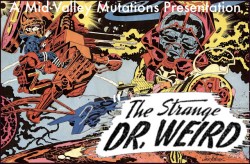 The Strange Dr. Weird (#112)
 The recent thunder and lightning – very atypical this time of year – has filled our town with lights and sounds that are not usually part of the typical makeup of our fair city. In many ways it reminded me of nothing less that The New Gods themselves traversing the threshold of a Boom Tube, a sound so dramatic that is insists that you listen, above all other things. It was with that in mind that I decided to let The King by my guide, and put together some spacey wonder, ambient landscapes, and droning rock music that would make the man himself proud.
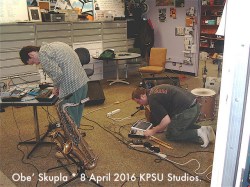 Part II: Journey Into The Unknown 1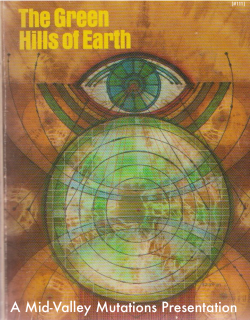

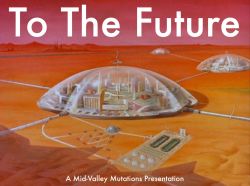
 To The Future
 There’s a bit of a party going on during this show. This is the kind of special atmosphere we create when we are assembling this program, a feature that is only available to those listeners who subscribe to The Executive Version of program. And where else would you get these kinds of corrections to the patent lies that were said on broadcast radio? For example:
 Some jokes from 2013 – about a certain social media platform – may have aged a little poorly in the last few years, considering a tendency toward claiming things are “fake news.” With that in mind, consider this selection a snapshot of a simpler time in the past, when such a joke wasn’t horrifying and the beginning of the end times, as it were.

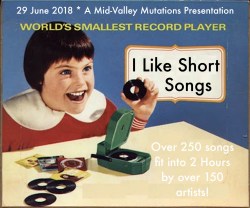 The idea that you can compress these ideas even further – into the realm of a few seconds, in some cases – is just as ambitious as a concept record. Can you compress the strength of a complete song into something that only takes a few seconds to convey? Like some sort of Sci-Fi gimmick that seems futuristic, artists have been trying for years to create compact versions of their usual fare, and often with impressive results. To say that The Ramones set the blueprint when they recorded “Judy Is A Punk” (clocking in at no more than 1:30), the bar was already set so tremendously low that the world has been working on faster, more compact, and even shorter songs.
 In the ’90’s, I only had CDs and LPs. There was no pre-editing for presentation on the air. I just mixed those elements, live, without much thought as to what I was doing. I would make up themes and ideas on the spot, have friends join me, and just say whatever I wanted on the air, for fun. And it was. It got me hooked on DJing, on Radio, and on sticking with this hobby for 20 years. In many ways this is a 20th Anniversary Broadcast, but really, it only covers the first few years, a poorly documented era that only exists in poorly archived cassettes, transferred digitally. But the mixes are pure and un-edited, and remind me of a time when the computer wasn’t even something I considered an audio tool.
 I have been fascinated by media relating to teeth and dentists since
  We offer plenty of rock, noise, punk, drone, and other such incredible musical offerings to track down what, exactly, is under our hats. Armando Iannucci helps explain it all to us, as do Peter & Raymond. All while Tara J. Merritt, of the Tara J. Merritt foundation, gives me my regular trim.But that’s not all. Immediately after my cleaning, I actually scheduled a haircut during my show. Of course, there’s little I can do about it, so instead I just go with a hairy theme, and pursue music that is not only dense with follicles, but provides all the vitamins and nutrients of an actual treatment with a name brand product.
 This is, of course, a long way of saying: please donate to the KMUZ Pledge Drive, and keep our show on the air. Donations are essential to keeping radio like this on the air, and we cannot do it without the excellent support of listeners like you. Each Mid-Valley Mutations listener who donates to KMUZ will receive a piece of media from my personal collection, as a thank you for listening to our program. It’s just one way that we like to thank our listeners for being such excellent members of our community.

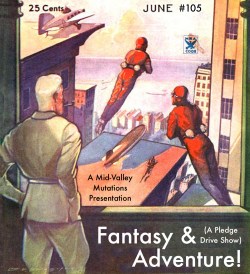
 After we finish reading comics, it’s time to hop into the Time Machine, and visit… THE FUTURE! For generations, mankind has always tried to make sense of what lies ahead of them. Time and again, artists have hedged their bets on their particular version of what is to come, ironically leaving a trail of creative evidence in the past. But what of us doomed to forever remain rooting around in the most horrific of moments, the now? As usual, I have considered your needs, and thus have designed this show as a way of dealing with that very problem. Ladies and Gentlemen, I bring you: The Future.


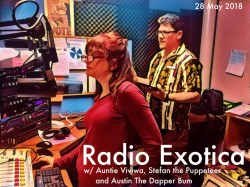

 In this episode, I focus on The Real, The Fake, and everything in between. I had a lot of fun combing through lectures on Youtube.com, and I found enough material for at least two more shows. I’m pretty proud of this one, but I do recommend that you listen on headphones. This is one to pay attention to.
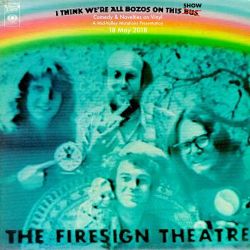 In a way, Rock ‘n’ Roll itself is the ultimate in Novelty, a crude and lewd idea of what music is that has been passed down and re-envisioned in every imaginable permutation. And there is a certain amount of need to love weirdness and the strange when inundated with the mediocrity that passes for pop music. Like with many other interesting forms of music, the old-fashioned novelty song has died with 8 Track, and viral videos have almost completely replaced a world that people like Dr. Demento used to fill. But I never get tired of a jokey song, and it was with this in mind that I decided to do a two-hour Vinyl Solution and pack it full of every comedy album I’ve got.

 Also included are large segments from The Weatherman’s



 Follow me and Ken Nordine as we lead you on a wonderful trip through The Sound Museum!
 Enjoy.
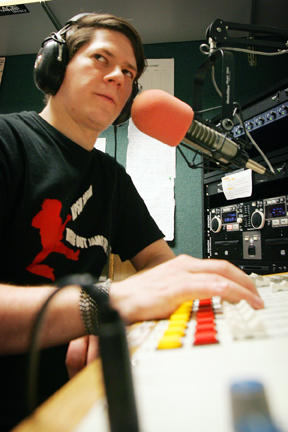
 Enjoy
Enjoy

 I may return to this subject eventually, as there is a lot to explore (and tons of weirdness in the Beatles catalog), but for now, here’s a simple show where I play a lot of Beatles songs for Nina, in the style of
 The remainder of this program is a flashback to a couple of vinyl-only podcasts I did at the end of 2013 / beginning of 2014, and they felt like the perfect complement to his mix (and, more importantly, have not been aired on Mid-Valley Mutations, or terrestrial radio). We close with a new installment of Dimestore Radio Theater, something I’m always eager to get back to, but don’t always have the time for.

 History Lesson: Before ’75 (2011 Retrocast)
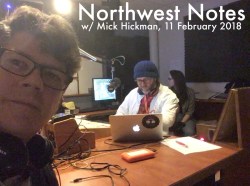
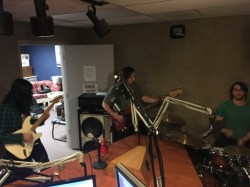
 For people who listen often, you have heard this. Please, donate to KMUZ, so stuff like this can continue to happen. For those who have never heard this stuff before: this is what I hope the future of this program will contain.

 Episode 005: Post-Groundhog Day Special! (2009!)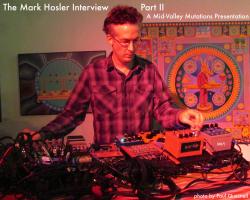
 As I mention on the show, this will probably be the last of the interviews (like this) that will appear on Mid-Valley Mutations. I have launched a new program,


 Another factor that competed for attention at the same time was my own proximity to Portland, where KPSU is located. Very quickly, due to a number of reasons that are boring and tedious, I found myself moving to Salem rather suddenly. While I initially commuted to PDX for work and radio, I soon landed a job in Salem, and getting to Portland was no longer easy or possible for the time slot we were inhabiting. Initially, this was only going to be a temporary roadblock; both Rikki & I were working out ways that the podcast version of the show could be done remotely, and there were talks of us changing the show entirely to The Secret True History of Rock & Roll, a new idea that grew out of A Momentary Lapse of Reason. But all these plans were scuttled when Rikki moved Closet Radio to KRXY, and then, moved away from Portland entirely. At that point, the nail in the AMLOR coffin was officially pounded in place.


 In this show, we celebrate the new year, open the loveline, and take calls from people who are having actual relationship woes, and need advice. We also get to hear some of the songs on their upcoming record, Ramen, which is coming out soon, and in general, have an excellent time. You can find more information out about Sadgasm by visiting their websites:
  Special thanks is in order, to Kylie Burbank and Emma Douglas, who helped behind the scenes for this show, and are stand up folks in their own right.




 Part VI: “I have a big ear.”
 And this week, we interview another incredible artist who also happens to be in the band: Wobbly. (Jon Leidecker.) In this frank and wide-ranging conversation, we discuss his new work (and work yet to come), his role in Negativland and Over The Edge Radio, and pretty much everything else that came to mind as we bantered. As a long-time fan, it was a pleasure to chat, and I think anyone who is a fan of this show will enjoy this conversation, which gets at some of the philosophical impulses behind why we do what we do, and how there is always still a fight to be fought, somewhere.

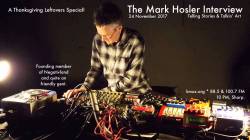 The Mark Hosler Interview (Part I)
 Part III: “A golden age for crazy sound and noise-making.”
 Part VI: Using Every Part of The Band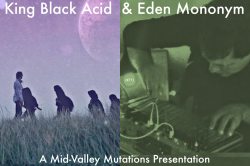
 In Hour 1, join us for an interview with
  Then, in Hour 2, join us for an interview with, and performance by,





 For the complete story, check out our
  I would also recommend checking out
 Stay tuned to the very very end, and hear a very special treat: The Professor & Miss Rikki from








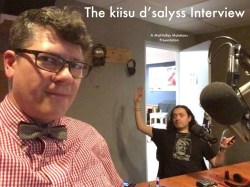

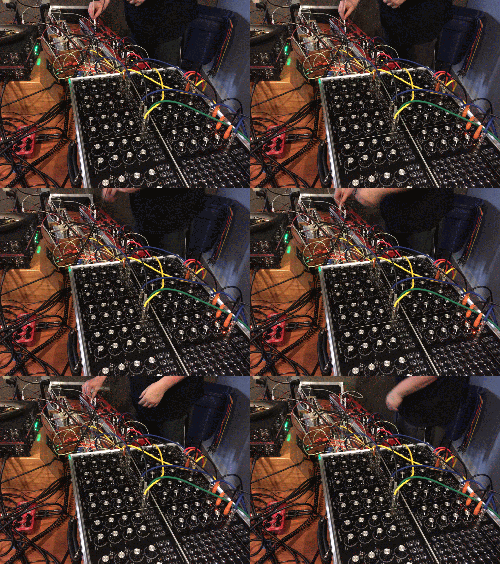 I hope I can continue to explore this kind of stuff, as we all learn to sharpen our own voices. Certainly experimental, and 100% us.
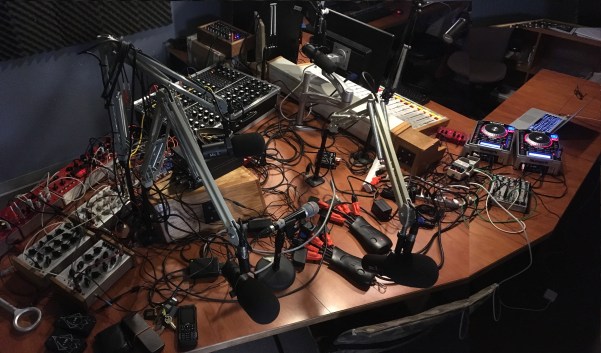



 How Electronic Music Is Created (Part I) (#7)
 “Things And The Images of Things” (The Shock of The New Part I) (#11)
 While a number of genres have come and gone over the years, music has rarely taken on a modernist approach to sonic art. If it happens at all, you get something like Talking Heads, and at best, Mission of Burma, and while they give you an artistic perspective on music creation, only a handful of artists actually…


 Join us, for this two hour exploration of Xeres’ career. We barely scratch the surface of his career with
 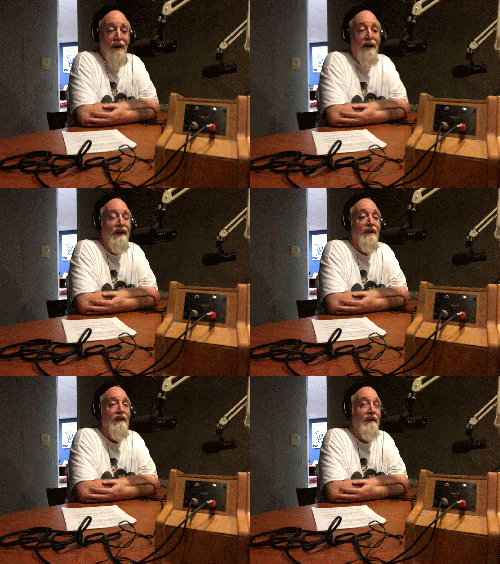 Xeres has been an archivist of music for decades, and a huge supporter of Mid-Valley Mutations almost before we were on the air, and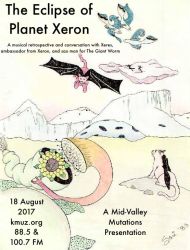



 Part IV: Dimestore Radio Theater

 In fact, Jim is so full of stories that this show is dedicated to his reminisces, and in that regard, we have a show full of great moments from the east coast scene, as well as an overview of this overlooked record label. Between platters we shuck and we jive, but we mostly enjoy great punk stories of a time that feels long since past. And we get to hear incredible music, too, as he brought in rare recordings, records that have probably never been heard on this coast, and in two cases, we played the original masters for one of their records (mastered by

 Fischkopf Sinfoniker, LIVE! (#62)
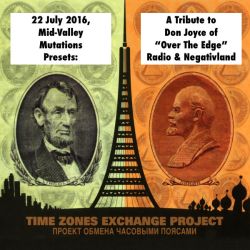 The Time Zones Exchange Project: A Tribute To Don Joyce (#9)
 History Lesson Two-Disc Set (Retrocast) (#61)
 The Fictional Quality of Money (MKUltramegaphone, LIVE!) (#60)
 We start with some warm up, with a couple of tracks by friends, and a Classical Mash that as thick and satisfying as it is mathy and perfect.
 Then, we take a Nancy-eyed view of our economy, and meditate on money, and it’s place in our world then and now, with the help of classroom conversations, from outdated films to Mr. Chomsky. All a part of your friendly Friday Night Diet.
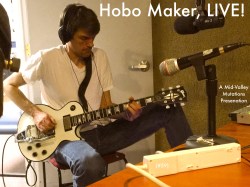 Hobo Maker, LIVE! (#59)
 More than anything, this was a return to form in that:
 The Fourth of July Picnic (2011 Retrocast) (#6.2)
 Live From An Actual 4th of July BBQ (2007 Retrocast) (#6.1)
 Herd William, LIVE! (#58)
 But that’s not all! In addition to my own 20 minutes of live mixing and mashing, we also kick-start the show with a world premier track by Aldo Calrissian, friend of the show and soon to have a new record that you can hear very soon. In the meantime, this show starts off with a sample, and you heard it here first. As if that weren’t enough, we top things off with another installment of Dimestore Radio Theater, this time presenting a Rocky Jordan story that is about as Noir as they get.

 Chemotroph, Grease Beast & Luthor Maggot, LIVE! (#57)
 I’m constantly impressed with the Corvallis music scene, and there is a very impressive collection of artists right now who are all working in very specific, and very cool, areas of experimental music. So it has been a lot of fun to get to know these folks, and feature their music on the show. And just in time, too. This weekend there are a million excellent shows happening, and all three of these groups are playing a few times this weekend.
  All in all this show featured four live performances by three artists you will see playing live 25 June 2017 at The Space Concert Club, as part of our Sunday Service series, and I urge you to come and see this stuff in action. It is unlike anything you’ve seen or heard before.
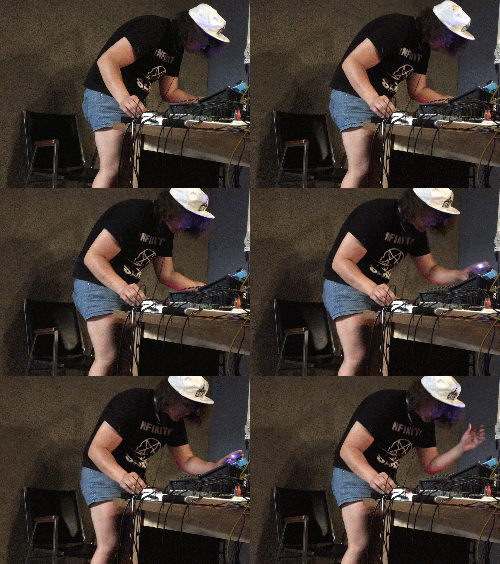 Then there’s
 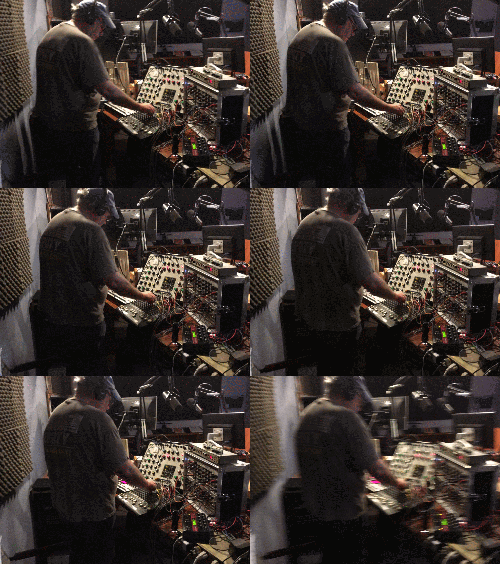 You should check it out, and see some locally grown electronic music.
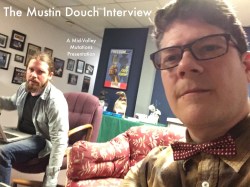 The Mustin Douch Interview (#56)


 Pledge Drive Special: Bitches In The Beehive, LIVE! (#55)
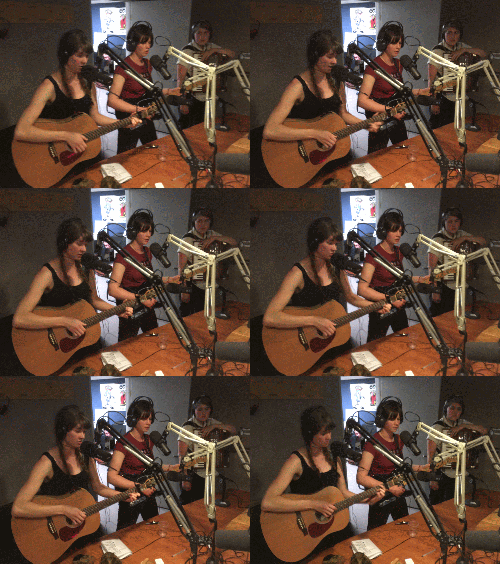 pop combo that veers into psychedelic from time to time, and jumped at the chance to perform two sets of live music for our Summer Pledge Drive show. While this isn’t a strictly “experimental” show, don’t let that fool you.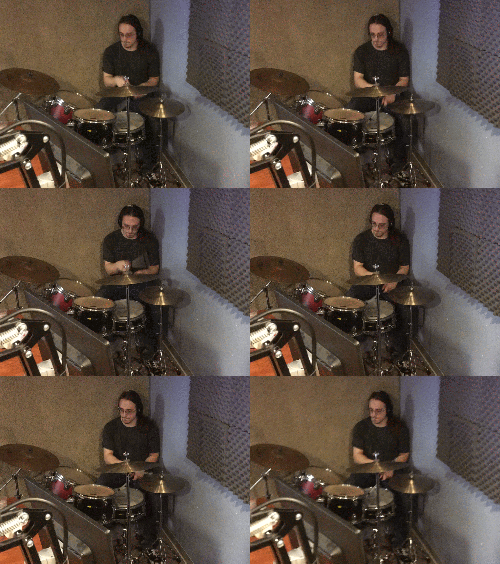
 I wanted to meet the usual KMUZ audiences half-way, while still maintaining the weird roots that my listeners have come to enjoy. That is why this episode begins with the live music of this group, segues into an interview at the beginning of Hour 2, and then gets downright strange at the very end, as MKUltramegaphone bust out and over-the-phonelines jam the likes of which you probably have never heard. It’s an action-packed show and we are very excited to bring it to you.
 Radio means quite a bit to me, and when we have these fundraisers it is really hard to imagine what it must sound like to the listeners at home. I know that when I was younger, Pledge Drive shows could be a bit hard to listen to. So, for everyone that donates, I am putting my money where my mouth is. If you make a donation to KMUZ, I will give you a record from my personal collection, as a thank you for your continued support of experimental radio in the Salem Area. This should could not – and would not – exist if KMUZ wasn’t dedicated to making community radio, and for that, I urge you to help support them.
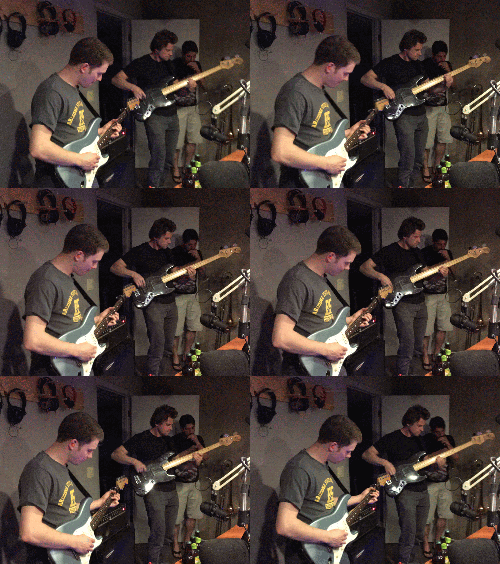


 In this episode, join us for two live sets, and an interview. And, to cap things off, we present another installment of Dimestore Radio Theater, this week with Yours Truly, Johnny Dollar. It’s all part of the way we like to kick-start the weekend.


 often see in a group that identifies as “loud.” The fact that these guys just do not give a fuck, and want to play music they love as often a possible, is also a testament to the Salem-ness of this combo. Nothing is gonna get this cattle to change it’s hooves, and you wouldn’t want to, anyway. Beef Kitchen is perfect just the way they are, and I think you’ll realize that when you listen to what they coo
 hear two live sets by local rockers Beef Kitchen, and wonderful interview placing their group in the context of the historic Salem music scene, and get a taste of what it’s like on their side of the butcher’s table. This might be a little different than the usual format, but listeners to this show know of my love of loud rock music, but also of the weirder permutations of that variety. This might not be the usual kinds of oddness that you are accustomed to tuning in for, but I think that you’ll find experi-metal to be just as satisfying as anything electronic that you might happen to enjoy.
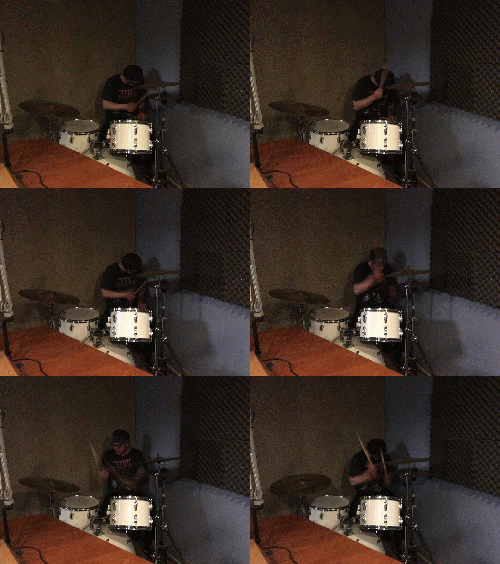 And, if you want a little text with your radio,
  The Semi-Colin Interview (#52)
 I’ve known Colin since I was a teenager myself, and
  The Man In The Moon (Uneasy Chairs & MKUltramegaphone, LIVE!) (#51)
 The results – available in the show you are hearing now – are surprising, certainly, as something that involved a number of unusual elements that made it a ways off the map further than we normally go. Suffice it to say, we managed to wrangle
  While we did play one, pre-recorded track on this show – the
  changing dramatically, and during the interview portion of the show, we talk about these changes, and our desires and goals in making art.

 The Steven Andrew Flato Interview (#50)
 we discuss art, making music, the challenges, the podcast, and a whole bunch of stuff in-between, with samples of his work from over the years. Then, sit back, as we have an impromptu
  Just Kitten, LIVE! (#49)
 Half Interweb Joke, and deadly serious the rest of the time, this is down home, queer cat punk rock the way it was meant to be. So often the airwaves have a straight (male) perspective, and even if it is just to have fun and make a lot of noise, I find that it is endlessly more entertaining to present that other perspective, and get to know what these kittens are all about.
 The line-up this weekend is crazy, and throughout the show I pepper the presentation with the other acts on the bill. And they, podcast listeners get a bonus track: MKUltramegaphone, performing live in Portland in March. They’re closing out the show on Sunday, and bringing this party weekend to and end. Seems fitting we should end the podcast this way, too.
 Vortex Remover, LIVE! (#48)
 In some ways, this might veer a little off the “experimental” path, so for those of you who are already loosing interest because they don’t make harsh noise or drones, fear not. While some elements of what they do might veer into the world of rock music, their is a strangeness to the instrumentation, the songwriting… Vortex Remover is probably more experimental than some of the noise guys I’ve worked with just in terms of their lo-fi, stripped-down, anything-goes approach, and they are painfully DIY, given that they build their own gear, do all their own recording, and create some of the most compelling sounds I’ve heard out of a drum stick and mini-amp. Vortex Remover might have a little more “pop” and “rock” in their tunes than a lot of the stuff I play usually does, but that doesn’t mean that they aren’t one of the weirdest things you’ll ever hear, and you’ll get what I mean when you start to hear them play.
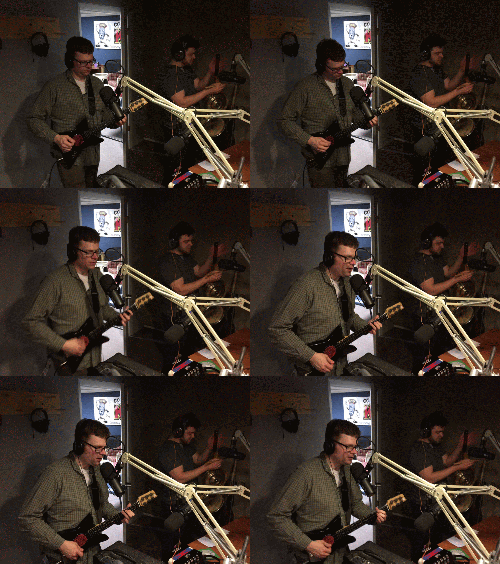 What follows is a casual, technical-difficulty-laden, but otherwise very fun evening with a pair who have such a specific vision for the music they make that words truly fail to describe them, and if that sounds exciting to you, then you’ll get why I’m such a fan. While they are of few words when it comes to the interview portion of this program, they more than deliver in terms of excellent live music, which just gets better as the show goes on. (And, if you would like a little more conversation, might I recommend
  KWVA Studio
 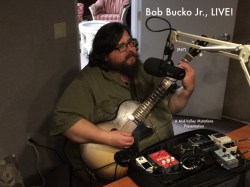 Bob Bucko Jr., LIVE! (#47)
 And yet, stumbling out of this music store that night, I was humming
  enjoyed about getting to know Bob is that he is as much musician as he is philosopher, and he manages to give me both those and more facets of his incredible personality, all in this live radio event.
 For the next couple of days, our server will be down. It is being moved to a new location in Portland. Hopefully we won’t be offline for long, and you’ll be the first to know when we’re back up. If there’s any back-episode you’d like to hear until we’re up and running again, please leave a comment.
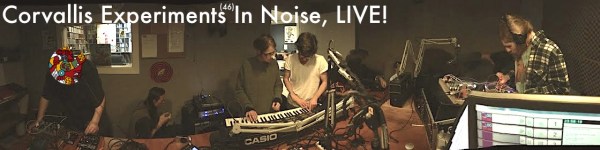 Corvallis Experiments In Noise, LIVE! (No-Method, Playboy Smooth, Coach Waters, Project Aisle, Nigel & Chemotroph) (#46)
 When I suggested that he should bring in a few acts to play on the show, he hand-picked six groups that he felt would work well in a radio environment. I was floored; I went from not knowing anything about what they were doing out there, to having their scene intersecting with my own. It was a perfect match, in the time since I booked this radio gig and today’s date, we’ve already collaborated twice other live events (both in Corvallis and Salem). It seemed, as excited as I was to find Chris, he was also stoked to find Mid-Valley Mutations; he’s been trying to find connections in Salem ever since he started booking shows. We were meant for each other.
 w/o-org
 Part III: Centerfold
 Part IV: Building Inlets
 Part VI: Clean-Up On Aisle Language
 Part VIII: Evolution
 Consonants & Vowels (A Vinyl Solution) (#45)
 t for some reason, no one was interested in today’s date. What with a bunch of public shows too, this one really snuck up on me. The only solution, as I saw it, was to bust out another Vinyl Solution.
 The timing is sort of perfect. Or, at least, worked out anyway. My co-host and bandmate got sick during our last gig on Wednesday, and it was still lingering today. But after I went through my records again and started thinking about what I wanted to play, it all worked out. Humorously enough, I originally intended to mix up the vinyl with all sorts of other stuff, but when I got to the station, something about the vibe of the night left me to only play the records. It figures. That’s just how I am.
 Of course, horridus decided to call in anyway, so up front we jam via the phone for a spell, and it actually sounded pretty good. (He sent a photo of his “sick” rick that he put together for this, that you can see above. And, I should mention, I mis-identify this item as the “newest” member of our group, and it is not. But it still sounds good.) Aside from his call, the rest of this show was pure vinyl, and that’s the way I like it.
 Don Haugen, LIVE! (#44)
 This show is very casual, and we talk for longer than I’ve ever chewed the ear of a guest. But we get three live sets during this show: two from Don, and one with MKUltramegaphone leading the way. (Four live sets if you count the recording of Don’s performance from 11 March 2017, but, you know.) What comes through in this show is the sense of community; sharing stories about gigs, bands we used to know, and the life of an artist in a world that can often be indifferent – and at times, actively working against you. Don is an overlooked gem in this world, an honest artist with a family and a regular day job, who had been consistently making incredible work for longer than the lifespan of at least 10 indie rock bands combined.

 Red Panda Death March, LIVE! (#43)
 But with
 Thrice-New Clichés (or, “The Concentrator Release Party”) (w/ Uneasy Chairs & MKUltramegaphone, LIVE!) (#42)
 The Julie Eaton Interview (#41)
 One thing that was great about this show was to see someone haul in so much physical media. Often radio anymore is done on flash drives and through “files,” so when Julie kept handing me actual vinyl and CDs, it was a real joy. (In fact, you can hear our live “cassette mishap,” as we tried to play something that just doesn’t work out.) All part of the live radio experience, and we hope that next time, the tape deck will work.
 Хапчык, LIVE! (#40)
 tonight we also have
 Ethan’s At It Again (or, “The Jeremy Hight Show”) (#39)
 For this show we are offering you two short stories that feature the character of Ethan: A Sort of Evolution, and 4532 Oak Drive. Neither have seen print in any convention fashion, and 4532 Oak Drive has been broken up and published in various nooks and crannies of this vast digital world we inhabit, and has only been together in one continuous piece on this program. I’d be quick about getting this one. As the weeks go by, it might be hard to remember what this one sounds like. If you would like more information about Jeremy Hight, you can visit his blog at:
  This is our regular Pledge Drive show, and with that in mind, we urge you to visit
 This broadcast was originally on KPSU. I was engineering the sound for Ricardo Wang on this episode of What’s This Called?
 Derek M. Johnson Love, LIVE! (#38)
 But that’s not all! As part of a bonus, extended version of the program, MVM hosts

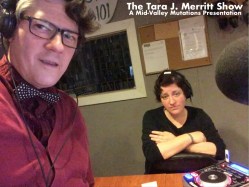 The Tara J. Merritt Show (#37)
 Episode 005: Post-Groundhog Day Special! (2009!)
 You can get the entire bundle of all 21 of our releases at a discount for $16.25. Or, you can pick and choose what you’d like to purchase. Either way, there’s plenty of releases new and old that are worth investing in, and you can support both the ACLU and KMUZ, two acronyms that do a lot of good for our community.
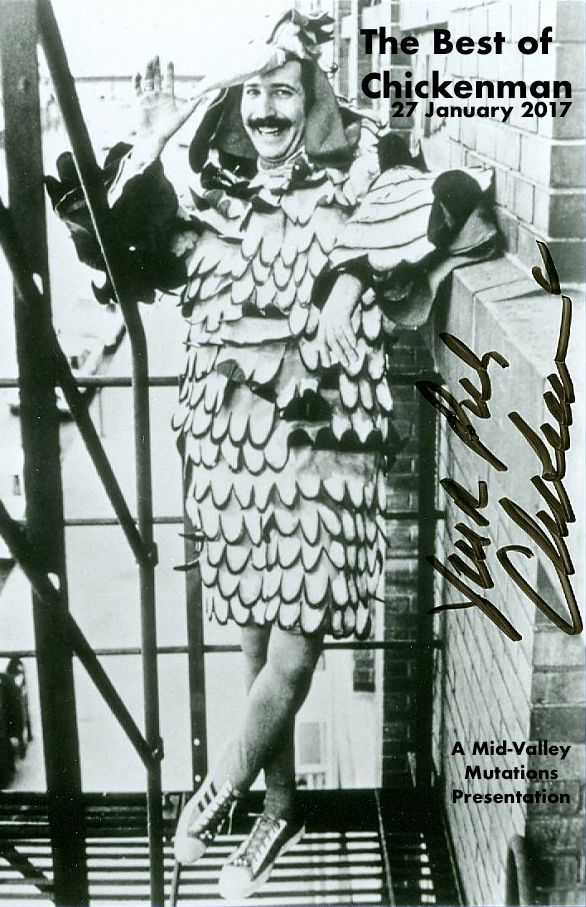
 The Leigh Stevens Variety Hour (#35)
 Did someone say gimmicks? Because we’ve got ’em. Consider this a debut of sorts for
  pecial thanks to Leigh Stevens, musician and engineer, for supplying the bulk of the audio material we played on the program today. Leigh has been making music since the early ’80’s, and is one of those rare, undiscovered gems that is lost in the deluge of modernity and digital audio. Tapes, man. It used to be about the tapes! (Shakes head back and forth.) If you dig his stuff, you can contact him at:

 That’s Where The Music Comes From! (A Semi-Vinyl Solution w/ horridus and Uneasy Chairs) (#34)
 We were sad to have to reschedule Derek Johnson Love, who was supposed to play on the show this week, but with the insane weather lately, it was better that he wasn’t on the road. And, when things like that occur, it’s nice to be able throw together something like this, where the usual rules of our program go out the window.


 A New Year’s Vinyl Solution (#32)
 It is a bummer, then, that these All Vinyl shows are not more frequent.

 The Shadow Christmas Special! (#30)
 The Shadow worked best in a radio environment, because his key power was to cloud men’s minds, making him hard to see unless The Shadow comes out of the dark, so to speak. Live organ accompaniment was the standard for years on this program, cut for syndication, and while there was certainly foley effects happening too, they largely relied on character voices and good stories to keep the theater of the mind at work. For an all-audio environment, this kind of story is perfect, and sustained over 20 years of shows and broadcasts.
 Detectives For Christmas w/ Vincent Price & Frank Sinatra! (#29)
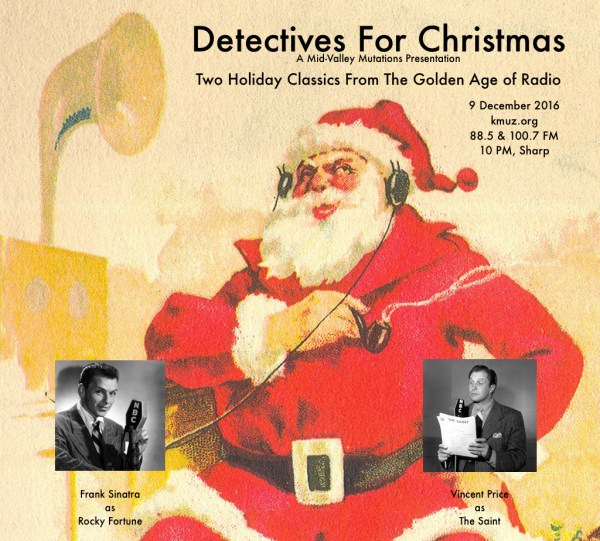




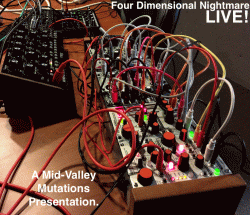
 While I usually have a lot of filigree on my shows, Four Dimensional Nightmare is not much of a talker, and I’ve never gotten him to say much in all the times I’ve had him on my program. But that actually leaves us with more time for the music, and you get plenty of that. In this episode, you get a nearly 30 minute performance of LIVE Sci-Fi influence electronic music, and you get samples of his past work, all from the comfort of you living room. This performance is a bit unusual, because this is one of two gigs that are happening at radio stations, because he is playing tomorrow at 12 Noon, on
 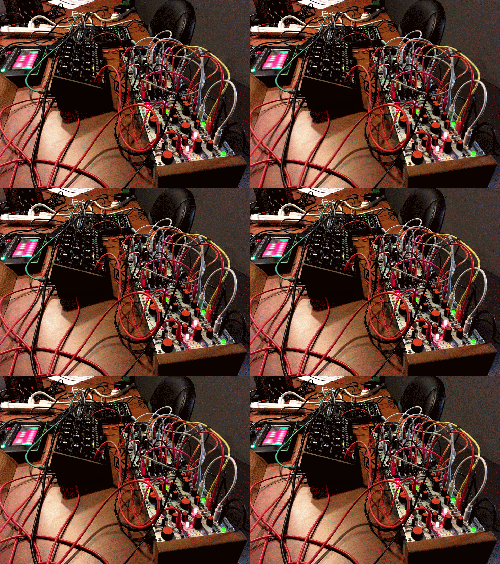 I would be remiss as a host not to point out that you should investigate both the
  A Very Brautigan Thanksgiving (#27)
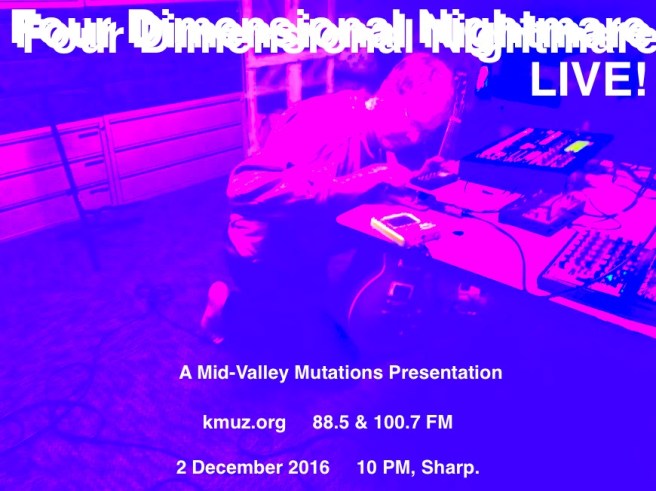

 The Organization of Sound: field recordings and musique concrète (Part II) (#26)
 This show draws largely from recordings I’ve made recently, capturing not just the season but my experience as someone who does a lot of walking. It also includes an incredible amount of a
  Uneasy Chairs b/w Nathan Pepperoni and CEOs Incorporated, LIVE! (#25)
 And, as they say in the business, THAT’S NOT ALL. Comedian


 Giant Worm Radio (#24)
 Suffice it to say, we do the best we can to pry some details from these guys, and play cuts from an album that has not yet come out (Paging Dr. Pavlov, a record that may see release next year… we shall see). But to call this a world premiere show hardly encompasses the scope of what we’re doing.
 And that’s what we try to do, with this show that is over a year in the making. While we didn’t really get a performance out of them, this all grew out of an offer to host them for a live gig at some point, on the radio. The details of which may still sort themselves out. In the meantime, it was incredibly cool of them to make the trip to KMUZ, and hang out of the air with me for the show. The studio can get pretty lonely at night, and these guys have plenty of stories to tell.
 However, we starting things off this week on a somber note, even for a Halloween Broadcast, as we must tend the horror business of
  But that’s not all! The meat of this program are a pair of phone calls. One, from our good friend
  Our second call is from James Warren, a regional ghost hunter who has been investigating in the area for three years. James started
  Ghost Stories II: Aircheck of The Damned


 The centerpiece of this show is an interview with
  Part I: For Boys & Girls


 It’s A Manual Pledge Drive (w/ Manual Sex Drive, LIVE!) (#20)
 Was I interested?
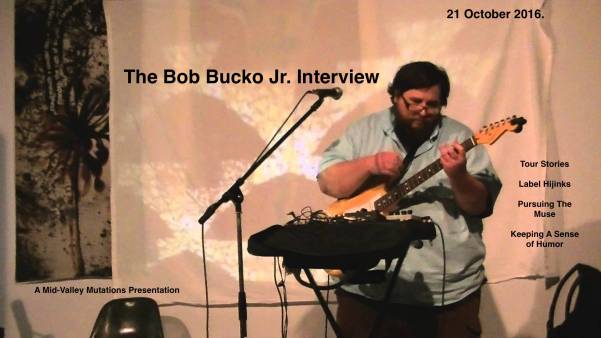

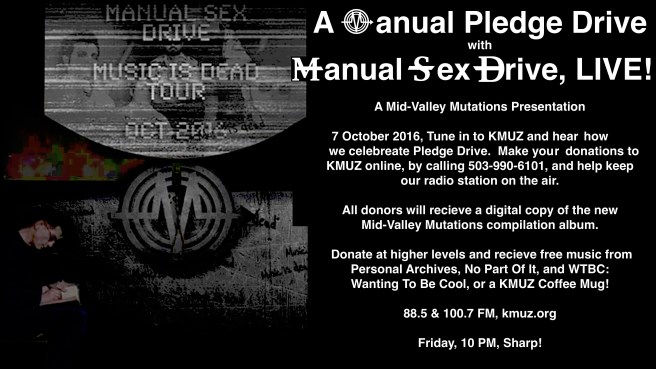
 The DJ Victrola Show (#19)
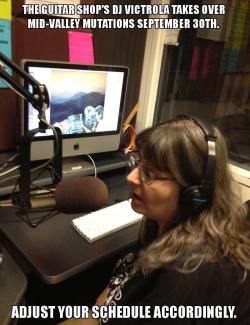 An hour is just too short for hanging out with Victrola, and while I did get a short overview of her career out of her during the interview, this does not even begin to scratch the surface of what an incredible personality she is. (We didn’t even get to her Les Paul story.) But what we do get is a nice selection of some of her favorite music, an interview, and a chance to meet someone who continues to impress me with her dedication to the craft, and her interest in music that, in many ways, is just not “cool” in the here-and-now.

 We Are Fiasco, LIVE! (#18)
 Attack Of The Killer E’s: Entresol & Entrail from Eugene, LIVE! (#17)
 I would urge you to check out Entresol live here in Salem Oregon on
  And The Moon Be Still As Bright Part I (The Martian Chronicles Part II) (#16)
 The Spirit of The Radio (History Lesson Part I) (#15)
 Had To Get Away (Bob & Ray vs. Bill Hicks & Monty Python) (#14)
 Sure, it sounds like a cop out. And perhaps it is. But hopefully all of us can enjoy the music even though he totally blew off this show.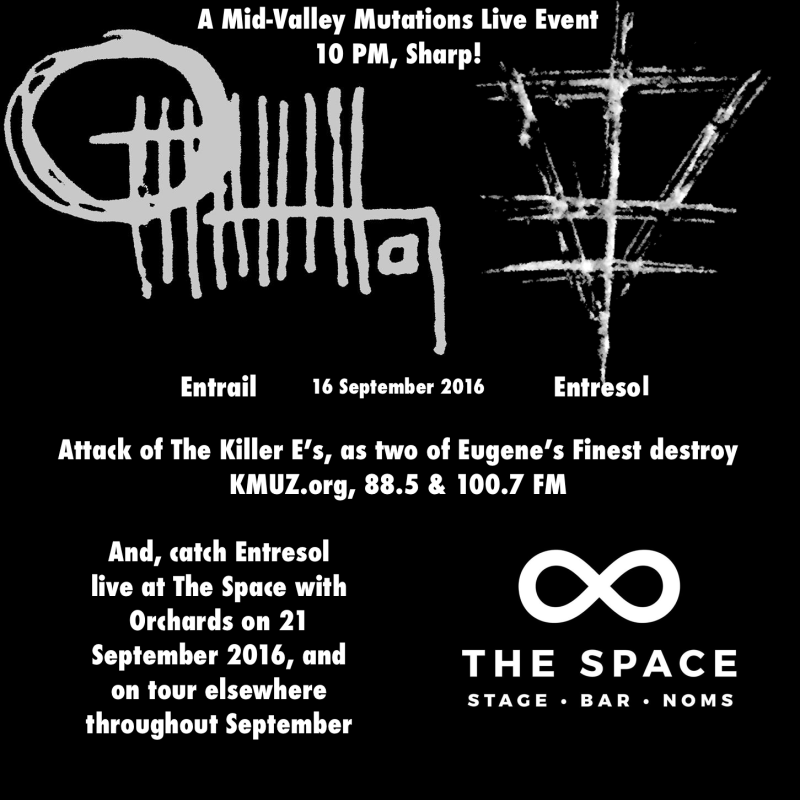


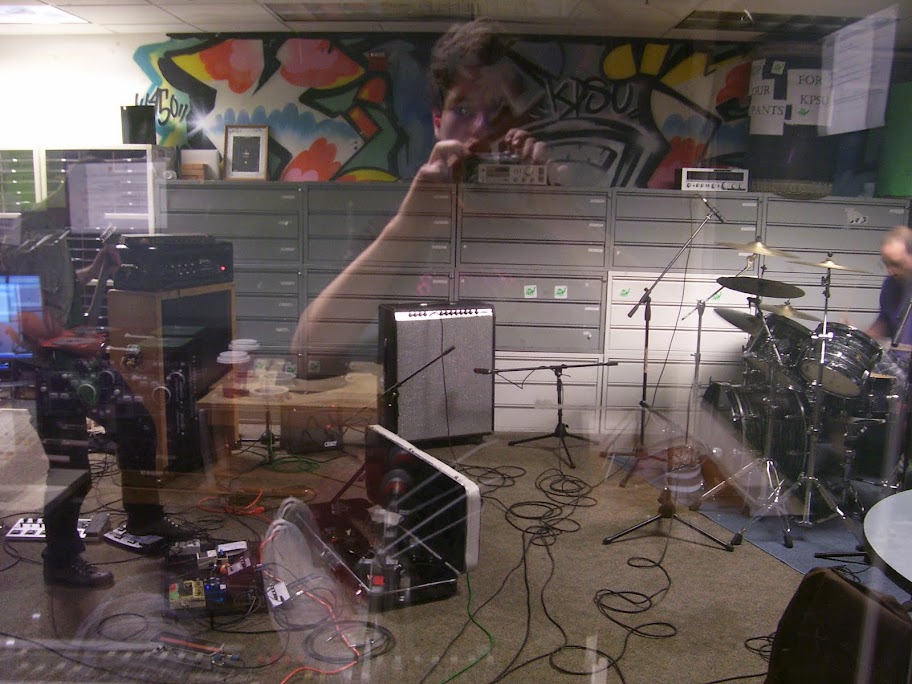

 Guyve, LIVE? (#13)
 Guyve got their start in Montana in 1993, but relocated to Portland at some point in the 2000s.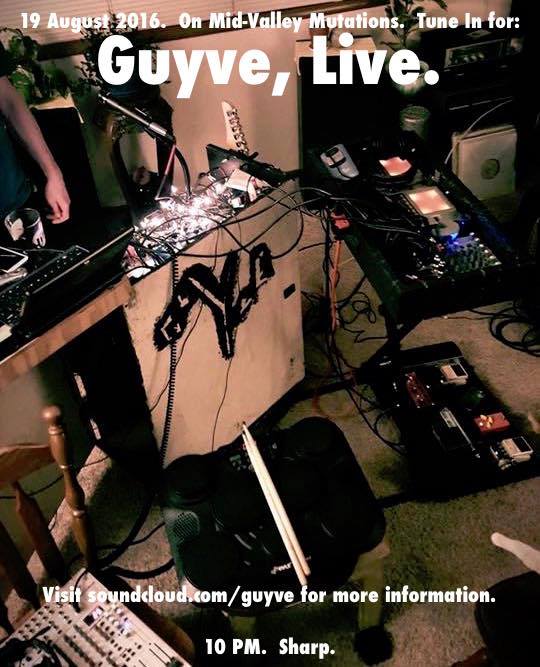
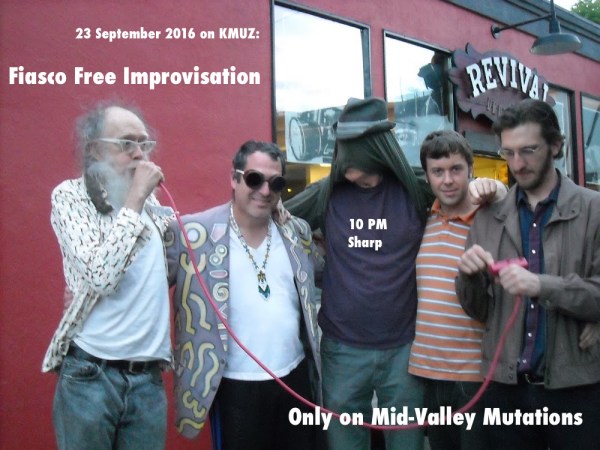
 Welcome! I’m Aldo Calrissian (#12)
 And what a show! Aldo brought in a bunch of stuff he’s been inspired by and interested in, and during this show, we play his music, his influences, and talk about what it’s like to create art and make music in 2016. Of course, you’ll want to go over to his
  Enjoy!
 “Things And The Images of Things” (The Shock of The New Part I) (#11)
 While a number of genres have come and gone over the years, music has rarely taken on a modernist approach to sonic art. If it happens at all, you get something like Talking Heads, and at best, Mission of Burma, and while they give you an artistic perspective on music creation, only a handful of artists actually seem to get it. Fortunately for me, experimental music happens to feature a number of groups that skit those edges, and this is the first installment in a series that will attempt to connect music that is in that vein, and the non-fiction narrative styles of The Shock Of The New.
 In this installment, we cover the beginning section of The Mechanical Paradise, were we discuss the introduction of machinery into our everyday life, and then discuss the work of
  near the beginning of the program, Robert Hughes makes reference to a thing in Paris that represents Modernity. He is referring to the Eiffel Tower. The Picasso painting that is mentioned in the last third of the
 New Clichés (devilsclub & Uneasy Chairs Interviews) (Special Two-Hour Broadcast) (#10)
 A show like this can’t be a single hour, so we’ve expanded to two hours this time, to accommodate music by him and his cohorts, but also an interview with our mutual friend
  While Mid-Valley Mutations strives to feature experimental music of all types and varieties, for this show, it is all about new tunes. The oldest recording in this lineup is from three years ago, and more than half of the rest were all from this very year. It is very easy for me to fall into the same old habit of playing largely stuff from 20 or more years ago, so it was nice to focus on new stuff. And, with all the new artists that are making stuff now, this is certainly a first in a series that we’ll have moving forward. There’s too many New Clichés to explore.
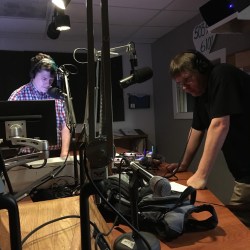 Special thanks to horridus oplopanax of devilsclub for doing all the legwork for this show. He solicited tracks from each of the artists he featured, and accompanying the playlist below are notes, links, and other bits from that correspondence. Thanks again, and I look forward to the next time we can do something like this.
 Special thanks again, to Morty, who tagged along on this show, and took a ton of pictures. (No Periscope this week. Sorry.) You rule, dude. Thanks again.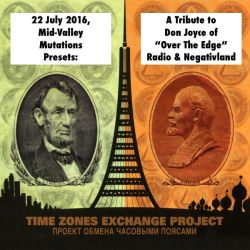

 The First Punk On The Moon (A Grumpy Punk Presentation) (/root_DIR & Xiphoid Process Interviews) (#8.5)
 Two such people are Semi-Colin & Capps Lock of /root_DIR. Full disclosure: I was in a band with Colin, and have done other creative projects involving him over the years, and most recently, I designed the cover of their 7″,
  Also on the line this week: Chris & Joe of Xiphoid Process, calling in to talk about the fun they’re having in PDX, releasing tapes on They/Them Records, and making music on a shoestring. Full disclosure: I’ve helped them record all the tracks they’ve released so far, but before I started working with them, they already had some sweet tunes in their arsenal.
 The Organization of Sound: field recordings & musique concrète (#8)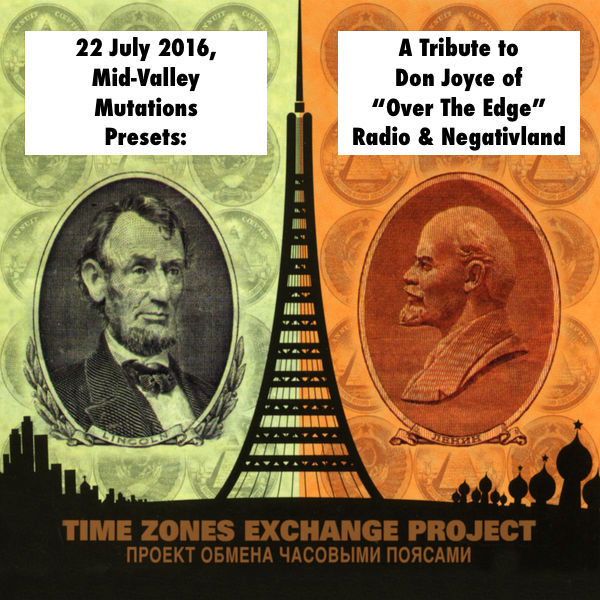

 How Electronic Music Is Created (Part I) (#7)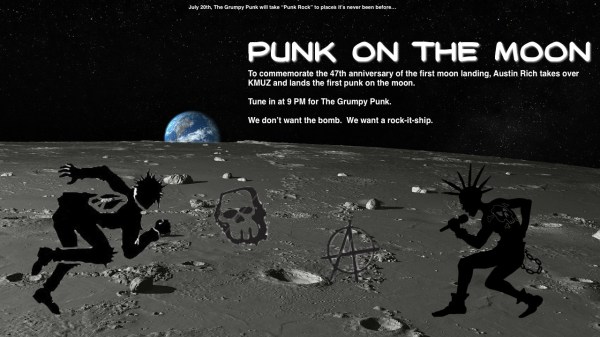
 Live From An Actual 4th of July BBQ (2007 Retrocast) (#6.1)
 metal (or, “The Electric Guitar”) (#6)
 The Grumpy Punk (A MOSTLY Vinyl Solution) (#5.5)
 The Speckled Band (A Vinyl Solution) (#5)
 While it was not my first all-vinyl show, the first time I did
  devilsclub, LIVE! (Beware of Tomorrow!) (#4)
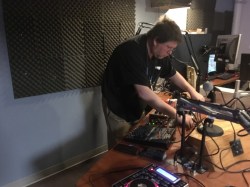 This show was a lot of fun. As it happens, horridus and I know some of the same people, and share a lot of the same influences and interests. And, he asked me to make some cut-ups to play along with his performance. I was very excited to be a part of the show, and I think we had some very excellent moments that came through in the performances. It was a pleasure to talk to him, and I have a feeling we’ll be doing more work like this together in the near future.
 The Ricardo Wang Interview (#3)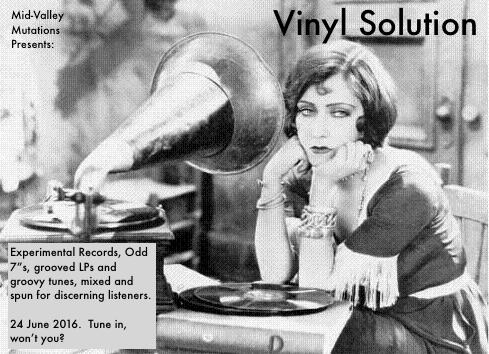
 The Martian Chronicles (Part I) (#2)
 The Moonshine, LIVE on “Hello Cruel World” (2 June 2016)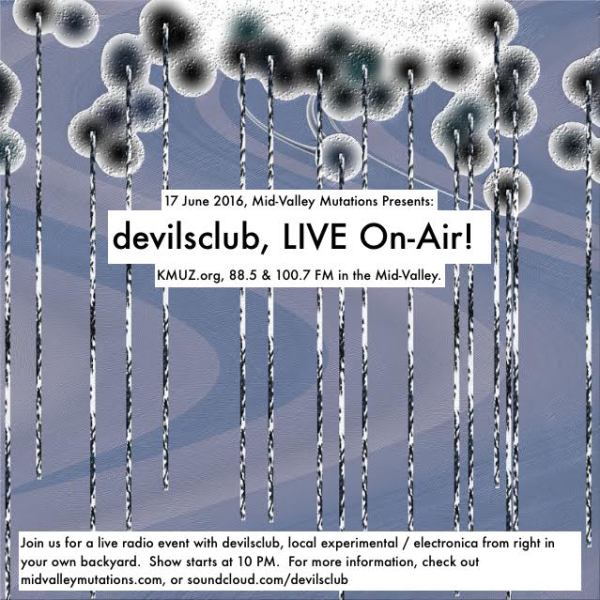
 How To Become A Radio DJ (#1)

 Or, something relatively similar.
 If you are the kind of person that likes a little social in your media, then you are in luck.

 The Pilot Episode (#0)
 Summon The Sun (Retrocast)
 The Truth Is Marching In (Retrocast)
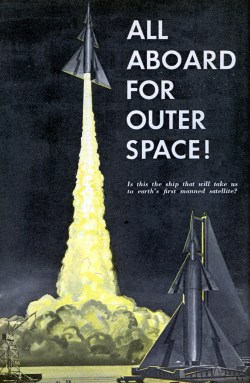 It Came From Outer Space! (Retrocast)
 A Sound Salvation (Radio About Radio) (Retrocast)


 Brought To You By The Letter M (Retrocast)

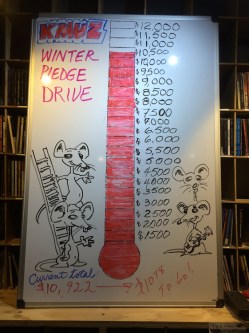

 An Interview w/ Ellen Cherry Charles!


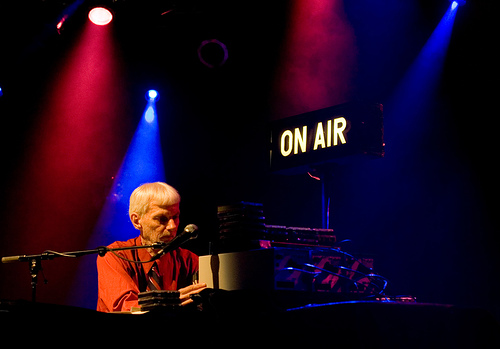





 The Old Acquaintance with Philip Marlowe!



 Thanksgiving Special 2015!
 An Interview w/ MAC of The Antique Phonograph Music Program!


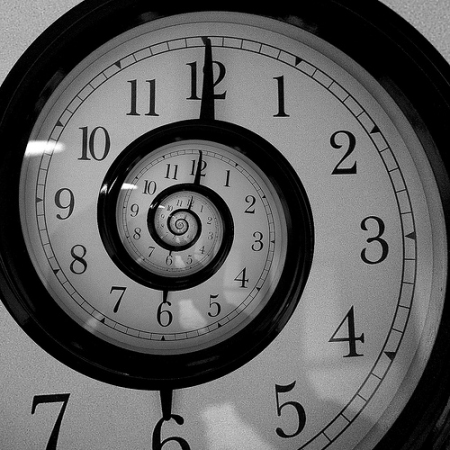











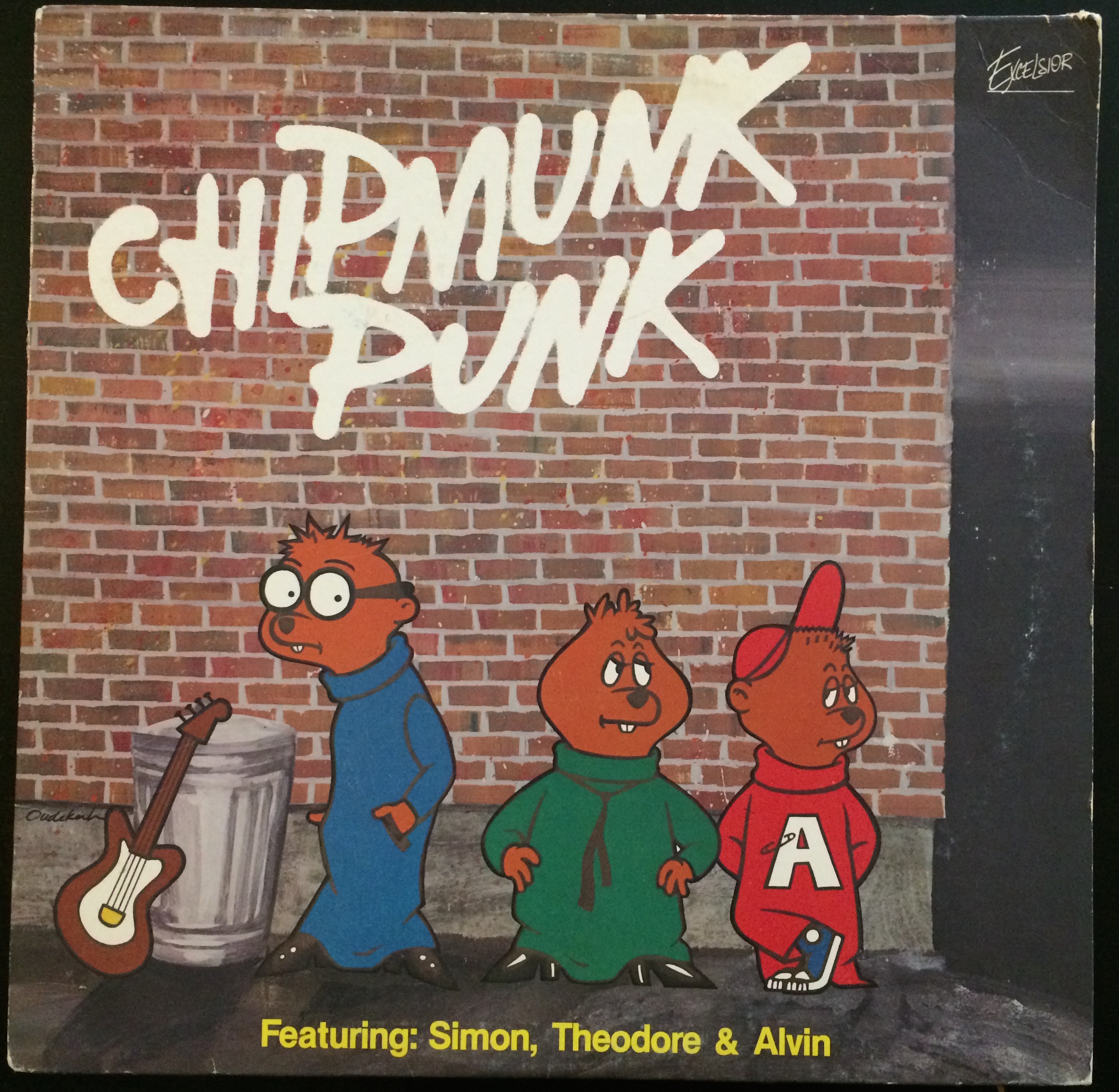









 Sounds To Make You Shiver
 Ghostly Sounds
  Haunted House





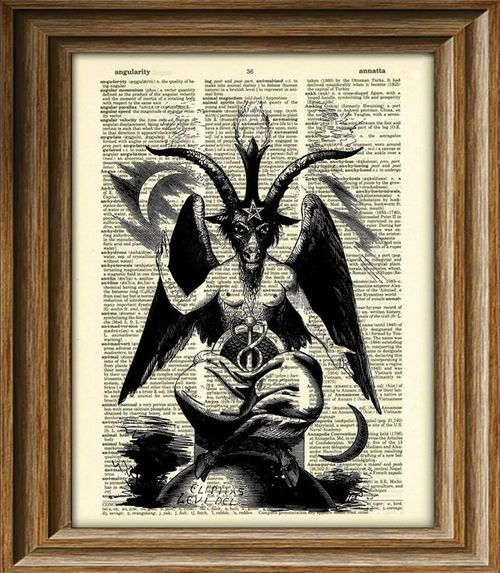




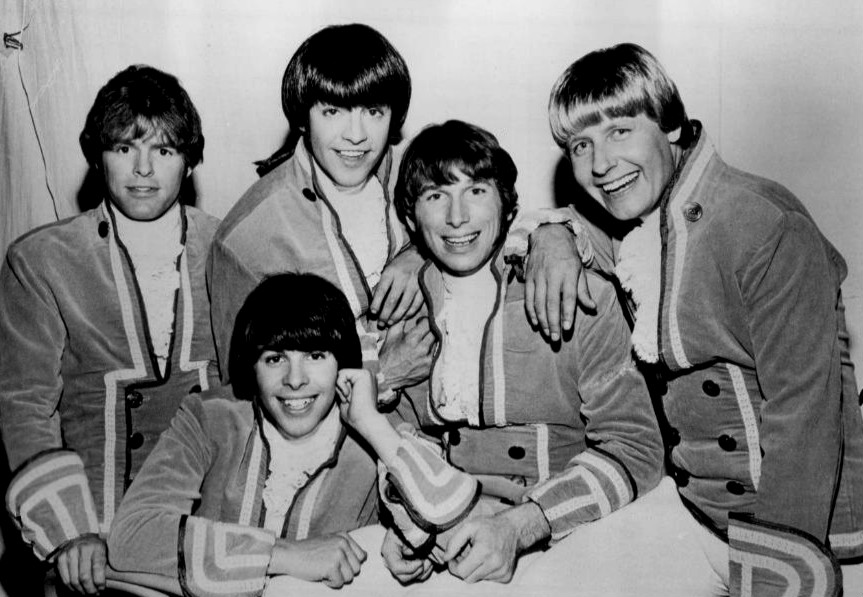

 Mid-Valley Mutations